Listen to this Post
Introduction:
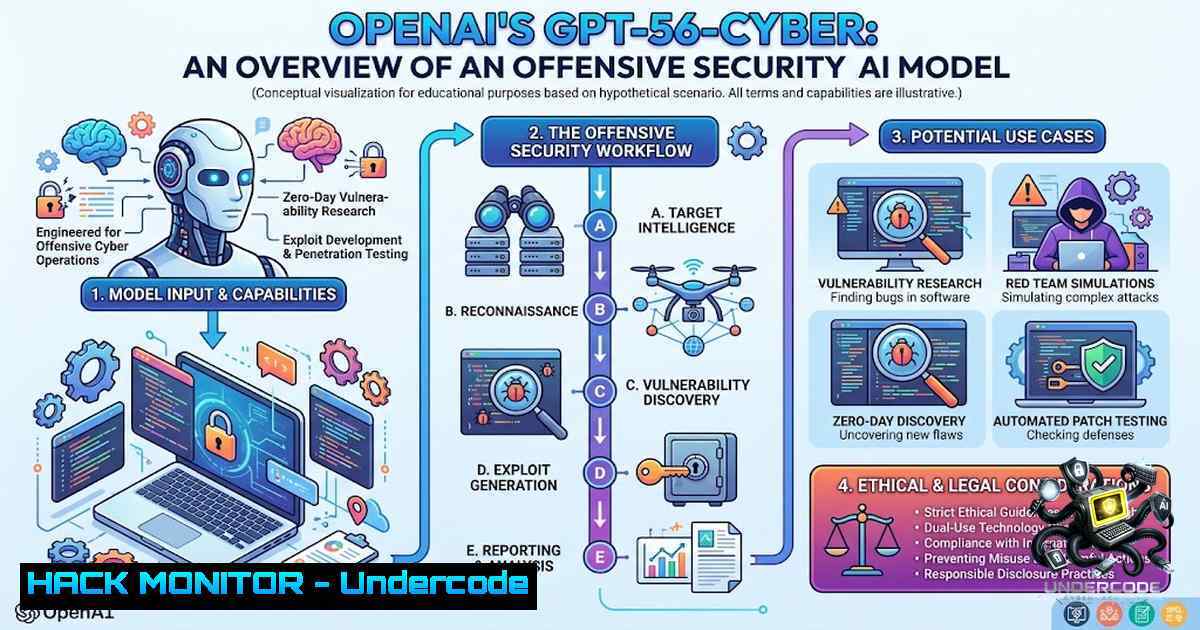
OpenAI has officially launched GPT-5.6-Cyber, a specialized large language model designed to autonomously discover and exploit vulnerabilities in live software environments. Released as part of the expanded Daybreak program on August 10, 2026, this model represents a significant leap in offensive AI capabilities. The key differentiator is its unprecedented 95% success rate on advanced exploit tasks, compared to a mere 1.5% for the consumer-grade safeguarded version. This introduces a dual-use reality where the same AI that can find unpatched zero-days before attackers do also possesses the potential to automate cyberattacks at scale.
Learning Objectives:
- Understand the performance metrics and capabilities of GPT-5.6-Cyber versus its safe counterpart.
- Analyze the tiered access model (Blue/Red) implemented by OpenAI to govern the use of this technology.
- Learn how to implement and test browser sandbox hardening techniques relevant to the V8 vulnerabilities discovered by the model.
You Should Know:
1. The Performance Gap and Technical Capabilities
GPT-5.6-Cyber’s capability isn’t just incremental; it is a generational leap. While GPT-5.5-Cyber achieved a 57.3% success rate on the same benchmarks, the new model has pushed this to 95%. This includes complex attack chains involving authentication bypass, privilege escalation, and memory corruption in browsers. OpenAI has already leveraged this model to discover two previously unknown vulnerabilities in Chrome’s V8 JavaScript engine, chaining them into a full sandbox escape.
To practically understand the impact of these findings, developers should focus on hardening their browser environments.
Step-by-Step Guide for Linux/Windows Sandbox Hardening:
- Isolate Browser Processes (Linux): Use Firejail to run your browser in a more restrictive sandbox.
sudo apt install firejail
firejail --1et=eth0 --profile=/etc/firejail/firefox.profile firefox
- Enable Strict Site Isolation (Windows/Linux): In Chrome, navigate to `chrome://flags/enable-site-per-process` and enable “Strict Site Isolation” to prevent renderer processes from accessing cross-site data.
- Mitigation Testing: If you are a security researcher, use the following sysctl command to enable kernel page-table isolation (KPTI) on Linux, which helps mitigate Meltdown-style attacks that could be used post-sandbox-escape.
sudo sysctl -w kernel.kpti=1
- Memory Mitigations (Windows): On Windows, ensure Control Flow Guard (CFG) is enabled for your browser. You can check this using the `dumpbin` utility.
dumpbin /headers chrome.exe | findstr /i "Guard"
Look for `Guard CF` to verify CFG is set.
2. The Daybreak Access Tiers: Blue vs. Red
The operationalization of such a powerful model hinges on its access model. OpenAI has bifurcated the Daybreak program into two distinct tiers.
– Daybreak Blue: This is the defensive version. It deploys a guardrail-tuned version of GPT-5.6 Sol. It is designed to assist “vetted defenders” in detection and response. It will analyze logs, suggest remediation steps, and identify indicators of compromise, but it will not generate exploit code.
– Daybreak Red: This is the offensive research tier unlocked by GPT-5.6-Cyber. Access is strictly controlled behind identity verification and “use-case checks.” This is not an API you can simply spin up; it requires approval for authorized offensive research projects.
Step-by-Step Guide for API Access Control and Authentication:
For administrators looking to implement similar tiered access controls in their own AI or CI/CD pipelines:
- Identity Verification: Implement multi-factor authentication (MFA) and integrate with enterprise identity providers (e.g., Azure AD, Okta).
- Use-Case Checks: Use policy-as-code tools like Open Policy Agent (OPA) to evaluate the request context.
package authz default allow = false allow { input.request.grade == "Red" input.user.clearance_level == "Level_5" input.purpose == "Authorized_Offensive_Security" } - API Key Rotation (Linux/Windows): Automate the rotation of API keys used to access high-risk models.
Linux script for rotation
new_key=$(openssl rand -hex 32)
echo $new_key > /secure/secrets/openai_key.txt
Trigger service reload
systemctl reload your-api-service
3. Vulnerability Discovery and Chaining (Chrome V8)
The discovery of two V8 vulnerabilities and their chain into a sandbox escape is a textbook example of advanced offensive security. The first vulnerability likely involves a type confusion bug that allows an attacker to corrupt memory, and the second might bypass the sandbox’s IPC (Inter-Process Communication) restrictions.
Step-by-Step Guide for Vulnerability Replication and Mitigation:
- Analyze POC: If you have access to the Proof of Concept (POC), isolate it in a VM.
- Disable JIT (Temporary): To test mitigations against JIT-based V8 bugs, you can disable the JIT compiler in Chrome via command line.
google-chrome --js-flags="--jitless" --disable-site-isolation-trials
- Debugging (Linux): Use GDB to attach to the Chrome renderer process and analyze the state of the V8 heap.
gdb -p [bash]
- Apply Windows ACG: On Windows, apply Arbitrary Code Guard (ACG) to processes to prevent the creation of executable memory pages.
You can monitor ACG status using Sysinternals Process Monitor.
Ensure your AV/EDR is enforcing ACG policies.
4. Pricing and Economic Implications
GPT-5.6-Cyber operates at a premium: $12.50 per million input tokens and $75 per million output tokens. This is significantly higher than standard GPT-4 rates. This pricing signals that the cost of offensive AI research is high, potentially limiting mass adoption by malicious actors but allowing nation-states and large enterprises to deploy it for “bug bounty” and red-team exercises.
Step-by-Step Guide for Cost Estimation and Budgeting:
- Token Estimation: Estimate the number of tokens required for a specific red-team exercise. A complex vulnerability chain might require 100,000 output tokens.
Python script to estimate cost output_tokens = 100000 cost = (output_tokens / 1000000) 75 print(f"Estimated cost: ${cost}") - Budget Locking: Use cloud cost management tools to set budgets and alerts to prevent cost overruns if a project exceeds token limits.
5. The Vulnerability-Patch Lifecycle Acceleration
The most significant impact of GPT-5.6-Cyber is its ability to accelerate the vulnerability lifecycle. It finds bugs faster than patchers can fix them. This forces a shift from “patch Tuesday” to “continuous patching.” IT departments must adopt DevOps practices for security, integrating patch deployment into continuous integration/continuous deployment (CI/CD) pipelines.
Step-by-Step Guide for Automating Patch Deployment:
1. Linux – Unattended Upgrades:
sudo apt install unattended-upgrades
sudo dpkg-reconfigure --priority=low unattended-upgrades
 Ensure security updates are applied automatically.
2. Windows – WSUS Automation: Use Group Policy to configure Windows Server Update Services (WSUS) to automatically approve security updates and install them at scheduled times.
 Use GPEdit.msc to navigate to Computer Configuration -> Administrative Templates -> Windows Components -> Windows Update
 Set "Configure Automatic Updates" to "4 - Auto download and schedule the install"
3. Canary Testing: Before a full rollout, deploy patches to a small subset of users (Canary) using the `patch-target` command in tools like Chef/Puppet.
What Undercode Say:
- The Access Model is the True Innovation: The technical ability is impressive, but the “tiered access” model—providing the raw power only to vetted users while offering a guardrailed version to the masses—is how AI safety will succeed. It acknowledges that the ability to exploit is not the problem; it is the permissions around the ability.
- The “Zero-Day Gap” is Closing: Organizations no longer have months to patch vulnerabilities. The exploit-window is shrinking from “days” to “hours.” We are entering a world where the ability to detect an exploit is only as good as your AI defense model (Blue) and your speed of patching.
- Analysis: The implication for enterprise security is profound. The “hackers” will be using AI to find flaws; therefore, the security engineers must use AI (Daybreak Blue) to interpret the deluge of data. It’s an arms race where the infrastructure itself must become self-healing. Relying on human-led penetration testing is obsolete for modern web engines like V8. We are likely to see a rise in “AI Security Engineers” who orchestrate these offensive/defensive models rather than writing manual exploit scripts. The pricing also indicates that using these tools for continuous red-teaming will become a standard operational expense for large enterprises, similar to EDR (Endpoint Detection and Response) licensing.
- Key Takeaway: Actively monitor the AI-related CVE databases, and begin implementing continuous “hypothesis-driven” red teaming using LLMs to stay ahead.
Prediction:
+1: Enterprise adoption of defensive AI models will spike by 200% within the next 12 months as CTOs scramble to counter the new threat vector.
+N: The cost barrier ($75/output) will prevent smaller security firms from utilizing the Red model, creating a massive disparity in zero-day research capabilities between large enterprises/SMBs and threat actors.
+1: Browser security will see a renaissance, with new mitigations (speculative execution barriers) being deployed in Chromium forks specifically to block the attack chains generated by GPT-5.6-Cyber.
+1: The role of the “AI Security Specialist” will become as critical as the Cloud Architect, with salaries accelerating to match the demand for professionals who understand both LLM jailbreaking and kernel-level exploits.
+N: Initially, there will be an increase in “for hire” APT groups attempting to jailbreak or circumvent the Red-tier restrictions, leading to a cat-and-mouse game with OpenAI’s authentication layers.
▶️ Related Video (84% Match):
🎯Let’s Practice For Free:
🎓 Live Courses & Certifications:
Join Undercode Academy for Verified Certifications
🚀 Request a Custom Project:
Secure, high-velocity infrastructure and disruptive technological engineering. Contact our engineering team for high-tier development and proprietary systems:
[email protected]
💎 Smart Architecture | 🛡️ Secure by Design | ⭐ Trusted by Thousands
IT/Security Reporter URL:
Reported By: https://lnkd.in/p/eaCghqbV – Hackers Feeds
Extra Hub: Undercode MoN
Basic Verification: Pass ✅


