Listen to this Post
Introduction:
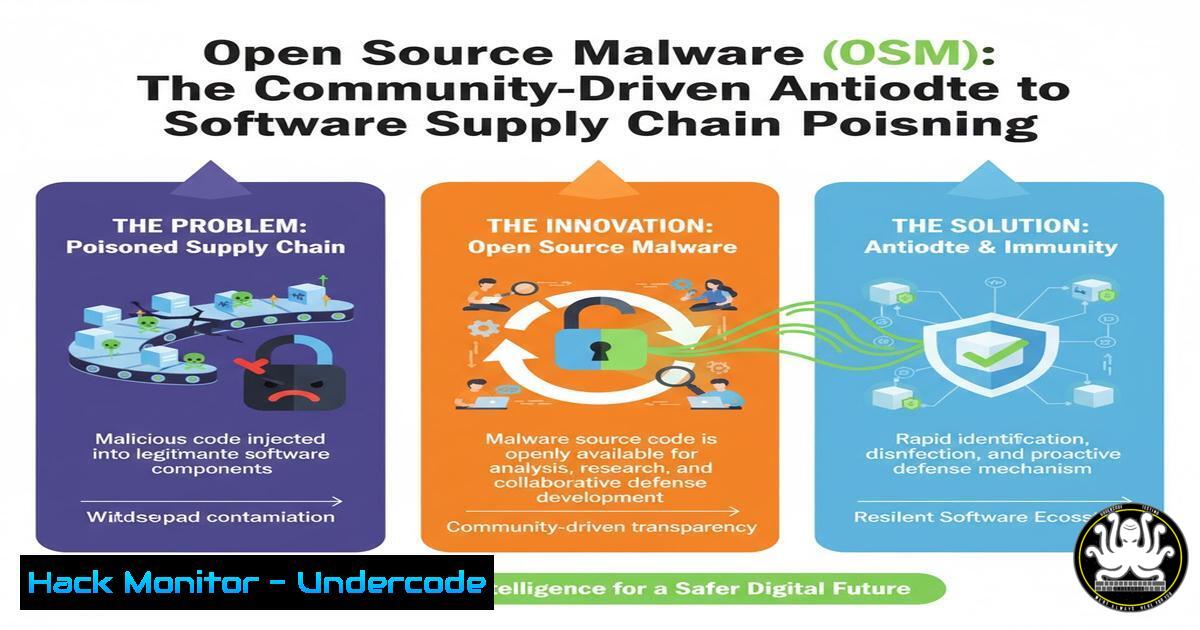
The software supply chain has become a primary attack vector, with malicious open-source components posing a catastrophic risk to organizations worldwide. Open Source Malware (OSM) emerges as a groundbreaking community-powered platform, fusing threat intelligence, collaborative research, and actionable data to defend against these insidious threats. This initiative represents a paradigm shift from reactive vulnerability databases to a proactive, holistic ecosystem for combating software supply chain attacks.
Learning Objectives:
- Understand the architecture and core functionalities of the Open Source Malware (OSM) platform.
- Learn how to integrate OSM data into your CI/CD pipeline and security tooling using its API and CLI.
- Develop a practical workflow for querying, submitting, and validating threats within the OSM community.
You Should Know:
1. OSM Architecture: Beyond a Simple Database
OSM is not merely a list of known malicious packages; it’s an integrated ecosystem. Its architecture combines a centralized database with a community-driven reporting mechanism, akin to a Wikipedia for malware, fortified with the incentive structures of a bug bounty platform. The platform aggregates data from sources like GitHub Security Advisories (GHSA) and the Open Source Vulnerability (OSV) schema but significantly expands upon them by including packages, git repositories, and CDNs that exhibit malicious behavior not necessarily tied to a specific vulnerability.
Step‑by‑step guide explaining what this does and how to use it.
Core Components:
Community Database: Allows researchers and automated tools to submit findings, which are then peer-reviewed.
RESTful API: Provides programmatic access to the entire dataset for integration into security tools.
Collaboration Platform: Facilitates discussion, validation, and analysis of emerging threats among security professionals.
How to Access the Data:
The primary interface is the web platform, but for operational use, the API is key. You can perform a simple lookup using `curl` from your terminal or build scripts.
`curl -X GET “https://api.osm.org/v1/package/npm/malicious-package-example”`
This command would return a JSON object detailing the package, its version, the type of malice (e.g., data exfiltration, crypto-mining), and references to community analysis.
2. Integrating OSM into Your CI/CD Pipeline
The true power of OSM is realized when its intelligence is baked directly into the development lifecycle. By querying the OSM API during the build process, you can prevent malicious dependencies from ever being integrated into your application.
Step‑by‑step guide explaining what this does and how to use it.
Concept: Add a pre-install or pre-build check that audits all `package.json` (Node.js), `requirements.txt` (Python), or `pom.xml` (Java) dependencies against the OSM database.
Implementation Example (Linux/Bash in a GitLab CI Job):
!/bin/bash
 This script scans all dependencies in a package.json file against the OSM API.

for package in $(jq -r '.dependencies | keys[]' package.json); do
echo "Checking package: $package"
response=$(curl -s -o /dev/null -w "%{http_code}" "https://api.osm.org/v1/package/npm/$package")
if [ "$response" -eq 200 ]; then
echo "🚨 BLOCKED: Package '$package' is flagged as malicious in OSM."
exit 1  Fail the build
else
echo "✅ Package '$package' is clean."
fi
done
echo "All dependencies scanned. No malicious packages found."
This script uses `jq` to parse the `package.json` and `curl` to check each dependency. If any package is found in the OSM database (HTTP 200 response), the build fails immediately.
- Leveraging the OSM CLI for Local Development Scans
For developers working locally, a command-line interface provides immediate feedback before code is even committed. This shifts security left, empowering developers with real-time threat intelligence.
Step‑by‑step guide explaining what this does and how to use it.
Installation: The OSM platform would ideally provide a CLI tool, installable via common package managers.
`npm install -g @opensourcemalware/cli` or `pip install osm-cli`
Basic Usage:
Scan your current project directory for known malicious dependencies.
`osm scan –path ./my-project`
The CLI would output a report listing any flagged components, their risk level, and a link to the detailed OSM report for further investigation.
4. Contributing Back: Submitting a Malicious Package
The community-driven model relies on contributions. If you discover a suspicious package, submitting it to OSM is a critical civic duty for the open-source ecosystem.
Step‑by‑step guide explaining what this does and how to use it.
Process:
- Gather Evidence: Collect the package name, version, repository URL, and any IoCs (Indicators of Compromise) like suspicious network calls or file system operations.
- Use the Submission API: Authenticate and submit a structured JSON report.
`curl -X POST “https://api.osm.org/v1/submit” -H “Authorization: Bearer $OSM_API_KEY” -H “Content-Type: application/json” -d ‘{“package”: “npm:suspicious-package”, “version”: “1.0.3”, “evidence”: “Observed beaconing to known C2 server…”, “type”: “data-exfiltration”}’`
3. Community Review: The submission enters a queue for peer review by trusted community members and OSM’s internal team before being officially added to the database.
5. Advanced Usage: Webhooks for Proactive Alerting
For security teams managing large-scale operations, polling an API is inefficient. Configuring webhooks allows OSM to push notifications to your internal systems the moment a new threat is validated.
Step‑by‑step guide explaining what this does and how to use it.
Concept: Register a URL endpoint from your SIEM, Slack, or internal dashboard with OSM.
Configuration:
Via the OSM web UI or API, you would register your webhook URL and subscribe to event types (e.g., package.malicious.new).
Sample Payload Handling (Python Flask Example):
from flask import Flask, request
import json

app = Flask(<strong>name</strong>)

@app.route('/osm-webhook', methods=['POST'])
def handle_osm_alert():
data = request.json
package_name = data['package']['name']
threat_type = data['package']['threat']
 Logic to alert team, scan internal code for this package, etc.
print(f"ALERT: Malicious package {package_name} detected. Type: {threat_type}")
return {'status': 'success'}, 200
This simple server listens for POST requests from OSM and triggers an internal alert.
What Undercode Say:
- OSM’s community-driven model is its greatest strength and its most significant challenge; the quality and speed of its data depend entirely on a vibrant, active community.
- The platform’s success hinges on seamless integration into developer workflows. If it’s not frictionless, it will be bypassed, rendering the intelligence useless.
Analysis: Open Source Malware is a bold and necessary evolution in supply chain security. While existing databases like GHSA and OSV are critical for tracking vulnerabilities, OSM tackles the more nebulous problem of outright malice—packages designed from the ground up to be harmful. The comparison to a hybrid of Wikipedia and a bug bounty platform is apt, as it leverages collective intelligence in a structured, incentivized way. However, the platform must overcome the classic hurdles of community projects: avoiding false positives, ensuring consistent data quality, and achieving critical mass to become the definitive source. If it succeeds, it could fundamentally change how the industry defends against one of its most pernicious threats.
Prediction:
The concept of community-curated threat intelligence for the software supply chain will become a standard pillar of DevSecOps within the next 2-3 years. We will see OSM and similar platforms become integrated by default into major package managers (npm, pip, Maven) and commercial security scanners. This will create a “immune system” for open source, where new malicious packages are identified and neutralized within hours of publication, drastically reducing the attack surface for all downstream users. The future will involve more automated submission and validation using AI, making the response to these threats nearly instantaneous.
🎯Let’s Practice For Free:
IT/Security Reporter URL:
Reported By: Mccartypaul I – Hackers Feeds
Extra Hub: Undercode MoN
Basic Verification: Pass ✅


