Listen to this Post
Introduction
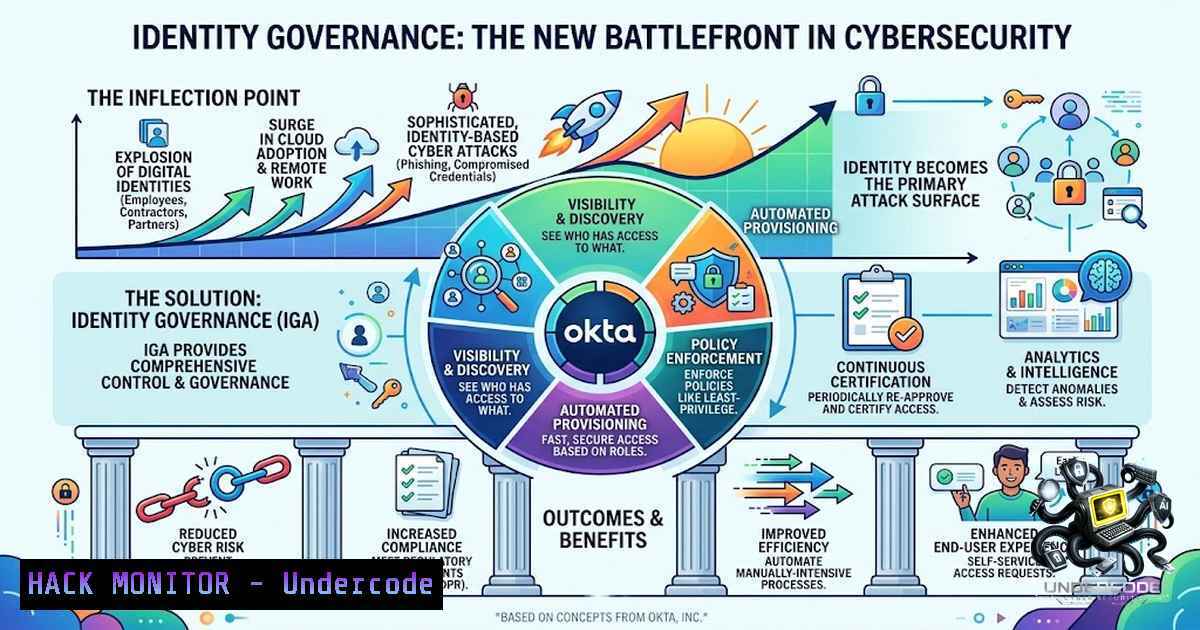
As Okta Inc. hires Silicon Valley legal veteran Scott Morgan as its new chief legal officer at a critical AI inflection point, the identity and access management (IAM) giant finds itself at the nexus of two seismic forces: the explosive proliferation of autonomous AI agents and the tightening web of global data privacy regulations. With 91% of organizations already deploying AI agents but only 10% having a mature governance strategy to manage them, the gap between adoption and security has never been wider. Morgan’s appointment signals that Okta is preparing for the legal and regulatory battlefield that will define the next era of enterprise AI—where identity is not just a security control plane but a compliance imperative.
Learning Objectives
- Understand the security implications of non-human identity (NHI) proliferation in agentic AI environments
- Master the technical implementation of AI agent governance using Okta’s Identity Cloud and kill-switch mechanisms
- Learn practical Linux, Windows, and API security commands for auditing and securing AI agent identities
You Should Know
- The Non-Human Identity Explosion: Securing the Unseen Attack Surface
The rise of agentic AI has introduced a new class of digital actor into the enterprise: non-human identities (NHIs) that operate at machine speed and unprecedented scale. Service accounts, API keys, and autonomous AI agents now outnumber human users in most organizations—with Okta reporting 650% year-over-year growth in service accounts powering automation and agentic workflows. This proliferation expands the attack surface dramatically, turning every over-privileged account into a potential vector for automated breaches.
The security reality is sobering: while 58% of executives cite AI governance as their top security concern, less than a third (32%) secure AI agents with the same rigor they apply to human employees. This disconnect creates a dangerous blind spot that attackers are already exploiting.
Step-by-Step Guide: Auditing Non-Human Identities
Linux – Identify Service Accounts and Their Permissions:
 List all service accounts (UID < 1000 typically reserved for system/services)
sudo awk -F: '$3 < 1000 {print $1, $3, $6}' /etc/passwd

Find all cron jobs that run with service account privileges
sudo crontab -l -u [bash]

Audit sudo privileges for service accounts
sudo grep -r "NOPASSWD" /etc/sudoers /etc/sudoers.d/

Check for SSH keys associated with service accounts
sudo find /home -1ame ".ssh" -type d -exec ls -la {} \;
Windows – Audit Service Accounts and Managed Service Accounts:
 List all service accounts and their logon configurations
Get-WmiObject Win32_Service | Where-Object {$<em>.StartName -like "$" -or $</em>.StartName -like "NT AUTHORITY"} | Format-Table Name, StartName, State

Check for unconstrained delegation (high-risk for NHIs)
Get-ADUser -Filter {ServicePrincipalName -like ""} -Properties ServicePrincipalName, Delegation

Audit scheduled tasks running with service account privileges
Get-ScheduledTask | ForEach-Object { $_.Principal.UserId } | Sort-Object -Unique

Review local group memberships for service accounts
net localgroup "Administrators"
Okta API – Discover and Inventory AI Agent Identities:
 Authenticate to Okta API and list all OAuth 2.0 clients (potential NHIs)
curl -X GET "https://{yourOktaDomain}.okta.com/api/v1/apps" \
-H "Authorization: SSWS ${OKTA_API_TOKEN}" \
-H "Accept: application/json" | jq '.[] | select(.status=="ACTIVE") | {id, name, label, lastUpdated}'

Identify service apps with high privilege scopes
curl -X GET "https://{yourOktaDomain}.okta.com/api/v1/apps?filter=status+eq+%22ACTIVE%22" \
-H "Authorization: SSWS ${OKTA_API_TOKEN}" | jq '.[] | select(.credentials.oauthClient.scopes != null) | {name, scopes: .credentials.oauthClient.scopes}'
- The AI Kill-Switch: Technical Implementation and Compliance Architecture
In May 2026, Okta announced a proprietary license embedding a self-executing “kill-switch” at the IAM layer, giving security teams the ability to discover, monitor, and instantly revoke access for rogue AI agents. The mechanism ties legal termination rights to real-time telemetry, allowing automatic deactivation of any AI-driven integration that violates predefined safety parameters.
From a compliance perspective, this directly addresses GDPR 30 (record-keeping), 5 (lawful processing), and CCPA Section 1798.150 (reasonable security measures). The kill-switch provides auditable records of every agent that touches personal data, enabling organizations to demonstrate accountability for automated decision-making as required by the European Data Protection Board.
Step-by-Step Guide: Implementing AI Agent Kill-Switch Controls
Okta API – Enforce Policy-Based Access with Instant Revocation:
 Create a policy rule that enforces token issuance constraints for AI agents
curl -X POST "https://{yourOktaDomain}.okta.com/api/v1/policies/{policyId}/rules" \
-H "Authorization: SSWS ${OKTA_API_TOKEN}" \
-H "Content-Type: application/json" \
-d '{
"name": "AI Agent Revocation Rule",
"status": "ACTIVE",
"conditions": {
"people": {
"users": {
"exclude": []
}
},
"network": {
"connection": "ANYWHERE"
}
},
"actions": {
"appSignOn": {
"access": "ALLOW",
"verificationMethod": {
"type": "ASSURANCE"
}
},
"authentication": {
"enforceDeviceEnrollment": false,
"maxSessionIdleMinutes": 15
}
}
}'
Linux – Real-Time Agent Behavior Monitoring and Kill-Switch Script:
!/bin/bash
 AI Agent Kill-Switch Monitor - Detects anomalous behavior and revokes access

AGENT_WHITELIST="/etc/okta/agent_whitelist.conf"
ALERT_THRESHOLD=100  requests per minute

Monitor API request rates per agent
tail -f /var/log/nginx/access.log | while read line; do
AGENT_ID=$(echo $line | grep -oP 'agent-id=\K[^&]+')
REQ_COUNT=$(grep -c "$AGENT_ID" /var/log/nginx/access.log | tail -1)

if [ $REQ_COUNT -gt $ALERT_THRESHOLD ]; then
echo "ALERT: Agent $AGENT_ID exceeded rate limit - triggering kill-switch"
 Revoke the agent's Okta session token
curl -X DELETE "https://{yourOktaDomain}.okta.com/api/v1/sessions/${AGENT_ID}" \
-H "Authorization: SSWS ${OKTA_API_TOKEN}"

Log the revocation event for compliance audit
logger "Kill-switch activated for agent $AGENT_ID at $(date)"
fi
done
Windows PowerShell – AI Agent Compliance Audit Script:
 AI Agent Compliance Auditor - GDPR/CCPA readiness check
$AuditLog = @()
$Agents = Get-AzureADServicePrincipal -All $true | Where-Object {$<em>.DisplayName -like "AI" -or $</em>.DisplayName -like "agent"}

foreach ($Agent in $Agents) {
$Permissions = Get-AzureADServicePrincipalOAuth2PermissionGrant -ObjectId $Agent.ObjectId
$AuditLog += [bash]@{
AgentName = $Agent.DisplayName
AgentID = $Agent.ObjectId
Permissions = ($Permissions.Scope -join ", ")
LastActivity = $Agent.CreatedDateTime
RiskScore = if ($Permissions.Scope -match "Directory.ReadWrite.All") {"HIGH"} else {"MEDIUM"}
GDPR_Compliant = if ($Agent.CreatedDateTime -gt (Get-Date).AddMonths(-6)) {"Pending Review"} else {"Compliant"}
}
}
$AuditLog | Export-Csv -Path "C:\Security\AI_Agent_Inventory_$(Get-Date -Format 'yyyyMMdd').csv" -1oTypeInformation
- API Security in the Age of Autonomous Agents
AI agents communicate through APIs, and every API key, OAuth token, and service account credential represents a potential attack vector. Security researchers have uncovered malicious packages that silently harvest authentication tokens and exfiltrate them to command-and-control servers. With autonomous agents capable of discovering over-permissioned APIs and crafting exploit payloads without human input, traditional firewalls and signature-based tools often miss these threats entirely.
Step-by-Step Guide: Hardening API Security for AI Agents
Linux – API Gateway Rate Limiting and Anomaly Detection:
 Nginx rate limiting configuration for AI agent endpoints
cat <<EOF | sudo tee /etc/nginx/conf.d/ai_agent_rate_limit.conf
limit_req_zone \$binary_remote_addr zone=ai_agents:10m rate=50r/m;
limit_req zone=ai_agents burst=10 nodelay;
limit_req_status 429;

Apply to AI agent endpoints
location /api/v1/agents/ {
limit_req zone=ai_agents;
proxy_pass http://backend_ai_service;
}
EOF
sudo nginx -t && sudo systemctl reload nginx
Okta API – Revoke Compromised Tokens Immediately:
 Revoke all tokens for a suspected compromised AI agent
curl -X POST "https://{yourOktaDomain}.okta.com/api/v1/users/${USER_ID}/credentials/revoke" \
-H "Authorization: SSWS ${OKTA_API_TOKEN}" \
-H "Content-Type: application/json" \
-d '{
"revokeAll": true,
"reason": "Compromised AI agent detected"
}'

List all active OAuth tokens and check for anomalies
curl -X GET "https://{yourOktaDomain}.okta.com/api/v1/oauth2/tokens" \
-H "Authorization: SSWS ${OKTA_API_TOKEN}" | jq '.[] | select(.clientId != null) | {clientId, userId, expiresAt, scopes: .scopes}'
Windows – API Key Rotation and Secret Management:
 Azure Key Vault - Rotate API keys for AI agent service principals
$ServicePrincipal = Get-AzureADServicePrincipal -SearchString "AI-Agent-Production"
$NewCredential = New-Guid
Set-AzureADApplicationPasswordCredential -ObjectId $ServicePrincipal.ObjectId -PasswordCredential $NewCredential

Audit all API permissions for AI agents
Get-AzureADServicePrincipal -All $true | ForEach-Object {
$perms = Get-AzureADServicePrincipalOAuth2PermissionGrant -ObjectId $<em>.ObjectId
if ($perms) {
Write-Host "SPN: $($</em>.DisplayName) - Permissions: $($perms.Scope)"
}
}
- AI Governance Framework: Building the Legal-Technical Control Plane
Okta’s AI Governance Team has established guardrails that balance innovation with security, setting criteria and auditable approval processes for AI tools across business units. The company saved more than 300,000 work hours through AI and automation in six months, demonstrating that governance doesn’t have to stifle productivity. However, the governance gap remains critical: less than a third of organizations secure AI agents with the same rigor as human employees.
Step-by-Step Guide: Implementing an AI Governance Framework
Linux – Automated Compliance Scanning for AI Agent Configurations:
!/bin/bash
 AI Governance Compliance Scanner

echo "=== AI AGENT GOVERNANCE AUDIT ==="
echo "Timestamp: $(date)"
echo ""

Check for hardcoded secrets in agent configurations
echo "[bash] Scanning for hardcoded credentials..."
grep -r -E "(password|secret|token|api_key)\s=\s['\"][^'\"]+['\"]" /etc/ai-agents/ 2>/dev/null

Verify agent logging is enabled
echo "[bash] Verifying audit logging..."
grep -r "audit_enabled\s=\strue" /etc/ai-agents/ 2>/dev/null || echo "WARNING: Audit logging not enabled for some agents"

Check agent isolation (container or sandbox)
echo "[bash] Checking isolation status..."
docker ps --format "table {{.Names}}\t{{.Image}}\t{{.Status}}" | grep -i agent

Validate agent data access scope
echo "[bash] Validating data access boundaries..."
find /etc/ai-agents -1ame ".conf" -exec grep -H "data_access_scope" {} \;
Okta Workflows – Automated Agent Lifecycle Management:
 Okta Workflow template for AI agent governance
workflow:
name: "AI Agent Lifecycle Governance"
trigger:
- type: "app_created"
app_type: "AI_AGENT"
actions:
- name: "Initial Compliance Check"
type: "http_request"
url: "https://compliance-api.internal/validate"
body: |
{
"agent_id": "{{app.id}}",
"requested_scopes": "{{app.scopes}}",
"owner": "{{app.owner}}"
}
- name: "Conditional Approval"
type: "condition"
if: "{{compliance_check.status}} == 'APPROVED'"
then:
- name: "Grant Limited Access"
type: "okta_assign_group"
group_id: "AI_AGENTS_LIMITED"
else:
- name: "Auto-Revoke and Alert"
type: "okta_revoke_app"
app_id: "{{app.id}}"
alert: "Security team notified"
- Data Privacy and Regulatory Compliance for AI Agents
The regulatory landscape for AI is rapidly evolving. GDPR, CCPA/CPRA, and the emerging U.S. AI Accountability Act require that personal data stays within defined borders and that organizations retain full control over its lifecycle. Autonomous agents often pull data from multiple clouds, making it difficult to guarantee compliance without a hard-stop mechanism. Okta’s kill-switch license directly addresses these obligations by providing a record of every agent that touches personal data and enabling real-time revocation as a technical and organizational measure.
Step-by-Step Guide: GDPR/CCPA Compliance for AI Agents
Linux – Data Access Audit and Compliance Reporting:
!/bin/bash
 GDPR/CCPA Compliance Report Generator for AI Agents

REPORT_DIR="/var/reports/compliance"
mkdir -p $REPORT_DIR

echo "Generating GDPR/CCPA Compliance Report: $(date)" > $REPORT_DIR/ai_compliance_$(date +%Y%m%d).txt
echo "========================================" >> $REPORT_DIR/ai_compliance_$(date +%Y%m%d).txt

List all AI agents that access personal data
echo "[bash] AI Agents with Personal Data Access:" >> $REPORT_DIR/ai_compliance_$(date +%Y%m%d).txt
grep -r "personal_data.true" /etc/ai-agents/ 2>/dev/null | cut -d: -f1 | sort -u >> $REPORT_DIR/ai_compliance_$(date +%Y%m%d).txt

Verify data processing agreements (DPA) are in place
echo "[bash] Data Processing Agreement Status:" >> $REPORT_DIR/ai_compliance_$(date +%Y%m%d).txt
for agent in $(ls /etc/ai-agents/); do
if [ -f "/etc/ai-agents/$agent/dpa_signed.txt" ]; then
echo "$agent: DPA Signed" >> $REPORT_DIR/ai_compliance_$(date +%Y%m%d).txt
else
echo "$agent: DPA MISSING" >> $REPORT_DIR/ai_compliance_$(date +%Y%m%d).txt
fi
done

Audit data retention policies
echo "[bash] Data Retention Compliance:" >> $REPORT_DIR/ai_compliance_$(date +%Y%m%d).txt
grep -r "retention_days" /etc/ai-agents/ 2>/dev/null | while read line; do
days=$(echo $line | grep -oP 'retention_days\s=\s\K\d+')
if [ $days -gt 365 ]; then
echo "WARNING: $line - exceeds GDPR retention limits" >> $REPORT_DIR/ai_compliance_$(date +%Y%m%d).txt
fi
done

echo "Report generated at $REPORT_DIR/ai_compliance_$(date +%Y%m%d).txt"
Windows – DSAR (Data Subject Access Request) Automation:
 DSAR Automation for AI Agent Data
param([bash]$UserEmail)

$AgentLogs = Get-Content "C:\Logs\AI_Agents\access_$(Get-Date -Format 'yyyyMMdd').log" | Where-Object {$_ -match $UserEmail}
$PersonalData = @()

foreach ($Entry in $AgentLogs) {
$Data = [bash]@{
Timestamp = ($Entry -split ',')[bash]
Agent = ($Entry -split ',')[bash]
DataAccessed = ($Entry -split ',')[bash]
Purpose = ($Entry -split ',')[bash]
}
$PersonalData += $Data
}

$PersonalData | Export-Csv -Path "C:\Compliance\DSAR_$UserEmail_$(Get-Date -Format 'yyyyMMdd').csv" -1oTypeInformation
Write-Host "DSAR report generated for $UserEmail"
What Undercode Say:
- Identity Is the New Security Perimeter: In the agentic AI era, traditional network perimeters are obsolete. Identity—both human and non-human—is the ultimate control plane. Organizations must treat every API key, service account, and AI agent as a potential entry point and govern them with the same rigor as privileged human users.
-
Compliance Is a Technical Problem, Not Just a Legal One: The convergence of AI proliferation and data privacy regulations means legal teams can no longer operate in isolation. Technical controls like Okta’s kill-switch, real-time revocation, and auditable token issuance are now essential compliance tools. Scott Morgan’s appointment reflects this reality—the CLO must be as technical as the CISO.
The appointment of a seasoned tech legal executive at this critical juncture signals that Okta is positioning itself not just as an identity provider but as the governance layer for the entire AI ecosystem. With 91% of organizations already deploying AI agents and regulators tightening rules on automated decision-making, the companies that succeed will be those that embed compliance into their identity infrastructure from day one. The kill-switch is just the beginning—the next frontier will be AI agent behavioral analytics, predictive threat detection, and automated compliance remediation. Organizations that fail to close the identity governance gap will find themselves on the wrong side of both security breaches and regulatory fines.
Prediction:
- +1 The AI agent identity management market will grow exponentially, with IAM providers like Okta, Microsoft Entra, and Ping Identity competing to offer the most comprehensive agent governance frameworks. This will create new cybersecurity job categories focused exclusively on non-human identity security.
-
-1 Organizations that treat AI agent governance as an afterthought will face a wave of automated breaches. The speed at which rogue agents can operate means traditional incident response timelines (hours or days) will be insufficient—we will see the first major breach caused by a malicious AI agent within 18 months.
-
+1 Regulatory bodies will increasingly mandate identity-level controls for AI systems, with GDPR and CCPA setting the precedent. This will accelerate enterprise adoption of IAM solutions with built-in compliance features, benefiting security vendors and enterprises alike.
-
-1 The complexity of managing thousands of non-human identities will overwhelm understaffed security teams, leading to “identity sprawl” where orphaned service accounts and forgotten API keys create massive attack surfaces. Automation will be required to manage automation.
-
+1 The integration of legal and technical controls (as exemplified by Okta’s kill-switch license) will become the new standard for enterprise AI governance. Legal teams will increasingly work alongside security engineers to draft enforceable terms that are technically verifiable at the API level.
▶️ Related Video (82% Match):
https://www.youtube.com/watch?v=2EP216BMruE
🎯Let’s Practice For Free:
🎓 Live Courses & Certifications:
Join Undercode Academy for Verified Certifications
🚀 Request a Custom Project:
Secure, high-velocity infrastructure and disruptive technological engineering. Contact our engineering team for high-tier development and proprietary systems:
[email protected]
💎 Smart Architecture | 🛡️ Secure by Design | ⭐ Trusted by Thousands
IT/Security Reporter URL:
Reported By: https://lnkd.in/p/epQgyzgY – Hackers Feeds
Extra Hub: Undercode MoN
Basic Verification: Pass ✅


