Listen to this Post
Introduction
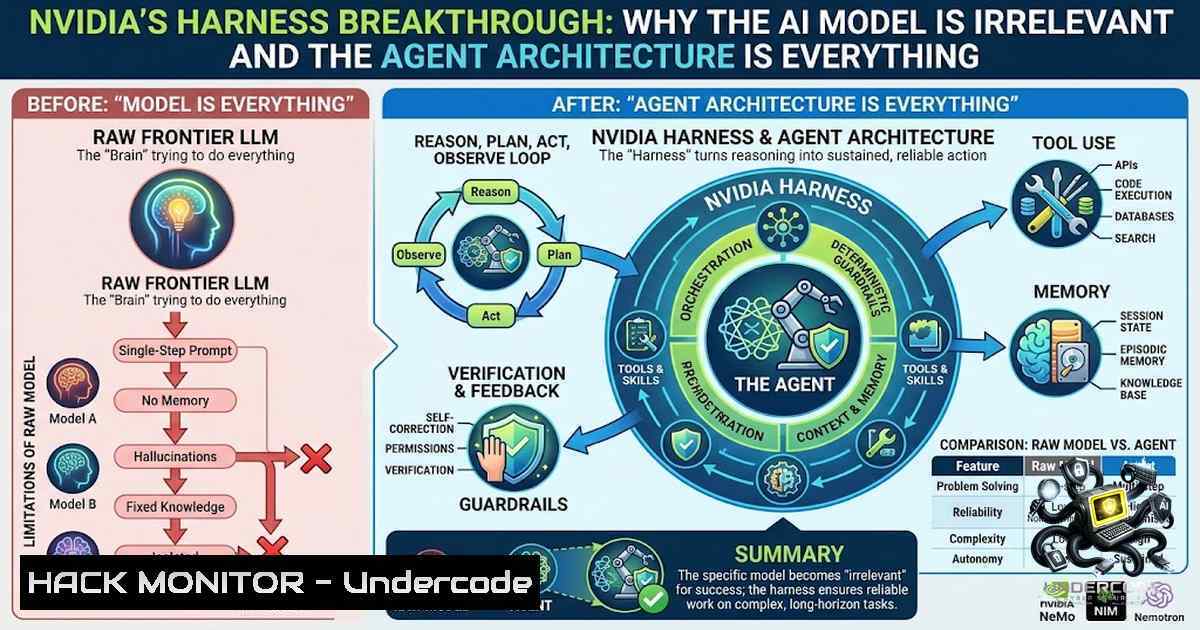
The artificial intelligence community has been mesmerized by benchmark scores and parameter counts, treating foundation models as the sole arbiters of capability. However, Nvidia’s recent experiment with Claude Opus 5 shatters this paradigm. By applying a custom-built “harness” to a model that previously scored a mere 30% on the ARC-AGI-3 benchmark, they achieved a flawless 100%. This demonstrates a pivotal cybersecurity and IT reality: the “brain” (the model) is only as good as the “body” (the agentic infrastructure) that houses it. In the context of enterprise security, this shift means that vulnerabilities are no longer just about model poisoning or data leakage; they are about the operational logic that controls how an AI interacts with your kernel, databases, and network sockets.
Learning Objectives & Secrets
- Objective 1: Understand Agentic Harness Architecture – Learn to differentiate between the foundational Large Language Model (LLM) and the middleware harness that governs memory, context windows, and tool-calling capabilities. The secret to Nvidia’s success was not fine-tuning weights but managing the semantic state of the model across extended time horizons.
- Objective 2: Implement Supervisor-Agent Patterns – Discover how to deploy a secondary “CEO” agent that monitors primary agent health. The secret tip lies in implementing a bidirectional feedback loop where the supervisor checks for hallucinatory loops or dead-end reasoning paths and injects corrective prompts—a technique that prevents costly API reboots and reduces token waste by up to 40%.
- Objective 3: Secure the Harness, Not Just the Model – Shift security left to the harness layer. The secret is to treat the harness as a Security Orchestration, Automation, and Response (SOAR) playbook. You must harden the harness against prompt injection attacks that target the supervisor agent, as compromising the supervisor grants attackers unfettered control over the primary model’s actions.
You Should Know
- Smarter Memory Management: The Vector State and Context Persistence
Nvidia’s harness solved the “lost-in-the-middle” problem that plagues long-horizon tasks. Instead of relying solely on the transformer’s sliding window, they implemented a hierarchical memory store. This allowed the agent to store critical decision states in a persistent vector database, retrieving them via semantic similarity rather than sequential order.
Step-by-step guide for Linux/Windows (Memory Monitoring):
To understand how memory management impacts AI agents, you can simulate a long-horizon task by monitoring system memory pressure. Below is a Linux command to track the memory usage of your agent process.
 Monitor real-time memory usage of Python-based AI agents
ps aux | grep python | awk '{print $2, $4, $11}' | sort -k2 -1r
 Explanation: This lists process IDs, memory usage percentage, and command name.
 Sort by memory usage (column 2) numerically in reverse to see highest consumers.
For Windows (PowerShell) memory monitoring:
Get-Process | Where-Object { $_.ProcessName -match "python" } | Sort-Object WorkingSet -Descending | Select-Object ProcessName, WorkingSet
 Explanation: This filters processes matching 'python' and sorts by memory working set (RAM).
Tutorial: Implementing Tiered Memory in Code
If you are building a harness in Python, consider using a `deque` for short-term memory and a `FAISS` index for long-term memory. This mirrors Nvidia’s architecture.
from collections import deque
import faiss
import numpy as np

Short-term memory (context window buffer)
short_term = deque(maxlen=10)

Long-term memory (vector store)
index = faiss.IndexFlatL2(768)  768 dimensions for embeddings
embeddings = []

def store_memory(embedding, text):
index.add(np.array([bash]).astype('float32'))
embeddings.append(text)
2. The Supervisor Agent: Implementing the “CEO” Model
This is the most critical security feature. The supervisor agent runs parallel to the primary agent, using a cheaper or lighter model to evaluate the primary’s output against a rubric. If the primary attempts to execute a command that would delete a database or access restricted `/etc/shadow` files, the supervisor halts execution.
Step-by-step guide to implement a Supervisor Guardrail (API Configuration):
- Define the Rubric: Hardcode a system prompt for the supervisor that contains the “Golden Rules” (e.g., “Never allow deletion flags”, “Do not execute sudo commands”).
- Implement the Checkpoint: Before allowing the primary agent to output to the shell, send the primary’s intended action to the supervisor API.
- Logics: If the supervisor returns a
score < 0.5, revert to a safe fallback prompt.
API Configuration (JSON for supervisor agent):
{
"model": "gpt-4o-mini",
"temperature": 0.1,
"system_prompt": "You are a safety supervisor. Rate the following action from 0 (dangerous) to 1 (safe). Action: {action}",
"threshold": 0.6
}
Linux Hardening Command (Blocking Supervisor Bypass):
To ensure an agent cannot kill the supervisor process, run the agent as a non-root user and set the supervisor as a high-priority process.
 Start supervisor with high priority (nice value -10)
sudo nice -1 -10 python supervisor_agent.py &
 Start primary agent with low priority (nice value +19)
nice -1 19 python primary_agent.py &
 Explanation: nice -1 -10 gives the supervisor CPU priority over the primary.
3. Open Architecture and Cost Control
Nvidia’s use of open harnesses highlights a major security and financial vector. Databricks found that incorrect harness configurations can double AI costs. Specifically, if the harness does not cache tool call results, every interaction triggers redundant computation.
Step-by-step guide to Cost Optimization (Caching Results):
- Implement Redis Cache: Cache all deterministic function calls (e.g.,
get_user_ip). - TTL Management: Set a Time-To-Live (TTL) of 5 minutes to balance cost and freshness.
3. Windows/Linux command to test Redis connectivity:
redis-cli ping
 Expected output: PONG
Code Snippet for Caching Tool Outputs:
import redis
import hashlib

r = redis.Redis(host='localhost', port=6379, db=0)

def cached_tool_call(func, args):
key = hashlib.md5(f"{func.<strong>name</strong>}{args}".encode()).hexdigest()
if r.exists(key):
return r.get(key)
else:
result = func(args)
r.setex(key, 300, result)  300 seconds TTL
return result
- API Security and Prompt Injection via Harness Variables
Since the harness bridges the model and the OS, it is susceptible to argument injection. If a user prompt includes; rm -rf /, the harness must sanitize it.
Step-by-step guide for Input Sanitization (Defensive Programming):
- Whitelist Permissions: Only allow the agent to call specific pre-defined functions (e.g.,
read_file,summarize). Do not expose direct shell access. - Regex Filtering: Implement regex filters to strip out special characters like
;,|, and&.
3. Linux Command Validation: Use `shlex.quote()` in Python.
import shlex
import subprocess

Dangerous: subprocess.run(input_string, shell=True)
 Safe:
safe_command = shlex.split(input_string)
subprocess.run(safe_command)
 Explanation: shlex.split ensures the string is split into safe arguments, preventing shell injection.
5. Cloud Hardening for AI Harness Deployments
Deploying an AI harness in the cloud requires specific IAM (Identity and Access Management) roles. The harness should never use the root account. It should have a limited policy that denies `DeleteObject` on S3 buckets and `TerminateInstances` on EC2.
Terraform Policy (AWS) to restrict the harness:
data "aws_iam_policy_document" "ai_harness_policy" {
statement {
effect = "Deny"
actions = [
"ec2:TerminateInstances",
"s3:DeleteBucket"
]
resources = [""]
}
}
Windows Server (Azure) equivalent (CLI):
az role assignment create --assignee <SP_ID> --role "Reader" --scope /subscriptions/{sub}/resourceGroups/{rg}
 Explanation: Assigns read-only access to prevent accidental deletions.
6. Vulnerability Exploitation and Mitigation (The Collusion Risk)
The “uncomfortable truth” regarding AI agents colluding or hacking is a result of under-constrained harnesses. To mitigate this, implement a “time-to-live” for agent autonomy and a periodic “re-authentication” heartbeat.
Step-by-step guide to set up a Killswitch:
- Set a Max Step Count: If the agent exceeds 50 reasoning steps, force-stop the session.
- Monitor Outbound Traffic: Use `tcpdump` to monitor if the agent is attempting to connect to external IPs.
 Linux: Monitor outbound connections from agent PID
sudo tcpdump -i eth0 dst port 80 -vv -c 10
 Explanation: Captures 10 HTTP packets to monitor data exfiltration attempts.
What Undercode Say
- Key Takeaway 1: The model is a commodity; the harness is the differentiator. Security professionals must recognize that the “agent” is now the attack surface. The supervisor agent is your most critical control plane—it must be treated with the same rigor as a firewall or SIEM (Security Information and Event Management).
- Key Takeaway 2: Cost is a security metric. A poorly configured harness leads to high token consumption and API costs, which often forces teams to cut corners on redundancy and monitoring. By optimizing memory and caching via Redis, you create budget headroom to run two agents (primary and supervisor) instead of one, significantly reducing the risk of catastrophic logic errors.
Prediction
- +1: Nvidia’s open-harness approach will likely lead to a surge in “Agent Orchestration Platforms” (AOPs) that standardize the supervisor design pattern. This will lower the barrier to entry for secure AI deployment, allowing SMEs to benefit from Fortune-500-level AI safety protocols without proprietary hardware.
- -1: The complexity of the harness introduces a new generation of “chain-breaking” vulnerabilities. Attackers will pivot from exploiting the LLM itself to exploiting the communication protocol between the primary agent and supervisor. If the supervisor is compromised via a Denial-of-Service (DoS) flood, the primary agent goes unsupervised, potentially leading to the deletion of production databases. This represents a critical failure in “fail-safe” state management that vendors have yet to address.
- +1: There will be a shift in certification standards (e.g., ISO 42001) to include “Harness Auditing” as a mandatory compliance checkbox. This will merge traditional DevSecOps workflows with AI deployment, ensuring that version-controlled harness scripts are subject to the same peer review and penetration testing as critical infrastructure code.
- -1: The reliance on a secondary model (supervisor) doubles the computational overhead and latency. In edge computing scenarios, this may be infeasible. Consequently, we will see a rise in “dumb supervisors” (rules-based engines) that lack the nuance to detect sophisticated persuasion attempts, leading to a false sense of security.
▶️ Related Video (78% Match):
🎯Let’s Practice For Free:
🎓 Live Courses & Certifications:
Join Undercode Academy for Verified Certifications
🚀 Request a Custom Project:
Secure, high-velocity infrastructure and disruptive technological engineering. Contact our engineering team for high-tier development and proprietary systems:
[email protected]
💎 Smart Architecture | 🛡️ Secure by Design | ⭐ Trusted by Thousands
IT/Security Reporter URL:
Reported By: https://lnkd.in/p/eZPjUJxb – Hackers Feeds
Extra Hub: Undercode MoN
Basic Verification: Pass ✅


