Listen to this Post
Introduction
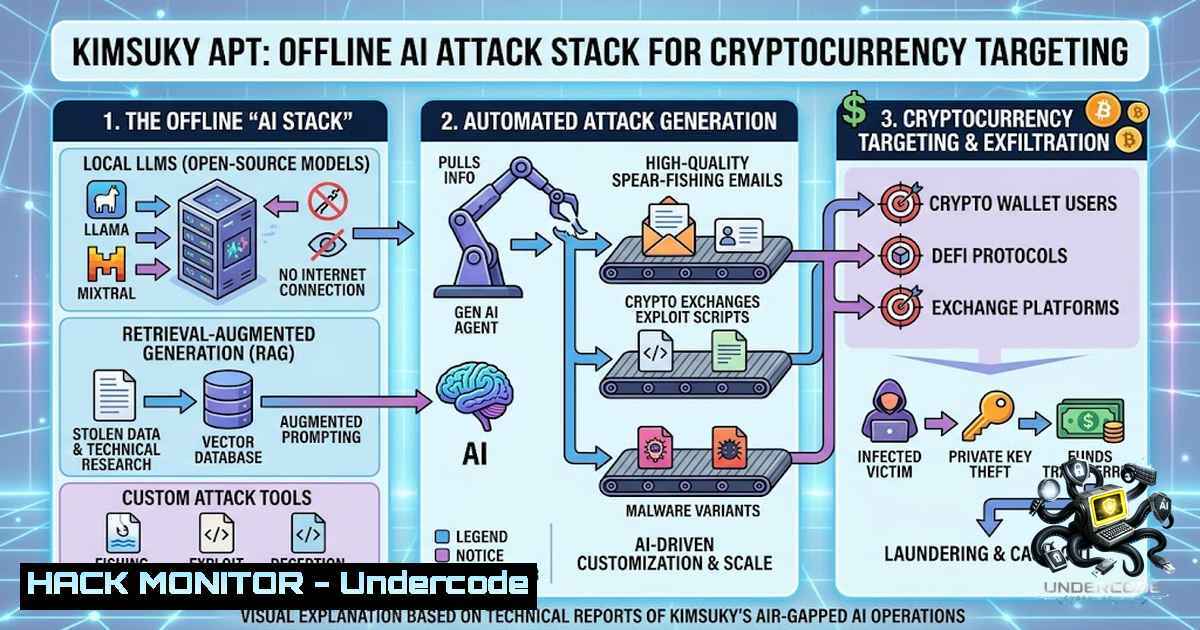
The Kimsuky advanced persistent threat (APT) group—operating under North Korea’s Reconnaissance General Bureau—has moved beyond using generative AI merely for crafting phishing lures. Recent findings from South Korean cybersecurity firm Genians Security Center reveal that Kimsuky has deployed a fully operational offline AI infrastructure comprising local large language models (LLMs), retrieval-augmented generation (RAG) pipelines, and AI-assisted development frameworks. This shift represents a fundamental escalation: state-sponsored hackers are now integrating AI directly into their attack workflows—from malware development to data exfiltration analysis—while eliminating the operational security risks associated with cloud-based AI services. For defenders, this means traditional signature-based detection and phishing awareness training are no longer sufficient; behavioral detection, endpoint logging, and network anomaly monitoring must become the new baseline.
Learning Objectives
- Understand the technical components of Kimsuky’s offline AI attack stack, including Ollama, GPT4All, Msty, and RAG implementations
- Analyze the LNK-to-PowerShell infection chain and GitHub-based C2 infrastructure used in Operation GitPower
- Identify indicators of compromise (IoCs) and implement EDR-based threat hunting strategies against AI-assisted attacks
- Apply practical detection and mitigation commands across Linux and Windows environments
- Recognize the implications of AI-accelerated cryptocurrency theft and nation-state cyber operations
You Should Know
- The Offline AI Stack: Components, Configuration, and Operational Security
Kimsuky’s AI infrastructure is built around three locally deployed platforms: Ollama, GPT4All, and Msty. Unlike previous AI-assisted attacks that relied on public chatbots (which leave audit trails and risk exposure), offline deployment allows the group to process stolen documents, analyze extracted data, and generate phishing content without transmitting sensitive information to external services.
Technical Evidence: Genians identified that Ollama generated its first-launch cryptographic keys on the compromised infrastructure, confirming active runtime execution rather than mere download. GPT4All contained a configured localdocs_v3.db—the database file used by its LocalDocs RAG feature—indicating the group connected the LLM to a private document corpus. This RAG capability enables Kimsuky to query stolen intelligence documents, financial records, and cryptocurrency wallet data using natural language, dramatically accelerating information extraction.
Beyond these ready-made tools, the group deployed AI development frameworks including Microsoft Semantic Kernel, LLaMaSharp, and Microsoft.Agents.AI—components for building custom AI functions into C and .NET malware. They also installed OpenAI’s Whisper speech-to-text files with extraction guides, and active traces of Cursor, an AI-powered coding editor, were found on the same infrastructure.
Defensive Recommendations
Organizations should monitor for unauthorized deployment of these tools. Below are practical detection commands:
Linux Detection (Endpoint):
 Detect Ollama installation and running processes
ps aux | grep -E "ollama|gpt4all|msty"
sudo find / -1ame "ollama" -type f 2>/dev/null
sudo netstat -tulpn | grep -E "11434|4891"  Ollama default ports

Check for RAG database artifacts
sudo find / -1ame "localdocs_v3.db" 2>/dev/null
sudo find / -1ame ".db" -path "/gpt4all/" 2>/dev/null

Detect Cursor IDE or AI coding tools
sudo find / -1ame "cursor" -type f 2>/dev/null
Windows Detection (PowerShell):
 Check for AI tool installations
Get-Process | Where-Object {$<em>.ProcessName -match "ollama|gpt4all|msty|cursor"}
Get-WmiObject -Class Win32_Product | Where-Object {$</em>.Name -match "ollama|gpt4all"}

Search for RAG database files
Get-ChildItem -Path C:\ -Recurse -ErrorAction SilentlyContinue | Where-Object {$_.Name -eq "localdocs_v3.db"}

Check scheduled tasks for persistence
Get-ScheduledTask | Where-Object {$_.TaskName -match "ollama|gpt4all|ai|llm"}
- The Infection Chain: LNK Files, PowerShell Obfuscation, and GitHub C2
Kimsuky’s primary delivery mechanism remains the malicious LNK file concealed within ZIP archives disguised as legitimate business documents. When executed, the LNK file processes obfuscated command-line arguments that trigger an embedded PowerShell loader.
The Technical Flow:
- Delivery: Spear-phishing email with ZIP attachment (e.g., “Investment_Strategy_Report.zip”)
- Execution: User double-clicks the LNK file inside the ZIP
3. PowerShell Trigger: Obfuscated Base64-encoded PowerShell payload executes
- C2 Communication: PowerShell script reaches out to GitHub repositories used as command-and-control (C2) infrastructure
- Payload Deployment: Encrypted AsyncRAT payloads (disguised as image files) are downloaded and executed
Genians tracks this activity as Operation GitPower, which inherits the attack flow from the 2023 “FlowerPower” campaign while incorporating Git-based C2 operational structures. The abuse of legitimate GitHub repositories as C2 channels makes detection challenging, as traffic to GitHub appears benign to most security tools.
Step-by-Step Detection and Analysis
Extract and Analyze LNK Files (Windows):
 Use LNK parsing tool (download LnkParse3 from GitHub)
pip install LnkParse3
python -c "import LnkParse3; print(LnkParse3.lnk_parse('malicious.lnk'))"

Extract PowerShell command from LNK target
$shell = New-Object -ComObject WScript.Shell
$shortcut = $shell.CreateShortcut("C:\path\to\malicious.lnk")
$shortcut.TargetPath  Shows the obfuscated command
Decode Base64-Encoded PowerShell:
Decode Base64 payload
Monitor GitHub C2 Traffic (Network/SIEM):
 Linux: Monitor outbound GitHub API calls
sudo tcpdump -i any -1 'host github.com and port 443' -v
sudo journalctl -f | grep -i "github"

Check for suspicious git operations
sudo find /tmp -1ame ".git" -type d 2>/dev/null
lsof -i :443 | grep github
Windows: Detect AsyncRAT Payloads:
 Search for AsyncRAT indicators
Get-ChildItem -Path C:\ -Recurse -ErrorAction SilentlyContinue | Where-Object {
$<em>.Extension -match ".png|.jpg|.jpeg" -and $</em>.Length -gt 500KB
} | ForEach-Object {
 Check for PE headers hidden in images
$bytes = [System.IO.File]::ReadAllBytes($<em>.FullName)
if ($bytes[0..1] -eq 0x4D,0x5A) { Write-Host "Suspicious: $</em>" }
}
EDR Hunting Query (Pseudocode):
alert (
process.name == "powershell.exe" AND
command_line contains "-enc" AND
destination.ip in github_c2_indicators AND
file.path matches ".lnk" AND
parent.process.name == "explorer.exe"
)
- AI-Generated Decoy Documents: The New Social Engineering Frontier
Kimsuky has been using AI-generated financial and cryptocurrency-themed decoy documents since early 2026. These documents exhibit natural language, highly polished structure, and formatting that closely mimics legitimate investment reports, honorarium payments, and meeting materials. The quality is sufficient to bypass traditional phishing detection that relies on grammatical errors or awkward phrasing.
Observed Lures Include:
- Cryptocurrency investment strategy reports
- Virtual asset wallet verification documents
- Financial audit requests
- Game development partnership proposals
- Gmail credential and website registration verification requests
Mitigation Strategy
Traditional email filtering is insufficient. Organizations should implement:
Content Analysis (Linux/Windows):
 Linux: Analyze document metadata for AI generation artifacts
exiftool suspicious.pdf | grep -E "Producer|Creator|Software"
strings suspicious.docx | grep -i "openai|gpt|llama"

Check for unnatural text patterns using entropy analysis
ent suspicious.txt  High entropy may indicate AI-generated content
Windows: Document Analysis:
 Extract and analyze OLE metadata
Get-ChildItem -Path "C:\Documents" -Recurse -Include .docx,.pdf | ForEach-Object {
$hash = Get-FileHash $<em>.FullName -Algorithm SHA256
Write-Host "$($</em>.Name): $($hash.Hash)"
}
4. Infrastructure and IoCs: What to Hunt For
Genians identified multiple indicators exhibiting North Korea-linked characteristics, including Korean language artifacts such as “Arirang”, “싸이트” (site), “가입리력” (registration history), and “로출되였는지” (whether exposed). Key IoCs include:
- Local AI Tool Artifacts:
ollama,gpt4all, `msty` processes; `localdocs_v3.db` files; Ollama default port 11434 - Development Frameworks: Microsoft Semantic Kernel, LLaMaSharp, Microsoft.Agents.AI, Whisper STT, Cursor IDE
- C2 Infrastructure: GitHub repositories used for payload staging and command channels
- Payload Indicators: Encrypted AsyncRAT disguised as PNG/JPG images; PowerShell obfuscation patterns (Base64, string splitting, custom decoding)
Automated Detection Script (Linux)
!/bin/bash
 Kimsuky AI Stack Detection Script

echo "[] Scanning for Kimsuky AI tool artifacts..."

Check processes
ps aux | grep -E "ollama|gpt4all|msty|cursor" | grep -v grep

Check for RAG databases
sudo find / -1ame "localdocs_v3.db" 2>/dev/null

Check for Ollama configuration
sudo find / -1ame "ollama" -type f 2>/dev/null

Check for suspicious GitHub C2 patterns in logs
sudo grep -r "github.com" /var/log/ 2>/dev/null | grep -E "powershell|base64"

Check for LNK files in recent downloads
find ~/Downloads -1ame ".lnk" -mtime -7 2>/dev/null

echo "[] Scan complete. Review above for anomalies."
5. Defense-in-Depth: Building Resilience Against AI-Enabled APTs
The Kimsuky case demonstrates that nation-state actors are systematically integrating AI across all attack phases. Defenders must adopt a multi-layered approach:
Layer 1: Endpoint Detection and Response (EDR)
- Monitor process execution chains, especially LNK → PowerShell → network connections
- Implement behavior-based detection rules for GitHub C2 patterns
- Flag unauthorized AI tool installations
Layer 2: Network Security
- Inspect outbound traffic to GitHub for suspicious API calls
- Implement TLS inspection for encrypted channels
- Deploy next-generation firewalls with threat intelligence feeds
Layer 3: Email Security
- Supplement traditional filtering with AI-generated content detection
- Implement DMARC, DKIM, and SPF strict policies
- Conduct regular phishing simulations with AI-generated lures
Layer 4: Access Control
- Enforce least-privilege access principles
- Implement MFA for all critical systems
- Monitor for credential exposure on dark web
Layer 5: Threat Hunting
- Proactively hunt for Kimsuky IoCs using SIEM queries
- Correlate LNK execution, PowerShell activity, and GitHub traffic
- Share intelligence with ISACs and government partners
6. Cryptocurrency Targeting: The Financial Motivation
North Korean hackers stole approximately $2.02 billion in cryptocurrency during 2025, including the $1.5 billion Bybit exchange heist. Kimsuky’s AI infrastructure is specifically designed to accelerate this revenue stream by:
– Automating analysis of stolen wallet data
– Generating convincing investment lures targeting crypto firms
– Streamlining the attack-to-exfiltration timeline
Genians recovered an operator request to check a dataset for “wallet details, Gmail credentials and site-registration history,” ending with the instruction: “The more detailed the analysis, the better. Please do not do it haphazardly”. This suggests active, quality-controlled use of AI for intelligence extraction.
What Undercode Say
- AI Offline Deployment Is a Game-Changer: Kimsuky’s move to local LLMs eliminates the operational security risks of cloud AI services, making detection significantly harder. Defenders can no longer rely on cloud provider threat intelligence to identify nation-state AI abuse.
-
The LNK-to-PowerShell Chain Remains the Weakest Link: Despite sophisticated AI integration, the initial infection vector remains relatively primitive. Organizations that rigorously enforce execution policies, restrict PowerShell usage, and monitor LNK file activity can break the attack chain before AI capabilities are leveraged.
-
Behavioral Detection Over Content Analysis: With AI-generated phishing lures becoming indistinguishable from legitimate documents, security teams must shift focus from analyzing email content to monitoring endpoint behaviors—process execution, network connections, and file system changes.
-
GitHub as C2 Is a Growing Threat: The abuse of legitimate developer platforms for C2 communication highlights the need for organizations to monitor and restrict outbound traffic to code repositories, especially from non-developer endpoints.
-
Cryptocurrency Industry Must Elevate Defenses: Given the $2.02 billion stolen in 2025, crypto firms and financial institutions must treat AI-enhanced APTs as a primary threat vector, implementing dedicated threat hunting and red teaming exercises.
Prediction
-
-1 AI-enabled APT attacks will accelerate the automation of the entire cyber kill chain, reducing the time from initial compromise to data exfiltration from weeks to hours, overwhelming traditional incident response capabilities.
-
-1 The proliferation of offline AI stacks among nation-state actors will lead to a “democratization” of sophisticated attacks, as toolkits like those used by Kimsuky are reverse-engineered and adopted by less-capable threat groups.
-
+1 Increased awareness of AI-assisted attacks will drive innovation in defensive AI, including AI-powered EDR, automated threat hunting, and real-time anomaly detection that can counter AI-generated threats at machine speed.
-
-1 Cryptocurrency exchanges and DeFi platforms will face unprecedented social engineering campaigns using AI-generated deepfakes and personalized lures, potentially leading to multi-billion-dollar losses in 2026-2027.
-
+1 Government and industry collaboration on AI threat intelligence sharing will improve, as evidenced by Genians sharing findings with KISA and international partners, creating a more resilient global defense posture against AI-enabled cyber threats.
This article is based on threat intelligence from Genians Security Center, Reuters, The Hacker News, and other cybersecurity sources covering the Kimsuky APT group’s AI integration activities as of August 2026.
▶️ Related Video (66% Match):
🎯Let’s Practice For Free:
🎓 Live Courses & Certifications:
Join Undercode Academy for Verified Certifications
🚀 Request a Custom Project:
Secure, high-velocity infrastructure and disruptive technological engineering. Contact our engineering team for high-tier development and proprietary systems:
[email protected]
💎 Smart Architecture | 🛡️ Secure by Design | ⭐ Trusted by Thousands
IT/Security Reporter URL:
Reported By: Gregorydevans North – Hackers Feeds
Extra Hub: Undercode MoN
Basic Verification: Pass ✅


