Listen to this Post
Introduction
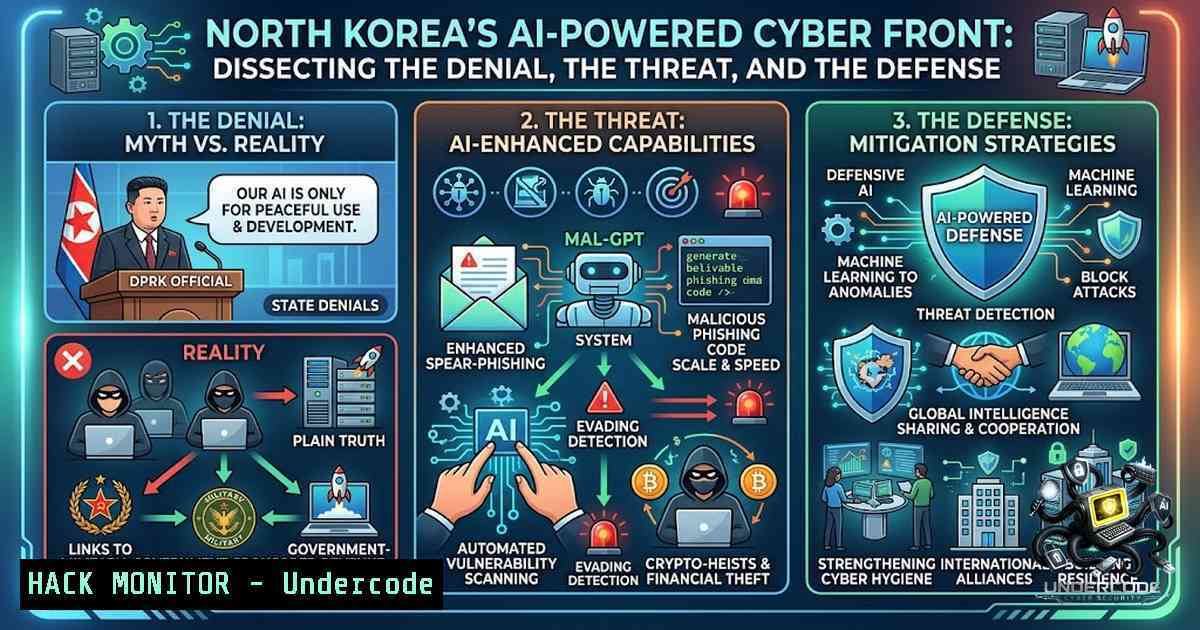
North Korea has issued a rare public rebuttal to U.S.-led allegations that its overseas IT workers are leveraging artificial intelligence and forged identities to infiltrate global companies and fund weapons programs—a denial that underscores just how central cyber operations have become to the geopolitical confrontation between Pyongyang and Washington. As AI tools lower the barrier to sophisticated cyberattacks, state-sponsored hacking groups are increasingly automating vulnerability discovery, malware development, and social engineering at scale, transforming the cybersecurity landscape from a human-driven arms race into an algorithmic one.
Learning Objectives
- Understand the technical mechanics of North Korea’s AI‑enhanced cyber operations, including fake IT worker schemes, supply‑chain attacks, and AI‑driven vulnerability research.
- Master defensive strategies and tool configurations to detect, block, and remediate AI‑powered infiltration campaigns across cloud, endpoint, and identity layers.
- Apply practical Linux and Windows commands, API security controls, and cloud hardening techniques to mitigate the specific tactics used by DPRK‑linked APT groups.
You Should Know
- The Fake IT Worker Pipeline: AI‑Generated Identities and Insider Threat Vectors
North Korean IT workers have been accused of using forged identity documents, third‑party intermediaries, VPNs, remote desktop tools, and AI‑generated profiles to pose as legitimate foreign employees. In some cases, operatives have deployed manipulated video during job interviews to create convincing false identities. Once hired, they gain access to internal systems, sensitive data, and company networks—creating a potent insider threat that bypasses traditional perimeter defenses.
Step‑by‑Step Defensive Guide: Detecting and Blocking Fake IT Worker Activity
Step 1: Implement Rigorous Identity Verification
- Require live, multi‑factor video verification during onboarding with randomized challenge prompts (e.g., “turn your head left, show your ID next to your face”).
- Use behavioral biometrics tools (e.g., typing cadence, mouse movement) to continuously authenticate remote workers.
Step 2: Enforce Zero‑Trust Network Access (ZTNA)
- Deploy ZTNA solutions that verify every access request based on device posture, user identity, and contextual risk—not just network location.
- Example configuration using `opnsense` with Zero‑Trust plugin:
Install zero‑trust client on Linux endpoint
sudo apt-get install zero-trust-client
sudo zt-cli enroll --token YOUR_ORG_TOKEN
sudo zt-cli policy set --require-mfa --device-health-check
Step 3: Monitor for Anomalous Remote Access Patterns
- Use SIEM queries to flag logins from unexpected geolocations, unusual working hours, or multiple concurrent sessions from the same user.
- Windows PowerShell command to extract remote desktop login anomalies:
Get-EventLog -LogName Security -InstanceId 4624 | Where-Object { $<em>.Message -match "logon type 10" } | Select-Object TimeGenerated, UserName, @{Name="IP";Expression={$</em>.ReplacementStrings[-2]}} | Export-Csv RemoteLogins.csv - Linux command to audit SSH logins and flag repeat failures:
sudo grep "sshd" /var/log/auth.log | grep "Failed password" | awk '{print $11}' | sort | uniq -c | sort -1r
Step 4: Scan for AI‑Generated Profile Artifacts
- Deploy deepfake detection tools (e.g., Microsoft Video Authenticator, Intel FakeCatcher) during video interviews.
- Use OSINT tools to cross‑reference candidate profile photos against reverse image search databases.
2. Supply‑Chain Compromise: Weaponizing Open‑Source Trust
Amazon Threat Intelligence recently linked a North Korea‑associated group to attacks targeting open‑source software packages used by developers worldwide. The group compromised trusted software maintainers and inserted malicious code into popular developer libraries, potentially exposing thousands of organizations that relied on those packages. This tactic—combined with AI‑generated code that mimics legitimate contributions—represents a paradigm shift in software supply‑chain security.
Step‑by‑Step Guide: Hardening Your Software Supply Chain
Step 1: Enforce Strict Dependency Pinning and Integrity Checks
– Use dependency lock files (package-lock.json, Gemfile.lock, Cargo.lock) to pin exact versions.
– Verify package integrity via checksums:
 Verify npm package integrity
npm install --package-lock-only
npm audit --production
 Verify SHA‑512 checksum of downloaded package
sha512sum ./downloaded-package.tgz
Step 2: Implement Automated Vulnerability Scanning in CI/CD
- Integrate tools like Snyk, Trivy, or OWASP Dependency‑Check into your pipeline.
GitHub Actions example</li>
<li>name: Run Trivy vulnerability scanner
uses: aquasecurity/trivy-action@master
with:
scan-type: 'fs'
scan-ref: '.'
format: 'sarif'
output: 'trivy-results.sarif'
Step 3: Monitor for Suspicious Package Updates
- Set up alerts for new versions of critical dependencies using tools like Dependabot or Renovate, but with manual approval gates.
- Linux script to compare package signatures against known‑good baselines:
For Debian/Ubuntu
debsums -c | grep -v "OK"
For Alpine
apk info -L <package> | xargs sha256sum | sort > current_checksums.txt
diff baseline_checksums.txt current_checksums.txt
Step 4: Adopt Software Bill of Materials (SBOM)
- Generate and maintain an SBOM for every build using tools like `syft` or
cyclonedx.syft dir:. -o cyclonedx-json > sbom.json
- Upload SBOMs to a central repository and scan against CVE databases.
3. AI‑Driven Vulnerability Discovery: The New Offensive Frontier
Google has reported that North Korean threat actors (notably APT45) have demonstrated “significant interest” in leveraging AI to detect previously unknown cybersecurity vulnerabilities. They leveraged AI to send thousands of repetitive prompts that recursively analyze different cybersecurity blind spots for possible exploitation. APT45 used AI to validate thousands of exploits and expand its stock of tools. This marks a transition from AI as an experimental aid to an industrialized component of offensive cyber operations.
Step‑by‑Step Guide: Defending Against AI‑Powered Vulnerability Discovery
Step 1: Proactive Vulnerability Management with AI‑Enhanced Scanning
- Deploy AI‑powered vulnerability scanners that simulate attacker behavior (e.g., Pentera, SafeBreach).
- Schedule continuous, automated penetration tests that use machine learning to prioritize high‑risk paths.
Step 2: Harden API Endpoints Against Automated Exploitation
- Implement rate limiting, request validation, and anomaly detection.
- Nginx rate‑limiting configuration:
limit_req_zone $binary_remote_addr zone=mylimit:10m rate=10r/s; server { location /api/ { limit_req zone=mylimit burst=20 nodelay; proxy_pass http://backend; } } - Use API gateways with ML‑based threat detection (e.g., Kong with AI plugin, AWS WAF with ML).
Step 3: Deploy Deception Technology
- Place decoy assets (honeypots, canary tokens) across your network to detect AI‑driven reconnaissance.
- Linux command to set up a simple SSH honeypot:
sudo apt-get install cowrie
sudo cowrie start
- Monitor honeypot logs for automated scanning patterns.
Step 4: Implement Runtime Application Self‑Protection (RASP)
- Deploy RASP agents that monitor application behavior in real time and block suspicious actions.
- Example using Contrast Security or Imperva RASP:
Java agent example
java -javaagent:contrast-agent.jar -Dcontrast.agent.name=MyApp -jar myapp.jar
4. Cloud Infrastructure Hardening Against AI‑Enhanced Persistence
North Korean operatives, once inside a network, establish persistence through compromised cloud credentials, misconfigured storage, and API abuse. The combination of AI‑generated phishing lures and automated credential stuffing makes cloud environments particularly vulnerable.
Step‑by‑Step Guide: Securing Cloud Environments
Step 1: Enforce Conditional Access Policies
- Require MFA for all users, with risk‑based conditional access (e.g., block logins from high‑risk countries).
- Azure AD conditional access policy via PowerShell:
New-AzureADMSConditionalAccessPolicy -DisplayName "Block High-Risk Countries" -Conditions @{Locations=@{IncludeLocations=@("All")}} -GrantControls @{BuiltInControls=@("Block")}
Step 2: Monitor for Unusual API Calls and Data Exfiltration
– Enable CloudTrail (AWS), Activity Logs (Azure), or Audit Logs (GCP) with real‑time alerting.
– AWS CLI command to query suspicious API calls:
aws cloudtrail lookup-events --lookup-attributes AttributeKey=EventName,AttributeValue=GetObject --start-time 2026-08-01T00:00:00Z --region us-east-1
Step 3: Implement Least‑Privilege IAM
- Use tools like AWS IAM Access Analyzer or Azure Privileged Identity Management to audit over‑permissive roles.
- Linux script to audit IAM policies (using
awscli):aws iam list-policies --scope Local --only-attached --output json | jq '.Policies[] | select(.AttachmentCount > 5)'
Step 4: Enable Cloud Security Posture Management (CSPM)
- Deploy CSPM tools (e.g., Prisma Cloud, Wiz, Orca) to continuously scan for misconfigurations.
- Automate remediation with infrastructure‑as‑code (Terraform) policies:
Terraform example: enforce bucket encryption
resource "aws_s3_bucket" "secure_bucket" {
bucket = "my-secure-bucket"
server_side_encryption_configuration {
rule {
apply_server_side_encryption_by_default {
sse_algorithm = "AES256"
}
}
}
}
5. AI‑Powered Social Engineering and Deepfake Defense
The joint U.S. warning noted that North Korean operatives have used manipulated video during job interviews to create convincing false identities. Beyond hiring fraud, AI‑generated deepfakes are now used to impersonate executives, conduct voice‑phishing (vishing), and bypass biometric authentication.
Step‑by‑Step Guide: Defending Against AI‑Generated Social Engineering
Step 1: Deploy Deepfake Detection in Communication Channels
- Integrate deepfake detection APIs (e.g., Microsoft Video Authenticator, Sensity) into video conferencing and recruitment platforms.
- Use audio forensic tools to detect synthetic voice patterns.
Step 2: Establish Secure Out‑of‑Band Verification
- Require a secondary verification channel (e.g., internal Slack message, phone call to known number) for any sensitive financial or data requests.
- Linux script to log and alert on out‑of‑band verification failures:
Monitor for failed verification attempts
tail -f /var/log/verification.log | grep "FAILED" | mail -s "Verification Alert" [email protected]
Step 3: Train Employees on Deepfake Awareness
- Conduct regular phishing simulations that include deepfake audio and video samples.
- Use AI‑based training platforms (e.g., KnowBe4 with AI modules) to personalize learning.
Step 4: Implement Biometric Liveness Detection
- Require liveness detection (e.g., blinking, head movement) for any biometric authentication.
- Example using AWS Rekognition liveness check:
aws rekognition detect-faces --image '{"S3Object":{"Bucket":"mybucket","Name":"face.jpg"}}' --attributes ALL
- Endpoint Detection and Response (EDR) for AI‑Generated Malware
North Korean hacking groups like Kimsuky are leveraging generative AI to develop malware targeting government digital certificates and authentication systems. AI‑generated code can evade signature‑based detection by producing polymorphic variants at scale.
Step‑by‑Step Guide: Configuring EDR for AI‑Generated Threats
Step 1: Deploy Next‑Gen EDR with Behavioral Analysis
- Use EDR solutions that rely on behavioral heuristics and machine learning (e.g., CrowdStrike Falcon, SentinelOne, Microsoft Defender for Endpoint).
- Enable cloud‑delivered protection and real‑time behavior monitoring.
Step 2: Create Custom Detection Rules for AI‑Generated Code Patterns
– Windows PowerShell script to detect suspicious PowerShell obfuscation:
Get-WinEvent -LogName "Microsoft-Windows-PowerShell/Operational" | Where-Object { $<em>.Message -match "-e" -or $</em>.Message -match "Base64" } | Select-Object TimeCreated, Message
– Linux command to detect base64‑encoded commands in process lists:
ps aux | grep -E "echo.base64|openssl enc" | grep -v grep
Step 3: Enable Fileless Malware Detection
- Monitor for scripts running directly from memory (e.g., PowerShell without
-File). - Use Sysmon on Windows to log process creation with command lines:
Install Sysmon with custom config
.\Sysmon64.exe -accepteula -i sysmon-config.xml
Step 4: Implement Application Whitelisting
- Use AppLocker (Windows) or `fapolicyd` (Linux) to restrict execution to approved binaries.
- Linux `fapolicyd` configuration:
sudo apt-get install fapolicyd
sudo fagenrules --load
sudo systemctl enable fapolicyd --1ow
7. Incident Response Playbook for AI‑Powered Cyber Attacks
Given the speed and scale of AI‑driven attacks, organizations must have an incident response (IR) plan that accounts for automated, polymorphic threats.
Step‑by‑Step Guide: Building an AI‑Aware IR Plan
Step 1: Establish an AI Threat Intelligence Feed
- Subscribe to threat intelligence feeds that track AI‑related TTPs (e.g., Recorded Future, CrowdStrike Falcon Intelligence).
- Automate feed ingestion into your SIEM:
Python script to fetch and parse STIX/TAXII feeds
python3 -c "import stix2; feed = stix2.TAXIICollectionSource('https://feed.example.com'); print(feed.query())"
Step 2: Develop Automated Containment Playbooks
- Use SOAR platforms (e.g., Palo Alto XSOAR, Splunk Phantom) to automate isolation of compromised endpoints.
- Linux command to isolate an endpoint via firewall:
sudo iptables -I INPUT -s 192.168.1.100 -j DROP
sudo iptables -I OUTPUT -d 192.168.1.100 -j DROP
Step 3: Conduct Regular Tabletop Exercises with AI Scenarios
– Simulate attacks where AI generates phishing emails, deepfake vishing calls, and automated vulnerability scanning.
Step 4: Post‑Incident AI Forensics
- Preserve AI‑generated artifacts (logs, prompts, generated code) for forensic analysis.
- Use tools like Autopsy or The Sleuth Kit to analyze disk images for AI‑generated file artifacts.
What Undercode Say
- Key Takeaway 1: North Korea’s denial of AI‑powered cyber operations is a strategic deflection—the technical evidence from Google, Amazon, and multiple cybersecurity firms confirms that DPRK‑linked APT groups are actively integrating AI into every stage of the attack chain, from reconnaissance to exploitation to persistence.
-
Key Takeaway 2: The convergence of AI with traditional insider‑threat and supply‑chain tactics creates a new class of risk that cannot be addressed by perimeter defenses alone—organizations must adopt zero‑trust architectures, continuous behavioral monitoring, and AI‑aware incident response to stay ahead.
Analysis: The geopolitical significance of this moment cannot be overstated. Pyongyang’s decision to issue a formal rebuttal signals that cyber operations have become a primary vector of statecraft—and that the DPRK is acutely aware of the reputational and diplomatic stakes. For security professionals, this means the threat landscape is no longer defined by isolated malware samples or individual APT groups; it is defined by algorithmic warfare where AI amplifies the speed, scale, and sophistication of attacks. The rise of AI‑generated code, deepfake identities, and automated vulnerability discovery demands a fundamental rethinking of defensive strategies. Traditional signature‑based detection is obsolete; behavioral analytics, deception technology, and AI‑enhanced defense are now table stakes. Moreover, the supply‑chain attacks targeting open‑source packages reveal that trust—the bedrock of modern software development—has become a primary attack surface. Organizations must treat every dependency, every remote worker, and every API call as potentially hostile. The future of cybersecurity belongs to those who can out‑algorithm the adversary.
Prediction
- -1 The proliferation of AI‑powered cyber tools will further democratize state‑level offensive capabilities, enabling smaller nations and even non‑state actors to launch sophisticated attacks that were previously the domain of elite APT groups—leading to a fragmentation of the global threat landscape and an increase in false‑flag operations.
-
-1 As AI‑generated deepfakes and synthetic identities become indistinguishable from real humans, traditional identity verification and background checks will lose efficacy, forcing a costly migration toward biometric liveness detection, behavioral analytics, and decentralized identity frameworks that may introduce new privacy and compliance challenges.
-
+1 The same AI technologies that enable offensive cyber operations will also drive innovation in defensive AI—predictive threat hunting, automated patch validation, and real‑time anomaly detection will mature rapidly, creating a new cybersecurity sub‑industry focused on AI‑vs‑AI adversarial machine learning, which could ultimately tilt the balance back toward defenders.
▶️ Related Video (82% Match):
https://www.youtube.com/watch?v=0PgJpICLoAk
🎯Let’s Practice For Free:
🎓 Live Courses & Certifications:
Join Undercode Academy for Verified Certifications
🚀 Request a Custom Project:
Secure, high-velocity infrastructure and disruptive technological engineering. Contact our engineering team for high-tier development and proprietary systems:
[email protected]
💎 Smart Architecture | 🛡️ Secure by Design | ⭐ Trusted by Thousands
IT/Security Reporter URL:
Reported By: North Korea – Hackers Feeds
Extra Hub: Undercode MoN
Basic Verification: Pass ✅


