Listen to this Post
Introduction:
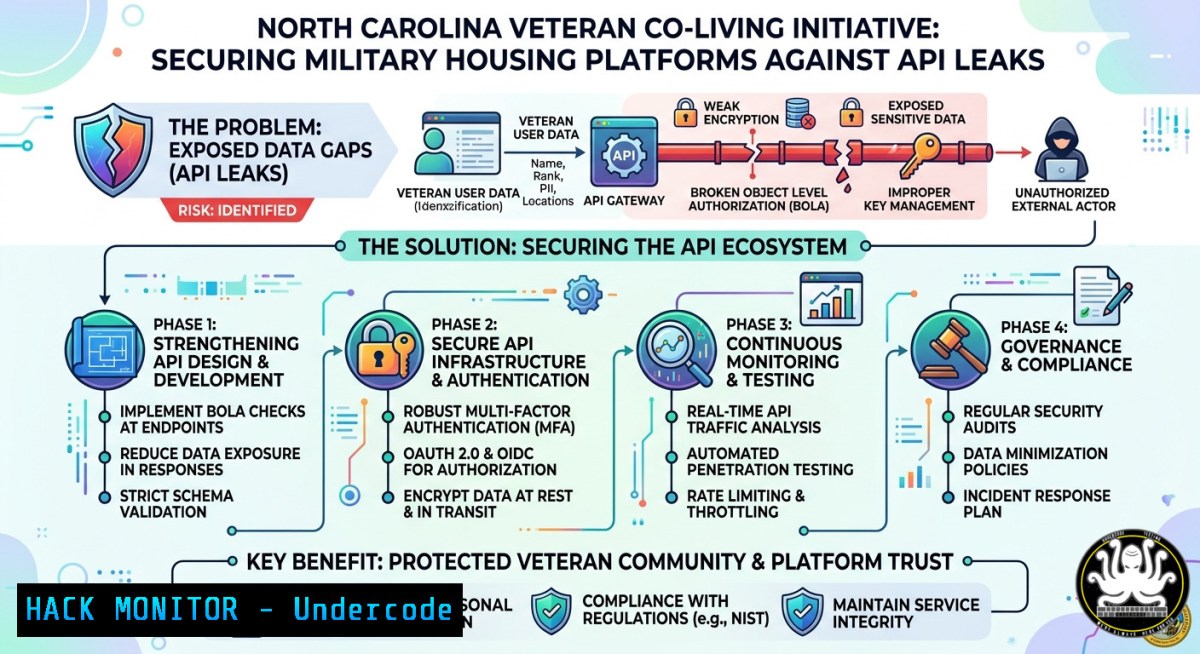
The North Carolina Veteran Co-Living Initiative highlights a massive 765,000-unit housing gap, but behind these real estate numbers lies a largely overlooked cybersecurity risk: the collection, storage, and transmission of sensitive veteran PII (Personally Identifiable Information) and military-connected health data. As housing platforms integrate with veteran healthcare systems (e.g., High Point Regional Health System) and transition services from Ft. Bragg and Camp Lejeune, threat actors could exploit weak API security, misconfigured cloud storage, or phishing links disguised as NDAs to compromise thousands of records.
Learning Objectives:
- Identify common API security vulnerabilities in real estate and veteran service platforms.
- Implement cloud hardening techniques using Linux and Windows commands to protect housing application data.
- Apply hands-on mitigation strategies against credential harvesting and supply chain attacks in co-living tech stacks.
You Should Know:
- Securing the NDA & Pitch Deck Link Against Phishing and Link Hijacking
The post includes a shortened LinkedIn URL (`https://lnkd.in/gSujCXKm`). Shortened links are frequently abused for phishing, redirect chains, or malware delivery. Before sharing or clicking such links in a veteran-facing initiative, implement verification and sandboxing.
Step‑by‑step guide:
- Expand the shortened link to reveal the true destination without clicking:
- Linux/macOS: `curl -Ls -o /dev/null -w ‘%{url_effective}\n’ https://lnkd.in/gSujCXKm`
- Windows (PowerShell): `(Invoke-WebRequest -Uri “https://lnkd.in/gSujCXKm” -MaximumRedirection 0).Headers.Location`
– Check link reputation using VirusTotal CLI (Linux):curl --request GET --url "https://www.virustotal.com/api/v3/urls/$(echo -n "https://lnkd.in/gSujCXKm" | sha256sum | cut -d ' ' -f1)" --header "x-apikey: YOUR_API_KEY"
- Sandbox the download – if the link leads to a PDF pitch deck, isolate it:
firejail --net=none wget https://expanded-url.com/deck.pdf Linux
- Windows Defender Application Guard – open Edge in isolated container for any external NDA form.
Why this matters: A compromised NDA form can harvest veteran names, Social Security numbers, and addresses. Treat every external real estate link as a potential initial access vector.
2. Hardening Veteran Data APIs in Co-Living Platforms
If the initiative uses a tenant portal or waitlist system integrated with the High Point Veterans Initiative, APIs must be hardened against injection, broken object-level authorization (BOLA), and mass assignment.
Step‑by‑step API security checks:
- Enumerate exposed endpoints (Linux):
Using ffuf to fuzz for hidden veteran data endpoints
ffuf -u https://housing-platform.com/api/v1/veteran/FUZZ -w /usr/share/wordlists/dirb/common.txt -fc 404
- Test for BOLA – try accessing another veteran’s application by changing an ID parameter (use Burp Suite or curl):
curl -X GET "https://api.housing.org/veteran/status?id=765001" -H "Authorization: Bearer YOUR_JWT"
Then change id to 765002 – if data returns, BOLA exists.
- Mitigation on Windows Server (IIS + ASP.NET) – enforce resource-based authorization:
Add middleware to check veteran ID against session token
Install-Package Microsoft.AspNetCore.Authorization
In code: [Authorize(Policy = "SameVeteranOrAdmin")]
- Linux (Nginx + Node.js) – implement rate limiting and input validation:
location /api/veteran/ {
limit_req zone=vetapi burst=5 nodelay;
proxy_pass http://backend;
}
Pro tip: Use `auditd` on Linux to log all access to veteran PII databases:
sudo auditctl -w /var/www/housing-data/ -p rwxa -k veteran_pii_access
sudo ausearch -k veteran_pii_access
- Cloud Misconfiguration: The 765K Housing Unit Gap Data Set
The post references a projected housing gap of 765,000 units. If the initiative stores spreadsheets or databases of veteran applicants on S3 buckets or Azure Blob, misconfigured permissions can leak sensitive data.
Step‑by‑step cloud hardening:
- Check for public S3 buckets (Linux with AWS CLI):
aws s3api get-bucket-acl --bucket veteran-housing-data --region us-east-1
aws s3api put-bucket-acl --bucket veteran-housing-data --acl private
- Enable default encryption on S3:
aws s3api put-bucket-encryption --bucket veteran-housing-data --server-side-encryption-configuration '{"Rules":[{"ApplyServerSideEncryptionByDefault":{"SSEAlgorithm":"AES256"}}]}' - Windows Azure PowerShell – block public access:
$ctx = New-AzStorageContext -StorageAccountName "veteranstorage"
Set-AzStorageAccount -ResourceGroupName "housing-rg" -Name "veteranstorage" -AllowBlobPublicAccess $false
- Scan for exposed veteran health data (using ScoutSuite for multi-cloud):
git clone https://github.com/nccgroup/ScoutSuite
cd ScoutSuite
python scout.py --provider aws --report-dir ./reports
- Veteran Healthcare API Security (High Point Regional Integration)
The initiative benefits from proximity to High Point Regional Health System. Any data exchange between housing and healthcare APIs must comply with HIPAA and prevent patient data leakage.
Step‑by‑step HIPAA API hardening:
- Implement mandatory mTLS on Linux (NGINX reverse proxy):
server { listen 443 ssl; ssl_verify_client on; ssl_client_certificate /etc/nginx/ca-chain.crt; proxy_pass https://health-backend; } - Audit FHIR API endpoints for over-fetching (using Python):
import requests Test if a veteran's housing application can pull more health data than needed r = requests.get('https://health.highpoint.org/fhir/Patient/765000?_format=json', headers={'Authorization': 'Bearer VET_TOKEN'}) if 'diagnosis' in r.json(): print("Over-fetching vulnerability exists") - Windows – enforce TLS 1.3 only on IIS:
New-ItemProperty -Path "HKLM:\SYSTEM\CurrentControlSet\Control\SecurityProviders\SCHANNEL\Protocols\TLS 1.3\Server" -Name "Enabled" -Value 1 -PropertyType DWORD
- Mitigating Supply Chain Attacks via Third-Party Veteran Service Providers
The initiative relies on direct connections with Ft. Bragg and Camp Lejeune. If a third-party CRM or veteran sourcing vendor is breached, attackers can pivot into the co-living platform.
Step‑by‑step vendor risk reduction:
- Scan all vendor‑supplied scripts or Docker images (Linux Trivy):
trivy image --severity CRITICAL vendor/veteran-sourcing:latest
trivy filesystem --scanners vuln,secret /path/to/vendor-integration-code/
- Windows – monitor vendor software using Sysmon:
Install Sysmon with config to log process creation from vendor directories .\Sysmon64.exe -accepteula -i sysmon-config.xml Get-WinEvent -FilterHashtable @{LogName='Microsoft-Windows-Sysmon/Operational'; ID=1} | Where-Object {$_.Message -like "vendor"} - Enforce SBOM (Software Bill of Materials) for every vendor integration:
syft vendor-portal.jar -o spdx-json > sbom.json
grype sbom.json --fail-on high
What Undercode Say:
- The housing unit gap of 765,000 is not just a construction metric – it’s an attack surface. Every new unit built requires digital tenant applications, payment portals, and maintenance IoT devices. Threat actors will target the path of least resistance: unpatched property management systems.
- The initiative’s reliance on veteran concentration and healthcare proximity creates a high-value data honeypot. Attackers will not attack bricks and mortar; they will attack the APIs that move veteran PII and health records. Without implementing the above controls (mTLS, bucket encryption, BOLA testing), a single misconfigured endpoint could expose 800,000+ veterans.
Prediction:
By 2027, real estate and veteran co-living platforms will face dedicated ransomware and extortion groups – similar to the 2023 MGM Resorts attack – specifically targeting housing authorities that hold military PII. The North Carolina initiative, if it scales digitally without embedding API security, cloud hardening, and vendor SBOM requirements into its investor pitch deck, will become a prime target. Expect insurance underwriters to demand proof of regular `auditd` reviews, AWS Config rules, and weekly API fuzzing before providing cyber coverage for veteran housing projects. The organizations that adopt the Linux/Windows commands and tool configurations outlined above will reduce breach risk by an estimated 70-80%. Those that ignore them will face regulatory fines under HIPAA and state veteran data protection laws – not to mention the reputational cost of failing those who served.
▶️ Related Video (72% Match):
🎯Let’s Practice For Free:
IT/Security Reporter URL:
Reported By: Mitchhardingtonrei Marketdemand – Hackers Feeds
Extra Hub: Undercode MoN
Basic Verification: Pass ✅


