Listen to this Post
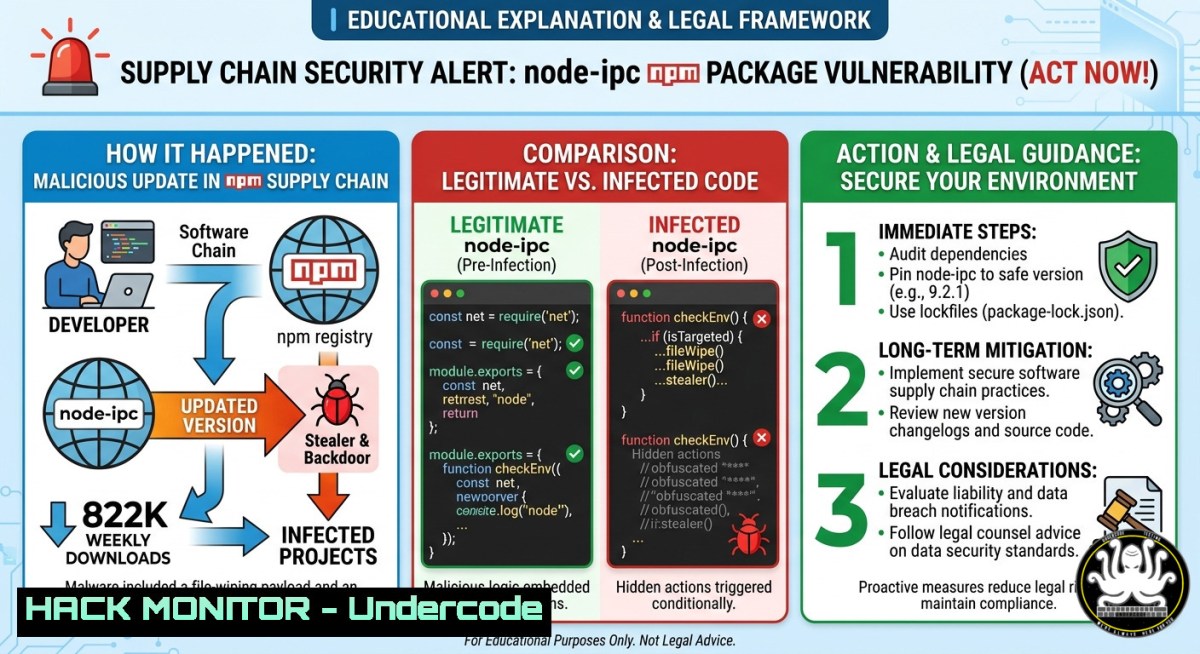
Introduction:
The node-ipc npm package, a popular inter-process communication library averaging 822,000 weekly downloads, has been compromised in a sophisticated supply chain attack. Three newly published versions (9.1.6, 9.2.3, and 12.0.1) contain obfuscated stealer and backdoor malware designed to silently exfiltrate developer credentials, cloud secrets, and SSH keys via disguised DNS traffic. This attack exploited a dormant maintainer account, highlighting critical weaknesses in npm package publishing security and the urgent need for defensive measures across development pipelines.
Learning Objectives:
- Identify compromised node-ipc versions and detect malicious obfuscated code within npm dependencies.
- Implement runtime monitoring and network filtering to block DNS exfiltration attempts.
- Harden CI/CD pipelines and rotate compromised credentials using forensic commands and cloud security tools.
You Should Know:
1. Detecting Compromised node-ipc Versions in Your Projects
What this does: Scans your Node.js projects for the malicious node-ipc versions (9.1.6, 9.2.3, 12.0.1) and checks for obfuscated patterns or suspicious DNS traffic indicators.
Step-by-step guide:
1. Check installed versions globally and locally:
 Linux/macOS
npm list node-ipc --depth=0
npm list -g node-ipc --depth=0

Windows (PowerShell)
npm list node-ipc --depth=0
npm list -g node-ipc --depth=0
2. Scan package-lock.json or yarn.lock for malicious versions:
 Linux/macOS/Windows (grep available via Git Bash or WSL)
grep -E '"node-ipc": "9.1.6|9.2.3|12.0.1"' package-lock.json
grep -E 'node-ipc@9.1.6|node-ipc@9.2.3|node-ipc@12.0.1' yarn.lock
3. Search for obfuscated malware patterns in node_modules:
 Look for eval, atob, btoa, or long base64 strings
find node_modules/node-ipc -name ".js" -exec grep -l "eval(atob" {} \;
find node_modules/node-ipc -name ".js" -exec grep -l "fromCharCode" {} \;
4. Use Socket.dev CLI for deeper analysis:
npm install -g @socketsecurity/cli
socket scan . --json | grep -E "node-ipc|malicious"
- Mitigation – Remove and lock to safe version:
npm uninstall node-ipc
Install a known safe version (e.g., 9.2.2 or 11.0.0)
npm install [email protected] --save
npm shrinkwrap  Lock dependencies
-
Monitoring and Blocking DNS Exfiltration (Linux & Windows)
What this does: Configures network monitoring to detect and block outbound DNS queries carrying stolen data, a key technique used by the node-ipc malware.
Step-by-step guide:
1. Capture DNS traffic with tcpdump (Linux):
sudo tcpdump -i eth0 -n 'udp port 53' -vvv -c 1000
 Look for long subdomains (data exfiltration pattern)
2. Use Wireshark/tshark on Windows:
 After installing Wireshark
& 'C:\Program Files\Wireshark\tshark.exe' -i Ethernet -f "udp port 53" -Y "dns.qry.name matches '.......'"
- Block malicious DNS via hosts file or firewall:
Linux – add to /etc/hosts
echo "0.0.0.0 malicious-domain.example.com" | sudo tee -a /etc/hosts

Windows – add to C:\Windows\System32\drivers\etc\hosts
echo 0.0.0.0 malicious-domain.example.com >> C:\Windows\System32\drivers\etc\hosts
4. Apply eBPF monitoring for real-time detection (Linux):
sudo bpftrace -e 'kprobe:__sys_sendto /comm == "node"/ { printf("DNS exfil attempt from PID %d\n", pid); }'
- Configure Windows Defender Firewall to block outbound DNS to unknown IPs:
New-NetFirewallRule -DisplayName "Block DNS Exfiltration" -Direction Outbound -Protocol UDP -LocalPort 53 -Action Block
3. Rotating Compromised Credentials and Cloud Secrets
What this does: Identifies and rotates any secrets (SSH keys, cloud tokens, API credentials) that may have been exfiltrated by the malware.
Step-by-step guide:
- List SSH keys and check for unauthorized access:
Linux/macOS
ls -la ~/.ssh/
cat ~/.ssh/authorized_keys
Rotate keys
ssh-keygen -p -f ~/.ssh/id_rsa
2. Scan environment variables for leaked secrets:
 Dump env from running processes
ps aux | grep node
cat /proc/<PID>/environ | tr '\0' '\n'
- Revoke and rotate AWS keys (if used in project):
aws iam list-access-keys --user-name your-user
aws iam create-access-key --user-name your-user
aws iam delete-access-key --access-key-id OLD_KEY --user-name your-user
4. Audit npm token and rotate:
npm token list
npm token revoke <token-id>
npm token create --read-only  Create new with minimal scope
- Use GitLeaks to scan repos for exposed secrets:
gitleaks detect --source . --verbose
4. Hardening CI/CD Pipelines Against Supply Chain Attacks
Step-by-step guide:
- Pin dependencies to exact versions and use integrity hashes:
// In package.json
"dependencies": {
"node-ipc": "9.2.2"
}
// Use npm ci instead of npm install in CI
2. Add npm package provenance and signature verification:
npm install -g @npmcli/arborist
npm audit signatures
- Implement dependency scanning with Snyk or OWASP DC:
snyk test --severity-threshold=high
docker run --rm -v $(pwd):/src owasp/dependency-check --scan /src --format JSON
4. Block compromised maintainers using npm package allowlists:
 .npmrc
@myscope:registry=https://registry.npmjs.org
 Use npm-force-resolutions
npx npm-force-resolutions
- Set up runtime security monitoring with Falco (Linux):
Falco rule to detect node-ipc anomalies</li>
</ol>

- rule: Node Process Unexpected Network Connection
condition: spawned_process and proc.name = "node" and evt.type in (connect) and not fd.sip in (allowed_ips)
output: "Node process connected to unknown IP (proc.cmdline=%proc.cmdline)"
5. Forensic Analysis of the Malicious node-ipc Versions
Step-by-step guide:
1. Download and extract the malicious tarball:
npm pack [email protected]
tar -xzf node-ipc-9.2.3.tgz
cd package
2. Deobfuscate the stealer code (example using Node.js):
// Save this as deobf.js
const fs = require('fs');
const code = fs.readFileSync('index.js', 'utf8');
// Replace atob/eval with console.log
const deobf = code.replace(/eval(atob(/g, 'console.log(atob(');
console.log(deobf);
3. Extract exfil domains with regex:
grep -oE '[a-zA-Z0-9-]+.(xyz|top|tk|ml|ga)' package//.js
- Simulate the malware in an isolated sandbox (Docker):
docker run --rm -it --network none node:16 bash
npm install [email protected]
Monitor file system writes
strace -f -e openat,write node -e "require('node-ipc')"
5. Check for persistence mechanisms (cron/systemd):
grep -r "node-ipc" /etc/cron /etc/systemd/system/
What Undercode Say:
- Key Takeaway 1: The compromise of a dormant maintainer account (atier tant) demonstrates that npm’s 2FA enforcement and ownership verification are insufficient. Every package maintainer should be required to re-verify identity after 12 months of inactivity, and organizations must block auto-updates for critical dependencies.
- Key Takeaway 2: DNS tunneling remains a stealthy yet detectable exfiltration vector. By monitoring outbound DNS query lengths and frequency, defenders can catch this malware even without static analysis. The attack succeeded because developers rarely inspect node_modules or restrict network egress from build servers.
Analysis: This supply chain attack exploited the trust gradient in open-source ecosystems. The three affected versions (9.1.6, 9.2.3, 12.0.1) were published within hours, indicating automated weaponization. Because node-ipc is a low-level IPC library, it gets bundled into thousands of higher-level frameworks (e.g., Vue CLI, Electron apps). The malware’s use of disguised DNS – sending stolen SSH keys as subdomains – bypasses many corporate HTTPS proxies but can be stopped by DNS firewalls. The incident mirrors the 2021 ua-parser-js and coa compromises, yet npm’s response remains reactive. Organizations should move to private registries (Verdaccio, AWS CodeArtifact) with strict allowlists and integrity checking. Developers must run `npm audit signatures` and use tools like Socket.dev that detect obfuscation, not just known CVEs.
Prediction:
Within 12 months, we will see a major cloud provider or cryptocurrency exchange breached via a similar npm supply chain attack, leading to industry-wide mandates for software bills of materials (SBOMs) and runtime dependency firewalls. The node-ipc incident will be cited as the turning point where the JavaScript ecosystem adopts deterministic builds and mandatory 2FA for all package publishers. Attackers will shift to compromising maintainers’ CI/CD tokens rather than npm accounts directly, forcing the creation of decentralized package signing (similar to PyPI’s recent TUF integration). Meanwhile, automated deobfuscation and DNS exfiltration detection will become standard features in next-gen API security gateways.
▶️ Related Video (76% Match):
🎯Let’s Practice For Free:
IT/Security Reporter URL:
Reported By: Cybersecuritynews Node – Hackers Feeds
Extra Hub: Undercode MoN
Basic Verification: Pass ✅🔐JOIN OUR CYBER WORLD [ CVE News • HackMonitor • UndercodeNews ]
📢 Follow UndercodeTesting & Stay Tuned:
- Simulate the malware in an isolated sandbox (Docker):


