Listen to this Post
Introduction:
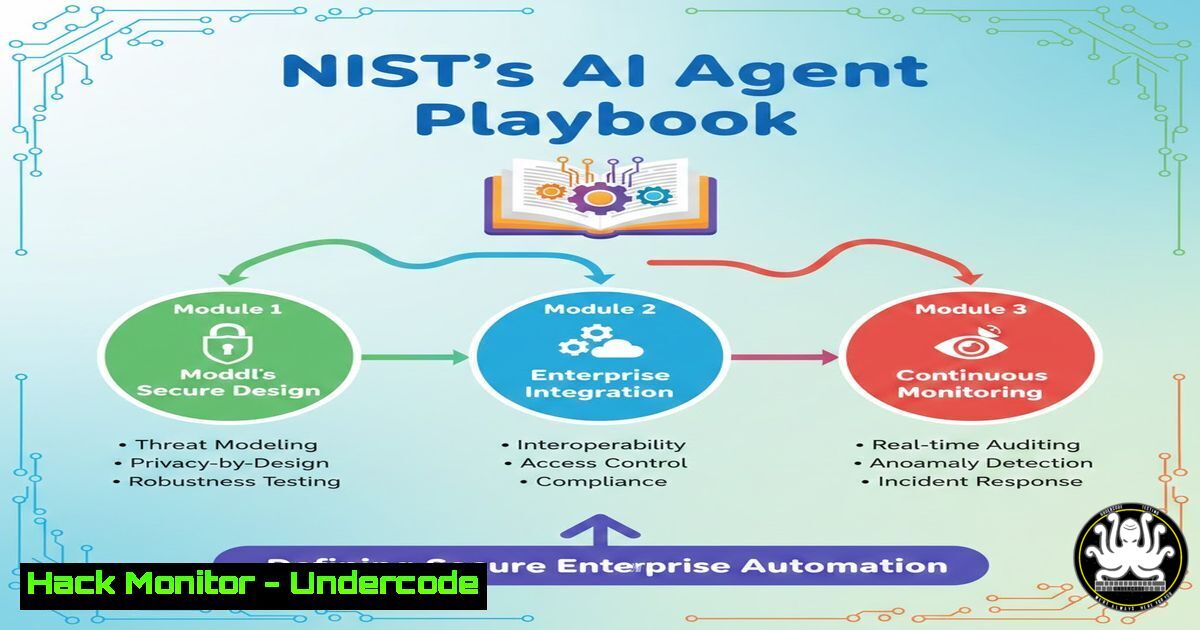
The artificial intelligence landscape is hurtling towards an agentic future, where systems don’t just generate text but execute tasks, interact with enterprise resource planning (ERP) systems, and move data across networks. However, this rapid evolution has occurred in a regulatory and structural vacuum, leading to fragmentation and significant security ambiguities. The National Institute of Standards and Technology (NIST) is poised to intervene with its AI Agent Standards Initiative, aiming to impose the same structured rigor on AI agents that the NIST Cybersecurity Framework (CSF) brought to infosec, establishing a common language for governance, interoperability, and zero-trust boundaries in automated workflows.
Learning Objectives:
- Understand the core tenets of the incoming NIST AI Agent Standards and their alignment with existing cybersecurity frameworks.
- Identify the security boundaries and access control models required to govern autonomous AI agents interacting with critical systems.
- Analyze the technical implications of standardization on AI agent auditing, observability, and vulnerability management.
You Should Know:
- The NIST Overlap: Applying the Cybersecurity Framework to Agentic AI
To understand where NIST is heading with AI agents, one must look at the NIST Cybersecurity Framework (CSF) 2.0. The CSF organizes security into six core functions: Govern, Identify, Protect, Detect, Respond, and Recover. The upcoming AI Agent standards will likely map these functions onto the AI lifecycle.
– Govern: Establishing policies for what an AI agent is allowed to do (its “sphere of autonomy”).
– Identify: Maintaining an inventory of all active AI agents, their versions, and the permissions they hold within a system.
– Protect: Implementing Just-In-Time (JIT) access and encryption for agent-to-agent (A2A) communications.
For security teams, this means treating an AI agent not just as software, but as a user identity with privileges. Just as you audit a human user’s SSH access, you will soon need to audit an API key used by an AI agent to modify a database.
- Hardening the Agentic Environment: Least Privilege and Sandboxing
The most significant risk of agentic AI is “autonomous privilege escalation”—an agent with excessive permissions being tricked into deleting files or exfiltrating data. NIST standards will likely mandate strict sandboxing. On Linux systems, this involves running agent processes within containers or using `seccomp` profiles to restrict system calls.
Step‑by‑step guide: Running an AI agent in a restricted Linux sandbox
To simulate a restricted environment for an untrusted agent process, you can use Linux Firejail or Docker with dropped capabilities.
1. Create a restricted user: `sudo useradd -m -s /bin/bash restricted_agent_user`
2. Use Firejail to limit network and filesystem:
`firejail –net=eth0 –private=/home/agent_sandbox –seccomp python3 agent_script.py`
--net=eth0: Restricts network access.--private=/home/agent_sandbox: Makes the filesystem read-only except for the sandbox directory.--seccomp: Enables system call filtering.
- Verify restrictions: Run `firejail –list` to see active jails and ensure the agent cannot access
/etc/passwd.
3. API Security and Agent Interoperability
For AI agents to interact with enterprise software (CRMs, databases), they rely heavily on REST APIs and GraphQL. Standardization will likely enforce specific API security patterns to prevent injection attacks. A common threat is “Indirect Prompt Injection,” where an attacker poisons a piece of data (like a support ticket) that the agent reads, causing the agent to execute malicious commands.
Step‑by‑step guide: Securing the agent-to-API pipeline
- Input Sanitization: Before sending user data to an agent’s context window, strip out control characters and unexpected syntax.
Python Example using `re` library:
import re
def sanitize_agent_input(raw_text):
 Remove potential escape characters and markdown injection
sanitized = re.sub(r'[\\$()]', '', raw_text)
return sanitized
2. Implement OAuth 2.0 Device Authorization Grant: Since agents are headless, they cannot use interactive logins. Secure agent API access using client credentials and short-lived JWTs. Store secrets using Windows Credential Manager or Linux Secret Service (libsecret) rather than plaintext config files.
PowerShell (Windows) to store secret:
 Store API key securely
$Cred = Get-Credential
$Cred | Export-Clixml -Path "C:\secure\agent_cred.xml"
 Agent script reads the secure credential
$secureCred = Import-Clixml -Path "C:\secure\agent_cred.xml"
- Auditing and Telemetry: The “Black Box” Flight Recorder
One of the challenges NIST aims to solve is the “black box” nature of agent reasoning. If an agent makes a fraudulent transaction or deletes a file, we need to know why. Standards will require immutable audit logs that record the agent’s chain-of-thought, the tool calls it made, and the environmental variables at the time.
Step‑by‑step guide: Implementing agent telemetry
Use structured logging (JSON) to capture every action.
1. Configure Logging (Python):
import logging
import json
log_data = {
"agent_id": "support_bot_v2",
"action": "database_query",
"input": "SELECT  FROM users",
"timestamp": "2025-03-20T10:00:00Z",
"decision_confidence": 0.95
}
logging.info(json.dumps(log_data))
2. Forward Logs to SIEM: Use tools like Filebeat (for Elasticsearch) or Splunk Universal Forwarder to ship these logs to a central Security Information and Event Management (SIEM) system for anomaly detection. A sudden spike in “database_query” actions by an agent might indicate a compromise.
5. Vulnerability Exploitation: Hijacking the Agent Pipeline
Standardization will also include red-teaming guidelines. Attackers will target the “orchestration layer”—the software that decides which agent to call. If an attacker can perform a man-in-the-middle (MITM) attack on the internal message queue (like RabbitMQ or Kafka), they can alter the instructions sent to agents.
Step‑by‑step guide: Hardening the message bus
- Enable TLS for Message Queues: Ensure all traffic between the agent orchestrator and the queue is encrypted.
Example for RabbitMQ:
 Enable TLS on RabbitMQ listener
rabbitmqctl set_parameter listener tls_listener \
'{"port":5671,"ssl":true,"ssl_opts":[{"cacertfile":"/path/ca.pem","certfile":"/path/server_cert.pem","keyfile":"/path/server_key.pem"}]}'
2. Network Segmentation: Use firewall rules (iptables on Linux or Windows Firewall with Advanced Security) to restrict which IPs can talk to the message queue port. Only the orchestrator server IP should have access.
6. Cloud Hardening for Agent Deployments
Enterprises will deploy agents in cloud environments (AWS, Azure, GCP). NIST standards will likely mandate the principle of “Immutability”—where agent containers are replaced rather than patched, and their service accounts have the minimum permissions required.
Step‑by‑step guide: AWS IAM for an AI Agent
Instead of giving an agent AdministratorAccess, create a strict policy.
1. Create IAM Policy (JSON):
{
"Version": "2012-10-17",
"Statement": [
{
"Effect": "Allow",
"Action": [
"s3:GetObject",
"dynamodb:Query"
],
"Resource": [
"arn:aws:s3:::agent-data-bucket/",
"arn:aws:dynamodb:us-east-1:123456789012:table/agent-tasks"
],
"Condition": {
"IpAddress": {"aws:SourceIp": "10.0.1.0/24"}
}
}
]
}
This ensures the agent can only read specific S3 buckets and query specific DynamoDB tables, and only if the request originates from the internal network.
What Undercode Say:
- Standardization is the Antidote to Fragmentation: Just as the NIST CSF stopped security from being a “wild west” of proprietary jargon, these AI agent standards will force vendors and open-source frameworks to align. This is critical for enterprises that cannot afford to rebuild their security posture for every new AI tool.
- Security Boundaries Must Shift Left: The initiative confirms that security can no longer be an afterthought in AI development. We must treat agent workflows as we treat code deployments—with version control, CI/CD security scans, and strict access controls from day one.
Prediction:
The NIST AI Agent Standards Initiative will likely become the de facto benchmark for procurement by 2026. Companies selling AI solutions without NIST alignment will find themselves locked out of government contracts and Fortune 500 deals. This will force a rapid consolidation in the AI framework space, where interoperability and security auditing features become the primary differentiators, ultimately reducing the “cowboy coding” atmosphere of current AI development and ushering in an era of regulated, reliable, and secure automation.
▶️ Related Video (84% Match):
🎯Let’s Practice For Free:
IT/Security Reporter URL:
Reported By: Paulfruitful Throughout – Hackers Feeds
Extra Hub: Undercode MoN
Basic Verification: Pass ✅


