Listen to this Post
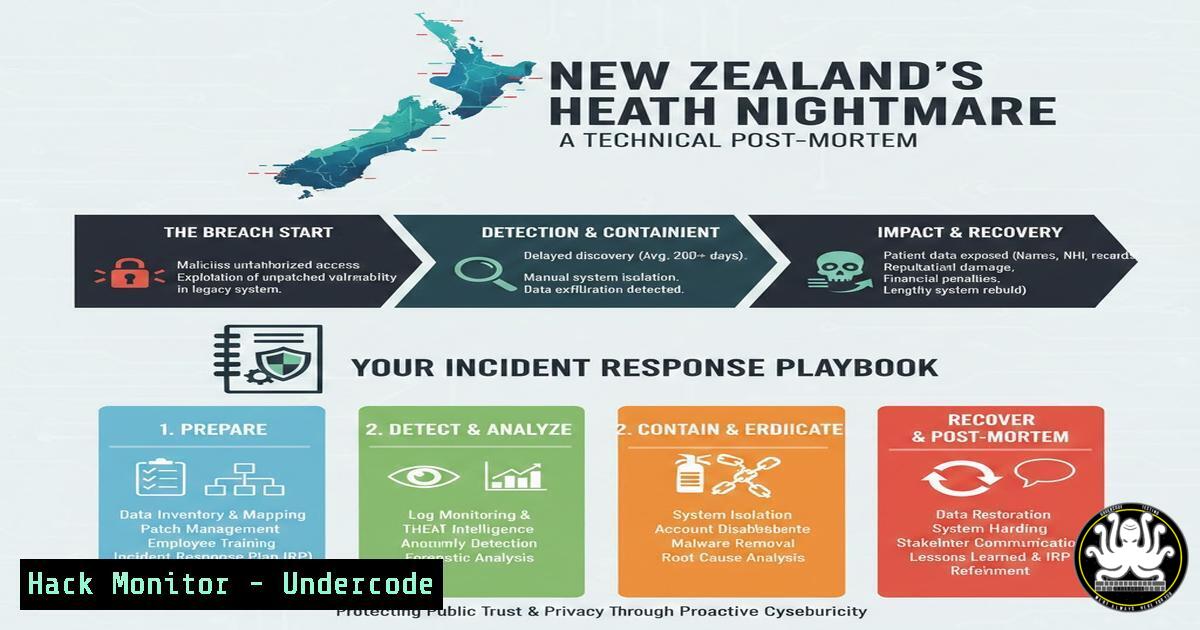
Introduction:
The recent public disclosure by Rik Gielen, a victim of the Health New Zealand data breach, highlights a catastrophic failure in digital trust. When sensitive personal information (PSI) and entire medical records are exfiltrated, the incident transcends standard IT failure and enters the realm of national security risk. This article provides a technical deep dive into the anatomy of such a breach, offering cybersecurity professionals a structured guide to incident response, system hardening, and data recovery protocols that could have mitigated the damage or can prevent similar future occurrences.
Learning Objectives:
- Understand the specific attack vectors targeting healthcare infrastructure (PACS, EHR systems) and how to simulate their exploitation.
- Learn to implement Linux and Windows forensics commands to identify data exfiltration indicators.
- Master the configuration of API security gateways and cloud hardening techniques to protect sensitive patient data.
You Should Know:
- Reconnaissance and Initial Access Vectors in Healthcare IT
Healthcare breaches often start not with a bang, but with a scan. Attackers target legacy systems that manage medical devices (DICOM servers) or exposed APIs used for patient portals. The recent New Zealand incident likely involved a compromised endpoint or a misconfigured cloud bucket.
To understand your exposure, perform an external footprinting exercise using legitimate OSINT tools to see what attackers see:
Linux Command (External Recon):
nmap -sV -p 80,443,8080,8443 --script http-enum <target_healthcare_domain>
Windows Command (Internal Network Sweep for Lateral Movement Checks):
Test-NetConnection -ComputerName <Internal_EHR_Server> -Port 3389
Step-by-step: This guide helps you map the external footprint. Attackers use these scans to find outdated content management systems or open RDP ports, which are common entry points into hospital networks.
2. Privilege Escalation: From User to Domain Admin
Once inside, the adversary seeks to elevate privileges to access the database containing PSI. This often involves exploiting misconfigured service accounts or dumping LSASS memory on Windows servers.
Windows Command (Post-Exploitation Simulation – Ethical Hacking Only):
To check for stored credentials that might be reused:
cmdkey /list
Linux Command (Checking for Sudo Misconfigurations):
sudo -l
Step-by-step: If a helpdesk account was the entry point, these commands simulate how an attacker looks for credentials. Defenders must ensure that service accounts are not local admins and that “sudo” rights are restricted to specific commands only.
3. Data Exfiltration Detection: Monitoring Outbound Traffic
The goal of the Health New Zealand attackers was data exfiltration. Traditional antivirus often misses this because it looks like encrypted web traffic. Security teams must monitor for unusual data volume spikes.
Linux Command (Monitoring Live Traffic):
sudo tcpdump -i eth0 -nn -s0 -c 10000 port not 443 and host not <trusted_backup_server>
Windows PowerShell (Checking Recent File Access on Sensitive Shares):
Get-EventLog -LogName Security -InstanceId 4663 | Select-Object TimeGenerated, Message | Out-GridView
Step-by-step: This configuration helps identify if a process is reading thousands of medical records at 3:00 AM, which is a classic sign of a script harvesting data for exfiltration.
4. API Security and Misconfiguration Audits
Katja Feldtmann’s petition highlights systemic failures. Often, these failures are technical—like broken object level authorization (BOLA) in healthcare APIs. If the patient portal API lacks strict rate limiting or authentication checks, a simple script can download every patient’s record.
Tutorial: Testing for Insecure Direct Object References (IDOR)
Using `curl` to test if you can access another patient’s data by incrementing an ID:
curl -X GET https://healthapi.example.com/v1/patient/12345/record -H "Authorization: Bearer <token_A"
curl -X GET https://healthapi.example.com/v1/patient/12346/record -H "Authorization: Bearer <token_A"
Step-by-step: If the second command returns data, the API is vulnerable. Developers must implement strict ownership checks rather than just relying on a valid token.
5. Cloud Hardening for Sensitive Medical Data
The breach may have originated from a misconfigured S3 bucket or Azure Blob storage used for medical imaging. Attackers use tools like `Cloud_Enum` to find open storage.
AWS CLI Command (Audit for Public Buckets):
aws s3api get-bucket-acl --bucket <healthcare-data-bucket> | grep -i "uri"
Azure CLI Command (Check Diagnostic Logs):
az monitor diagnostic-settings list --resource <storage_account_id>
Step-by-step: Ensure that “public-read” ACLs are not present. Enable diagnostic logging to see who accessed the data and from which IP, which is crucial for legal proceedings and the “accountability” the petition demands.
6. Incident Response: The Containment Playbook
When Rik Gielen received notification, the response likely focused on PR, not technical containment. In a live breach, the first step is to isolate the compromised host without tipping off the attacker.
Windows Firewall Rule to Isolate a Compromised Machine Remotely:
New-NetFirewallRule -DisplayName "BLOCK_ALL_OUT" -Direction Outbound -Action Block
Linux (Blocking an Attacker’s C2 IP):
sudo iptables -A OUTPUT -d <malicious_C2_IP> -j DROP
sudo iptables -A INPUT -s <malicious_C2_IP> -j DROP
Step-by-step: These commands cut the lifeline of the ransomware or exfiltration tool, preventing further data loss while preserving the machine’s state for forensics.
What Undercode Say:
– Systemic Failure vs. Technical Glitch: The breach underscores that cybersecurity is not just about firewalls, but about governance. The technical commands above are useless if the organizational culture ignores “Privacy Act” enforcement until after a petition is filed.
– Proactive Hardening is Non-Negotiable: The attack surface of healthcare (IoT devices, legacy DICOM viewers, third-party APIs) is vast. Regular red team exercises using the commands listed above would have revealed the misconfigurations that led to this massive PSI exposure.
Prediction:
The growing public outcry, evidenced by the parliamentary petition, will force regulatory bodies to mandate stricter technical standards. We will likely see the adoption of mandatory “Cyber Security Health Checks” for all government contractors, enforced by automated compliance scanning tools. Furthermore, as victims like Rik Gielen share their stories, we predict a surge in class-action lawsuits that will compel organizations to move from “reactive remedies” to deploying AI-driven behavioral analytics capable of stopping data exfiltration in real-time.
▶️ Related Video (76% Match):
🎯Let’s Practice For Free:
IT/Security Reporter URL:
Reported By: Rikgielen I – Hackers Feeds
Extra Hub: Undercode MoN
Basic Verification: Pass ✅


