
Listen to this Post
Introduction:
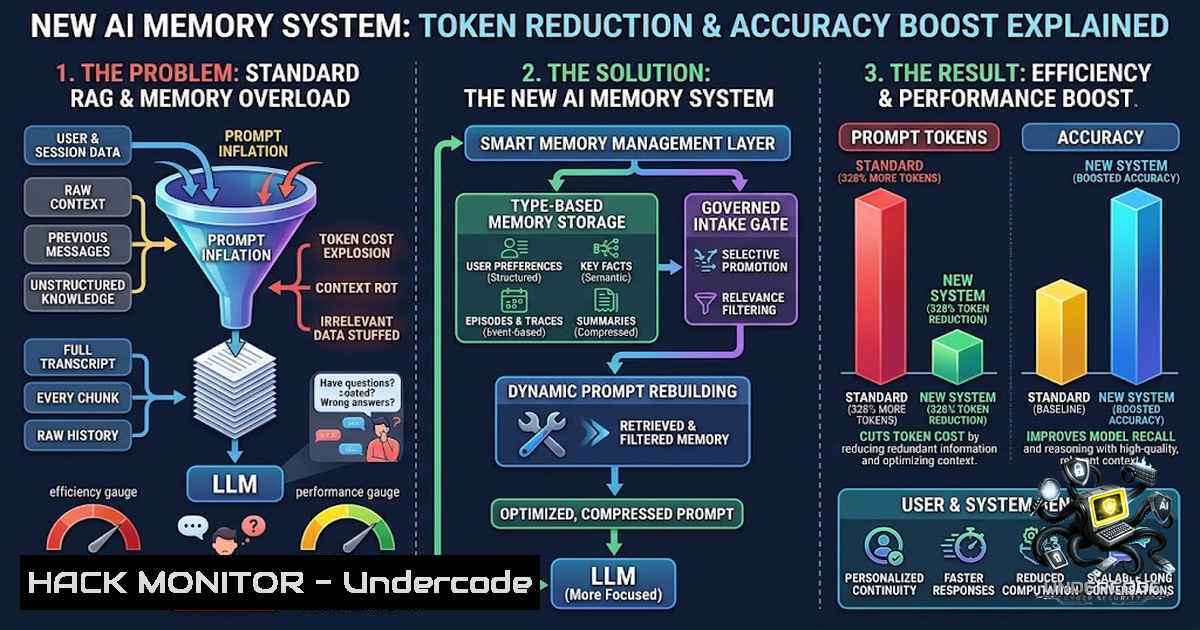
The exponential growth of AI agent capabilities has been accompanied by a persistent challenge: effectively managing the expanding context window. While long-context models are becoming more prevalent, research from Georgia Tech and Rose-Hulman reveals that simply enlarging the prompt is not the solution. Their new system, using a weighted memory tree and dynamic retention scoring, reduces prompt tokens by nearly a third while simultaneously improving agent accuracy, suggesting a fundamental shift in how AI agents will process and recall information.
Learning Objectives & Secrets:
- Objective 1: Understand the Weighted Memory Tree Structure – Learn how to organize agent interactions into a hierarchical tree where user questions form the root and actions branch into weighted memories, enabling efficient information retrieval.
- Objective 2: Master the Retention Scoring Mechanism – Implement a dynamic scoring system where each memory receives a retention score (0-1) that is adjusted based on success or failure, ensuring only relevant information reaches the model.
- Objective 3: Implement Selective Prompting – Apply the selector model that ranks memories by score and applies penalties for passed-over items, building prompts from only the most trustworthy and recent validated data.
You Should Know:
1. Weighted Memory Tree Architecture
The system fundamentally reimagines how an AI agent stores and retrieves its history. Rather than maintaining a linear log or simple summary, the team at Georgia Tech structures memory as a hierarchical tree. The user’s question forms the root node, with the agent’s primary objectives branching outward. Each recorded action (a memory) sits at the end of its respective branch, containing both the action performed and its result. This architecture allows the system to maintain relationships between actions, goals, and outcomes without losing crucial context.
Step-by-step guide to simulate a memory tree:
class MemoryTree:
def <strong>init</strong>(self, user_question):
self.root = {"question": user_question, "children": []}
self.memories = {}

def add_memory(self, action, result, parent_branch):
memory = {"action": action, "result": result, "score": 0.5, "id": len(self.memories)}
 Link to parent branch in the tree
self.memories[memory["id"]] = memory
return memory["id"]
In a live deployment, this would be stored in a graph database (Neo4j) or a custom in-memory structure that tracks relationships and allows for quick traversal to build prompts.
2. Retention Scoring and Signal Processing
The core intelligence of this system lies in its dynamic retention scoring. Each memory carries a numerical score between 0 and 1, which is adjusted based on two primary signals: success and failure. A successful outcome from an action raises its corresponding memory’s score, while a failure lowers it. Crucially, failed memories are not deleted; they remain readable as warnings to prevent repeating the same mistake. Additionally, the selector system applies a penalty to memories it considered but passed over, ensuring that frequently skipped memories gradually lose their prominence.
Step-by-step guide to implement scoring logic:
class RetentionScorer:
def update_score(self, memory, success):
if success:
memory["score"] = min(1.0, memory["score"] + 0.2)
else:
memory["score"] = max(0.0, memory["score"] - 0.3)
return memory["score"]

def apply_selector_penalty(self, memory):
memory["score"] = max(0.0, memory["score"] - 0.1)
return memory["score"]
In practice, you would integrate this with your LLM’s API call, evaluating the output to determine success/failure. For automation, tools like `langsmith` can trace these interactions, while `weave` by Weights & Biases can be used to visualize the scoring patterns across thousands of runs.
3. The Selector: Building the Optimal Prompt
At every turn, the system employs a selector mechanism to build the final prompt. It ranks all eligible memories by their retention scores and selects the top candidates to include in the context window. This process incorporates a unique penalty mechanism: when the selector passes over a high-ranking memory in favor of another, that memory receives a penalty. The next selection cycle resets this penalty, preventing long-term starvation of any single memory. This approach ensures that the prompt is not only relevant but also adaptable to shifting evidence.
Step-by-step guide to selector implementation:
def build_prompt(memories, max_tokens=2048):
 Sort by score (highest first) and apply pass-over penalties
sorted_memories = sorted(memories, key=lambda m: m["score"], reverse=True)

Apply penalty to memories passed over
for memory in sorted_memories:
if memory not in selected_memories:
memory["score"] = max(0.0, memory["score"] - 0.05)

Reset penalty for selected memories
for memory in selected_memories:
memory["score"] = min(1.0, memory["score"] + 0.05)

return prompt
For Windows environments using PowerShell, you can simulate this ranking with:
$memories = Get-Content -Path "memories.json" | ConvertFrom-Json
$selected = $memories | Sort-Object -Property Score -Descending | Select-Object -First 10
This ensures your LLM receives only the highest-quality memories, reducing token usage while increasing reliability.
4. Results vs. Summaries: The Critical Distinction
The authors make a critical distinction between summarizing and deciding. Many existing systems compress finished branches into summaries, but they lose the ability to revisit and verify that information. In contrast, this system maintains both the raw memory and the summary, flagging low-scoring memories as obsolete but never deleting them. When the agent encounters contradictory evidence, the tree holds both versions, and the selector can prioritize the more recent or higher-scoring memory.
Step-by-step guide to branch summarization without loss:
def summarize_branch(branch_memories):
summary = {"type": "branch_summary", "content": summarize(branch_memories)}
 Keep the summary and mark original memories as 'folded'
for memory in branch_memories:
memory["folded"] = True
return summary
If new evidence arises, a folded branch can be reopened by setting `folded=False` on its memories, allowing the agent to reconsider prior actions. This is particularly useful in dynamic environments like penetration testing or incident response, where new data can invalidate previous assumptions.
5. Practical Implementation and Hardware Considerations
While the paper reports results on small open models (likely under 13B parameters), the architecture is scalable. For organizations, implementing this would require a robust memory server (e.g., Redis with custom scoring functions) and a lightweight model to handle the selector logic. The extra model calls for scoring are offset by the 32.8% reduction in prompt tokens, resulting in net savings on inference costs. A Python implementation with asynchronous I/O can handle thousands of concurrent agent sessions.
Implementation checklist:
- Set up a graph database for memory storage (Neo4j or Amazon Neptune).
- Implement scoring functions in a microservice (Flask/FastAPI).
- Deploy a small scorer model (e.g., BERT-based) for success/failure evaluation.
- Integrate with your primary LLM API (OpenAI, Anthropic, or open-source).
- Monitor token usage and retention scores with Prometheus/Grafana.
What Undercode Say:
Key Takeaway 1: Context Window Myth Busted
The research conclusively demonstrates that larger context windows are not a panacea. With models like GPT-4 having 128K token windows, the tendency is to cram everything in, but this results in diminished accuracy due to the “lost-in-the-middle” problem. The weighted memory tree provides a structured alternative that actively manages what the model sees, improving both performance and cost-efficiency.
Key Takeaway 2: Memory as a Dynamic, Learned Resource
The scoring and selector mechanism transforms memory from a passive log into an active, learned resource. By penalizing passed-over memories and rewarding successful ones, the system effectively learns which information is most valuable over time. This is a significant step toward truly autonomous agents that can operate over extended periods without human intervention, making it a cornerstone for future AIOps and automated security platforms.
Prediction:
- +1: The 32.8% token reduction will translate to significant cost savings for enterprises running large-scale agentic workflows, making AI agents more economically viable for real-time security operations and threat hunting.
- +1: This memory architecture will become a standard component in agent frameworks like LangChain and AutoGPT, accelerating the adoption of memory-efficient AI systems.
- -1: The requirement for additional model calls (for scoring) introduces latency overhead that may not be suitable for ultra-low-latency applications like high-frequency trading or real-time network defense.
- -1: As a preprint with no code released, replication and implementation will be challenging for non-research teams, potentially delaying practical adoption by 6-12 months.
- +1: The distinction between summarization and retention scoring will inspire new approaches to RAG (Retrieval-Augmented Generation), moving beyond vector similarity to dynamic, context-aware retrieval.
- -1: The tests were conducted only on small open models, leaving uncertainty about performance scaling to frontier models like GPT-4 or Claude 3.5, which may exhibit different behavior with long contexts.
- +1: This research paves the way for AI agents that can maintain thousands of interactions without degrading performance, making them suitable for long-term projects like software development or continuous monitoring.
▶️ Related Video (84% Match):
🎯Let’s Practice For Free:
🎓 Live Courses & Certifications:
Join Undercode Academy for Verified Certifications
🚀 Request a Custom Project:
Secure, high-velocity infrastructure and disruptive technological engineering. Contact our engineering team for high-tier development and proprietary systems:
[email protected]
💎 Smart Architecture | 🛡️ Secure by Design | ⭐ Trusted by Thousands
IT/Security Reporter URL:
Reported By: https://lnkd.in/p/eJqFdaKK – Hackers Feeds
Extra Hub: Undercode MoN
Basic Verification: Pass ✅


