Listen to this Post
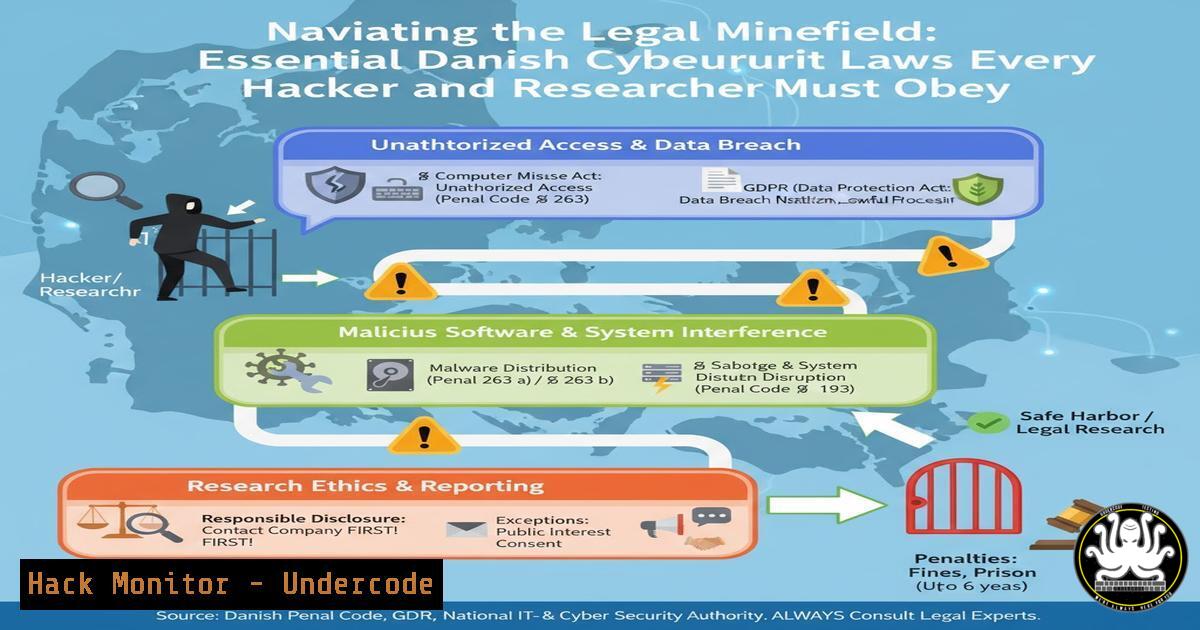
Introduction:
The line between ethical security research and criminal hacking activity is defined by national legislation, a reality that can have profound consequences for cybersecurity professionals. In Denmark, a specific set of laws dictates what constitutes authorized security testing, making legal awareness as crucial as technical skill. Understanding these statutes is not merely academic; it is a fundamental requirement for operating without facing severe legal penalties.
Learning Objectives:
- Identify the key Danish laws that criminalize unauthorized access and data interference.
- Understand the legal prerequisites for conducting ethical security research and penetration testing in Denmark.
- Learn practical, technical steps to ensure compliance with Danish legal frameworks during security assessments.
You Should Know:
- The Foundation: The Danish Penal Code’s Hacking Provisions
The cornerstone of cybersecurity law in Denmark is the Penal Code (Straffeloven). Specifically, Chapter 27 outlines crimes against the public peace, including unauthorized system access. The core offense is defined as “unauthorized access to information systems” (§ 263). This law criminalizes any access to a system or data where the individual is not entitled to access. For security researchers, this means that any probing, scanning, or testing of a system without explicit permission from the owner is, on its face, illegal. There is no broad “security research” exemption.
Step‑by‑step guide explaining what this does and how to use it.
Step 1: Obtain Explicit Written Permission. Before any testing begins, secure a signed agreement from the system owner. This document, often a Scope of Work (SOW) or an engagement letter, is your legal shield. It should explicitly grant you authorization to access the defined systems.
Step 2: Define and Adhere to Scope. Your permission is not a blank check. The SOW must meticulously detail the in-scope IP addresses, domains, and applications. Testing anything outside this scope violates § 263.
Step 3: Document All Actions. Use tools that generate detailed logs of your activities. For command-line logging on Linux, you can use the `script` command to record your entire terminal session.
Linux Command: `script -a engagement_log.txt`
This command will save all input and output to engagement_log.txt, providing a verifiable audit trail that your actions were within the authorized scope.
- The Data Protection Hurdle: Compliance with the GDPR and Danish Data Protection Act
Even with permission to test a system, you may encounter personal data. The General Data Protection Regulation (GDPR), as enforced in Denmark through the Data Protection Act (Databeskyttelsesloven), imposes strict rules on processing such data. If your security testing involves accessing, storing, or exfiltrating personal data (even as part of a proof-of-concept), you could be in violation of these laws.
Step‑by‑step guide explaining what this does and how to use it.
Step 1: Data Minimization in Testing. Plan your tests to avoid interacting with live personal data whenever possible. Advocate for the use of anonymized or synthetic test environments.
Step 2: Secure Data Handling Protocols. If you must handle personal data, ensure it is encrypted both in transit and at rest. On a Windows system, you can use BitLocker to encrypt a drive containing test data.
Windows Command (run as Administrator): `Manage-bde -on C:`
This command enables BitLocker encryption on the C: drive.
Step 3: Legal Basis for Processing. Your engagement contract must establish a legal basis for processing personal data under 6 of the GDPR, typically “legitimate interests” or “necessary for compliance with a legal obligation,” and should outline the responsibilities of both data controller (the client) and data processor (you).
- Navigating the Gray Area: Vulnerability Disclosure and the “Right” to Research
Denmark does not have a specific “safe harbor” law that protects security researchers who discover and report vulnerabilities in good faith. This creates a significant gray area. While the Danish government supports coordinated vulnerability disclosure (CVD) in principle, the act of discovering the vulnerability—if it involves any unauthorized access—may still be technically illegal.
Step‑by‑step guide explaining what this does and how to use it.
Step 1: Practice Passive Reconnaissance. Initial information gathering should be limited to passive techniques that do not send packets to the target’s systems. Use tools like `whois` and publicly available sources like Shodan or Censys.
Linux Command: `whois example.dk`
Step 2: Understand “Implicit Consent”. Some organizations publish a vulnerability disclosure policy (VDP) or a bug bounty program. This can be interpreted as limited implicit consent for good-faith testing, but it is not as legally robust as direct permission. Always read the policy’s scope carefully.
Step 3: Responsible Disclosure Workflow. If you find a vulnerability without explicit permission, do not access or exfiltrate data. Document your findings and submit a report through the organization’s official channels without making any demands.
- Hardening Your Own Operations: Secure Communication and Data Storage
As a security professional, you are a high-value target. The legal requirement to protect your findings and client data necessitates a hardened operational environment. A breach of your systems could lead to liability under the same laws you are helping others navigate.
Step‑by‑step guide explaining what this does and how to use it.
Step 1: Full-Disk Encryption. Ensure all devices used for work, including laptops and external drives, are encrypted.
Linux Command (for LUKS encryption during OS installation): Select “Encrypt the new Ubuntu installation for security” in the installer.
Step 2: Use a VPN for All Engagements. Conduct all testing and communication over a trusted VPN to secure your connection and obscure your home IP address.
Step 3: Secure File Transfers. When sharing reports with clients, use secure methods like SFTP or SCP, not email attachments.
Linux Command: `scp -P 22 report.pdf [email protected]:/secure/upload/path/`
- Cloud-Specific Legal Pitfalls: The Shared Responsibility Model in Denmark
Testing cloud environments (e.g., AWS, Azure) hosted in or serving Denmark adds another layer of complexity. The cloud provider’s Acceptable Use Policy (AUP) is a legally binding document. Violating it can result in your account being terminated and potentially legal action. Furthermore, you must understand the shared responsibility model; you are responsible for the security in the cloud (e.g., your EC2 instance configuration), while the provider is responsible for the security of the cloud.
Step‑by‑step guide explaining what this does and how to use it.
Step 1: Get Authorization in Writing from the Cloud Tenant. The client, as the cloud tenant, must authorize your testing. They may also need to notify the cloud provider (e.g., via AWS Vulnerability Reporting or Azure Bug Bounty program) to pre-approve the engagement.
Step 2: Configure API Security Testing Safely. When testing cloud APIs, use dedicated testing keys and ensure your requests are rate-limited to avoid triggering DDoS protections. Never test against production API endpoints without explicit clearance.
Step 3: Harden Cloud Storage (S3 Buckets). A common test is for misconfigured S3 buckets. To mitigate this on the client side, you can advise them to use bucket policies that explicitly deny all access except from authorized IPs.
AWS S3 Bucket Policy Snippet:
{
"Effect": "Deny",
"Principal": "",
"Action": "s3:",
"Resource": "arn:aws:s3:::example-bucket/",
"Condition": {"NotIpAddress": {"aws:SourceIp": ["192.0.2.0/24"]}}
}
What Undercode Say:
- Legal Permission is Your First Exploit: Without a signed contract granting explicit access, your very first `nmap` scan is a criminal act under Danish law. Your technical skills are irrelevant if you lack this legal foundation.
- Data is a Toxic Asset: During a penetration test, any personal data you encounter is a legal liability. Your methodology must be designed to minimize contact with and secure any such data you are authorized to interact with.
The analysis of the collected Danish laws reveals a legal environment that is cautious and does not inherently distinguish between malicious hackers and ethical researchers. The burden of proof is on the individual to demonstrate that their access was authorized. This creates a high-stakes environment where meticulous documentation and contractual agreements are not just best practices but essential defenses against prosecution. The absence of a strong safe harbor law means that even well-intentioned public vulnerability research carries significant legal risk, potentially stifling the independent security research community in Denmark.
Prediction:
The global trend is moving towards more nuanced cybersecurity legislation, often incorporating safe harbor provisions to protect ethical research. Denmark will likely face pressure to follow suit, as overly broad criminalization can hinder cybersecurity resilience by discouraging the discovery and reporting of vulnerabilities. We predict that within the next 3-5 years, Denmark will amend its Penal Code or introduce supplementary legislation to create a defined legal pathway for good-faith security testing, balancing the need for public safety with the practical necessity of allowing security professionals to identify and help fix critical flaws.
🎯Let’s Practice For Free:
IT/Security Reporter URL:
Reported By: Andreimungiu Danish – Hackers Feeds
Extra Hub: Undercode MoN
Basic Verification: Pass ✅


