
Listen to this Post
Introduction
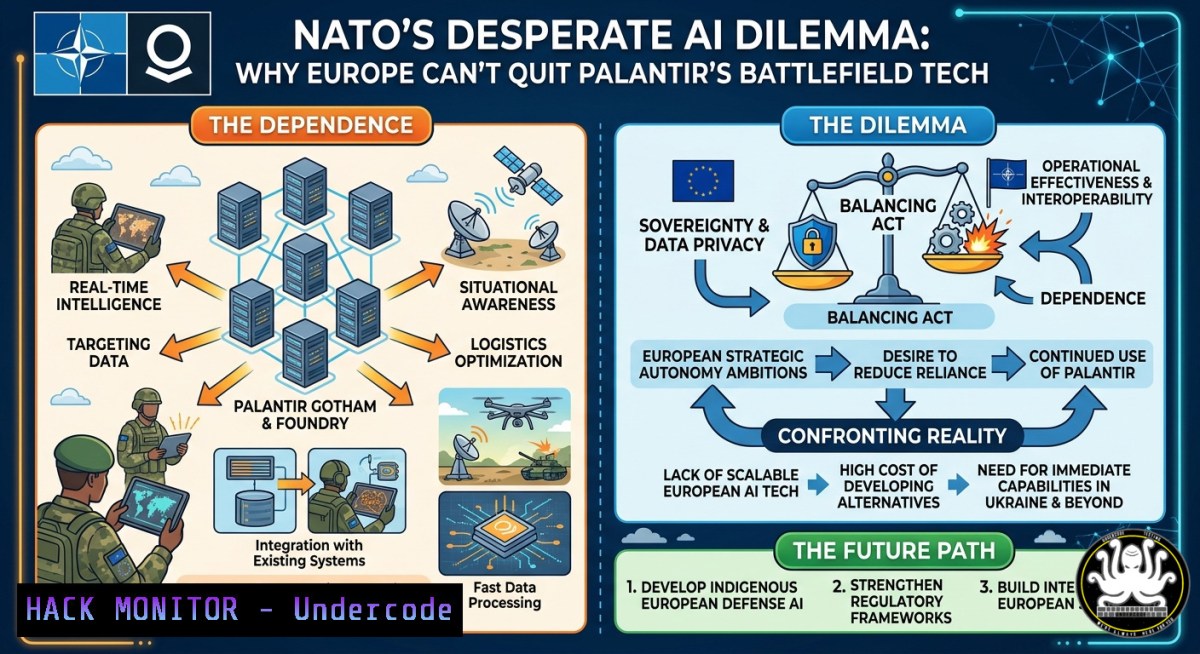
NATO’s recent acquisition of Palantir’s Maven Smart System has ignited a fierce debate over Europe’s dangerous dependence on American AI for battlefield decisions. As Admiral Pierre Vandier, NATO’s Supreme Allied Commander Transformation, concedes that “there is no real competitor to Palantir,” European nations face a stark cybersecurity reality: sovereignty requires secure indigenous alternatives, yet the gap is alarmingly wide.
Learning Objectives
- Analyze the Security Risks of AI Monoculture: Understand why single-supplier reliance on proprietary battle AI creates exploitable vulnerabilities and geopolitical “kill switch” scenarios.
- Deconstruct the Maven Smart System Architecture: Learn how Palantir’s AI integrates multi-domain data sources and accelerates targeting cycles to machine-speed.
- Identify European Alternatives and Hardening Techniques: Explore emerging sovereign platforms and learn specific commands to detect, log, and mitigate unauthorized AI data exfiltration.
You Should Know
The following sections provide a technical deep dive into Palantir’s capabilities, the associated security vulnerabilities, and practical steps to build resilient alternatives.
- The Unmatched Capabilities of Palantir Gotham and the Maven System
Palantir Gotham is the cornerstone of modern US and NATO battlefield intelligence. It creates an AI-enabled, ontology-based data fusion layer that unites disparate feeds—from satellite imagery to intercepted signals—into a single “source of truth.” During recent conflicts, the system generated over 1,000 targeted recommendations per day, with one artillery unit performing the work of 2,000 staff using just 20 operators.
Key Technical Features
- Kill Web Architecture: Gotham moves beyond linear “kill chains” to a distributed “kill web.” Any sensor can trigger AI recommendations, and the system autonomously tasks effectors (from drones to cyber munitions) while maintaining human-in-the-loop veto power.
- Digital Twin Simulation: Gotham uses high-precision digital twins to model strike impacts in complex environments, identifying evasion routes or collateral damage risks before deployment.
- Maven Smart System: Specifically acquired by NATO, this integrates dozens of intelligence sources into a cognitive architecture, generating targets at a rate of one every 86 seconds.
Step‑by‑step overview of a typical AI-assisted targeting mission:
- Ingest: Drones, satellites, and ground sensors push real-time data into the system.
- Fuse & Correlate: AI algorithms link entities across multiple intelligence feeds (e.g., linking a mobile phone’s GPS to a visual ID).
- Recommend: The system presents operators with likely threat profiles, prioritizing targets based on mission rules.
- Act: Upon manual approval, commands are relayed to weapon systems. All audit logs are centralized for forensic analysis.
Linux Command to Simulate Security Logging for Battlefield AI Feeds
sudo journalctl -f -u maven_data_feed.service | grep --color=always "ANOMALY|UNAUTH"
 Explanation: Monitors the AI feed service in real-time, highlighting anomalies or unauthorized access attempts.
- The Cybersecurity Achilles’ Heel: Data Sovereignty and “Kill Switch” Risks
The reliance on Palantir introduces unique cybersecurity and geopolitical vulnerabilities. Data processed by Palantir may be subject to US laws (like the CLOUD Act), making it accessible to US authorities despite being “European” data. Germany’s recent decision to exclude Palantir from its military cloud project over “data security concerns” highlights this risk.
Critical Threat Vectors
- Foreign Access to Classified Data: German intelligence fears that sensitive European targeting data could be unwittingly accessed by US agencies under a “foreign intelligence” justification.
- The “Kill Switch” Scenario: While Pentagon denies a physical switch, the legal authority exists for the US government to compel Palantir to disable or degrade services for allied nations, effectively killing the digital brain of European forces.
- Zero-Day Vulnerabilities in Supply Chain: Palantir uses third-party AI models (e.g., Anthropic’s Claude originally), which could contain hidden backdoors or malicious code discovered in the future.
Palantir’s Security Controls (for defensive reference)
- Air-Gapped Deployments: Palantir claims systems can be fully offline, protecting against remote intrusions.
- Purpose-Based Access Controls: Data governance is enforced through strict “purpose” attributes linked to user roles.
- Zero-Trust and Assume Breach: Palantir uses continuous authentication, encrypted storage (AES-256), and extensive audit logging of every analyst click.
Windows Command to Detect Potential Data Exfiltration (to Simulate Insider Threat)
Get-WinEvent -LogName Security | Where-Object { $<em>.Id -eq 4663 -and $</em>.Message -match "WriteData" } | Format-List TimeCreated, Message
 Explanation: Filters Windows security logs for write access events, helping identify when a user possibly exfiltrated files.
3. Forging European Alternatives: From ArgonOS to Michelangelo
Recognizing the risk, Europe is moving to build sovereign defense AI solutions. Germany’s domestic intelligence agency has selected ChapsVision’s ArgonOS as a Palantir alternative. Meanwhile, Leonardo’s Michelangelo project is developing a fully European AI-enabled “kill web”.
Current European Contenders
- Helsing (Germany/France): A defense AI startup specializing in real-time electronic warfare and autonomous drone swarm management.
- TYTAN Technologies: Backed by the NATO Innovation Fund, TYTAN builds AI-powered interceptor drones and command-control software for low-cost drone defense.
- Project Bromo: A Leonardo-Thales-Airbus partnership to manufacture space-based sensors and high-performance computing for missile detection.
Step‑by‑step hardening for a new AI platform (generic security best practices):
1. Develop a Software Bill of Materials (SBOM) using `trivy` to scan for vulnerabilities in open-source components.
2. Enforce RBAC with an identity provider like Keycloak, restricting roles to “Analyst,” “Reviewer,” and “Admin.”
3. Implement Audit Trails: Use `auditd` on Linux to log all file reads on the AI recommendation engine.
Linux Command for File Integrity Monitoring (FIM) of AI Models
sudo auditctl -w /opt/michelangelo/models/ -p wa -k model_integrity
 Explanation: Sets an audit watch on the directory containing AI models, alerting on any write or attribute changes.
- Human vs. Algorithm: The Invisible Threat of Automation Bias
Beyond traditional cyber attacks, the speed of AI-assisted targeting introduces a human-factors vulnerability. At a target generation rate of one every 86 seconds, human oversight becomes perfunctory—an operator “approving” algorithm-derived targets without truly assessing proportionality. This automation bias is a systemic cyber-failure that adversaries can exploit: a few poisoned data points can cause the AI to classify civilian infrastructure as hostile, leading to strategic outrage and loss of trust.
Mitigation Strategy: Enforce “cognitive hardening” by requiring a mandatory 60-second review delay on high-consequence targeting recommendations. This breaks the automation feedback loop.
5. Infrastructure and Cloud Hardening for Sovereign AI
Europe’s push for digital sovereignty requires secure cloud infrastructure independent of AWS or Azure. The German Armed Forces are building a “secure private cloud” for military AI, requiring strict architectural rules.
Windows PowerShell Security Hardening Checklist for AI Servers
 1. Disable unnecessary SMB versions to prevent lateral movement
Set-SmbServerConfiguration -EnableSMB1Protocol $false -Force
 2. Enable Windows Defender Credential Guard
 This requires registry modification and reboot; stage via Group Policy
 3. Configure Windows Firewall to whitelist only specific AI peer ports
New-NetFirewallRule -DisplayName "BLOCK_ALL_BUT_MAVEN" -Direction Inbound -Action Block
New-NetFirewallRule -DisplayName "ALLOW_MAVEN_443" -Direction Inbound -LocalPort 443 -Protocol TCP -Action Allow
What Undercode Say
- Supplier Lock-In Is a Core Cyber Risk: Dependence on Palantir creates an IT monoculture where a single vulnerability (or political decision) can paralyze NATO’s intelligence apparatus. Europe must treat defense AI as critical infrastructure and mandate redundant, interoperable systems.
- Data is the New Battlefield; Sovereignty is a Zero-Day Defense: The analysis of the German decision shows that national security hinges on controlling data access rights. Without “purpose-based” and geographically enforced controls, AI systems are backdoors for foreign intelligence.
Analysis: The strategic risk is not merely that Palantir has vulnerabilities, but that Europe has no way to attribute a malfunction. If a targeting error occurs using European data on US-run models, was it a cyber attack, a software bug, or intentional interference? This ambiguity is the most dangerous threat. Developing sovereign AI is not about nationalism—it’s about maintaining a credible, controllable defence posture.
Prediction
Within five years, we will see a bifurcated NATO: a “fast-response” wing reliant on US battle AI (like Maven) and a “sovereign” European layer based on open-source, transparent models. However, the speed of AI warfare will erode the tolerance for latency between these layers, pushing Europe to either accept the risks of American tech or innovate at a startup pace—a “race” that may redefine transatlantic power dynamics. Expect European defense cloud providers to emerge as the new cybersecurity unicorns by 2028.
▶️ Related Video (86% Match):
🎯Let’s Practice For Free:
IT/Security Reporter URL:
Reported By: Ivan Savov – Hackers Feeds
Extra Hub: Undercode MoN
Basic Verification: Pass ✅


