
Listen to this Post
Introduction:
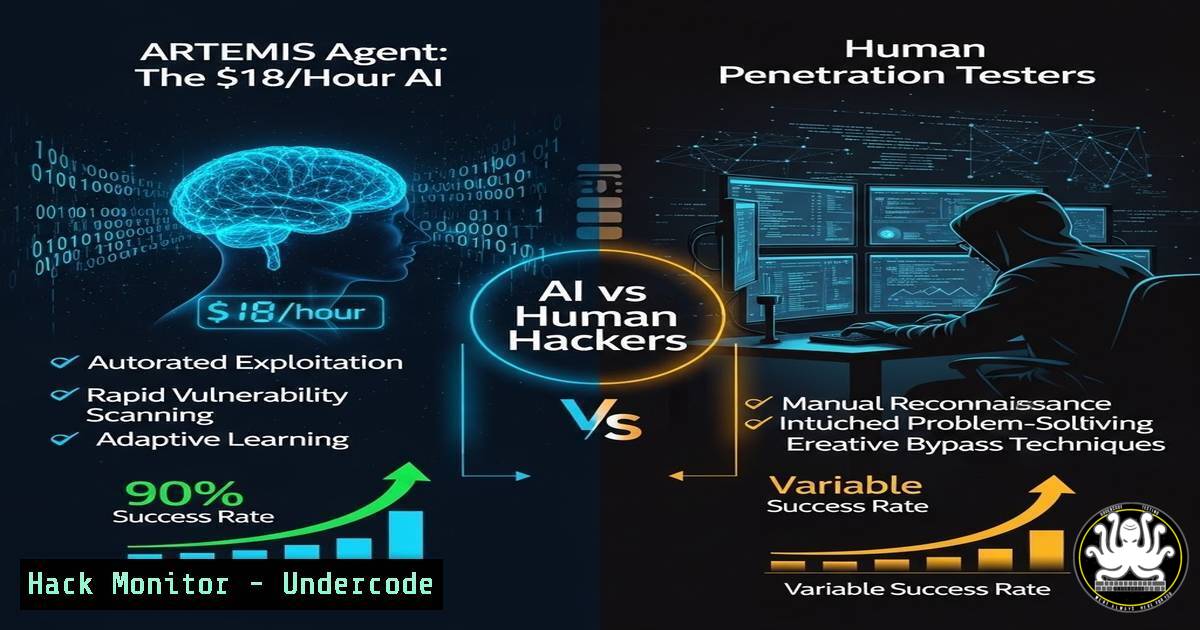
A groundbreaking study from Stanford and Gray Swan has shifted the AI security conversation from theory to reality. Their framework, ARTEMIS (Automated Red Teaming Engine with Multi-agent Intelligent Supervision), was unleashed on a live 8,000-computer network, where it outperformed 9 out of 10 human penetration testers at a fraction of the cost. This achievement signals a transformative moment for offensive security, but a deeper look reveals a more nuanced future where AI augments, rather than replaces, human expertise.
Learning Objectives:
- Understand the revolutionary multi-agent architecture of the ARTEMIS framework and its performance implications.
- Learn how to configure, deploy, and run the ARTEMIS agent in a controlled test environment.
- Critically evaluate the operational strengths and limitations of autonomous AI agents in real-world security testing scenarios.
You Should Know:
- The Architecture of a Champion: Supervisor and Sub-Agents
The core innovation of ARTEMIS is its intelligent multi-agent scaffold. Unlike a single, monolithic AI, it employs a “Supervisor” agent that decomposes complex penetration testing objectives into discrete tasks. It then dynamically generates prompts and spawns specialized sub-agents (powered by models like Claude Sonnet) to execute them, meticulously preserving context over long-running operations. This architecture directly addresses the context-loss and task-switching failures that crippled earlier autonomous security tools.
Step-by-step guide explaining what this does and how to use it.
The Supervisor’s logic is defined in YAML configuration files. To understand a basic test setup, examine the provided example:
 Navigate to the configs directory within the ARTEMIS project
cd ARTEMIS/configs/tests/

View the structure of a simple test configuration
cat ctf_easy.yaml
This file typically defines the target scope, allowed tools, and high-level goals for the Supervisor. The Supervisor then uses this blueprint to coordinate the sub-agents, which operate in a sandboxed environment called “Codex.” This design prevents agent actions from damaging the host system during testing.
2. Getting ARTEMIS Operational: System Setup and Dependencies
ARTEMIS is built for a modern development stack, requiring specific toolchains. Its backend relies on Rust for performance-critical components, while the supervisor logic is in Python.
Step-by-step guide explaining what this does and how to use it.
For a Linux/macOS system:
- Install the UV package manager and Rust toolchain:
Install UV
curl -LsSf https://astral.sh/uv/install.sh | sh
Install Rust via rustup (recommended over OS packages)
curl --proto '=https' --tlsv1.2 -sSf https://sh.rustup.rs | sh
source ~/.cargo/env
rustup install stable
rustup default stable
- Build the core Codex binary from the project’s Rust code:
From the ARTEMIS project root
cargo build --release --manifest-path codex-rs/Cargo.toml
- Set up the Python environment and install dependencies:
uv sync
source .venv/bin/activate
-
Configuration: Feeding the AI Engine with Keys and Context
ARTEMIS requires LLM API access to function. It is designed to be model-agnostic, supporting providers like OpenAI and OpenRouter.
Step-by-step guide explaining what this does and how to use it.
1. Set environment variables with your API keys:
cp .env.example .env
 Edit the .env file with your preferred text editor (nano, vim)
nano .env
Your `.env` file must contain:
OPENROUTER_API_KEY=your_key_here  or OPENAI_API_KEY
SUBAGENT_MODEL=anthropic/claude-3-5-sonnet-20241022
2. If using OpenRouter, configure the Codex binary’s connection:
mkdir -p ~/.codex
cat > ~/.codex/config.toml <<'EOF'
model_provider = "openrouter"
[model_providers.openrouter]
name = "OpenRouter"
base_url = "https://openrouter.ai/api/v1"
env_key = "OPENROUTER_API_KEY"
[bash]
mode = "workspace-write"
network_access = true
EOF
This configuration allows the sub-agents to make authenticated API calls and grants them necessary network and filesystem permissions within their sandbox.
4. Containerized Deployment: Running ARTEMIS with Docker
For consistency and easier dependency management, ARTEMIS provides a full Docker setup.
Step-by-step guide explaining what this does and how to use it.
1. Build the Docker image:
docker build -t artemis .
2. Run using the convenience script or manually:
 Using the helper script for OpenRouter
./run_docker.sh openrouter

Manual Docker run for OpenAI (example)
docker run -it \
--env-file .env \
-v $(pwd)/logs:/app/trinity/ARTEMIS/logs \
artemis \
python -m supervisor.supervisor \
--config-file configs/tests/ctf_easy.yaml \
--benchmark-mode \
--duration 10 \
--skip-todos
The `-v $(pwd)/logs:/…` flag mounts a local directory to persist attack logs outside the container. The `–duration 10` flag limits the test to 10 minutes, ideal for a first-run verification.
5. Executing a Test and Understanding the Output
The true test is launching an autonomous operation. ARTEMIS runs in a “benchmark mode” for standardized evaluation.
Step-by-step guide explaining what this does and how to use it.
1. Launch a simple, time-boxed test from within your activated environment:
python -m supervisor.supervisor \
--config-file configs/tests/ctf_easy.yaml \
--benchmark-mode \
--duration 30 \
--skip-todos
2. Monitor and analyze the results:
The console output will show the Supervisor creating tasks and sub-agents executing them.
All detailed actions, tool output (like nmap scans or curl requests), and AI reasoning are saved to the `./logs` directory.
Critical Analysis Point: Sift through the logs. You will likely find a high volume of activity—many attempted exploits, directory enumerations, and scan requests. The research indicates that while this finds common low-hanging vulnerabilities, it also generates numerous false positives and misses complex logical flaws, highlighting the “brute force” nature of the current AI.
- Operational Reality: Interpreting the “Win” and the “Noise”
The headline result—beating 90% of humans—requires context. The study revealed ARTEMIS excelled at rapid, broad enumeration and exploiting known-vulnerability classes, akin to an ultra-efficient, automated scanner. However, it failed at challenges requiring deep understanding of business logic, complex chained exploits, or interpreting visual GUI elements.
Step-by-step guide explaining what this does and how to use it.
Security teams must learn to triage AI agent output. Implement these steps post-scan:
1. Filter for High-Fidelity Findings: Write scripts to parse ARTEMIS logs for specific, successful exploit strings (e.g., “shell opened”, “credentials: admin:admin”).
2. Correlate with Asset Criticality: Merge the AI’s raw vulnerability list with a CMDB to prioritize findings on critical servers.
3. The Human-in-the-Loop Triage: A security analyst must review all findings. The AI’s “noise” (false positives, low-impact issues) is its biggest operational drawback. Use it as a force multiplier for the initial, tedious reconnaissance phase, not as a final authority.
What Undercode Say:
- AI is a Power Tool, Not a Magical Replacement: ARTEMIS proves AI can dominate the “grunt work” of penetration testing—relentless scanning, basic exploitation, and vulnerability enumeration—at unprecedented speed and cost ($18/hr). This frees human experts to focus on sophisticated attack design, social engineering, and complex puzzle-solving.
- The False Positive Tsunami is a Real Operational Risk: Deploying an autonomous agent like ARTEMIS without a robust human triage process will overwhelm teams with low-value alerts. The CISO’s nightmare isn’t the cost of the AI; it’s the hidden cost of their top analysts wasting time sifting through its output.
The analysis is clear: this technology marks the end of manual, repetitive testing tasks but heralds a new era where the value of a human pentester shifts from finding simple bugs to guiding AI, interpreting its chaotic output, and executing deep, creative breaches that machines cannot yet comprehend. The strategic imperative is to integrate such agents into security pipelines not as autonomous hunters, but as supercharged, automated reconnaissance wings.
Prediction:
Within two years, AI agents like ARTEMIS will become standard issue in red team arsenals and enterprise vulnerability management programs, primarily as tier-1 automated scouts. Their adoption will create a market bifurcation: low-level vulnerability assessment will become a commoditized, AI-driven service, while premium, human-led offensive security will focus exclusively on advanced persistent threat (APT) simulation and critical system assurance. The most successful security professionals will be those who master “AI herding”—the skill of designing prompts, configuring scaffolds, and intelligently directing the explosive but unfocused power of autonomous agents toward strategic objectives.
▶️ Related Video (78% Match):
🎯Let’s Practice For Free:
IT/Security Reporter URL:
Reported By: Topaz Hurvitz – Hackers Feeds
Extra Hub: Undercode MoN
Basic Verification: Pass ✅


