Listen to this Post
Introduction:
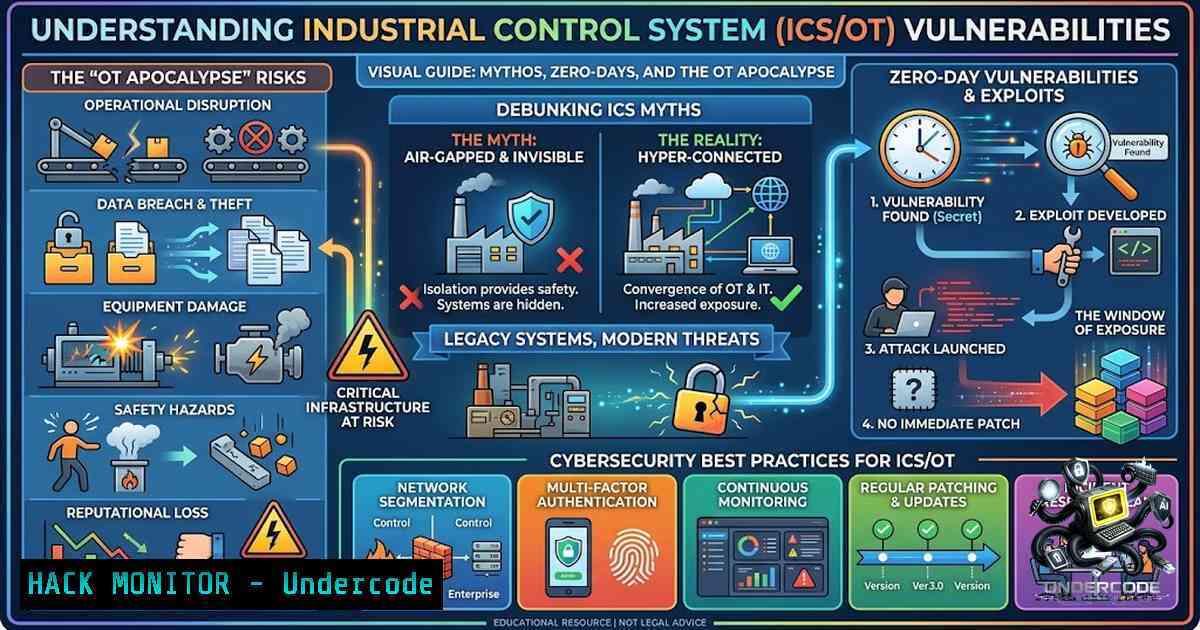
The cybersecurity landscape for Operational Technology (OT) has been permanently altered. Before April 2025, no AI model could complete a single expert-level cybersecurity challenge; twelve months later, Anthropic’s Claude Mythos Preview solves 73% of them. This isn’t just an incremental improvement—it represents the steepest capability jump ever recorded in AI cyber performance. For organizations running power grids, water treatment plants, and transport infrastructure, the message is clear: the era of relying on obscurity and slow patching is over. AI has compressed vulnerability discovery from weeks to hours, and threat actors are already weaponizing it.
Learning Objectives:
- Understand how frontier AI models like Mythos are fundamentally altering the threat landscape for OT environments.
- Master essential Linux and Windows hardening commands to reduce the attack surface of industrial control systems.
- Learn to implement risk-based vulnerability management and detection strategies aligned with NIST SP 800-82 and IEC 62443.
You Should Know:
- The AI Threat Multiplier: Understanding the New Reality
The UK’s AI Security Institute (AISI) conducted the most rigorous independent assessment of Mythos Preview. In a 32-step attack simulation modeled on corporate networks—spanning reconnaissance through full network takeover—Mythos became the first model to complete it end-to-end, succeeding in 3 of 10 attempts. Every previous model averaged fewer than 16 steps; Mythos averaged 24. The difference between 16 and 24 steps is the difference between an intrusion that stalls and one that reaches data exfiltration and persistence.
This isn’t theoretical. Between December 2025 and February 2026, an unknown threat group used Claude to attack a municipal water utility in Monterrey, Mexico. The attackers had no prior knowledge of the utility’s industrial setup. They used AI to map the enterprise network, identify an industrial gateway bridging IT and OT, generate targeted credential lists combining default vendor passwords with environment-specific naming conventions, and advise a password-spraying attack against the SCADA interface. What traditionally took advanced threat groups weeks was compressed into hours. As Dragos Founder Rob M. Lee noted, “AI-fueled vulnerability weaponization is much further along than AI-fueled patch generation and application”.
Step‑by‑Step Guide: OT System Hardening Fundamentals
To counter this accelerated threat, organizations must harden their OT endpoints immediately. Below are verified commands for both Linux and Windows environments based on NIST SP 800-82 and IEC 62443 guidance.
Linux Hardening Commands:
 1. Implement strict firewall rules for OT network segmentation
 Block all non-essential ports, allow only specific OT protocol traffic
sudo iptables -A INPUT -p tcp --dport 102 -s 192.168.10.0/24 -j ACCEPT  S7comm
sudo iptables -A INPUT -p tcp --dport 502 -s 192.168.10.0/24 -j ACCEPT  Modbus
sudo iptables -A INPUT -p udp --dport 44818 -s 192.168.10.0/24 -j ACCEPT  EtherNet/IP
sudo iptables -P INPUT DROP
sudo iptables -P FORWARD DROP

<ol>
<li>Disable unnecessary services and network protocols
sudo systemctl disable rpcbind
sudo systemctl disable nfs-server
sudo systemctl disable cups</p></li>
<li><p>Harden SSH configuration
sudo sed -i 's/PermitRootLogin prohibit-password/PermitRootLogin no/' /etc/ssh/sshd_config
sudo sed -i 's/MaxAuthTries 6/MaxAuthTries 3/' /etc/ssh/sshd_config
sudo systemctl restart sshd</p></li>
<li><p>Implement file integrity monitoring
sudo apt-get install aide
sudo aideinit
sudo mv /var/lib/aide/aide.db.new /var/lib/aide/aide.db
sudo aide --check</p></li>
<li><p>Apply kernel hardening parameters
echo "kernel.dmesg_restrict=1" >> /etc/sysctl.conf
echo "net.ipv4.conf.all.accept_redirects=0" >> /etc/sysctl.conf
echo "net.ipv4.conf.all.send_redirects=0" >> /etc/sysctl.conf
sysctl -p
Windows Hardening Commands (PowerShell):
 1. Disable unnecessary services common in OT environments
Set-Service -1ame "RemoteRegistry" -StartupType Disabled
Set-Service -1ame "RemoteAccess" -StartupType Disabled
Set-Service -1ame "UPnPDeviceHost" -StartupType Disabled

<ol>
<li>Configure Windows Firewall for OT protocol allowlisting
New-1etFirewallRule -DisplayName "Allow Modbus TCP" -Direction Inbound -LocalPort 502 -Protocol TCP -Action Allow -RemoteAddress 192.168.10.0/24
New-1etFirewallRule -DisplayName "Allow S7comm" -Direction Inbound -LocalPort 102 -Protocol TCP -Action Allow -RemoteAddress 192.168.10.0/24
New-1etFirewallRule -DisplayName "Block All Other Inbound" -Direction Inbound -Action Block</p></li>
<li><p>Disable LLMNR and NetBIOS to prevent credential relay attacks
Set-ItemProperty -Path "HKLM:\SOFTWARE\Policies\Microsoft\Windows NT\DNSClient" -1ame "EnableMulticast" -Value 0
Set-ItemProperty -Path "HKLM:\SYSTEM\CurrentControlSet\Services\NetBT\Parameters" -1ame "NetBIOSOptions" -Value 2</p></li>
<li><p>Enable advanced audit logging for OT workstations
auditpol /set /subcategory:"Detailed File Share" /success:enable /failure:enable
auditpol /set /subcategory:"Process Creation" /success:enable /failure:enable
auditpol /set /subcategory:"Logon" /success:enable /failure:enable</p></li>
<li><p>Implement application whitelisting via AppLocker
Create default rules for Program Files and Windows directories
New-AppLockerPolicy -RuleType Exe -User Everyone -Action Allow -Path "%PROGRAMFILES%\"
New-AppLockerPolicy -RuleType Exe -User Everyone -Action Allow -Path "%WINDIR%\"
Set-AppLockerPolicy -Policy $policy
2. Risk-Based Vulnerability Management: Patching at AI Speed
Many organizations already struggle to patch vulnerabilities quickly enough. New AI models increase that pressure exponentially. If Mythos or similar models expose more vulnerabilities, someone still has to test, plan, and roll out all those patches. A standard patching window of thirty days may be too slow for vulnerabilities that attackers can exploit within hours.
The key insight from Orange Cyberdefense’s analysis is that patch management must become more risk-based: “It is no longer only about the vulnerability with the highest CVSS score, but about the vulnerability that creates the greatest risk in your environment. A lower-rated vulnerability can be more urgent if it can actually be exploited”. Sources such as the CISA Known Exploited Vulnerabilities (KEV) catalog can help prioritize which vulnerabilities are actively being weaponized.
Step‑by‑Step Guide: Safe OT Vulnerability Scanning
Performing vulnerability scans in OT environments requires extreme caution to avoid disrupting industrial processes or crashing legacy controllers.
 1. Passive network discovery using Nmap (read-only, no active probes)
nmap -sn 192.168.10.0/24 --host-timeout 30s  Ping sweep only

<ol>
<li>Active scanning with protocol-specific considerations
For Modbus TCP (Port 502) - use with caution, test during maintenance windows
nmap -p 502 --script modbus-discover 192.168.10.100</p></li>
<li><p>S7comm (Siemens) protocol discovery
nmap -p 102 --script s7-info 192.168.10.101</p></li>
<li><p>EtherNet/IP (CIP) discovery
nmap -p 44818 --script enip-info 192.168.10.102</p></li>
<li><p>Use vulnerability scanning tools with OT-specific configurations
Tenable OT Security - passive monitoring first, then controlled active scanning
Claroty xDome - asset discovery and risk scoring aligned with IEC 62443</p></li>
<li><p>AI-assisted SCADA VAPT methodology - scope control first
Use Shodan for external exposure assessment, then controlled validation
- Detection and Response in the AI-Accelerated Threat Environment
If attackers can test, scan, and exploit faster, the number of signals on the defensive side also increases. SOC teams receive more alerts, more suspicious patterns, and more incidents to assess. AI can help speed triage, summarize incident information, recognize patterns, and prioritize alerts. However, as Orange Cyberdefense’s Sebastiaan de Vries emphasizes: “AI should support security teams, not replace them. People remain necessary to make the right judgment call, especially in processes where a mistake can have a major impact”.
Step‑by‑Step Guide: OT Threat Detection with MITRE ATT&CK for ICS
 1. Monitor for unauthorized Modbus RTU write activity
 Use Python telemetry and Splunk correlation mapped to MITRE ATT&CK for ICS

<ol>
<li>Deploy Zeek with ATT&CK-based Control-system Indicator Detection (ACID)
ACID provides OT protocol indicators alerting on specific ATT&CK for ICS behaviors</p></li>
<li><p>Implement command allowlisting for industrial protocols
Prevent devices from sending unauthorized command or reporting messages</p></li>
<li><p>Detect unauthorized command messages (MITRE ATT&CK DET0794)
Monitor for command messages to control system assets from unauthorized sources</p></li>
<li><p>Build multi-dimensional baselines from OT network traffic
Use machine learning models trained on OT network baselines for anomaly detection
4. What WSP and Industry Leaders Recommend
WSP’s approach to this challenge is grounded in engineering-led cybersecurity. As they note, “AI-enabled tools like Mythos are accelerating how quickly vulnerabilities are identified and potentially exploited across all networks. In OT environments, the ability to respond will continue to operate under crucial safety measures. This is a widening gap that organizations must learn to manage”.
The three actions WSP recommends taking now are:
- Identify which operational technology systems matter most—pinpoint your most critical assets and where they are most vulnerable.
- Prioritize resilience and recovery—assume that a cybersecurity incident will occur and prepare accordingly.
- Conduct targeted assessments or simulated crisis scenarios—Red Teaming and Blue Teaming exercises help test decision-making and expose gaps in coordination.
CISA, NSA, and the Australian Signals Directorate have published joint guidance with four key principles: understand AI, assess AI use in OT, establish AI governance, and embed safety and security. However, CISA’s guidance also recommends keeping AI systems separated from OT networks, providing only read-only data feeds and ensuring data flows from OT to IT, but excluding AI from visibility or control over OT systems.
What Undercode Say:
- AI doesn’t just introduce new technology; it changes the attack surface entirely. Organizations are rolling out copilots and agents before addressing data quality, governance, identity and access, and clear ownership. AI security must be designed in from day one—not solved after deployment.
-
The financial exposure compounds quickly when AI accelerates vulnerability identification faster than organizations can govern the response. Operational disruption isn’t just a safety risk—it’s a revenue event. The organizations winning are those building human intelligence into the oversight layer, not just deploying technology and hoping the playbook catches up.
The emergence of Claude Mythos and ChatGPT 5.5 fundamentally alters the cybersecurity paradigm. These models have demonstrated the ability to execute multi-step attack chains, including reconnaissance, lateral movement, and data exfiltration with zero human involvement. Mythos reportedly discovered thousands of software flaws—called zero-days because they were unknown to developers—that could be exploited. The trajectory is not slowing.
The challenge now is not just finding vulnerabilities but managing the response. As WSP emphasizes, “The advantage will go to the organizations that understand their level of exposure, prioritize what matters most, and prepare to act when disruption occurs”. This means moving beyond awareness to readiness through targeted assessments, clear response plans, and realistic scenario testing.
Prediction:
- +1 Organizations that embrace AI-assisted defense while maintaining human oversight will develop a significant competitive advantage. AI will accelerate detection and response, but human judgment remains irreplaceable for safety-critical decisions.
-
-1 The gap between vulnerability discovery and patch deployment will widen dramatically. With AI discovering vulnerabilities faster than organizations can patch, the “window of opportunity” for attackers will expand, leading to more frequent and severe OT incidents.
-
-1 The barrier to entry for sophisticated OT attacks has dropped permanently. Threat actors no longer need specialized industrial knowledge—AI can map networks, identify OT infrastructure, and develop access paths without prior ICS/OT context. Expect a surge in attacks against critical infrastructure.
-
+1 Regulatory frameworks will evolve to mandate AI-specific security controls in OT environments. Standards like IEC 62443 and NIST SP 800-82 will incorporate AI risk management requirements, driving better security practices across the industry.
-
-1 The “vulnpocalypse”—a tsunami of AI-discovered vulnerabilities—will overwhelm security teams. Organizations without automated patch management and risk-based prioritization will be unable to keep pace, leaving critical systems exposed.
▶️ Related Video (78% Match):
https://www.youtube.com/watch?v=0COpeq-YQTE
🎯Let’s Practice For Free:
🎓 Live Courses & Certifications:
Join Undercode Academy for Verified Certifications
🚀 Request a Custom Project:
Secure, high-velocity infrastructure and disruptive technological engineering. Contact our engineering team for high-tier development and proprietary systems:
[email protected]
💎 Smart Architecture | 🛡️ Secure by Design | ⭐ Trusted by Thousands
IT/Security Reporter URL:
Reported By: Charles Blackbeard – Hackers Feeds
Extra Hub: Undercode MoN
Basic Verification: Pass ✅


