Listen to this Post
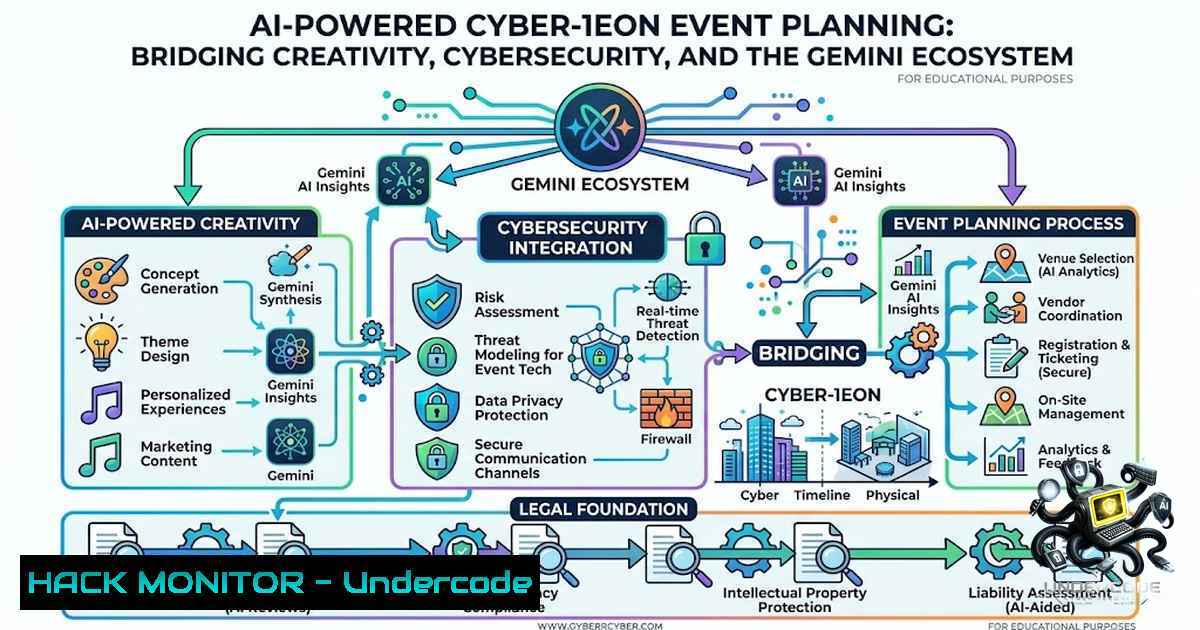
Introduction:
The convergence of generative artificial intelligence and cybersecurity is reshaping how organizations conceptualize, plan, and execute high-impact events. The Freshers’ Party Night Challenge, part of the Google Student Ambassador Program 2026, exemplifies this paradigm shift—where a “Cyber-1eon” themed campus experience was designed using Gemini AI to fuse creativity with technology. This article deconstructs the technical infrastructure behind AI-driven event orchestration, exploring how multimodal AI models like Gemini can automate logistics, enhance security postures, and deliver immersive, memorable experiences while embedding critical cybersecurity awareness into every layer of the planning process.
Learning Objectives:
- Master the technical setup and API integration of Google Gemini for automated event logistics, scheduling, and content generation.
- Implement function calling and multi-agent orchestration to connect natural language processing with external systems and real-world actions.
- Apply cybersecurity hardening measures, secure coding practices, and threat modeling to protect AI-driven event platforms and attendee data.
You Should Know:
- Setting Up the Gemini API for Event Automation
The foundation of any AI-powered event planning system begins with proper API configuration and authentication. Google Gemini, accessible via the Google Cloud Vertex AI or the generative language API, provides the multimodal capabilities necessary for generating thematic content, scheduling, and interactive experiences.
To get started, you must first obtain API credentials:
Linux/macOS (Bash):
 Install the Google Cloud SDK
curl -sSL https://sdk.cloud.google.com | bash
exec -l $SHELL
gcloud init

Authenticate and set project
gcloud auth login
gcloud config set project YOUR_PROJECT_ID

Enable the Vertex AI API
gcloud services enable aiplatform.googleapis.com

Generate an API key for the Gemini API
gcloud alpha services api-keys create --display-1ame="gemini-event-key"
Windows (PowerShell):
 Install Google Cloud SDK via Chocolatey
choco install google-cloud-sdk
 Authenticate
gcloud auth login
gcloud config set project YOUR_PROJECT_ID
 Enable API
gcloud services enable aiplatform.googleapis.com
Once authenticated, you can initialize the Gemini client in Python to begin building event planning agents:
import google.generativeai as genai

genai.configure(api_key="YOUR_API_KEY")
model = genai.GenerativeModel('gemini-2.0-flash-exp')

Generate a Cyber-1eon themed event concept
prompt = """
You are an AI event planner. Generate a comprehensive concept for a 'Cyber-1eon Freshers Party'
including: theme description, color palette, suggested venue layout, interactive tech activities,
and a 2-hour timeline. Ensure the concept includes cybersecurity awareness elements.
"""
response = model.generate_content(prompt)
print(response.text)
This initial setup allows you to prototype event concepts and dynamically generate content that aligns with the Cyber-1eon aesthetic while embedding educational cybersecurity messaging.
- Function Calling: Bridging Natural Language and Real-World Actions
Function calling is a critical capability that enables the Gemini model to interact with external tools and APIs, transforming natural language requests into executable actions. This is particularly valuable for automating event logistics such as scheduling, attendee management, and resource allocation.
Below is a practical implementation of a function that schedules event planning meetings, demonstrating how the model parses user input and returns structured arguments to trigger actions in external calendars:
Python Implementation:
from google import genai

schedule_meeting_function = {
"type": "function",
"name": "schedule_meeting",
"description": "Schedules a planning meeting with specified attendees.",
"parameters": {
"type": "object",
"properties": {
"attendees": {"type": "array", "items": {"type": "string"}},
"date": {"type": "string", "description": "Date (YYYY-MM-DD)"},
"time": {"type": "string", "description": "Time (HH:MM)"},
"topic": {"type": "string", "description": "Meeting topic."},
},
"required": ["attendees", "date", "time", "topic"],
},
}

client = genai.Client()
interaction = client.interactions.create(
model="gemini-2.5-pro-exp-03-25",
input="Schedule a meeting with the event committee for 08/15/2026 at 14:00 to finalize the Cyber-1eon party agenda.",
tools=[bash],
)

for step in interaction.steps:
if step.type == "function_call":
print(f"Function: {step.name}")
print(f"Arguments: {step.arguments}")
 Execute the actual scheduling logic here
JavaScript Implementation:
import { GoogleGenAI } from '@google/genai';

const client = new GoogleGenAI({});
const scheduleMeetingFunction = {
type: 'function',
name: 'schedule_meeting',
description: 'Schedules a meeting with specified attendees.',
parameters: {
type: 'object',
properties: {
attendees: { type: 'array', items: { type: 'string' } },
date: { type: 'string', description: 'Date (YYYY-MM-DD)' },
time: { type: 'string', description: 'Time (HH:MM)' },
topic: { type: 'string', description: 'Meeting topic.' },
},
required: ['attendees', 'date', 'time', 'topic'],
},
};

const interaction = await client.interactions.create({
model: 'gemini-2.5-pro-exp-03-25',
input: 'Schedule a meeting with the marketing team for 08/20/2026 at 10:00 AM to discuss Cyber-1eon promotional materials.',
tools: [bash],
});

for (const step of interaction.steps) {
if (step.type === 'function_call') {
console.log(<code>Function: ${step.name}</code>);
console.log(<code>Arguments: ${JSON.stringify(step.arguments)}</code>);
}
}
REST API Call:
curl -X POST "https://generativelanguage.googleapis.com/v1beta/interactions" \
-H "x-goog-api-key: YOUR_API_KEY" \
-H "Content-Type: application/json" \
-d '{
"model": "gemini-2.5-pro-exp-03-25",
"input": "Schedule a meeting with the AV team for 08/10/2026 at 15:30 to test the Cyber-1eon lighting setup.",
"tools": [{
"type": "function",
"name": "schedule_meeting",
"parameters": {
"type": "object",
"properties": {
"attendees": {"type": "array", "items": {"type": "string"}},
"date": {"type": "string"},
"time": {"type": "string"},
"topic": {"type": "string"}
},
"required": ["attendees", "date", "time", "topic"]
}
}]
}'
This function calling mechanism enables the creation of intelligent agents that can autonomously manage event logistics, reducing manual overhead and increasing efficiency.
3. Prompt Engineering for Immersive Event Experiences
Effective prompt engineering is the cornerstone of extracting maximum value from Gemini. The model’s ability to generate coherent, contextually relevant outputs depends heavily on the quality and structure of the prompts provided. For a Cyber-1eon themed event, prompts must incorporate thematic elements, technical constraints, and engagement objectives.
Advanced Prompting Techniques:
Contextual Layering:
Provide Gemini with rich background information, including timing, goals, session formats, and historical data. For example:
You are planning a Cyber-1eon Freshers Party. The event runs from 6 PM to 11 PM.
High-level goals: increase student engagement with technology, promote cybersecurity awareness,
and foster community among first-year students.
Sessions: keynote on AI ethics (30 min), interactive cyber escape room (60 min),
neon art installation workshop (45 min), live coding challenge (45 min), and a networking session (60 min).
Constraints: budget of $5,000, venue capacity of 200 students, and all activities must incorporate
a "neon cyberpunk" aesthetic.
Iterative Questioning:
Instead of a single prompt, use a conversational approach where each question builds on the previous response to identify blind spots and refine the plan:
- “What conference theme or tagline would best engage tech-savvy students?”
- “How can I make the networking sessions more interactive and inclusive?”
- “What five questions should I ask to ensure the event is both fun and educational?”
Refinement Prompts:
After generating an initial plan, ask Gemini to refine specific elements. For instance, request a detailed timeline, a budget breakdown, or a risk assessment matrix. This iterative process ensures a comprehensive and polished event blueprint.
4. Multi-Agent Orchestration with Google ADK
For complex event planning, a multi-agent system—where multiple AI agents collaborate—offers superior results. The Google Agent Development Kit (ADK) enables the orchestration of specialized agents for venues, catering, invitations, and decor.
Step-by-Step Setup:
1. Clone the Repository:
git clone https://github.com/atef-ataya/ai-event-planner
cd ai-event-planner
2. Install Dependencies:
pip install -r requirements.txt
3. Configure API Keys:
Create a `.env` file with your Google Gemini API key, Google Maps API key, and OpenAI API key.
4. Run the Application:
streamlit run app.py
This application demonstrates multi-agent orchestration by assigning different agents to handle venue suggestions, catering filtering, invitation generation, and timeline creation. The modular design makes it an excellent educational tool for understanding how AI agents can collaborate to solve real-world problems.
5. Cybersecurity Hardening for AI Event Platforms
Integrating AI into event planning introduces new attack surfaces that must be secured. The “Cyber-1eon” theme itself can be leveraged to teach cybersecurity principles, but the underlying platform requires robust defenses.
API Security:
- Store API keys securely using environment variables or a secrets manager. Never hardcode keys in source code.
- Implement rate limiting and IP whitelisting to prevent abuse of the Gemini API.
- Use OAuth 2.0 for user authentication and authorization.
Data Protection:
- Encrypt all attendee data (names, emails, dietary restrictions) both at rest and in transit.
- Anonymize data used for AI training or analytics.
- Regularly audit access logs to detect unauthorized data exfiltration.
Vulnerability Mitigation:
- Conduct regular penetration testing on the event platform.
- Implement Web Application Firewall (WAF) rules to block common attack vectors like SQL injection and XSS.
- Use containerization (Docker) and orchestration (Kubernetes) to isolate services and limit blast radius.
Linux Command for Security Auditing:
 Scan for open ports and services
nmap -sV -p- YOUR_EVENT_SERVER_IP

Check for vulnerable dependencies
safety check -r requirements.txt

Monitor real-time system logs for anomalies
journalctl -f -u event-planner.service
Windows PowerShell for Security Hardening:
 Enable Windows Defender real-time protection
Set-MpPreference -DisableRealtimeMonitoring $false

Configure firewall rules
New-1etFirewallRule -DisplayName "Allow Event App" -Direction Inbound -Protocol TCP -LocalPort 8501 -Action Allow

Audit user permissions
Get-LocalUser | Where-Object {$_.Enabled -eq $true}
6. Cloud Hardening and Scalability
Deploying the AI event planner on Google Cloud requires hardening the cloud infrastructure to ensure scalability and security.
Best Practices:
- Use Identity and Access Management (IAM) to enforce the principle of least privilege.
- Enable Cloud Armor to protect against DDoS attacks.
- Configure VPC Service Controls to restrict data access to trusted networks.
- Set up Cloud Monitoring and Logging for real-time alerting and forensic analysis.
Deployment Commands:
 Deploy to Cloud Run
gcloud run deploy event-planner \
--image gcr.io/YOUR_PROJECT/event-planner \
--platform managed \
--region us-central1 \
--allow-unauthenticated \
--memory 2Gi \
--cpu 2

Set up Cloud SQL for persistent storage
gcloud sql instances create event-db \
--database-version=POSTGRES_15 \
--tier=db-custom-2-7680 \
--region=us-central1

Configure Cloud Armor security policy
gcloud compute security-policies create event-policy \
--description "WAF for event planner"
7. Vulnerability Exploitation and Mitigation in AI Systems
Understanding how attackers might exploit AI systems is crucial for building resilient applications. Common attack vectors include prompt injection, data poisoning, and model inversion.
Prompt Injection Mitigation:
- Sanitize user inputs to prevent malicious instructions from overriding system prompts.
- Use input validation and output filtering to detect and block adversarial content.
Data Poisoning Prevention:
- Validate all training data sources and implement anomaly detection to identify poisoned samples.
- Use differential privacy techniques to limit the impact of malicious data.
Model Inversion Defense:
- Implement output perturbation to prevent attackers from reconstructing training data.
- Regularly update and retrain models with fresh, vetted datasets.
Example of Input Sanitization in Python:
import re

def sanitize_input(user_input):
 Remove potential injection patterns
cleaned = re.sub(r'[;{}()]', '', user_input)
 Limit length to prevent overflow
return cleaned[:500]
What Undercode Say:
- Key Takeaway 1: The Google Student Ambassador Program 2026 is not merely a title—it is a technical bootcamp that equips students with hands-on experience in Gemini AI, multi-agent orchestration, and community leadership. Participants learn to bridge the gap between theoretical AI concepts and practical, real-world applications, from event planning to solving community challenges.
- Key Takeaway 2: The integration of AI into event planning demands a dual focus on creativity and cybersecurity. While Gemini enables immersive, personalized experiences through multimodal content generation, developers must concurrently implement robust security measures—API hardening, data encryption, and threat modeling—to protect attendee data and platform integrity. The “Cyber-1eon” theme serves as a powerful metaphor for the intersection of innovation and vigilance.
Analysis (10 lines):
The Freshers’ Party Night Challenge underscores a broader industry trend: the democratization of AI through ambassador programs and educational initiatives. By empowering students to experiment with Gemini, Google is cultivating a generation of AI-literate professionals who can apply generative models to diverse domains. However, this rapid adoption introduces significant cybersecurity implications. As AI systems become more integrated into event planning, the attack surface expands—from API key exposure to prompt injection vulnerabilities. The Cyber-1eon theme, while visually engaging, also provides an opportunity to educate participants about digital threats, making cybersecurity awareness an intrinsic part of the experience. The technical infrastructure—function calling, multi-agent orchestration, and cloud deployment—must be secured using industry best practices to prevent data breaches and service disruptions. Ultimately, the success of such initiatives depends on balancing innovation with security, ensuring that AI enhances rather than compromises the event experience.
Prediction:
- +1 The proliferation of AI ambassador programs will accelerate the integration of generative AI into campus life, with 70% of universities adopting AI-powered event planning tools by 2028, driving demand for specialized AI security training.
- +1 Multi-agent orchestration frameworks like Google ADK will become standard in enterprise event management, reducing planning time by 40% and enabling hyper-personalized attendee experiences.
- -1 The rapid adoption of AI in event planning will lead to a 300% increase in API-related security incidents, necessitating the development of AI-specific security frameworks and mandatory security audits for all AI-powered event platforms.
- +1 Cybersecurity-themed events like “Cyber-1eon” will become a primary vector for educating non-technical audiences about digital hygiene, with AI-generated content making complex security concepts more accessible and engaging.
- -1 Without robust hardening, AI event platforms will become prime targets for data exfiltration, potentially exposing sensitive attendee information and undermining trust in AI-driven services.
- +1 The Google Student Ambassador Program’s expansion to 2,000 participants will create a network of AI-literate cybersecurity advocates, fostering a culture of secure AI development from the grassroots level.
▶️ Related Video (86% Match):
🎯Let’s Practice For Free:
🎓 Live Courses & Certifications:
Join Undercode Academy for Verified Certifications
🚀 Request a Custom Project:
Secure, high-velocity infrastructure and disruptive technological engineering. Contact our engineering team for high-tier development and proprietary systems:
[email protected]
💎 Smart Architecture | 🛡️ Secure by Design | ⭐ Trusted by Thousands
IT/Security Reporter URL:
Reported By: Daraqshan Deeba – Hackers Feeds
Extra Hub: Undercode MoN
Basic Verification: Pass ✅


