Listen to this Post
Introduction:
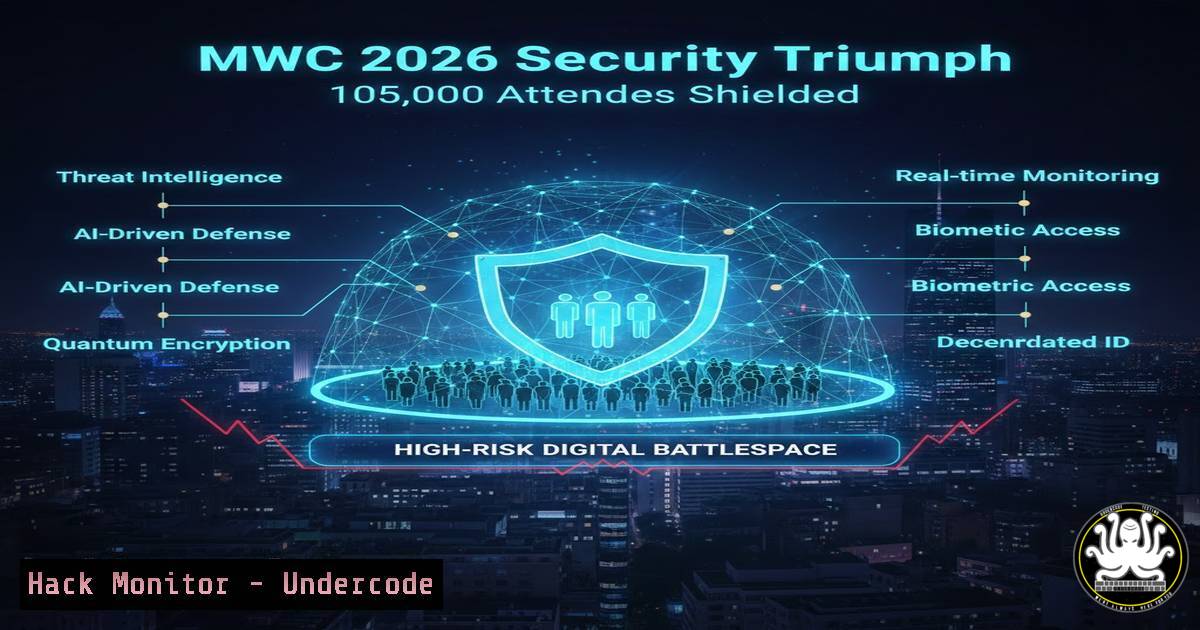
The recently concluded Mobile World Congress (MWC) 2026 in Barcelona wasn’t just a showcase of global connectivity; it was a testament to modern security convergence. With over 105,000 attendees from 207 countries, the event represented a massive attack surface for both physical threats and cyber intrusions. This article dissects the technical frameworks, operational coordination, and security stacks likely deployed to achieve “record security indicators,” providing a masterclass in securing large-scale, high-profile international events.
Learning Objectives:
- Understand the convergence of physical security (PS) and cybersecurity (IT) for large-scale events.
- Learn the command-line tools and configurations used for network segmentation and visitor Wi-Fi security.
- Analyze the role of SIEM, SOAR, and AI-driven surveillance in real-time threat detection.
- Identify best practices for supply chain risk management involving thousands of vendors.
- Explore post-event data handling and forensic analysis procedures.
1. The Network Segmentation Architecture: Isolating the Masses
Securing a venue with 2,900 participating companies requires a zero-trust network architecture. The goal is to provide internet access to attendees while isolating corporate backend operations, point-of-sale (POS) systems, and exhibitor demo environments.
Step‑by‑step guide: Configuring VLAN Isolation for Event Wi-Fi
This simulates the configuration on a Cisco enterprise switch or a Linux-based firewall (using iptables) to segregate traffic.
- Step 1: Define VLANs. Create separate VLANs for Attendees, Exhibitors, and Staff.
- Cisco Command:
configure terminal
vlan 100
name ATTENDEES
vlan 200
name EXHIBITORS
vlan 300
name STAFF_BACKEND
- Step 2: Assign to Switch Ports.
- Cisco Command: `interface gigabitEthernet0/1` then `switchport access vlan 100`
– Step 3: Implement Access Control Lists (ACLs). Prevent lateral movement (e.g., attendees scanning other attendees). - Cisco ACL: `access-list 101 deny ip 192.168.100.0 0.0.0.255 192.168.100.0 0.0.0.255 log`
– Step 4: Linux Firewall (iptables) for Gateway.
To block a specific subnet from accessing internal admin panels (e.g., IP 10.0.0.0/8):iptables -A FORWARD -s 192.168.100.0/24 -d 10.0.0.0/8 -j DROP iptables -A FORWARD -s 192.168.100.0/24 -p tcp --dport 22 -j DROP Block SSH scans
2. Rogue Access Point and De-Authorization Detection
With thousands of devices, “Evil Twin” attacks are a primary threat. Security teams must actively monitor the airwaves for MAC address spoofing and de-authentication floods used to force devices onto malicious networks.
Step‑by‑step guide: Using Aircrack-ng Suite for RF Monitoring
Note: Only perform on networks you own or have permission to test.
- Step 1: Enable Monitor Mode. Put your wireless card into monitoring mode to see all traffic.
sudo airmon-ng start wlan0
This creates a new interface, usually 'wlan0mon'
- Step 2: Scan for Rogue APs. Use `airodump-ng` to list all Access Points and Clients. Look for APs with the same SSID as the official “MWC-Guest” but with different BSSIDs (MAC addresses) or weak encryption.
sudo airodump-ng wlan0mon
- Step 3: Detect De-auth Attacks. Monitor for a high number of `Deauth` packets in the `airodump-ng` output. If a specific AP is showing thousands of deauths, it is likely under attack or is the attacker.
- Step 4: Countermeasure (WIDS). Enterprise systems use Wireless Intrusion Detection Systems (WIDS) like Cisco Prime or open-source solutions (e.g., Kismet) to automatically locate and contain rogue APs by flooding the channel they are on or alerting physical security to their location.
3. API Security and Application Layer Defense
Exhibitors often release demo apps or connect IoT devices. The GSMA’s 5G and IoT showcases are prime targets for API manipulation. Security here relies on Web Application Firewalls (WAF) and API gateways.
Step‑by‑step guide: Rate Limiting with Nginx to Prevent API Brute-Forcing
– Step 1: Define a Limit Zone in nginx.conf. This tracks requests by the client’s IP address.
http {
limit_req_zone $binary_remote_addr zone=mwc_api:10m rate=10r/s;
 Creates a 10MB zone called 'mwc_api' limiting to 10 requests per second.
}
– Step 2: Apply the Limit to the API Location.
server {
location /api/v1/demo/ {
limit_req zone=mwc_api burst=20 nodelay;
proxy_pass http://backend_servers;
}
}
What it does: Allows bursts of up to 20 requests over the limit but ensures sustained traffic is blocked, mitigating DDoS and credential stuffing.
4. Physical Access Control Integration (PSIM)
Modern security merges cyber with physical. A stolen badge or a breach in a restricted area must trigger an automated cyber-response (e.g., disabling the user’s VPN access or logging their network activity). This is managed by a Physical Security Information Management (PSIM) system.
Step‑by‑step guide: Simulating LDAP Deactivation
When a badge is reported stolen at the security desk, the PSIM system triggers a script to disable the user in Active Directory.
- PowerShell Command (Windows Server/AD): To disable a user account.
Disable-ADAccount -Identity "jdoe"
- Linux Command (FreeIPA/LDAP): To lock a user.
ipa user-disable jdoe
- Automation Logic: The PSIM sends an API call (e.g.,
POST /api/v1/identity/disable) to the Identity and Access Management (IAM) tool, which executes these commands, ensuring the physical breach doesn’t become a digital one.
5. CCTV Analytics and AI-Driven Threat Detection
“Unprecedented deployment of security” implies AI-powered CCTV. Cameras aren’t just recording; they are running algorithms to detect crowd anomalies, weapon shapes, or tailgating.
Step‑by‑step guide: Configuring Motion Detection with OpenCV (Conceptual)
While a full AI model is complex, the principle involves background subtraction.
– Python Snippet for Motion Heatmaps:
import cv2

cap = cv2.VideoCapture('camera_feed.mp4')
fgbg = cv2.createBackgroundSubtractorMOG2()

while True:
ret, frame = cap.read()
fgmask = fgbg.apply(frame)
 If fgmask shows too many white pixels in a restricted zone, alert.
if cv2.countNonZero(fgmask) > THRESHOLD:
print("Intrusion Detected in Zone Alpha")
 Trigger API to lock doors or alert guards
In a real MWC setting, this data is fed into a SIEM (like Splunk or Elasticsearch) to correlate physical alerts with network anomalies.
6. Post-Event Data Sanitization and Forensics
After the event, data privacy laws (GDPR) require the secure deletion of attendee data and forensic analysis of logs.
Step‑by‑step guide: Secure Deletion with Shred (Linux)
Before disposing of old servers or storage arrays used for CCTV footage and logs:
– Overwriting data: `shred -vfz -n 5 /dev/sdb`
– -v: verbose
– -f: force write permissions
– -z: add a final overwrite with zeros to hide shredding
– -n 5: overwrite the disk 5 times with random data
– Windows Command: Using `cipher` to overwrite free space.
cipher /w:C:\
What Undercode Says:
- Convergence is Key: The success at MWC 2026 underscores that cybersecurity cannot exist in a silo. The “record security indicators” were achieved by integrating badge access, camera feeds, and network traffic into a single pane of glass.
- Proactive Defense Wins: Waiting for an alert is too late. The heavy reliance on AI for anomaly detection (in both network traffic and physical spaces) shifted the strategy from reactive to predictive, allowing teams to disrupt potential threats before materialization.
- The scale of MWC required an automation-first approach. Manual configuration of 2,900 exhibitor networks is impossible. Infrastructure as Code (IaC) and automated API-driven security policies were the only way to maintain consistency and visibility across the massive attack surface.
Prediction:
Future iterations of MWC will likely move toward “Digital Twin” security modeling. Before the event even begins, security teams will run simulated attacks against a virtual replica of the Fira Barcelona network, using AI to predict how a specific zero-day exploit might spread through the 5G infrastructure, allowing pre-emptive patching and virtual “hardening” of the venue’s digital architecture before a single attendee arrives.
▶️ Related Video (80% Match):
🎯Let’s Practice For Free:
IT/Security Reporter URL:
Reported By: Oriolguerrero Mwc27 – Hackers Feeds
Extra Hub: Undercode MoN
Basic Verification: Pass ✅


