
Listen to this Post
Introduction:
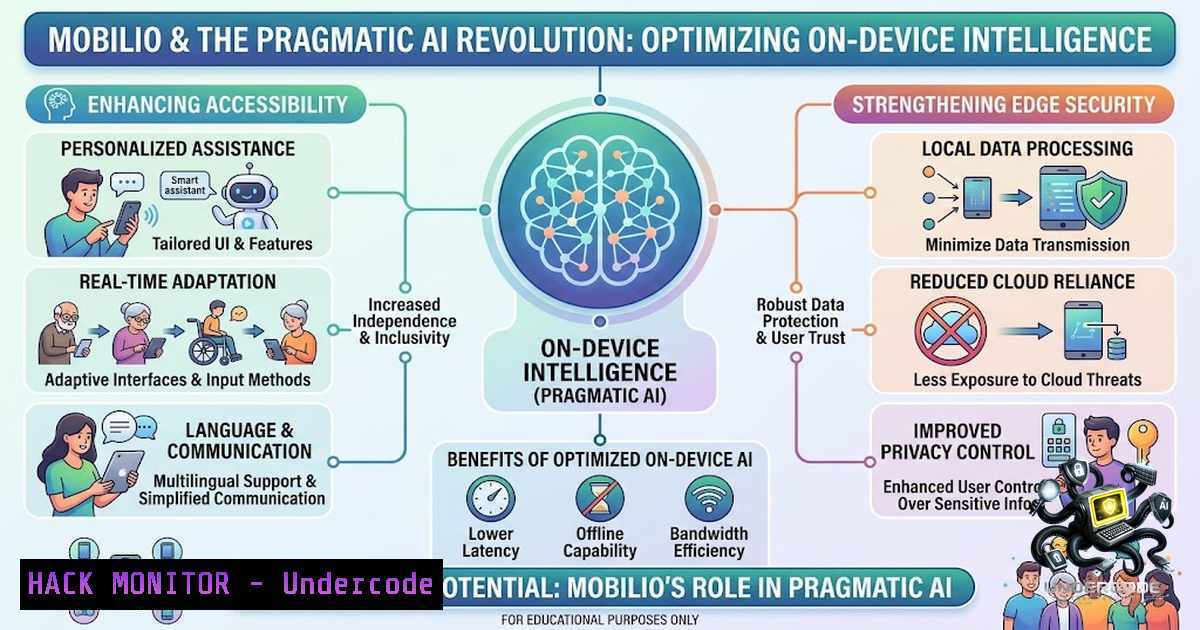
The artificial intelligence community often fixates on model parameter counts and benchmark leaderboards, yet the true measure of technological maturity lies in seamless integration into daily human workflows. Harvard’s development of Mobilio—a smartphone application assisting individuals with visual impairments—exemplifies a critical paradigm shift: leveraging existing hardware, such as smartphone sensors and cameras, to deliver high-impact AI solutions without custom hardware dependencies. For forward-deployed engineers and cybersecurity architects, this signifies a move toward “pragmatic AI,” where robust application security, real-time data processing, and personalized inference must operate within the stringent constraints of edge devices, emphasizing resilience and privacy-preserving architectures.
Learning Objectives & Secrets:
- Objective 1: Mastering On-Device Model Optimization for Security. Learn to quantize and prune neural networks for deployment on ARM-based architectures (Android/iOS) while ensuring the integrity of the inference pipeline against adversarial inputs.
- Objective 2: Sensor Fusion and API Hardening. Understand the architecture of fusing data from accelerometers, gyroscopes, and camera modules to trigger context-aware audio cues, focusing on securing the API endpoints that handle user-specific personalization data.
- Objective 3: Implementing Secure Personalization without Complexity. Secret tip: Utilize federated learning concepts locally to adjust audio cue thresholds, reducing the attack surface associated with transmitting biometric or behavioral data to the cloud.
You Should Know:
1. Cross-Platform Build Automation and Dependency Management
Building an application like Mobilio requires strict control over third-party libraries to prevent supply chain vulnerabilities. For a React Native or Flutter project, managing dependencies involves verifying checksums and utilizing dependency scanning tools.
– Step-by-step guide:
– Linux/macOS: Use `pip freeze` or `npm list` to generate a bill of materials. Integrate `OWASP Dependency-Check` (e.g., dependency-check --scan ./ --format HTML) into your CI/CD pipeline.
– Windows: Utilize PowerShell to verify the hash of downloaded SDKs: Get-FileHash .\tensorflow-lite.aar -Algorithm SHA256.
– Configuration: In `build.gradle` (Android), enforce strict versioning: `implementation(‘org.tensorflow:tensorflow-lite:2.13.0’) { transitive = false }` to limit dependency bloat and potential vulnerabilities.
2. Hardening the Camera-to-Model Pipeline
The application likely uses a continuous camera stream for object detection. To mitigate physical adversarial attacks (e.g., flashing images designed to confuse the model), implement input sanitization and statistical outlier detection.
– Step-by-step guide:
– Preprocessing: Resize images to a standard dimension (e.g., 224×224) using OpenCV to normalize input vectors.
– Security Layer: Add a lightweight autoencoder to reconstruct the image before inference. If the reconstruction loss exceeds a threshold (e.g., > 0.05), reject the frame. This is a defense against adversarial perturbations.
– Command-line check: For server-side validation, use `ffmpeg -i input.jpg -vf scale=224:224 output.jpg` to simulate preprocessing.
– Code Snippet (Python):
import numpy as np
def sanitize_image(frame):
 Basic clipping to remove adversarial outliers
return np.clip(frame, 0, 255).astype(np.uint8)
3. Audio Cue Generation and Secure Storage (Text-to-Speech)
Personalized audio cues require secure storage of user preferences. If using cloud-based TTS, ensure API keys are managed via a secrets vault rather than hard-coded in the app’s assets.
– Step-by-step guide:
– Android Keystore: Store API tokens using `KeyStore.getInstance(“AndroidKeyStore”)` to ensure they are hardware-backed.
– Encryption: Encrypt user-specific sound preferences using AES-256-GCM. Use `openssl enc -aes-256-gcm -salt -in config.json -out config.enc -pass pass:$(get_secret)` on the server.
– Network Security Config: Implement certificate pinning within the `network_security_config.xml` to prevent MITM attacks on the TTS endpoint.
4. Configuration Management and Environment Variables
To handle development vs. production environments (e.g., test audio vs. production audio models), employ strict environment separation.
– Step-by-step guide:
– Linux (Container): Pass variables via `docker run -e TTS_ENDPOINT=”https://secure.audio.com” -e LOG_LEVEL=”INFO” …`
– Windows: Set environment variables using
::SetEnvironmentVariable("MODEL_PATH", "C:\Models\", "User")</code>.
- CI/CD: Use `dotnet user-secrets` for .NET backends or `vault` commands to inject secrets during deployment.

<h2 style="color: yellow;">5. API Security and User Consent Management</h2>

Given the sensitivity of health-related data (vision impairment), compliance with HIPAA/GDPR is critical. The API must handle data anonymization and right-to-erasure requests.
- Step-by-step guide:
- Express.js/Node.js Middleware: Implement an audit log for every data access request.
- Linux Command: Use `jq` to parse JSON logs and grep for errors: <code>tail -f access.log | jq '.user_id, .action'</code>.
- Windows: Use `findstr` for log monitoring.
- Data Retention: Utilize a cron job (or Windows Task Scheduler) to run a script that deletes inactive user profiles:
[bash]
!/bin/bash
 Delete users inactive for > 2 years
find /data/users/ -type d -mtime +730 -exec rm -rf {} \;
6. Advanced Sensor Fusion Algorithm (Kalman Filtering)
To estimate the user's environment (indoor vs. outdoor) without draining the battery, software must efficiently filter sensor noise. This demonstrates the core lesson of "making better use of the device."
- Step-by-step guide:
- Android (Kotlin/Java): Implement a low-pass filter to smooth accelerometer data.
- Command-line testing: Use `adb shell dumpsys sensorservice` to check sensor availability and sample rate.
- Optimization: If the gyroscope drift exceeds a threshold, switch from vision-based tracking to solely audio-based guidance to save compute. This dynamic switching is a secret to building reliable agents.
7. Incident Response and Performance Monitoring
When deploying AI at the edge, monitoring for performance degradation (e.g., "AI drift") is vital for trust.
- Step-by-step guide:
- Prometheus Metrics: Expose a `/metrics` endpoint to track inference latency.
- Linux: Use `curl -s http://localhost:9090/metrics | grep inference_latency` to check in real-time.
- Alerting: Set up Alertmanager to notify developers if the 99th percentile latency exceeds 500ms, preventing a poor user experience.
What Undercode Say:
- Key Takeaway 1: "Innovation is not new hardware; it is the efficient orchestration of existing computational resources. The Mobilio app proves that high-level security and functionality can coexist on a smartphone if developers prioritize optimization over flash."
- Key Takeaway 2: "AI builders must pivot from model-centric to data-centric security. The application's success depends as much on the robustness of its sensor pipeline and user privacy settings as on the accuracy of its detection algorithms."
Analysis:
From a forward-deployed engineering perspective, Mobilio represents a critical use case for Graph RAG and LangGraph principles applied to context switching. The ability to parse a user's environment (the "graph") and deliver concise audio responses (the "RAG" retrieval) requires low-latency vector databases operating locally. The article implicitly warns against the "complexity trap"—where engineers build multi-cloud solutions when a simple, hardened SQLite database with encryption would suffice. The focus on "reducing friction" is a security boon; less complexity means fewer exposed API endpoints and a smaller attack surface. The emphasis on personalized audio cues without "becoming complicated" directly correlates to stringent access control lists (ACLs) that must be managed locally, avoiding cloud exposure of personal identifiers. Ultimately, this is a lesson in "Capability Mapping"—aligning AI models with user-owned endpoints to ensure both independence and data sovereignty.
Prediction:
- +1: Mobile devices will increasingly feature dedicated AI co-processors with TEE (Trusted Execution Environments), allowing sensitive inference to never leave the device, revolutionizing healthcare and accessibility privacy.
- +1: We will see a surge in "Compliance-as-Code" libraries for on-device models, enabling developers to effortlessly meet regional regulations (GDPR, HIPAA) via automated configuration files, much like security.txt for AI.
- -1: The reliance on built-in sensors opens a new vector for "Sensor Spoofing" cyberattacks; adversaries will attempt to feed manipulated gyroscope or magnetometer data to confuse navigation systems, necessitating robust multi-factor authentication for sensor inputs.
- +1: The open-source community will rapidly adopt "Optimization Adapters" (like LoRA) for visual models, allowing users to download small, model-specific weights over 5G without bloating storage, making AI truly ubiquitous.
- -1: The market may see fragmentation as Android and iOS implement divergent security APIs for camera and audio access, increasing the development cost and potential security misconfigurations for developers trying to maintain universal accessibility.
▶️ Related Video (80% Match):
🎯Let’s Practice For Free:
🎓 Live Courses & Certifications:
Join Undercode Academy for Verified Certifications
🚀 Request a Custom Project:
Secure, high-velocity infrastructure and disruptive technological engineering. Contact our engineering team for high-tier development and proprietary systems:
[email protected]
💎 Smart Architecture | 🛡️ Secure by Design | ⭐ Trusted by Thousands
IT/Security Reporter URL:
Reported By: https://lnkd.in/p/eYsrRJdX - Hackers Feeds
Extra Hub: Undercode MoN
Basic Verification: Pass ✅


