Listen to this Post
Introduction:
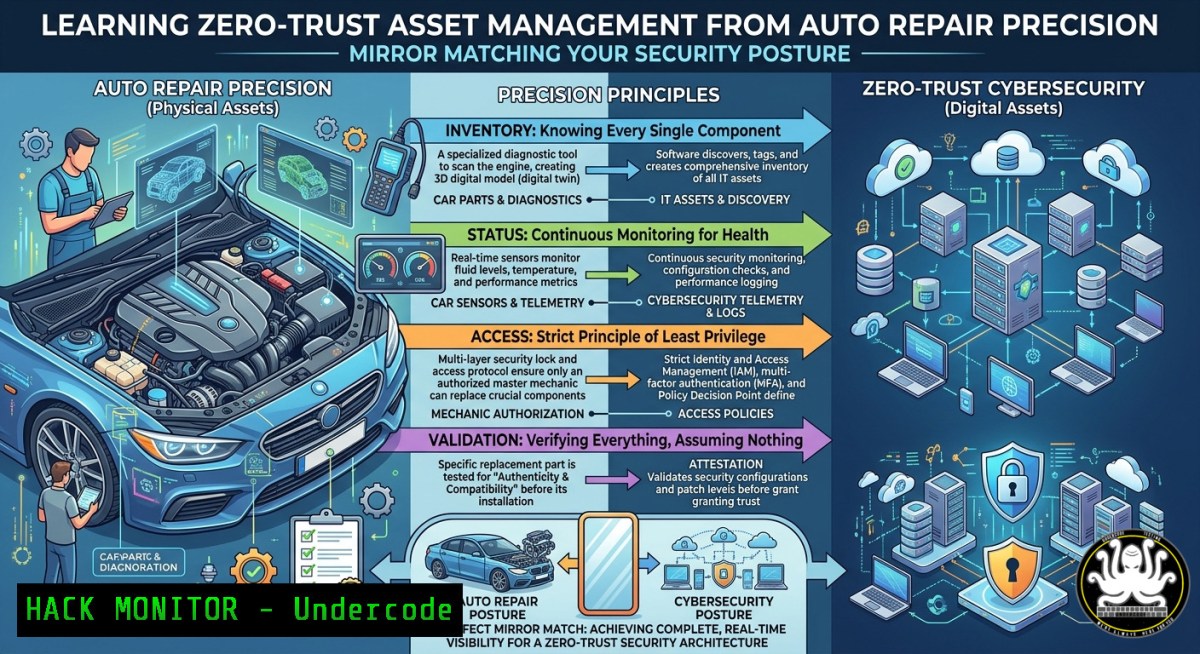
In auto body repair, precision organization—labeling every part, mirror‑matching components before painting, and catching issues early—directly determines cycle time, liability, and safety. The same principles apply to cybersecurity: asset inventory, configuration validation, and proactive drift detection form the backbone of a resilient security posture. This article translates the “cutting edge diagnostics” approach from collision repair into a technical playbook for IT, cloud, and AI security, complete with verified commands and hardening steps.
Learning Objectives:
- Implement a labeled, auditable asset management system for Linux and Windows endpoints.
- Perform “mirror matching” configuration validation using cryptographic hashes and diff tools.
- Build a data‑driven incident response workflow that eliminates mid‑breach delays.
You Should Know:
- Labeled Cart System for Digital Assets – Inventory & Discovery
The core of any repair shop’s efficiency is knowing exactly where each part resides. In cybersecurity, this translates to continuous asset discovery and tagging. Without an up‑to‑date inventory, you cannot defend what you cannot see.
Step‑by‑step guide – Linux (using lshw, dmidecode, and ansible‑cmdb):
 Generate detailed hardware inventory
sudo lshw -json > hardware_inventory.json

Extract serial numbers and firmware versions
sudo dmidecode -s system-serial-number
sudo dmidecode -s bios-version

Install and run ansible-cmdb to create a static HTML asset dashboard
sudo apt install ansible ansible-cmdb  Debian/Ubuntu
ansible all -m setup --tree /tmp/facts
ansible-cmdb /tmp/facts > inventory_report.html
Step‑by‑step guide – Windows (PowerShell):
 Get all physical hardware info
Get-WmiObject Win32_ComputerSystem | Select-Object Name, Manufacturer, Model
Get-WmiObject Win32_BIOS | Select-Object SerialNumber, Version

Export installed software to CSV
Get-WmiObject Win32_Product | Select-Object Name, Version, Vendor | Export-Csv -Path "software_inventory.csv"

Use Sysinternals autoruns for startup persistence
.\autoruns64.exe -a -c > autoruns_list.csv
For cloud environments, use AWS Config or Azure Resource Graph to label every resource with environment:production, data_classification:regulated. Automate missing‑tag alerts via Cloud Custodian.
- Mirror Matching – Configuration Drift Detection & Validation
“Mirror matching” in auto repair means comparing every new part to the old one immediately. In IT security, you must compare current system configurations against a known‑good baseline to catch unauthorized changes before they cause breaches.
Step‑by‑step guide – File integrity monitoring with `aide` (Linux):
 Initialize AIDE database
sudo apt install aide
sudo aideinit
sudo mv /var/lib/aide/aide.db.new /var/lib/aide/aide.db

Run integrity check
sudo aide --check

Automate daily with cron
echo "0 2    root /usr/bin/aide --check | mail -s 'AIDE Report' [email protected]" | sudo tee -a /etc/crontab
Step‑by‑step guide – Windows using PowerShell DSC and Get-FileHash:
 Compute baseline hashes for critical system files
Get-ChildItem C:\Windows\System32.dll | Get-FileHash -Algorithm SHA256 | Export-Csv -Path "baseline_hashes.csv"

Compare current state
$baseline = Import-Csv "baseline_hashes.csv"
$current = Get-ChildItem C:\Windows\System32.dll | Get-FileHash -Algorithm SHA256
Compare-Object -ReferenceObject $baseline -DifferenceObject $current -Property Hash | Where-Object {$_.SideIndicator -eq "=>"} | Export-Csv "drift_report.csv"

Deploy DSC to enforce config state
Configuration SecureConfig {
Node "webserver01" {
Registry RegistryLockdown {
Ensure = "Present"
Key = "HKLM:\SOFTWARE\Microsoft\Windows\CurrentVersion\Policies\System"
ValueName = "EnableLUA"
ValueData = "1"
ValueType = "DWord"
}
}
}
In Kubernetes, use `kubectl diff` and admission controllers like Kyverno to mirror‑match manifests before deployment.
- Catching Potential Issues Early – Pre‑Deployment Security Validation
The post emphasizes “by catching potential issues early, we eliminate mid‑repair delays.” In DevSecOps, this means shifting left: scanning IaC, containers, and secrets before they reach production.
Step‑by‑step guide – CI/CD pipeline security (GitHub Actions example):
name: Pre-Deploy Security Mirror
on: [bash]
jobs:
mirror-match:
runs-on: ubuntu-latest
steps:
- uses: actions/checkout@v4
- name: Scan Terraform with tfsec
run: |
docker run --rm -v $(pwd):/src aquasec/tfsec /src
- name: Secret detection with truffleHog
run: |
docker run --rm -v $(pwd):/pwd trufflesecurity/trufflehog:latest filesystem /pwd
- name: Container image CVE scan (trivy)
run: |
trivy image --severity HIGH,CRITICAL myapp:latest
For API security, use `curl` and `jq` to mirror‑match OpenAPI specs against live responses:
 Validate response schema matches expected
curl -s https://api.example.com/v1/parts | jq -e 'has("id") and has("status")' || echo "Mirror mismatch!"
- Reducing Carrier Liability – Cyber Compliance & Hardening
Insurance carriers and adjusters require factory‑spec safety. Similarly, cyber liability insurers demand adherence to frameworks like CIS Benchmarks or NIST 800‑53. Reducing liability means enforceable, auditable hardening.
Step‑by‑step guide – CIS‑inspired hardening for Linux (using `lynis` and fail2ban):
 Run lynis audit
sudo apt install lynis
sudo lynis audit system --quick > lynis_report.txt

Harden SSH
sudo sed -i 's/PermitRootLogin yes/PermitRootLogin no/' /etc/ssh/sshd_config
sudo sed -i 's/MaxAuthTries 6/MaxAuthTries 3/' /etc/ssh/sshd_config
sudo systemctl restart sshd

Install and configure fail2ban for API endpoints
sudo apt install fail2ban
sudo tee /etc/fail2ban/jail.local <<EOF
[bash]
enabled = true
maxretry = 3
bantime = 3600
EOF
sudo systemctl enable fail2ban --now
Windows hardening (PowerShell as Admin):
 Disable SMBv1 (known ransomware vector)
Disable-WindowsOptionalFeature -Online -FeatureName SMB1Protocol -Remove

Enforce NTLMv2 only
Set-ItemProperty -Path "HKLM:\SYSTEM\CurrentControlSet\Control\Lsa" -Name "LmCompatibilityLevel" -Value 5

Enable Windows Defender Credential Guard (HVCI)
$RegPath = "HKLM:\SYSTEM\CurrentControlSet\Control\DeviceGuard"
Set-ItemProperty -Path $RegPath -Name "EnableVirtualizationBasedSecurity" -Value 1
For cloud, enforce Azure Policy or AWS SCPs that block non‑compliant resource creation (e.g., public S3 buckets).
- Data‑Driven Process for Incident Response – Eliminating Mid‑Breach Delays
Just as the shop follows a data‑driven process to ensure road‑ready reliability, a SOC must follow a playbook that reduces dwell time. The “labeled cart” analogy applies to forensic artifacts: log sources, memory dumps, and network captures must be easily discoverable.
Step‑by‑step guide – Building an IR data pipeline with Elastic Stack:
 Install Filebeat to ship Windows Event Logs
curl -L -O https://artifacts.elastic.co/downloads/beats/filebeat/filebeat-8.x-amd64.deb
sudo dpkg -i filebeat-8.x-amd64.deb
sudo filebeat modules enable windows
sudo filebeat setup --dashboards
sudo systemctl start filebeat

Query Zeek/IDS logs for indicator enrichment
docker run --rm -v $(pwd)/logs:/logs zeek/zeek:latest zeek-cut -d /logs/conn.log time id.orig_h id.resp_h proto service
Windows IR command checklist:
 Collect running processes, network connections, and scheduled tasks
Get-Process | Export-Csv -Path "$env:COMPUTERNAME_ps.csv"
netstat -ano > $env:COMPUTERNAME_netstat.txt
schtasks /query /fo CSV > $env:COMPUTERNAME_tasks.csv
 Capture RAM using DumpIt or winpmem
.\winpmem_2.1.post4.exe $env:COMPUTERNAME.raw
Automate the “mirror match” of live process lists against a known good baseline using `Autoruns` and sigcheck.
6. Precision Craftsmanship in Security Training & Simulation
The original post states “Precision craftsmanship isn’t just a goal: it’s how we work every day.” For security teams, this means continuous, hands‑on training. Leverage AI‑powered attack simulators and blue team labs.
Step‑by‑step guide – Deploying a free training range with Calico & PwK (Pentester Lab):
 Install Docker and pull vulnerable images for OWASP Juice Shop
docker pull bkimminich/juice-shop
docker run -d -p 3000:3000 bkimminich/juice-shop

Set up Metasploitable for blue team mirror matching (old vs new exploits)
 After VM is running, scan against baseline
nmap -sV -oA baseline_scan 192.168.1.100
 After applying patches, compare:
nmap -sV -oA patched_scan 192.168.1.100
diff baseline_scan.xml patched_scan.xml
AI‑driven training: Use MITRE CALDERA to automate adversary emulation and measure response times. Install with:
git clone https://github.com/mitre/caldera.git
cd caldera && docker-compose up -d
 Access at http://localhost:8888, plugin training plans
Recommended training courses (aligned with the post’s “data‑driven process”):
– SANS SEC504: Hacker Tools, Techniques, and Incident Handling
– eLearnSecurity Certified Incident Responder (eCIR)
– AWS Security Essentials – Cloud hardening lab
– AI Security: OWASP Top 10 for LLMs (free course by Lakera)
What Undercode Say:
- Key Takeaway 1: Organization is not an end state but a real‑time, enforced process. In cybersecurity, a labeled asset inventory with automated drift detection reduces “mid‑breach delays” just as a labeled cart system reduces mid‑repair delays.
- Key Takeaway 2: Mirror matching – comparing current state to a trusted baseline – is the most effective early warning system. Whether for file hashes, API schemas, or cloud configurations, catching a mismatch before deployment eliminates liability and prevents cascading failures.
Analysis: The collision repair workflow implicitly follows a zero‑trust model: every part is verified, every step is tracked, and no assumption of correctness is carried over from previous repairs. Cybersecurity leaders should adopt the same discipline – shift from periodic audits to continuous, automated “mirror matches” of their entire stack. The commands and examples above provide a starting toolkit, but the real cultural shift is in refusing to skip steps even when pressure hits (as Toby J. Daniel’s comment warns). Where most shops abandon the labeled cart system when jobs back up, most security teams abandon incident playbooks during a live breach. The solution is hardcoded automation and immutable baselines.
Prediction:
In the next 18 months, cyber insurance carriers will mandate “mirror matching” telemetry – continuous configuration validation and asset integrity checks – as a prerequisite for liability coverage, similar to how auto insurers now require telematics or dashcams. AI‑driven drift detection will become as standard as antivirus, and organizations that fail to automate these comparisons will see premiums rise or coverage denied. The collision repair industry’s precision craftsmanship will be mirrored in cybersecurity, where real‑time, labeled, and verified asset states become the new factory spec.
▶️ Related Video (82% Match):
🎯Let’s Practice For Free:
IT/Security Reporter URL:
Reported By: Cutting Edge – Hackers Feeds
Extra Hub: Undercode MoN
Basic Verification: Pass ✅


