Listen to this Post
Introduction:
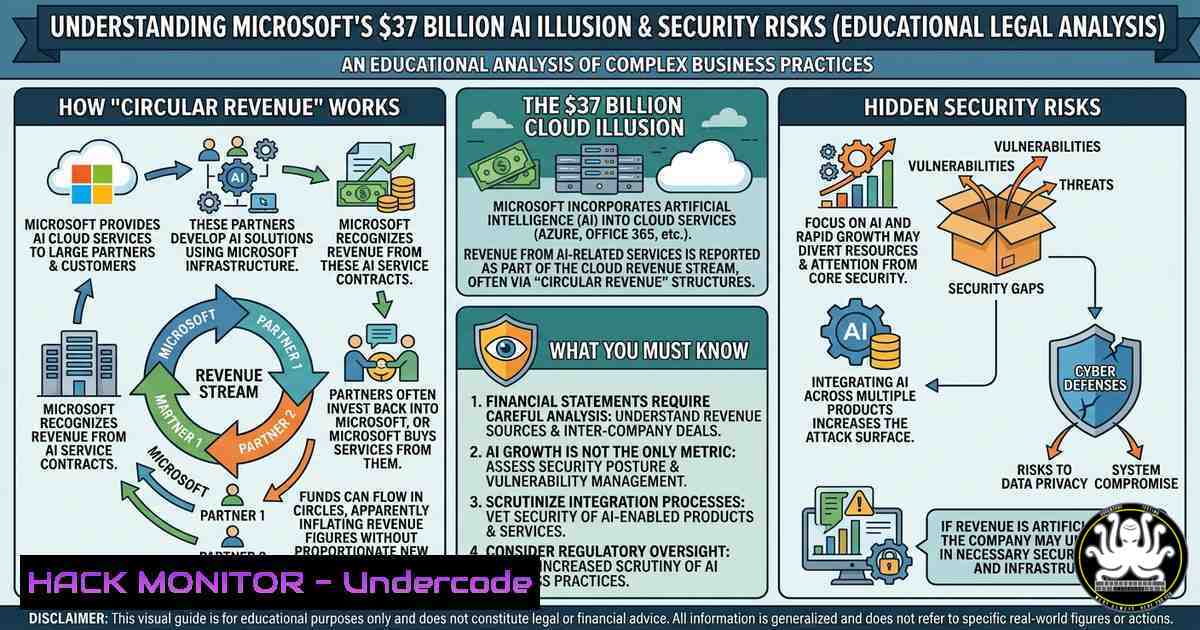
Microsoft’s reported $37 billion in AI revenue sounds like explosive growth, but a closer look reveals that the bulk comes from a circular arrangement: OpenAI burning Microsoft’s own investment on Azure compute. For cybersecurity, IT, and AI professionals, this isn’t just an accounting curiosity—it highlights critical risks around cloud concentration, workload monitoring, and the security of AI inference pipelines. Understanding where your AI spend actually goes is the first step to hardening your infrastructure against hidden vulnerabilities.
Learning Objectives:
- Identify circular cloud revenue patterns and why they matter for security asset allocation and cloud governance.
- Apply Linux and Windows commands to audit AI workload spend, monitor GPU utilization, and detect anomalous compute consumption.
- Implement step-by-step hardening techniques for Azure AI workloads, Copilot deployments, and API-driven inference services.
You Should Know:
- Auditing AI Compute Spend: Detecting Circular or Anomalous Workloads on Azure
Start with an extended version of what the post is saying: The largest driver of Microsoft’s AI revenue is OpenAI running entirely on Microsoft infrastructure. Every invested dollar returns as earnings, creating a closed loop that obscures genuine customer demand. In security terms, this means a single tenant (OpenAI) accounts for up to 81% of that $37B (Azure AI Compute). If you manage an enterprise Azure subscription, similar concentration risks exist—one over-provisioned AI project can dominate your spend and introduce a single point of failure or attack.
Step-by-step guide to audit your own environment for circular or anomalous AI compute patterns:
Linux (using Azure CLI and jq):
 Login to Azure and set subscription
az login
az account set --subscription "YourSubscriptionID"

List all AI/ML workspaces and their associated compute costs
az ml workspace list --query "[].{Name:name, Location:location}" -o table

Retrieve detailed usage for GPU VMs (NCas, NDas series) over last 30 days
az consumption usage list --query "[?contains(instanceName, 'NC') || contains(instanceName, 'ND')]" --max-items 50

Calculate total spend per resource group (find circular or internal spend)
az consumption usage list --query "group_by(@, &resourceGroup) | map({rg: resourceGroup[bash], total: sum(@[].pretaxCost)}, &@)" -o json | jq '.[] | select(.total > 1000)'

Monitor anomaly detection on compute runtimes (install jq first)
az monitor metrics list --resource "/subscriptions/{sub}/resourceGroups/{rg}/providers/Microsoft.MachineLearningServices/workspaces/{ws}" --metric "Active Cores" --interval PT1H | jq '.value[bash].timeseries[].data[-10:]'
Windows (PowerShell with Az module):
 Install Azure Az module if not present
Install-Module -Name Az -Force -AllowClobber

Connect and set subscription
Connect-AzAccount
Set-AzContext -SubscriptionId "YourSubscriptionID"

Get cost by resource group and filter AI-related tags
$cost = Get-AzConsumptionUsageDetail -BillingPeriodName "202603" | Where-Object {$<em>.InstanceName -like "NC" -or $</em>.InstanceName -like "ND"}
$cost | Group-Object ResourceGroup | Select-Object Name, @{Name="Total";Expression={($_.Group | Measure-Object PretaxCost -Sum).Sum}}

Identify any resource group with abnormal month-over-month growth
$lastMonth = Get-AzConsumptionUsageDetail -BillingPeriodName "202602" | Measure-Object PretaxCost -Sum
$thisMonth = $cost | Measure-Object PretaxCost -Sum
Write-Host "Growth: $($thisMonth.Sum - $lastMonth.Sum) USD"
What this does and how to use it: These commands help you isolate which workloads are driving AI compute costs, flag internal “recycled” spend (e.g., dev/test environments using paid production compute), and identify unexpected spikes that could indicate crypto mining or unauthorized inference jobs. Run them weekly as part of a FinOps and security review.
- Hardening Azure AI Workloads Against Single-Tenant Concentration Risks
Step-by-step guide: The post highlights that OpenAI is the single largest AI workload on Azure. In your own environment, a single model, project, or external partner consuming massive compute can become a security and availability hazard. Use these steps to enforce workload isolation, quota limits, and anomaly detection.
Linux / Azure CLI:
 Set a compute quota on specific VM families to prevent runaway spend
az vm list-sizes --location eastus --query "[?contains(name, 'NC')].[bash]" -o tsv | while read size; do
az quota update --resource-name $size --resource-provider Microsoft.Compute --limit 10 --location eastus
done

Deploy a network security group to restrict inference endpoints to only authorized IPs
az network nsg create --name "AI-Inference-NSG" --resource-group "AI-Security-RG" --location eastus
az network nsg rule create --nsg-name "AI-Inference-NSG" --name "AllowTrustedIPs" --priority 100 --direction Inbound --access Allow --protocol Tcp --destination-port-ranges 443 --source-address-prefixes "192.168.1.0/24"

Enable diagnostic logs for all AI workloads to audit every API call
az monitor diagnostic-settings create --name "AIWorkloadAudit" --resource "/subscriptions/{sub}/resourceGroups/{rg}/providers/Microsoft.MachineLearningServices/workspaces/{ws}" --logs "[{\"category\":\"AuditEvent\",\"enabled\":true}]" --storage-account "yourstorageaccount"
Windows PowerShell:
 Set a budget alert for any AI resource group exceeding threshold
New-AzConsumptionBudget -Name "AIBudgetCap" -Amount 50000 -Category "Cost" -TimeGrain "Monthly" -Scope "/subscriptions/{sub}/resourceGroups/AI-Prod-RG" -NotificationKey "Exceeded50k" -NotificationThreshold 0.9 -ContactEmail "[email protected]"

Enforce Azure Policy to prevent deployment of high-cost VMs without approval
$policy = '{
"if": {
"allOf": [
{ "field": "type", "equals": "Microsoft.Compute/virtualMachines" },
{ "field": "Microsoft.Compute/virtualMachines/sku.name", "in": ["NC24s_v3","ND96asr_v4"] }
]
},
"then": { "effect": "deny" }
}'
New-AzPolicyDefinition -Name "RestrictHighCostAI" -Policy $policy -Description "Blocks unauthorized GPU VM deployments"
These hardening steps prevent a single compromised API key or over-provisioned project from racking up millions in “circular” costs while also limiting blast radius if an inference endpoint is abused.
- Securing Microsoft 365 Copilot: From $7 Billion Illusion to Real-World Threat Surface
The post states that Copilot is at most one-quarter of the $37B, with 20 million paid seats but low genuine adoption. For security teams, Copilot introduces new data leakage vectors: it has access to user emails, chats, documents, and calendar events. If you must deploy Copilot, here’s how to lock it down.
Step-by-step Copilot security configuration (Microsoft 365 Admin Center & PowerShell):
First, audit existing Copilot assignments and usage:
 Connect to Exchange Online and Microsoft Graph
Connect-ExchangeOnline
Connect-MgGraph -Scopes "User.Read.All", "Organization.Read.All"

List all users with Copilot licenses (requires a license report)
Get-MgUser -Filter "assignedLicenses/any(x:x/skuId eq 'cfd8ec3c-4b7a-4a1c-9c8d-1234567890ab')" -All

Export Copilot interactions via Audit log (last 7 days)
Search-UnifiedAuditLog -Operations "CopilotInteraction" -StartDate (Get-Date).AddDays(-7) -ResultSize 5000 | Export-Csv "CopilotAudit.csv"
Linux / REST API approach to monitor Copilot data flows:
 Use Microsoft Graph API to get Copilot event logs
tenant_id="yourtenant"
client_id="yourappid"
client_secret="secret"
resource="https://graph.microsoft.com"

token=$(curl -s -X POST https://login.microsoftonline.com/$tenant_id/oauth2/v2.0/token -d "client_id=$client_id&scope=https://graph.microsoft.com/.default&client_secret=$client_secret&grant_type=client_credentials" | jq -r '.access_token')

Retrieve Copilot usage reports (preview endpoint)
curl -X GET "https://graph.microsoft.com/v1.0/reports/getCopilotUsageUserDetail(period='D7')" -H "Authorization: Bearer $token" -H "Content-Type: application/json" | jq '.value[] | {userId, lastActivityDate, interactionCount}'
Hardening actions:
- Go to Microsoft 365 Purview compliance portal → Data loss prevention (DLP) → Create policy for Copilot to block sharing of credit card numbers or SSH keys.
- Set session timeout for Copilot to 15 minutes in Azure AD Conditional Access (requires “Session control” policy).
- Disable Copilot for high-risk users (finance, HR, security admins) using PowerShell:
$user = Get-MgUser -Filter "userPrincipalName eq '[email protected]'"
Remove-MgUserLicense -UserId $user.Id -SkuId "cfd8ec3c-4b7a-4a1c-9c8d-1234567890ab"
- API Security for AI Inference: Preventing OpenAI/Azure API Abuse
The post notes OpenAI’s Azure spend dominates, but any enterprise using OpenAI APIs (direct or via Azure) faces similar risks: credential leakage, model extraction, and runaway inference costs. Here’s a Linux/Windows tutorial to lock down your API keys and monitor usage.
Step-by-step API security for Azure OpenAI:
Linux (using cURL and jq):
 Rotate and restrict API keys automatically
az cognitiveservices account keys list --name "YourOpenAI" --resource-group "RG" --query "key1"

Set rate limits per key using Azure API Management
az apim api create --resource-group "RG" --service-name "APIM" --api-id "openai-api" --display-name "OpenAI Proxy" --path "openai" --protocols https
az apim api policy set --resource-group "RG" --service-name "APIM" --api-id "openai-api" --policy-file rate-limit-policy.xml

Sample rate-limit-policy.xml content:
 <policies><inbound><rate-limit calls="100" renewal-period="60" /></inbound></policies>
Windows (PowerShell):
 Audit all OpenAI API calls in Azure Monitor
$workspace = Get-AzOperationalInsightsWorkspace -ResourceGroupName "RG" -Name "LogAnalytics"
$query = "AzureDiagnostics | where ResourceProvider == 'MICROSOFT.COGNITIVESERVICES' | where OperationName == 'Completion' | summarize Count = count() by CallerIPAddress, bin(TimeGenerated, 1h) | where Count > 1000"
$result = Invoke-AzOperationalInsightsQuery -Workspace $workspace -Query $query
$result.Results | Export-Csv "APIAbuse.csv"

Block IPs with high anomaly count using Azure Firewall
$rule = New-AzFirewallApplicationRule -Name "BlockMaliciousAI" -SourceAddress "10.0.0.0/24" -TargetFqdn ".openai.azure.com" -Protocol @{ProtocolType="Https"; Port=443} -Action Deny
Tutorial:
- Step 1: Never embed API keys in code. Use Azure Key Vault.
- Step 2: Enable Defender for Cloud’s “AI threat protection” (costs extra but detects prompt injection).
- Step 3: Implement token bucket throttling using Redis (works across both Linux and Windows).
5. Cloud Hardening Against “Circular” Supply Chain Attacks
The comment comparing Microsoft’s circular deals to Enron is a warning: in IT, circular dependencies can mask backdoors. If OpenAI’s code runs on Azure, and Microsoft’s security tools monitor OpenAI, an attacker could exploit this loop. Break the cycle with these verification steps.
Linux (containers and SBOM):
 Generate SBOM for any AI container you deploy
docker run --rm -v /var/run/docker.sock:/var/run/docker.sock anchore/syft alpine:latest -o spdx-json > ai-container-sbom.json

Check for known vulnerabilities in OpenAI-related images
docker run --rm -v /var/run/docker.sock:/var/run/docker.sock aquasec/trivy image openai/azure-compute:latest

Monitor for unauthorized egress from compute instances (which could exfiltrate models)
sudo tcpdump -i eth0 dst net 0.0.0.0/0 and not dst port 443 -c 100
Windows (PowerShell + Sysmon):
 Install Sysmon to log all process creation (detect AI inference tools running unexpectedly)
sysmon64 -accepteula -i sysmonconfig.xml

Monitor for network connections to Azure IPs that are not approved
Get-NetTCPConnection | Where-Object {$<em>.RemotePort -eq 443 -and $</em>.State -eq "Established"} | Select-Object LocalAddress, RemoteAddress, OwningProcess

Run a circular dependency check using Graph PowerShell
Get-MgServicePrincipal -Filter "appId eq '06a5b4d0-8a4c-4b6e-9b0e-1234567890ab'" | Get-MgServicePrincipalTransitiveMemberOf
What this does: The commands uncover hidden dependencies and potential supply chain risks—e.g., a container using a vulnerable base image, or an Azure function that calls another function in a loop, creating an unmonitored circular data flow. Run these weekly.
What Undercode Say:
- Circular cloud revenue is not fraud, but it creates a false sense of market validation that often leads to underfunded security for actual customer-facing AI workloads.
- Security teams must demand visibility into “internal” compute spend and treat every AI workload—even first-party—as a potential attack surface.
Expected Output:
Introduction:
[Already provided above]
What Undercode Say:
- Key Takeaway 1: The $37B number inflates perceived adoption, causing executives to skip proper risk assessments for Copilot and Azure AI—don’t fall for it; treat every AI service as high risk until audited.
- Key Takeaway 2: Concentration of compute (e.g., one tenant like OpenAI) introduces a single point of failure; apply the same zero-trust principles to cloud spend that you do to network access.
Expected Output:
Prediction:
Within 18 months, a major breach will occur via a circular AI dependency—likely an attacker pivoting from an over-privileged OpenAI workload into Azure’s control plane. Regulators will then mandate that hyperscalers separately report “internal” vs. “external” AI revenue, and security frameworks like NIST AI 600-1 will add specific controls for circular compute transparency. Start preparing now by implementing the command-line audits and hardening steps outlined above.
▶️ Related Video (72% Match):
🎯Let’s Practice For Free:
IT/Security Reporter URL:
Reported By: Hahnwo Ceo – Hackers Feeds
Extra Hub: Undercode MoN
Basic Verification: Pass ✅


