Listen to this Post
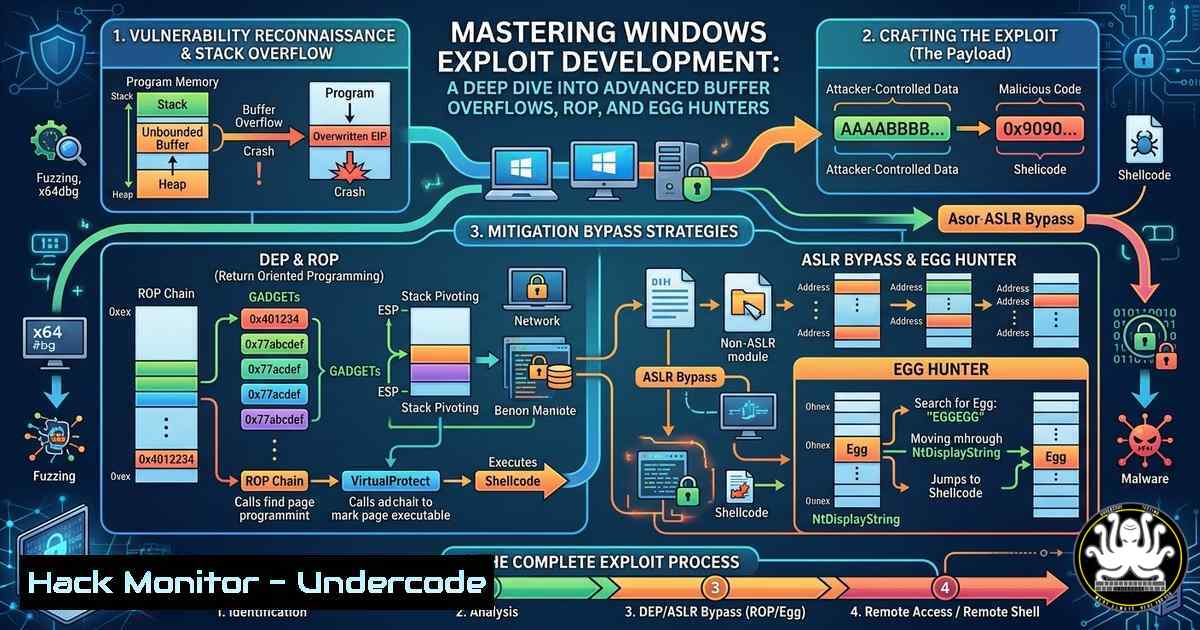
Introduction:
As software defenses evolve, so too must the techniques used to find and exploit their weaknesses. Windows exploit development remains a critical skill for security researchers and penetration testers who need to understand how vulnerabilities can be weaponized. Moving beyond simple stack overflows, modern exploitation requires a deep understanding of memory protection mechanisms and creative coding to bypass them, using tools like WinDbg to dissect processes at the assembly level.
Learning Objectives:
- Understand the architecture of Windows memory and how to analyze crashes using the WinDbg debugger.
- Master the construction of ROP (Return Oriented Programming) chains to bypass Data Execution Prevention (DEP).
- Learn to create advanced exploit components like Egg Hunters and Unicode-based shellcode to navigate restrictive memory environments.
You Should Know:
- Setting Up Your Windows Exploitation Lab and WinDbg
Before diving into exploit creation, a proper environment is essential. Modern Windows versions include numerous protections, so your lab should ideally run a vulnerable 32-bit application on a Windows 10 or 11 VM for practice. WinDbg (preferably the WinDbg Preview from the Microsoft Store) is the debugger of choice.
- Installation: Download WinDbg from the Microsoft Store or via the Windows SDK.
- Attaching to a Process:
- Open WinDbg as Administrator.
- Use `File > Attach to a Process` or the keyboard shortcut `F6` to select the vulnerable application.
- Alternatively, launch an application directly for debugging using
File > Launch Executable. - Essential Commands: Once attached, you can control execution and inspect memory.
– `g` – Go (execute the program).
– `bp kernel32!VirtualProtect` – Set a breakpoint on a specific function.
– `dd esp L10` – Display the memory contents at the top of the stack.
– `!teb` – Display the Thread Environment Block, useful for locating stack limits.
2. Fuzzing and Controlling the Instruction Pointer (EIP)
The first step in any exploit is to crash the application and gain control of the Instruction Pointer (EIP), which tells the program where to execute code next.
- Fuzzing: Send incrementally larger strings of data to the application’s input vector (e.g., a listening port or a local file) until it crashes.
- Pattern Creation: Once a crash is identified, use a unique string to pinpoint the exact offset. In Kali Linux, you can use:
Create a 5000-byte pattern
/usr/share/metasploit-framework/tools/exploit/pattern_create.rb -l 5000
- Offset Identification: After the crash, find the value in the EIP register within WinDbg. Use this value to find the offset:
/usr/share/metasploit-framework/tools/exploit/pattern_offset.rb -q 39694438
- Verification: Modify your exploit script to send exactly that many “A” characters, followed by “B” characters (4 bytes) to overwrite EIP. If the EIP becomes `42424242` (hex for “BBBB”), control is confirmed.
3. Crafting an Egg Hunter for Sparse Memory
In complex exploits, your main shellcode might be too large to fit in the initial buffer, or it might be placed in an unpredictable memory location. An Egg Hunter is a small piece of shellcode that searches the process memory for a specific “egg” (a unique 4-byte tag) followed by the actual payload.
- The Concept: The hunter iterates through memory pages, looking for the egg. Once found, it jumps to the code immediately following the egg.
- Assembly Logic (NASM Syntax): A basic Windows Egg Hunter might look for a tag like “w00t”.
; Set the starting address to search (e.g., 0x00000000)
xor edx, edx
; PAGE_SIZE increment
page_scan:
or dx, 0xFFF
next_address:
inc edx
; Load the egg candidate into eax
mov eax, [bash]
; Compare with egg "w00t" (0x74303077 in hex)
cmp eax, 0x74303077
jnz next_address
; Check the next 4 bytes for the second part of the egg (optional, for uniqueness)
cmp [edx+0x4], 0x74303077
jnz next_address
; Egg found, jump to the shellcode (after the 8-byte egg)
jmp edx
- Integration: Convert this assembly to opcodes using a tool like `nasm` and place it in your initial buffer. The large payload is prefixed with `w00tw00t` and placed elsewhere in memory.
4. Bypassing DEP with Return Oriented Programming (ROP)
Data Execution Prevention (DEP) marks memory pages like the stack as non-executable. You cannot simply jump to your shellcode on the stack. ROP bypasses this by chaining together small sequences of existing code (gadgets) ending in a `ret` instruction. These gadgets perform small operations, eventually calling a function like `VirtualProtect` to make the stack executable.
- Finding Gadgets: Use a tool like `rp++` or `mona.py` in Immunity Debugger to scan the executable and its loaded modules for useful gadgets.
Using rp++ on a target executable
rp-win-x86.exe -f vulnerable_app.exe -r 5 > gadgets.txt
- Constructing the Chain: A typical ROP chain to call `VirtualProtect` requires setting up the stack with the correct parameters:
- Address of the memory region to change (the stack).
2. Size of the region.
3. New protections (`0x40` for `PAGE_EXECUTE_READWRITE`).
- A pointer to a variable to receive the old protection.
- The return address for `VirtualProtect` (often set to the shellcode address).
– Chain Example: You need gadgets to pop these values into registers. A chain in your buffer might look like this (conceptual):
[Gadget: POP EAX; RET] -> [Value: 0x40 (PAGE_EXECUTE_READWRITE)]
[Gadget: POP ECX; RET] -> [Address of memory to change]
[Gadget: POP EDX; RET] -> [Size of memory]
[Address of VirtualProtect IAT entry]
[Address of shellcode] ; Return after VirtualProtect
5. Overcoming Unicode Exploits
When an application converts your input to Unicode (doubling every byte), it severely restricts what shellcode you can send. Exploits must use alphanumeric shellcode or clever tricks.
- Venom Encoding: You can generate alphanumeric shellcode (shellcode that only uses A-Z, a-z, 0-9) using Metasploit’s
msfvenom. This code is designed to survive translation and still decode itself.msfvenom -p windows/exec CMD=calc.exe -e x86/alpha_mixed BufferRegister=ESI -f python
- The BufferRegister: The `alpha_mixed` encoder requires a register to point to the encoded payload. You must first control a register (like ESI) to point to the start of your Unicode buffer before jumping to it. This requires a specific `POP ADJUST` ROP gadget to fix the register values before the shellcode executes.
What Undercode Say:
- Key Takeaway 1: Modern exploit development is less about injecting raw shellcode and more about manipulating existing program code. Mastering ROP is essential to bypass standard mitigations like DEP and ASLR, turning the program’s own logic against itself.
- Key Takeaway 2: Debuggers like WinDbg are not just for viewing crashes; they are surgical instruments for memory analysis. The ability to inspect the stack, heap, and registers at the assembly level is the difference between a crash and a working exploit.
The landscape of exploitation is shifting towards a deeper fusion of reverse engineering and software development. Practitioners are moving from using automated tools to manually crafting exploits that require a granular understanding of CPU architecture and operating system internals. This course, by emphasizing WinDbg and low-level concepts like Egg Hunters and ROP gadget repair, prepares security professionals for a reality where vulnerabilities are subtle and defenses are robust. It is a move from “script kiddie” to “security researcher,” demanding a methodical, engineering-based approach to cybersecurity.
Prediction:
As Microsoft continues to roll out mitigations like Control-flow Enforcement Technology (CET) and stronger kernel isolation, the focus of Windows exploit development will pivot further towards browser and kernel-mode attacks. The skills taught in foundational WinDbg-based training will become the baseline for tackling these new challenges. We will see a rise in demand for exploits that combine hardware-assisted debugging with complex, dynamically generated ROP chains that can adapt to the target environment on the fly, making the depth of knowledge offered in this course not just an advantage, but a necessity for future-proofing cybersecurity expertise.
▶️ Related Video (78% Match):
🎯Let’s Practice For Free:
IT/Security Reporter URL:
Reported By: Aleborges Assembly – Hackers Feeds
Extra Hub: Undercode MoN
Basic Verification: Pass ✅


