Listen to this Post
Introduction:
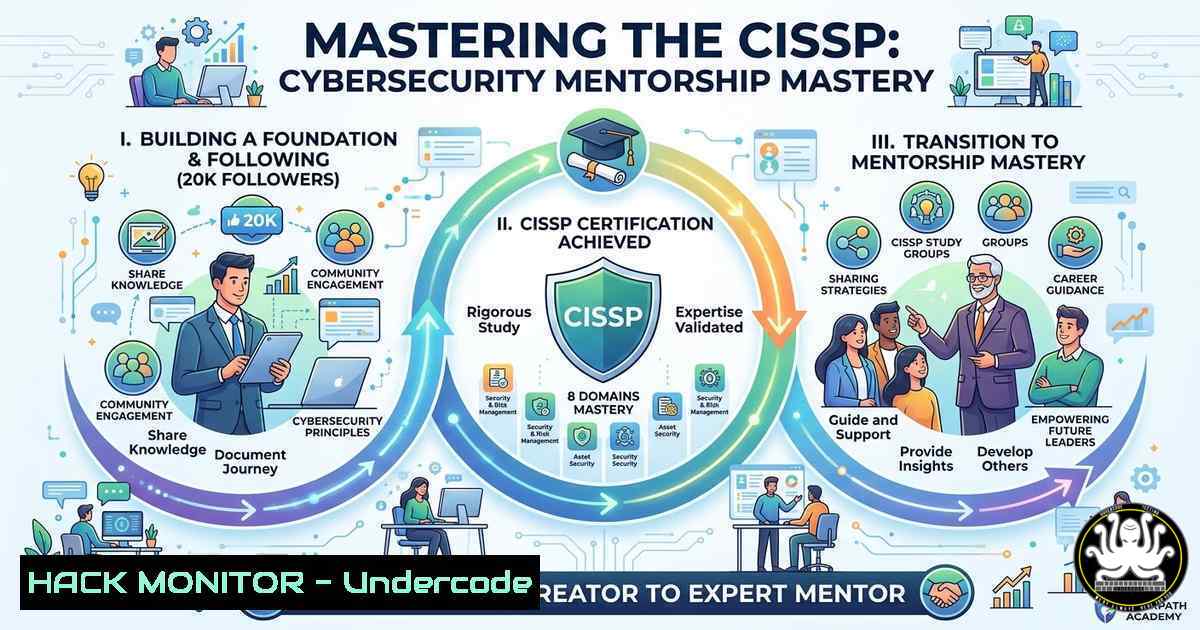
Achieving the CISSP (Certified Information Systems Security Professional) is widely considered one of the most challenging milestones in a cybersecurity career, requiring a deep understanding of security architecture, risk management, and operations. The recent milestone of Bastien Biren, who celebrated 20,000 followers while announcing a new mentorship program and upcoming YouTube channel, highlights a critical industry shift: the move from isolated certification cramming to guided, experiential learning. This article breaks down the technical domains covered by such mentorship, providing the practical commands, configuration examples, and hardening techniques that separate theoretical knowledge from real-world application.
Learning Objectives:
- Understand the core technical domains of the CISSP Common Body of Knowledge (CBK) through practical, command-line implementation.
- Learn how to configure security controls across Linux, Windows, and cloud environments to align with CISSP best practices.
- Develop a mentorship-ready skillset in identity management, network security, and incident response using verified technical procedures.
You Should Know:
1. Identity and Access Management (IAM) Hardening
Step‑by‑step guide explaining what this does and how to use it.
Effective IAM is the cornerstone of the CISSP’s Security and Risk Management domain. Mentorship in this area often moves beyond theory into granular configuration. To enforce least privilege on a Linux system, use `setfacl` to define granular permissions rather than relying solely on chmod. For example, to grant a specific user read and write access to a sensitive log file while denying all others:
 Grant read/write to user 'security_audit' on /var/log/auth.log
setfacl -m u:security_audit:rw /var/log/auth.log
 Verify the ACL
getfacl /var/log/auth.log
On Windows, use PowerShell to audit privileged groups. A critical CISSP control is monitoring membership changes in the Domain Admins group. Deploy this script to generate a baseline:
 Export current members of Domain Admins
Get-ADGroupMember "Domain Admins" | Select-Object name, objectClass, distinguishedName | Export-Csv -Path "C:\Security_Baselines\DomainAdmins_$(Get-Date -Format 'yyyyMMdd').csv" -NoTypeInformation
 Configure a scheduled task to run this daily and compare with baseline using Compare-Object
2. Network Security Architecture and Monitoring
Step‑by‑step guide explaining what this does and how to use it.
The CISSP exam emphasizes secure network design, including segmentation and monitoring. A practical mentorship exercise involves configuring a simple intrusion detection system (IDS) using Snort on a Linux gateway. First, install Snort and update the rules:
sudo apt update && sudo apt install snort -y
 During install, set the network range (e.g., 192.168.1.0/24)
 Test the configuration
sudo snort -T -c /etc/snort/snort.conf
To monitor traffic on a specific interface in packet logging mode (a core skill for incident response), use:
sudo snort -i eth0 -c /etc/snort/snort.conf -l /var/log/snort -K ascii
For cloud hardening—a growing focus in the CISSP—use the AWS CLI to enforce security groups that follow the principle of deny-all-inbound. A mentorship lesson would include scripting this check:
 List security groups with inbound rules allowing 0.0.0.0/0 on port 22
aws ec2 describe-security-groups --filters Name=ip-permission.cidr,Values='0.0.0.0/0' --query 'SecurityGroups[?IpPermissions[?FromPort==<code>22</code>]].[GroupName,GroupId]' --output table
3. Security Operations and Incident Response
Step‑by‑step guide explaining what this does and how to use it.
A CISSP mentor would stress that an incident response plan is useless without a tested, automated toolkit. Central to this is log aggregation and analysis. Using `auditd` on Linux, you can track critical file changes, a common requirement for Domain 7 (Security Operations). Configure `auditd` to watch the `/etc/passwd` file for unauthorized modifications:
 Add a watch on /etc/passwd for writes and attribute changes
auditctl -w /etc/passwd -p wa -k passwd_changes
 Search the audit log for changes
ausearch -k passwd_changes
On Windows, use `wevtutil` to create a custom event subscription for Sysmon (System Monitor) events, specifically Event ID 1 (process creation) and Event ID 3 (network connection), which are critical for threat hunting. A command to query for suspicious PowerShell network connections:
Get-WinEvent -FilterHashtable @{LogName='Microsoft-Windows-Sysmon/Operational'; ID=3} | Where-Object { $<em>.Message -like "powershell" -and $</em>.Message -like "internet" } | Select-Object -First 10 TimeCreated, Message
4. Software Development Security and AI Integration
Step‑by‑step guide explaining what this does and how to use it.
With the rise of AI engineering mentioned in the user’s profile, modern CISSP mentorship increasingly covers DevSecOps and AI supply chain risks. A practical command set involves using `trivy` to scan container images for vulnerabilities before deployment—a secure development lifecycle (SDLC) best practice.
 Scan a Docker image for vulnerabilities
trivy image python:3.9-slim
 Scan a local directory for Infrastructure as Code (IaC) misconfigurations
trivy config ./terraform
For AI security, a mentor might demonstrate using `gitleaks` or `trufflehog` to prevent API keys and secrets from being committed to repositories, a critical control in the age of LLM-driven development:
 Run trufflehog on a GitHub repo to find exposed secrets
trufflehog git https://github.com/example/repo.git --only-verified
5. Cryptography and PKI Management
Step‑by‑step guide explaining what this does and how to use it.
Understanding encryption is non-negotiable for the CISSP. A hands-on mentorship task involves creating a self-signed Certificate Authority (CA) and issuing a server certificate using OpenSSL—a skill applicable to securing internal services and aligning with Domain 3 (Security Architecture).
 Generate a private key for the CA
openssl genrsa -out ca.key 2048
 Generate the root CA certificate
openssl req -x509 -new -nodes -key ca.key -sha256 -days 3650 -out ca.pem
 Generate a private key and CSR for a server
openssl req -new -newkey rsa:2048 -nodes -keyout server.key -out server.csr
 Sign the server certificate with the CA
openssl x509 -req -in server.csr -CA ca.pem -CAkey ca.key -CAcreateserial -out server.crt -days 365 -sha256
6. Cloud Security Hardening (AWS & Azure)
Step‑by‑step guide explaining what this does and how to use it.
Given the shift to cloud-native architectures, a mentor would emphasize the CISSP’s Domain 4 (Communication and Network Security) in a cloud context. Hardening involves restricting metadata service access to prevent SSRF attacks. On AWS, a key command is to configure EC2 instance metadata options to require `v2` (IMDSv2) which requires session tokens, mitigating token theft.
 Modify an existing instance to require IMDSv2
aws ec2 modify-instance-metadata-options --instance-id i-1234567890abcdef0 --http-tokens required --http-endpoint enabled
For Azure, using Azure Policy to audit storage accounts that allow public access is a core governance skill:
 List all storage accounts with public network access enabled
az storage account list --query "[?publicNetworkAccess=='Enabled'].{Name:name, ResourceGroup:resourceGroup}" --output table
What Undercode Say:
- The transition from certification to mentorship is fueled by a demand for contextualized technical skills—knowing the exact `auditctl` command is as valuable as understanding the policy behind it.
- The convergence of AI engineering and cybersecurity creates new attack surfaces; mentorship must now cover AI supply chain security, including secrets detection in LLM-generated code and container vulnerability scanning as a pre-commit hook.
Key Takeaway 1: Mentorship accelerates the application of CISSP domains by moving from theory to executable commands. A mentor doesn’t just teach what a security group is; they teach the AWS CLI query to find misconfigured ones.
Key Takeaway 2: The future of cybersecurity training is hybrid—combining structured frameworks like the CISSP with hands-on, community-driven platforms (YouTube, mentorship calls) that provide the “how-to” for hardening, monitoring, and incident response in real-time environments.
Key Takeaway 3: Automation via PowerShell and Bash scripts is no longer a “nice-to-have” but a core competency for security professionals, enabling the repeatable, auditable controls that form the backbone of governance and compliance frameworks like the CISSP.
Prediction:
As AI-generated code and cloud-native architectures become ubiquitous, the role of mentorship in cybersecurity will pivot from teaching static certification content to guiding professionals through the dynamic landscape of AI supply chain risks, serverless security misconfigurations, and automated incident response pipelines. Platforms like YouTube will evolve into essential knowledge bases where seasoned experts provide not just exam tips, but live, executable tutorials that bridge the gap between passing the CISSP and truly mastering the complex, multi-domain reality of modern security engineering.
🎯Let’s Practice For Free:
IT/Security Reporter URL:
Reported By: Biren Bastien – Hackers Feeds
Extra Hub: Undercode MoN
Basic Verification: Pass ✅


