Listen to this Post
Introduction:
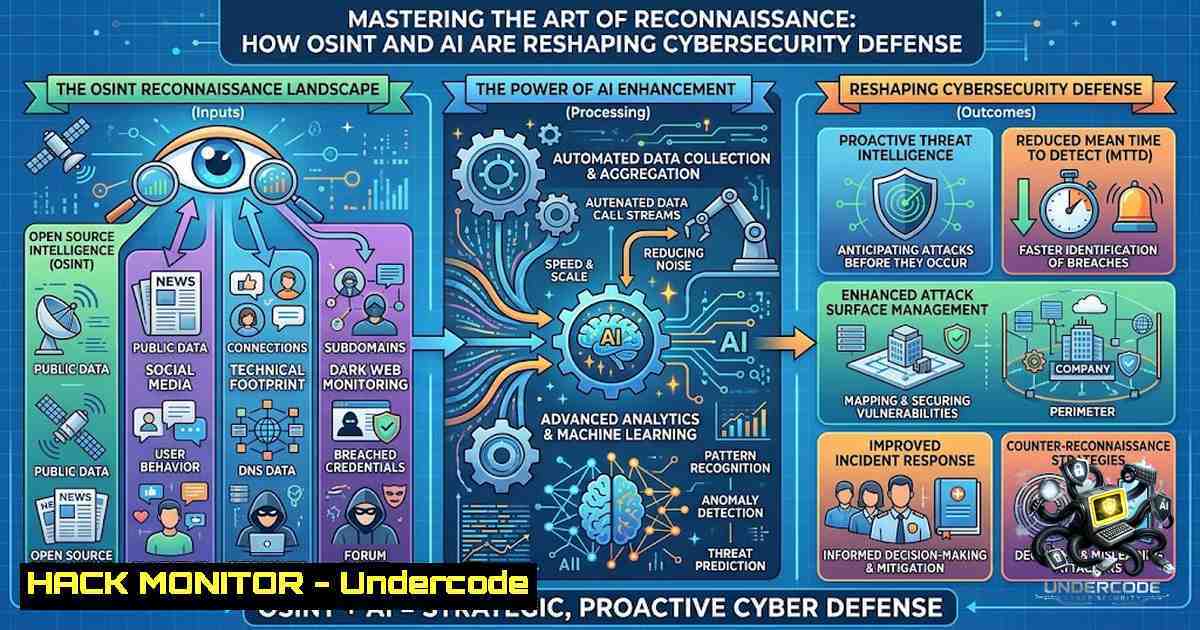
Open Source Intelligence (OSINT) has become the cornerstone of modern cybersecurity, serving as both the attacker’s first step and the defender’s earliest warning system. As security professionals, understanding how adversaries gather publicly available information—usernames, email addresses, phone numbers, and subdomains—is essential for building effective defenses. Combined with AI-powered tools that sharpen professional communication, these skills transform raw intelligence into actionable security outcomes.
Learning Objectives:
- Understand the four primary categories of OSINT reconnaissance and their real-world applications in security assessments
- Master practical command-line tools for email, username, phone number, and subdomain enumeration
- Learn how AI can enhance professional cybersecurity writing for incident reports and client communications
You Should Know:
1. Understanding OSINT Reconnaissance Categories
Reconnaissance is the phase where attackers map their target before launching any exploit. As Toluwani Egbewale notes in his 30-day cybersecurity challenge, this involves gathering publicly available information—nothing illegal, yet incredibly dangerous in the wrong hands. The four main categories are:
- Username Reconnaissance: Tracing the same username across multiple platforms to map a person’s digital footprint. Tools like Sherlock (400+ sites) and Maigret (2,500+ sites) automate this process.
- Phone Number Reconnaissance: Pulling carrier, location, and associated account data from a phone number. Frameworks like Phone OSINT Framework search breach databases by phone+name to discover verified emails and usernames.
- Email Reconnaissance: Checking if an email has been breached and where else it’s tied. Tools like holehe check service registrations, while h8mail performs local breach database searches.
- Subdomain Reconnaissance: Mapping a company’s complete web presence, including forgotten or unsecured assets. Tools like Amass, Subfinder, and Sublist3r combine passive and active enumeration methods.
Step-by-Step Guide: Email Reconnaissance with theHarvester
theHarvester is a powerful tool for gathering email accounts, subdomain names, and employee names from public sources. Here’s how to use it:
 Install theHarvester on Kali Linux
sudo apt install theharvester

Basic email enumeration from a domain using Google
theHarvester -d example.com -b google -l 200

Using DuckDuckGo as the source
theHarvester -d example.com -b duckduckgo -l 500

Search all available sources
theHarvester -d example.com -b all

Save results to a file
theHarvester -d example.com -b google -f results.html
The `-d` flag specifies the target domain, `-b` selects the source (google, duckduckgo, bing, etc.), and `-l` limits the number of results.
2. Subdomain Enumeration: Mapping the Attack Surface
Subdomain enumeration reveals hidden entry points that organizations often overlook. Attackers use this technique to discover admin panels, development environments, and API endpoints that may have weaker security postures.
Step-by-Step Guide: Subdomain Discovery with Amass
Amass, developed by OWASP, is the industry standard for subdomain enumeration:
 Install Amass (Go required)
go install -v github.com/owasp-amass/amass/v4/...@latest

Passive enumeration (uses public data sources)
amass enum -passive -d example.com -o subdomains.txt

Active enumeration with brute-force
amass enum -active -d example.com -brute -w wordlist.txt -o subdomains.txt

Verbose output with IP addresses
amass enum -v -src -ip -d example.com
For a comprehensive approach combining multiple tools:
 Combine Subfinder, Assetfinder, Amass, and Sublist3r
subfinder -d example.com -silent | anew subs.txt
assetfinder --subs-only example.com | anew subs.txt
amass enum -passive -d example.com | anew subs.txt
python sublist3r.py -d example.com | anew subs.txt
3. Username and Phone Number OSINT
Username enumeration across platforms helps map an individual’s online presence, while phone number OSINT reveals carrier information and potential breach exposure.
Step-by-Step Guide: Username Enumeration with Sherlock
 Install Sherlock
git clone https://github.com/sherlock-project/sherlock
cd sherlock
pip3 install -r requirements.txt

Search for a username across 400+ platforms
python sherlock.py username

Save results to a file
python sherlock.py username --output results.txt
Step-by-Step Guide: Phone Number Intelligence
For comprehensive phone number OSINT, the Phone OSINT Framework provides a professional-grade solution:
 Clone and install the framework
git clone https://github.com/aegisceo/phone-osint-framework
cd phone-osint-framework
python -m venv venv
source venv/bin/activate
pip install -r requirements.txt

Configure API keys in .env file
cp config/.env.example config/.env

Run an investigation
python phone_osint_master.py +1234567890
The framework uses breach-first discovery architecture—searching breach databases by phone number and name combination to discover verified emails and usernames.
4. AI-Powered Professional Writing in Cybersecurity
Beyond technical skills, communication determines whether security findings translate into action. As Egbewale emphasizes, a well-written incident report or client email gets read and acted on; a sloppy one gets skimmed and ignored.
AI tools can sharpen professional writing when used deliberately. However, caution is warranted—Cisco’s experiments with AI-generated incident reports found they were often inaccurate, inconsistent, and prone to data loss due to LLM limitations. Best practices include:
- Using granular, single-task prompts focusing on specific report sections
- Providing fixed source documents as reference material
- Applying strict formatting rules to maintain consistency
- Reviewing AI output for accuracy before finalizing
Step-by-Step Guide: Using AI for Incident Report Drafting
 Effective AI Prompt Template for Incident Reports

You are a security reporting specialist. Generate a concise incident summary based on the following raw notes:

[Insert raw investigation notes here]

Requirements:
1. Executive summary (2-3 sentences for non-technical stakeholders)
2. Timeline of events in chronological order
3. Root cause analysis with technical details
4. Actions taken during response
5. Prioritized remediation recommendations

Format: Professional tone, clear headings, bullet points for action items.
For structured reporting, tools like the Security Reporting Agent can categorize vulnerabilities by severity and create executive summaries of findings.
5. Building a Complete OSINT Toolkit
For security professionals serious about reconnaissance, a comprehensive toolkit is essential. The following setup script installs the most widely used OSINT tools:
!/bin/bash
 OSINT Toolkit Setup Script

Update system
sudo apt update && sudo apt upgrade -y

Install base dependencies
sudo apt install -y python3 python3-pip git curl wget \
build-essential libssl-dev libffi-dev python3-dev \
golang-go nmap masscan whois dnsutils exiftool

Create tools directory
mkdir -p ~/osint-tools
cd ~/osint-tools

Install Python OSINT tools
pip3 install recon-1g maigret h8mail holehe waybackpy

Clone Git-based tools
git clone https://github.com/laramies/theHarvester
cd theHarvester && pip3 install -r requirements.txt && cd ..

git clone https://github.com/sherlock-project/sherlock
cd sherlock && pip3 install -r requirements.txt && cd ..

Install Go tools
go install -v github.com/owasp-amass/amass/v4/...@latest
go install -v github.com/projectdiscovery/subfinder/v2/cmd/subfinder@latest

echo "OSINT toolkit setup complete!"
This setup provides a foundation for email reconnaissance (theHarvester, h8mail, holehe), username enumeration (Sherlock, Maigret), subdomain discovery (Amass, Subfinder), and web intelligence (Photon, Waybackpy).
What Undercode Say:
- OSINT is defense, not just offense—Understanding how attackers gather public information is the first step to protecting your organization’s digital footprint. Defenders who think like attackers build stronger security postures.
- Communication skills are technical skills—The most brilliant security findings are worthless if they can’t be communicated effectively. AI tools can help, but human review remains essential for accuracy and context.
- Reconnaissance is continuous, not one-time—Digital footprints evolve constantly. Regular OSINT assessments help identify exposed assets before attackers do.
- Public information is dangerous in aggregate—Individual data points may seem harmless, but when correlated across platforms, they create complete profiles that enable social engineering and targeted attacks.
- Tool proficiency requires practice—Mastering OSINT tools isn’t about running commands; it’s about understanding what each tool reveals and how to interpret results in context.
- AI enhances but doesn’t replace human judgment—Whether in writing or analysis, AI accelerates workflows but cannot substitute for critical thinking and domain expertise.
- Ethical boundaries are non-1egotiable—OSINT involves publicly available information only. Crossing into unauthorized access or private data violates legal and ethical standards.
- The 30-day challenge mindset works—Committing to daily skill development, as demonstrated in Egbewale’s journey, builds expertise systematically and sustainably.
- Subdomain enumeration reveals organizational blind spots—Many breaches begin with forgotten subdomains that lack proper security controls.
- Professional writing builds credibility—Clear, well-structured reports and emails signal professionalism and increase the likelihood that security recommendations will be implemented.
Prediction:
- +1 OSINT skills will become mandatory for all cybersecurity roles, not just penetration testers, as organizations recognize that prevention begins with understanding their own exposure.
- +1 AI-powered OSINT tools will automate much of the data collection process, allowing security professionals to focus on analysis and interpretation rather than manual gathering.
- -1 The democratization of OSINT tools means attackers—including less sophisticated ones—will have access to powerful reconnaissance capabilities, increasing the volume of targeted attacks.
- +1 AI-assisted writing tools will become standard in security operations centers for drafting incident reports, threat intelligence briefings, and client communications.
- -1 Over-reliance on AI for report generation without human oversight will lead to inaccurate or misleading security communications, potentially causing misinformed decision-making.
- +1 The integration of OSINT with threat intelligence platforms will enable real-time exposure monitoring, giving defenders an edge in identifying vulnerabilities before exploitation.
- -1 Privacy regulations will increasingly conflict with OSINT practices, creating legal gray areas that security professionals must navigate carefully.
- +1 Continuous learning challenges—like the 30-day model—will gain traction as organizations seek to upskill their security teams in practical, hands-on competencies.
- +1 Subdomain and asset discovery will become a standard component of security audits, reducing the number of forgotten or orphaned systems that attackers exploit.
- +1 The combination of OSINT proficiency and strong communication skills will distinguish top-tier security professionals, as technical expertise alone is insufficient for driving security improvements.
▶️ Related Video (82% Match):
🎯Let’s Practice For Free:
🎓 Live Courses & Certifications:
Join Undercode Academy for Verified Certifications
🚀 Request a Custom Project:
Secure, high-velocity infrastructure and disruptive technological engineering. Contact our engineering team for high-tier development and proprietary systems:
[email protected]
💎 Smart Architecture | 🛡️ Secure by Design | ⭐ Trusted by Thousands
IT/Security Reporter URL:
Reported By: https://lnkd.in/p/ew6NcmWa – Hackers Feeds
Extra Hub: Undercode MoN
Basic Verification: Pass ✅


