
Listen to this Post
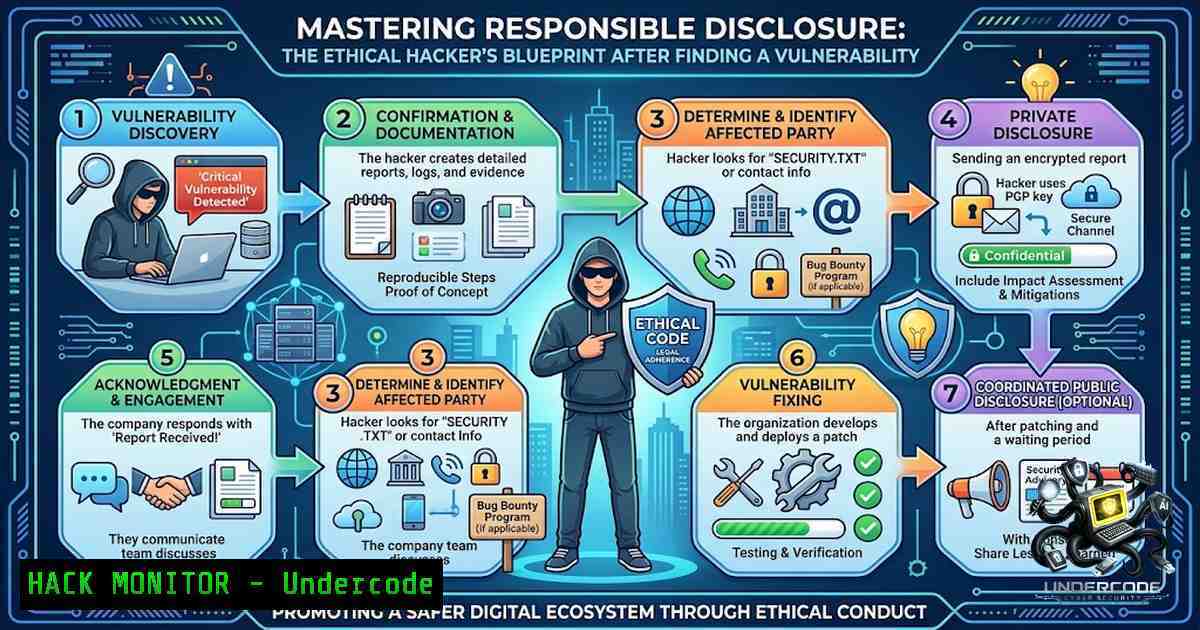
Introduction:
The moment a bug bounty hunter discovers a critical vulnerability is both exhilarating and perilous. The instinct to share the find publicly or exploit it further must be immediately suppressed in favor of a structured, responsible disclosure process. As emphasized by cybersecurity experts like Kastab Garai—a recognized bug bounty winner from IIT Bombay, IIT Madras, and IIT Roorkee—the first steps taken after a vulnerability is identified are crucial for legal compliance, professional reputation, and the overall security of the affected organization. This article provides a comprehensive, step-by-step guide on what to do immediately after finding a bug, drawing from industry best practices and the latest ethical hacking methodologies, including insights from the EC-Council’s CEH v13-AI curriculum.
Learning Objectives & Secrets:
- Objective 1: Establish a Disclosure-Ready Posture – Learn to document evidence and proof-of-concept (PoC) steps in real-time, maintaining chain-of-custody hygiene from the first signal of a vulnerability.
- Objective 2 Secret Tip: Prioritize Channel Identification – Before crafting a report, immediately check for established security reporting mechanisms. The priority order is: 1) Bug bounty platform (HackerOne, Bugcrowd, etc.), 2) GitHub Security Advisory (for open-source), 3) Direct email contact ([email protected] or PSIRT page), and 4) Escalation path.
- Objective 3 Secret Tip: Build the Report Alongside the Finding – Do not wait until the end to start the report. Open a per-finding evidence stub at the first sign of a vulnerability and append PoC steps as you confirm them. This ensures no critical detail is forgotten and streamlines the final submission.
You Should Know:
- Initial Response and Containment (The “Do Not Publish” Rule)
The cardinal rule of responsible disclosure is never to publicly disclose a vulnerability before the vendor has had a reasonable opportunity to patch it. Premature public disclosure can lead to widespread exploitation, legal repercussions, and damage to your professional reputation. The first action is to stop all further testing on the affected system to avoid causing unintended disruption or accessing/modifying data beyond the scope of the bounty program.
Step‑by‑step guide:
1. Stop all scanning and exploitation activities immediately.
- Capture a snapshot of the current state – take screenshots, record network traffic (e.g., using Wireshark), and save console outputs.
- Secure your evidence – store all logs, PoC scripts, and screenshots in an encrypted folder.
- Verify the scope – double-check that the affected asset is within the program’s scope to ensure you are eligible for a bounty and protected from legal action.
2. Comprehensive Evidence Documentation
A high-quality report is as important as finding the bug itself. Your goal is to provide the vendor with all the information needed to reproduce, understand, and fix the vulnerability with minimal back-and-forth. This involves creating a clear, fact-based narrative of your discovery.
Step‑by‑step guide:
- Create a report stub – open a new document and immediately fill in the date, time, target URL/IP, and a brief initial description.
- Document step-by-step reproduction – write out every action taken, from the initial reconnaissance to the final exploit. Include exact commands, URLs, and parameters used.
- Record the impact – clearly state what an attacker could achieve (e.g., data breach, privilege escalation, denial of service) and assess the potential business impact.
- Append supporting artifacts – attach sanitized screenshots, video recordings, and the PoC code or script. Ensure no sensitive customer or production data is included in the report.
3. Crafting the Vulnerability Report
The report is your primary communication tool with the vendor’s security team. It must be professional, concise, and structured for easy triage. A good vulnerability report includes a clear title and summary, the affected component and scope, severity and business impact, and fact-based steps to reproduce.
Step‑by‑step guide (using a template):
- & Summary: “SQL Injection vulnerability in `[bash]` of `[bash]` allowing unauthorized data retrieval.”
- Affected Component: Specify the exact URL, module, or software version.
- Severity: Use a standard scale like CVSS (Common Vulnerability Scoring System) to rate the severity. Justify your rating.
- Steps to Reproduce: Provide a numbered list of actions, including HTTP requests, payloads, and expected responses.
- Proof of Concept (PoC): Include a code snippet or a link to a private, non-functional PoC that demonstrates the vulnerability without causing harm.
- Mitigation Suggestions: Offer potential fixes, such as input validation, parameterized queries, or access control updates.
4. Secure Communication and Submission
Submitting the report through the correct channel is critical. Using unofficial channels can lead to your report being lost, ignored, or even flagged as a malicious attack.
Step‑by‑step guide:
- Identify the official channel – check the program’s policy page, `security.txt` file, or the `/.well-known/security` directory of the target domain.
- Use the platform’s reporting interface – if the program is on a platform like HackerOne or Bugcrowd, use their built-in reporting system. This ensures your report is tracked and you are protected under the platform’s terms.
- Encrypt sensitive information – if submitting via email, use PGP encryption if the vendor provides a public key.
- Include a clear subject line – e.g., “Vulnerability Report: [bash] in [bash]” to help the triage team prioritize it.
- Set a reasonable disclosure timeline – most coordinated disclosure windows are 90 calendar days from the date the vendor acknowledges the vulnerability.
5. Post-Submission: Follow-up and Coordination
After submitting the report, your role shifts to that of a collaborator. You may be asked for additional details, to test a patch, or to provide further clarification. Patience and professionalism are key during this phase.
Step‑by‑step guide:
- Wait for acknowledgment – most programs will send an automated acknowledgment. If you don’t hear back within a reasonable time (e.g., 48 hours), send a polite follow-up.
- Respond promptly to requests – if the triage team needs more information, provide it as quickly and clearly as possible.
- Test the fix (if requested) – once the vendor has developed a patch, they may ask you to verify that it effectively mitigates the vulnerability in a staging environment.
- Coordinate public disclosure – after the patch is released and the disclosure window has passed, you can publish a write-up. Coordinate with the vendor to ensure a smooth and responsible public disclosure.
-
Leveraging AI and Modern Tools (CEH v13-AI Context)
Modern ethical hacking, as taught in the CEH v13-AI curriculum, leverages AI-enhanced tools for penetration testing, IoT security, and advanced malware analysis. These tools can assist in automating the documentation and reporting process, but the core principles of responsible disclosure remain unchanged.
Relevant Commands & Tools:
- Linux (Recon & Enumeration):
– `nmap -sV -p- -T4 target.com` – Scan for open ports and service versions.
– `gobuster dir -u target.com -w /usr/share/wordlists/dirb/common.txt` – Directory enumeration.
– `curl -X POST target.com/api -d “param=value” -H “Content-Type: application/json”` – Manual API testing. - Windows (Poweshell for Analysis):
– `Test-1etConnection target.com -Port 443` – Test connectivity and port status.
– `Invoke-WebRequest -Uri target.com -Method POST -Body @{param=’value’}` – Send HTTP requests for testing. - Reporting Tools:
- Use Burp Suite or OWASP ZAP to capture and replay requests, which can be directly exported as part of your PoC.
- Use Markdown to format your report for platforms like HackerOne, which support it natively.
What Undercode Say:
- Key Takeaway 1: The discovery of a vulnerability is only half the battle; the true mark of a professional ethical hacker is the discipline and skill with which they handle the disclosure process. A well-documented, responsibly disclosed bug is far more valuable than a hastily published exploit.
- Key Takeaway 2: Modern ethical hacking, as exemplified by the CEH v13-AI certification, integrates AI-assisted offensive and defensive techniques. However, the fundamental principles of reconnaissance, enumeration, exploitation, and responsible reporting remain the bedrock of the profession. Mastering these phases, from initial scanning to final report, is essential for success in bug bounty programs.
Prediction:
- +1 The integration of AI into ethical hacking curricula, like the CEH v13-AI, will significantly reduce the time between vulnerability discovery and report submission, as AI can assist in automatically generating PoC code and drafting report sections. This will lead to faster patching cycles and a more secure internet.
- +1 As bug bounty programs become more mainstream, there will be a greater emphasis on the quality of reports. Platforms will likely implement AI-powered report validators that check for completeness, clarity, and the presence of critical elements like PoC and impact assessment, rewarding researchers who submit high-quality reports.
- -1 The increasing automation of vulnerability discovery through AI may lead to a flood of low-quality or false-positive reports, overwhelming triage teams. This could result in longer response times and a less effective disclosure process overall, unless strict guidelines and quality filters are enforced.
▶️ Related Video (86% Match):
https://www.youtube.com/watch?v=3TSFdhEemUM
🎯Let’s Practice For Free:
🎓 Live Courses & Certifications:
Join Undercode Academy for Verified Certifications
🚀 Request a Custom Project:
Secure, high-velocity infrastructure and disruptive technological engineering. Contact our engineering team for high-tier development and proprietary systems:
[email protected]
💎 Smart Architecture | 🛡️ Secure by Design | ⭐ Trusted by Thousands
IT/Security Reporter URL:
Reported By: https://lnkd.in/p/eu-GUmKb – Hackers Feeds
Extra Hub: Undercode MoN
Basic Verification: Pass ✅


