
Listen to this Post
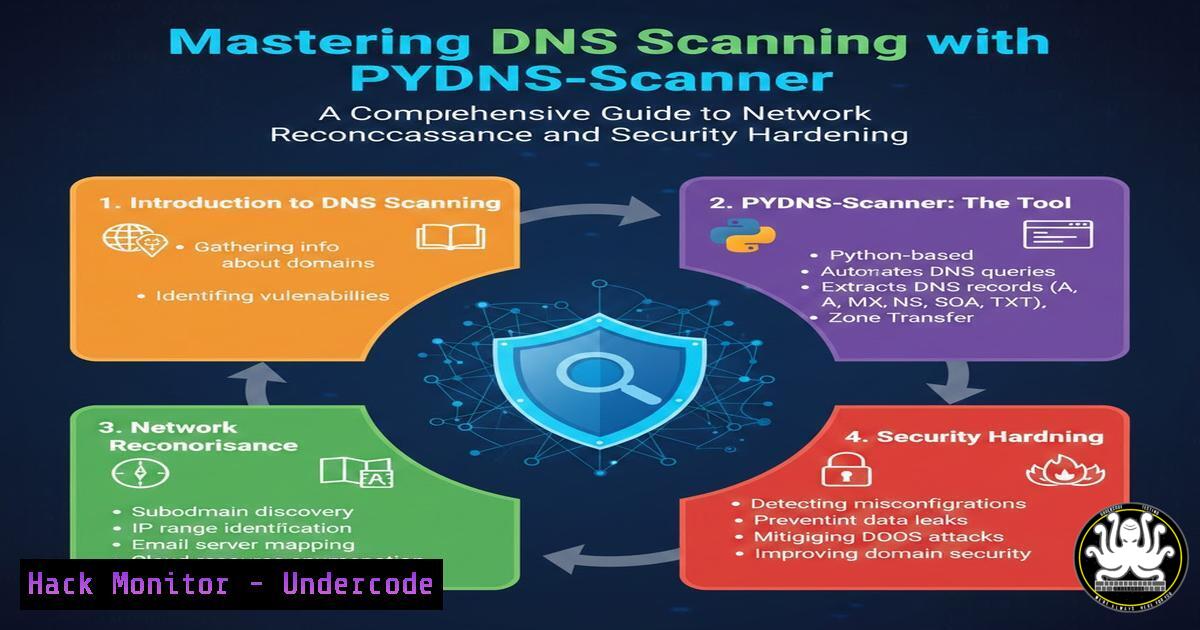
Introduction:
DNS scanning is a critical technique in cybersecurity for identifying misconfigured or vulnerable DNS servers that can be exploited in amplification attacks, data exfiltration, or network infiltration. The newly released PYDNS-Scanner, built with Python and the Textual TUI framework, empowers security professionals to scan millions of IP addresses efficiently, detecting open resolvers and testing for slipstream proxy vulnerabilities. This article provides a hands‑on walkthrough of deploying and leveraging PYDNS‑Scanner, combined with essential commands and hardening techniques to fortify your infrastructure.
Learning Objectives:
- Understand the role of DNS scanners in network security assessments and attack surface analysis.
- Learn to install, configure, and operate PYDNS‑Scanner on Linux and Windows platforms.
- Explore advanced features including Slipstream proxy testing and integration with complementary security tools.
You Should Know:
1. What Is PYDNS‑Scanner and Why It Matters
PYDNS‑Scanner is a modern, high‑performance DNS scanner that combines the power of asynchronous I/O with a sleek terminal user interface (TUI) built on Textual. It enables security analysts to rapidly discover DNS servers across vast IP ranges, identify open resolvers, and assess their susceptibility to DNS‑based attacks such as amplification or cache poisoning. The tool’s optional Slipstream proxy testing checks for vulnerabilities that could allow attackers to bypass firewalls by exploiting DNS responses. Its cross‑platform design and automatic client download feature make it accessible for both red and blue teams.
2. Installation and Environment Setup
Before scanning, ensure Python 3.8+ is installed on your system. PYDNS‑Scanner relies on several libraries including textual, aiohttp, and dnspython.
Linux Installation:
 Clone the repository
git clone https://github.com/example/pydns-scanner.git  replace with actual repo if available
cd pydns-scanner
 Create a virtual environment (recommended)
python3 -m venv venv
source venv/bin/activate
 Install dependencies
pip install -r requirements.txt
Windows Installation:
Open PowerShell as Administrator and run:
 Clone the repository
git clone https://github.com/example/pydns-scanner.git
cd pydns-scanner
 Create and activate virtual environment
python -m venv venv
.\venv\Scripts\activate
 Install dependencies
pip install -r requirements.txt
After installation, verify the tool runs with python pydns_scanner.py --help.
3. Basic Scanning with the TUI
Launch the scanner with a target IP range. The TUI provides real‑time progress, discovered servers, and error logs.
Example: Scanning a Class C subnet
python pydns_scanner.py --target 192.168.1.0/24 --output results.json
The interface displays:
- A live counter of IPs scanned.
- A table of responsive DNS servers with response times.
- Color‑coded status indicators (green for open resolver, red for closed).
Key Options:
– `–workers N` : Set the number of concurrent threads (default 100).
– `–timeout MS` : DNS query timeout in milliseconds.
– `–port PORT` : Target DNS port (default 53).
– `–output FILE` : Save results in JSON or CSV format for later analysis.
4. Advanced Features: Slipstream Proxy Testing
DNS slipstream is an attack technique where an attacker tricks a victim’s browser into making DNS queries that open a network path for direct exploitation. PYDNS‑Scanner includes a dedicated module to test if a discovered DNS server is vulnerable to slipstream.
Enable slipstream testing:
python pydns_scanner.py --target 10.0.0.0/8 --slipstream --output slipstream_results.json
The scanner sends specially crafted DNS responses and monitors if the target server forwards them in a way that could be used for NAT penetration. Results are flagged in the TUI with a “SLIPSTREAM” warning.
Understanding the Output:
– `”slipstream_vulnerable”: true` indicates the server may be used in slipstream attacks.
– The tool also logs the exact query and response payload for manual verification using `dig` or nslookup.
5. Analyzing Results and Identifying Risks
Once the scan completes, analyze the output file to prioritize remediation.
Using `jq` on Linux to filter open resolvers:
jq '.[] | select(.open_resolver==true) | {ip: .ip, response_time: .rtt}' results.json
On Windows PowerShell:
Get-Content results.json | ConvertFrom-Json | Where-Object { $_.open_resolver -eq $true } | Select-Object ip, rtt
Open resolvers (servers that answer recursive queries from any source) are prime candidates for DNS amplification attacks. Cross‑reference these with your asset inventory to confirm ownership.
- Integration with Nmap and Dig for Deeper Recon
Combine PYDNS‑Scanner with traditional tools to validate findings.
Example: Using `dig` to test a discovered DNS server manually:
dig @192.168.1.10 example.com A +short
If the server returns a valid answer, it is an open resolver.
Nmap DNS recursion script:
nmap -sU -p 53 --script dns-recursion 192.168.1.10
This confirms whether the server allows recursive queries. Correlate these results with PYDNS‑Scanner’s output to reduce false positives.
7. Hardening DNS Servers Against Scanning and Abuse
After identifying vulnerable servers, immediate mitigation is required.
For BIND (named.conf):
options {
recursion no;  Disable recursion for external clients
allow-query { trusted; };  Restrict queries to internal networks
rate-limit { responses-per-second 10; };
};
For Windows DNS Server (PowerShell):
Set-DnsServerRecursionScope -Name . -EnableRecursion $false
Add-DnsServerQueryResolutionPolicy -Name "BlockExternalRecursion" -Action DENY -Condition "Equals" -Value "External" -ZoneScope ""
Rate limiting is also essential. In Linux, use iptables:
iptables -A INPUT -p udp --dport 53 -m limit --limit 10/second -j ACCEPT
iptables -A INPUT -p udp --dport 53 -j DROP
Always test these changes in a staging environment first.
What Undercode Say:
- Key Takeaway 1: PYDNS‑Scanner democratizes large‑scale DNS reconnaissance, making it accessible for both defenders to audit their networks and attackers to discover entry points. Its TUI and speed dramatically reduce the time needed for such assessments.
- Key Takeaway 2: Slipstream proxy testing highlights a growing intersection between DNS and web application security; administrators must now consider how DNS responses can be weaponized to bypass network perimeters.
Analysis: The release of tools like PYDNS‑Scanner reflects a broader trend in cybersecurity: the convergence of user‑friendly interfaces with powerful, asynchronous scanning engines. This lowers the skill barrier for network discovery, which is a double‑edged sword. Blue teams must adopt proactive monitoring—such as DNS query logging and anomaly detection—to spot scans in progress. Additionally, the inclusion of slipstream testing underscores the need for holistic defense strategies that encompass both DNS configuration and web browser policies (e.g., preventing DNS prefetching on untrusted sites). As DNS continues to be a resilient attack vector, regular scanning with tools like this should become a staple in every organization’s vulnerability management program.
Prediction:
Within the next 12–18 months, we will see PYDNS‑Scanner‑like features integrated into commercial vulnerability scanners and SIEM platforms. Furthermore, as DNS‑over‑HTTPS (DoH) and DNS‑over‑TLS (DoT) gain adoption, scanners will evolve to test encrypted DNS endpoints, leading to a new wave of security assessments focused on privacy and tunneled exfiltration. Organizations that fail to continuously monitor their DNS exposure risk becoming unwitting participants in large‑scale DDoS attacks or data breaches.
▶️ Related Video (80% Match):
🎯Let’s Practice For Free:
IT/Security Reporter URL:
Reported By: Syed Muneeb – Hackers Feeds
Extra Hub: Undercode MoN
Basic Verification: Pass ✅


