Listen to this Post
Introduction:
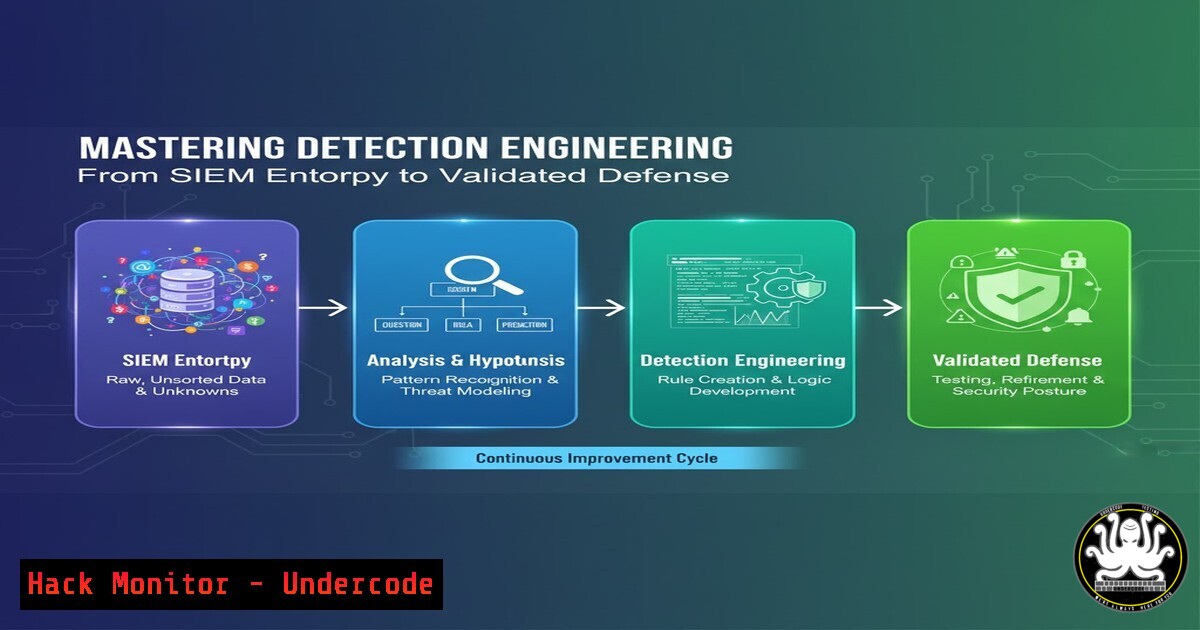
In modern Security Operations Centers (SOC), detection engineers face a constant battle against alert fatigue and noisy security systems. The journey from overwhelming entropy to actionable, evidence-based detection is critical for effective threat defense, requiring a disciplined approach to rule management and validation.
Learning Objectives:
- Understand the core principles of detection-as-code and rule lifecycle management
- Implement practical techniques for reducing false positives and refining detection logic
- Master detection validation through automated testing and breach-and-attack simulation
You Should Know:
1. SIEM Detection Rule Optimization
 Sigma Rule Example - Suspicious Process Execution
title: Suspicious PowerShell Execution
logsource:
category: process_creation
product: windows
detection:
selection:
Image|endswith: '\powershell.exe'
CommandLine|contains:
- 'Hidden'
- 'EncodedCommand'
- 'Bypass'
condition: selection
falsepositives:
- Legitimate administration scripts
level: high
This Sigma rule demonstrates proper detection structure for identifying suspicious PowerShell activity. The YAML format ensures portability across SIEM platforms. Key elements include specific log source targeting, command-line indicator selection, and documented false positive considerations. Deploy by converting to your SIEM’s native rule language using sigma converters.
2. Python Detection-as-Code Implementation
def validate_detection_rule(rule_yaml):
"""Validate detection rule syntax and logic"""
required_fields = ['title', 'logsource', 'detection', 'level']
for field in required_fields:
if field not in rule_yaml:
return False
return True

Usage for CI/CD pipeline integration
rule = load_sigma_rule('suspicious_ps.yaml')
if validate_detection_rule(rule):
deploy_to_siem(rule)
This Python snippet enables automated validation of detection rules within CI/CD pipelines. The function checks for required Sigma rule fields before deployment, ensuring consistency and preventing misconfigured rules from reaching production. Integrate this validation step in your detection engineering workflow.
3. Windows Event Log Hunting Query
-- KQL Query for Suspicious Service Creation
SecurityEvent
| where EventID == 4697
| where ServiceName contains "temp"
or ServiceName contains "update"
| where CommandLine contains "powershell"
or CommandLine contains "cmd"
| project TimeGenerated, Computer, SubjectUserName, ServiceName, CommandLine
This Kusto Query Language (KQL) hunts for suspicious service creations commonly abused by persistence mechanisms. The query filters on temporary-sounding service names combined with command-line interpreters. Run this in Azure Sentinel or custom SIEM implementations to detect established persistence.
4. Linux Process Anomaly Detection
!/bin/bash
 Detect process hollowing and anomalous execution patterns
ps aux --forest | awk '
$2 != "PID" {
if ($3 > 80.0) print "HIGH CPU: " $11 " (" $2 ")";
if ($4 > 80.0) print "HIGH MEM: " $11 " (" $2 ")";
if (match($11, "/tmp/") || match($11, "/dev/shm"))
print "SUSPECT LOCATION: " $11 " (" $2 ")"
}'

Monitor for process injection indicators
sudo strace -p <PID> -e trace=process -f 2>&1 | grep -i "execve|clone"
This bash script identifies potential process anomalies including resource exhaustion, execution from temporary directories, and process injection indicators. The first section monitors CPU/memory usage and suspicious binary locations, while the strace command traces process execution for injection patterns.
5. API Security Monitoring with JQ
 Analyze API logs for authentication anomalies
cat api_logs.json | jq '
select(.status_code >= 400) |
{timestamp: .timestamp,
endpoint: .endpoint,
status: .status_code,
user_agent: .user_agent,
ip: .remote_addr} |
group_by(.ip) |
map({ip: .[bash].ip, attempts: length, last_attempt: .[-1].timestamp}) |
sort_by(.attempts) | reverse[]'

Detect credential stuffing patterns
| jq 'select(.attempts > 100)'
This jq command processes JSON API logs to identify authentication failures and potential credential stuffing attacks. The query groups failed attempts by IP address, counts attempts, and identifies suspicious patterns. Integrate this into your log analysis pipeline for real-time API security monitoring.
6. Cloud Hardening – AWS S3 Security
!/bin/bash
 Audit and secure S3 buckets against public access
for bucket in $(aws s3api list-buckets --query 'Buckets[].Name' --output text); do
echo "Checking bucket: $bucket"

Check public access block configuration
aws s3api get-public-access-block \
--bucket $bucket \
--query 'PublicAccessBlockConfiguration'

Check bucket policy for public statements
aws s3api get-bucket-policy --bucket $bucket 2>/dev/null | \
jq '.Policy | fromjson | .Statement[] |
select(.Effect == "Allow" and .Principal == "")'
done

Apply secure configuration
aws s3api put-public-access-block \
--bucket $BUCKET_NAME \
--public-access-block-configuration \
BlockPublicAcls=true,IgnorePublicAcls=true,BlockPublicPolicy=true,RestrictPublicBuckets=true
This AWS S3 security script audits and hardens bucket configurations against public exposure. The script checks existing public access settings and identifies overly permissive policies, then applies security best practices. Run this regularly in your cloud security compliance checks.
7. Network Detection Rule – Suricata
 Suricata rule for C2 beaconing detection
alert http $HOME_NET any -> $EXTERNAL_NET any (msg:"SUSPECTED C2 Beaconing - Regular HTTP Requests";
flow:established,to_server;
content:"GET"; http_method;
flowbits:set,beacon.initial;
sameip;
flowint:beacon.count,+,1;
threshold:type limit, track by_src, count 5, seconds 60;
classtype:network-scan;
sid:1000001; rev:1;)

alert http $HOME_NET any -> $EXTERNAL_NET any (msg:"CONFIRMED C2 Beaconing - Pattern Detected";
flow:established,to_server;
content:"GET"; http_method;
flowbits:isset,beacon.initial;
flowint:beacon.count,>=,5;
classtype:trojan-activity;
sid:1000002; rev:1;)
These Suricata rules detect command-and-control beaconing through regular HTTP request patterns. The first rule sets a flowbit on initial detection and counts requests, while the second rule confirms beaconing when threshold is exceeded. Deploy in network monitoring infrastructure for C2 communication detection.
What Undercode Say:
- Detection engineering must evolve from reactive alerting to evidence-based validation frameworks
- Automated testing and BAS integration are non-negotiable for modern SOC effectiveness
- The human element remains critical despite automation – context and intuition drive final analysis
The shift from detection entropy to validated defense represents the maturation of security operations. While tools and automation provide scale, the strategic combination of threat intelligence, detection-as-code practices, and continuous validation creates truly resilient detection capabilities. Organizations investing in this methodology demonstrate significantly improved mean time to detect and respond, ultimately reducing breach impact and strengthening security posture.
Prediction:
Within three years, AI-driven attack simulation will automatically generate and validate detection rules in real-time, creating adaptive defense systems that evolve alongside threats. Detection engineering will shift from manual rule-writing to overseeing AI systems that continuously test and refine detection coverage, fundamentally changing SOC workflows and requiring new skill sets focused on machine learning oversight and validation.
🎯Let’s Practice For Free:
IT/Security Reporter URL:
Reported By: Dirkpraet Detection – Hackers Feeds
Extra Hub: Undercode MoN
Basic Verification: Pass ✅


