Listen to this Post
Introduction:
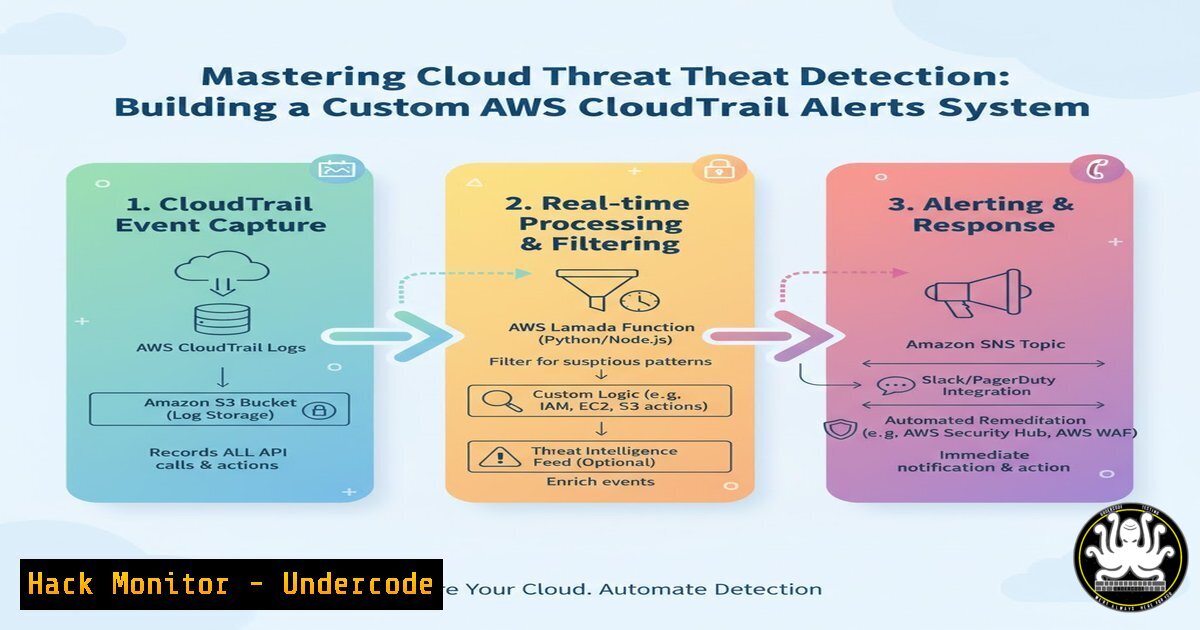
In an era of escalating cloud threats, traditional security tools often drown teams in alerts while missing critical incidents. TrailAlerts represents a paradigm shift toward lean, native AWS detection engineering that provides precise threat visibility without vendor bloat. This framework leverages CloudTrail, EventBridge, and Lambda to create customized detection pipelines tailored to your specific security requirements.
Learning Objectives:
- Architect custom detection logic for critical AWS security events
- Implement real-time alerting integrations with Slack and Opsgenie
- Optimize cloud detection costs while maintaining comprehensive coverage
You Should Know:
1. CloudTrail Log Analysis Fundamentals
 Query CloudTrail logs for root user activity
aws cloudtrail lookup-events --lookup-attributes AttributeKey=Username,AttributeValue=root --start-time 2023-10-01T00:00:00Z --end-time 2023-10-02T00:00:00Z --region us-east-1

Monitor for unauthorized regions
aws cloudtrail lookup-events --lookup-attributes AttributeKey=EventName,AttributeValue=RunInstances --query 'Events[?Resources[?Type==<code>AWS::EC2::Instance</code>]]' --output table
Step-by-step guide: These AWS CLI commands enable security teams to manually investigate CloudTrail events for suspicious activities. The first command filters events by the root username, crucial for monitoring privileged account usage. The second query identifies EC2 instance creations across all regions, helping detect potential unauthorized resource deployment. Regular execution establishes baseline monitoring before automating through TrailAlerts.
2. EventBridge Rule Configuration for Security Events
{
"source": ["aws.cloudtrail"],
"detail-type": ["AWS API Call via CloudTrail"],
"detail": {
"eventSource": ["iam.amazonaws.com"],
"eventName": ["CreateUser", "DeleteUser", "CreateAccessKey"]
}
}
Step-by-step guide: This EventBridge rule pattern creates a real-time detection mechanism for IAM user management activities. When deployed through AWS CLI or console, it triggers whenever new IAM users are created, deleted, or access keys are generated—critical indicators of potential account compromise or privilege escalation attempts.
3. Lambda Function for Alert Processing
import json
import boto3

def lambda_handler(event, context):
 Parse CloudTrail event
detail = event['detail']
event_name = detail['eventName']
user_identity = detail['userIdentity']

Check for suspicious patterns
if event_name == 'ConsoleLogin':
if user_identity['type'] == 'Root':
send_alert(f"Root console login detected: {detail}")

if event_name == 'CreateUser':
send_alert(f"New IAM user created: {detail}")

def send_alert(message):
 Implement Slack/Opsgenie integration here
sns = boto3.client('sns')
sns.publish(TopicArn='arn:aws:sns:us-east-1:123456789:security-alerts', Message=message)
Step-by-step guide: This Python Lambda function serves as the core processing engine for TrailAlerts. It receives events from EventBridge, analyzes them for security-relevant patterns, and triggers alerts through SNS. Security teams can extend the detection logic to include GuardDuty findings, unusual API activity, or region-specific violations.
4. GuardDuty Integration and Alert Enrichment
 Query GuardDuty findings via CLI
aws guardduty list-findings --detector-id 12abc34d567e8fa901bc2d34e56789f0

Get detailed finding information
aws guardduty get-findings --detector-id 12abc34d567e8fa901bc2d34e56789f0 --finding-ids id1 id2
Step-by-step guide: While TrailAlerts focuses on CloudTrail events, integrating GuardDuty findings provides complementary threat intelligence. These commands allow security teams to programmatically access GuardDuty detection results, which can be fed into the TrailAlerts pipeline for consolidated alerting and correlation analysis.
5. S3 Bucket Security Monitoring
 Check for S3 bucket policy changes
aws cloudtrail lookup-events --lookup-attributes AttributeKey=EventName,AttributeValue=PutBucketPolicy --query 'Events[].Resources[bash].ResourceName'

Monitor for public bucket configurations
aws s3api get-bucket-policy-status --bucket-name example-bucket --region us-east-1
Step-by-step guide: S3 misconfigurations represent a leading cause of cloud data breaches. These commands help detect bucket policy modifications and assess public access settings. In TrailAlerts, these checks can be automated to trigger immediate alerts when sensitive storage resources undergo security-relevant changes.
6. IAM Access Key Rotation Enforcement
import boto3
from datetime import datetime, timedelta

def check_key_age(iam_client):
users = iam_client.list_users()
for user in users['Users']:
keys = iam_client.list_access_keys(UserName=user['UserName'])
for key in keys['AccessKeyMetadata']:
create_date = key['CreateDate']
key_age = datetime.now(create_date.tzinfo) - create_date
if key_age.days > 90:
send_alert(f"Old access key detected: {key['AccessKeyId']} for user {user['UserName']}")
Step-by-step guide: This Python function extends TrailAlerts to monitor IAM access key hygiene, a critical aspect of AWS security posture. When integrated into a scheduled Lambda function, it automatically identifies keys exceeding rotation thresholds and alerts security teams for remediation.
7. CloudWatch Metrics for Detection Tuning
 Create custom metric for security events
aws cloudwatch put-metric-data --namespace Security --metric-data 'MetricName=TrailAlerts,Value=1'

Monitor Lambda function errors
aws cloudwatch get-metric-statistics --namespace AWS/Lambda --metric-name Errors --start-time 2023-10-01T00:00:00Z --end-time 2023-10-02T00:00:00Z --period 3600 --statistics Sum
Step-by-step guide: These CloudWatch commands enable monitoring of the TrailAlerts system itself, providing operational visibility into alert volumes and processing errors. Security teams can use these metrics to tune detection rules, reduce false positives, and ensure the reliability of their custom detection pipeline.
What Undercode Say:
- Native AWS services provide superior detection capabilities compared to third-party tools when properly configured
- Custom detection logic eliminates alert fatigue while maintaining comprehensive coverage
- The TrailAlerts approach demonstrates the evolution from generic security monitoring to precision detection engineering
The TrailAlerts framework represents a fundamental shift in cloud security philosophy—moving from reactive, vendor-dependent tools to proactive, infrastructure-as-code detection systems. By leveraging native AWS services, security teams gain unprecedented visibility and control while significantly reducing costs. This approach enables organizations to implement context-aware detection logic that aligns with their specific risk profile and operational patterns. The integration of CloudTrail, EventBridge, and Lambda creates a foundation that can evolve with emerging threats, while the modular design allows for seamless incorporation of new data sources and alerting channels.
Prediction:
Custom detection engineering will become the standard for mature cloud security programs within two years, rendering generic security tools obsolete for organizations with advanced security requirements. As attack techniques grow more sophisticated, the ability to rapidly develop and deploy context-aware detection logic will separate resilient organizations from vulnerable ones. The TrailAlerts methodology foreshadows a future where security monitoring is fully integrated into cloud infrastructure rather than bolted on as an afterthought.
🎯Let’s Practice For Free:
IT/Security Reporter URL:
Reported By: Asd Newsletter – Hackers Feeds
Extra Hub: Undercode MoN
Basic Verification: Pass ✅


