Listen to this Post
Introduction
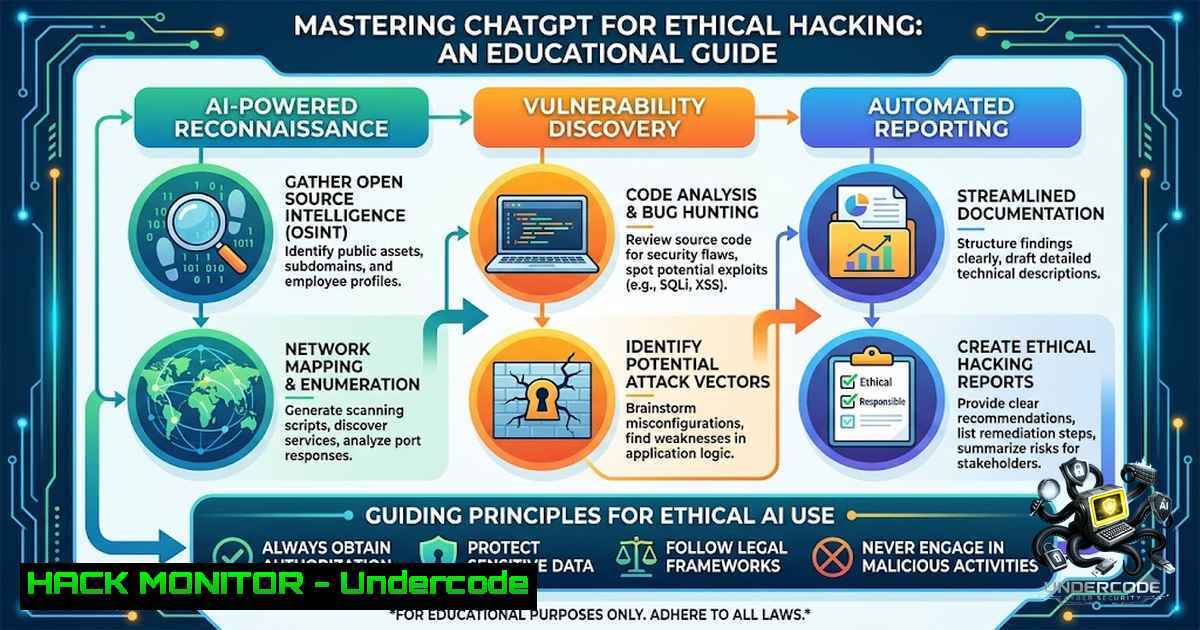
The integration of generative AI into cybersecurity workflows is transforming how ethical hackers conduct penetration testing. ChatGPT penetration testing automation is the process of using ChatGPT to assist in performing reconnaissance, vulnerability analysis, command generation, and security reporting—replacing manual research with AI-accelerated workflows. According to recent CREST research, 69% of cybersecurity providers now use AI in penetration testing workflows, with 76% increasing their use over the past year. This article explores practical techniques for leveraging ChatGPT across the full ethical hacking lifecycle, from initial reconnaissance to final reporting.
Learning Objectives
- Master AI-assisted reconnaissance and fuzzing techniques for accelerated vulnerability discovery
- Apply ChatGPT for web security analysis, including SQL injection and XSS detection through code auditing
- Implement AI-powered reporting automation for efficient penetration test documentation
- Understand the security implications and limitations of AI in ethical hacking workflows
You Should Know
1. AI-Assisted Reconnaissance and Scanning Automation
Reconnaissance remains the foundation of any penetration test. Traditionally, this phase requires manually running tools like Nmap, Gobuster, and Subfinder, then analyzing outputs line by line. ChatGPT accelerates this process by generating precise command strings, interpreting scan results, and suggesting next steps.
Step-by-Step Guide:
Step 1: Generate Nmap Scan Commands
Ask ChatGPT to generate targeted Nmap commands based on your reconnaissance goals:
“Generate an Nmap scan command for a comprehensive service version detection scan on target 10.10.11.230, including script scanning and output to all formats.”
ChatGPT generates:
nmap -sV -sC -oA nmap_initial 10.10.11.230
This command performs service version detection (-sV), runs default scripts (-sC), and saves output in all formats (-oA).
Step 2: Analyze Scan Outputs
Paste your Nmap scan results into ChatGPT and ask:
“Analyze this Nmap output and identify all open ports, services, and potential attack vectors. Suggest enumeration commands for each service.”
Step 3: Generate Enumeration Commands
For discovered services, ask ChatGPT to generate specific enumeration commands:
“Generate a Gobuster directory brute-force command for target.com using a common wordlist.”
Step 4: Automate Subdomain Discovery
“Generate a subdomain enumeration command using Subfinder and Amass for target.com, then suggest how to prioritize discovered subdomains.”
Windows Alternative:
For Windows environments, use PowerShell equivalents:
Test-1etConnection -ComputerName target.com -Port 80
Resolve-DnsName target.com -Type A
- Web Security Testing: SQL Injection and XSS Detection
ChatGPT excels at identifying web application vulnerabilities through code analysis and payload generation. Research shows that AI-assisted vulnerability detection can increase accuracy by 15-20% while reducing testing time by 35% compared to traditional methods.
Step-by-Step Guide:
Step 1: Code Auditing for SQL Injection
Provide ChatGPT with source code snippets and ask:
“Review this PHP code for SQL injection vulnerabilities. Identify insecure query constructions and suggest secure alternatives.”
Example vulnerable code ChatGPT might identify:
$query = "SELECT FROM users WHERE id = " . $_GET['id'];
ChatGPT will flag this and recommend parameterized queries using PDO or mysqli prepared statements.
Step 2: Generate SQL Injection Payloads
“Generate context-aware SQL injection payloads to test a login form that uses MySQL backend. Include union-based and boolean-based blind payloads.”
ChatGPT can generate payloads like:
' OR '1'='1' --
' UNION SELECT null, username, password FROM users --
admin' AND SLEEP(5) --
Step 3: XSS Detection
“Analyze this JavaScript code for XSS vulnerabilities. Identify where user input is unsafely inserted into the DOM.”
ChatGPT will flag patterns like:
document.getElementById('output').innerHTML = userInput;
And recommend using `textContent` or sanitization libraries instead.
Step 4: Build Custom Vulnerable Labs
Use ChatGPT to generate intentionally vulnerable environments for safe practice:
“Generate a simple Flask web application with a SQL injection vulnerability in the login form and an XSS vulnerability in the comment section.”
3. Burp Suite Integration and AI-Powered Scanning
Burp Suite remains the industry standard for web application testing. ChatGPT integration extends its capabilities through automated vulnerability discovery and reporting.
Step-by-Step Guide:
Step 1: Install BurpGPT Extension
The BurpGPT extension integrates OpenAI’s GPT to perform additional passive scanning for discovering highly bespoke vulnerabilities.
Step 2: Configure API Access
1. Select a domain from your HTTP history
- Provide an optional prompt specifying the vulnerability type you’re searching for
3. Enter your OpenAI API key
4. Choose ChatGPT version (GPT-4 or GPT-3.5 Turbo)
Step 3: Run AI-Assisted Passive Scan
The extension generates an automated security report summarizing potential security issues based on your prompt and real-time data from Burp-issued requests.
Step 4: AI Reporter for Report Generation
The AI Reporter extension automatically generates structured vulnerability findings from HTTP request/response pairs using Burp AI or a local Ollama instance. This keeps sensitive data on-premises when needed.
4. Automated Vulnerability Reporting
Reporting is often the most time-consuming phase of penetration testing. AI tools now automate findings documentation, risk scoring, and remediation recommendations.
Step-by-Step Guide:
Step 1: Use FinGen for Findings Generation
FinGen is a ChatGPT-based findings generator that produces structured vulnerability reports including:
– Remediation steps
– Business implications
– Risk rating with likelihood + impact justification
Step 2: Generate Professional Reports
“Generate a professional penetration testing report finding for a SQL injection vulnerability discovered in the login endpoint. Include description, impact, proof of concept, remediation, and risk rating.”
Step 3: Auto-Sanitize and Format
Tools like PentestVault auto-sanitize sensitive data and generate professional PDF/DOCX/Markdown reports using free AI models.
Step 4: Compliance-Mapped Reporting
Advanced frameworks like Pencheff handle reconnaissance, vulnerability scanning, exploit chain analysis, and compliance-mapped reporting automatically.
5. Linux and Windows Command Generation
ChatGPT can generate and explain commands for both operating systems, making it invaluable for cross-platform testing.
Linux Commands:
 Reconnaissance
nmap -sC -sV -p- target.com
gobuster dir -u target.com -w /usr/share/wordlists/dirb/common.txt
subfinder -d target.com

Privilege Escalation Checks
sudo -l
find / -perm -4000 -type f 2>/dev/null
linpeas.sh

Covering Tracks
history -c && history -w
shred -f -z -u /var/log/auth.log
Windows Commands (PowerShell):
 Reconnaissance
Test-1etConnection -ComputerName target -Port 80
Resolve-DnsName target.com
Get-1etTCPConnection -State Listen

Privilege Escalation Checks
whoami /priv
Get-Service | Where-Object {$_.Status -eq "Running"}
Get-ChildItem -Path C:\ -Include .exe -Recurse -ErrorAction SilentlyContinue

Covering Tracks
Clear-EventLog -LogName Security,Application,System
Remove-Item -Path $env:APPDATA\Microsoft\Windows\PowerShell\PSReadLine\ConsoleHost_history.txt
6. Tool Orchestration with MCP Servers
Model Context Provider (MCP) servers bridge AI with penetration testing tools, orchestrating workflows from reconnaissance to reporting.
Step-by-Step Guide:
Step 1: Set Up mcp-pentest
The mcp-pentest server orchestrates Nmap, Gobuster, and other tools while keeping the human pentester in control of scope, methodology, and reporting.
Step 2: Methodology Enforcement
MCP ensures each engagement progresses through proper phases: reconnaissance → scanning → exploitation → post-exploitation → reporting.
Step 3: Real-Time Context Aggregation
The system captures tool outputs, normalizes data into a unified engagement context, and stores it for analysis.
Step 4: LLM-Powered Insights
Leverages large language models to interpret findings and provide guidance during the engagement.
7. HackingGPT: Terminal-Based AI Assistant
HackingGPT is an advanced terminal tool that integrates ChatGPT and DeepSeek APIs to assist security researchers in executing and analyzing commands directly from the terminal.
Installation and Usage:
 Clone the repository
git clone https://github.com/DouglasRao/HackingGPT.git
cd HackingGPT

Create virtual environment
python -m venv venv
source venv/bin/activate  Linux/macOS
 venv\Scripts\activate  Windows

Install dependencies
pip install -r requirements.txt

Set API keys
export OPENAI_API_KEY="your-openai-key"
export DEEPSEEK_API_KEY="your-deepseek-key"

Run the tool
python hackingGPT.py
Key Features:
- Dynamic assistance with custom command suggestions
- Interactive command execution with xterm support
- Results integration for continuous guidance loops
- Multi-API compatibility (OpenAI and DeepSeek)
What Undercode Say
- AI augments, not replaces, core technical fundamentals. ChatGPT accelerates workflows but cannot substitute for understanding networking, operating systems, and application architecture. The human ethical hacker remains accountable for methodology and validation.
-
Reporting automation delivers immediate ROI. The most widely adopted AI use case in penetration testing today is report drafting, summarization, and data analysis—reducing reporting phases from weeks to days.
Analysis: The cybersecurity industry has reached “mature realism” regarding AI adoption. Organizations recognize AI’s clear benefits while acknowledging areas of risk that require careful management. The usage model remains human-led and AI-supported, with practitioners applying AI selectively to early-stage tasks like reconnaissance and enumeration, as well as reporting and quality assurance. As AI models like GPT-5.6-Cyber emerge with reduced safeguards for vulnerability research and penetration testing, the ethical hacker’s role will increasingly focus on validation, context, and governance rather than repetitive manual tasks.
Prediction
- +1 AI-assisted penetration testing will become standard practice across all security providers by 2028, with automated reconnaissance and reporting reducing engagement times by 50-70%.
-
+1 Specialized cybersecurity LLMs like GPT-5.6-Cyber will enable ethical hackers to discover and validate vulnerabilities at unprecedented speed, particularly in zero-day research.
-
-1 Increased reliance on AI-generated findings may lead to validation gaps and false positives if practitioners fail to maintain rigorous review processes.
-
-1 Adversarial use of AI for automated attack chains poses growing threats, as demonstrated by research showing single prompts can enable full-scale offensive operations.
-
+1 The demand for AI-literate security professionals will surge, making courses like CodeRed’s “Master ChatGPT for Ethical Hacking” essential for career advancement.
▶️ Related Video (84% Match):
https://www.youtube.com/watch?v=0FfwjjxkdEM
🎯Let’s Practice For Free:
🎓 Live Courses & Certifications:
Join Undercode Academy for Verified Certifications
🚀 Request a Custom Project:
Secure, high-velocity infrastructure and disruptive technological engineering. Contact our engineering team for high-tier development and proprietary systems:
[email protected]
💎 Smart Architecture | 🛡️ Secure by Design | ⭐ Trusted by Thousands
IT/Security Reporter URL:
Reported By: https://lnkd.in/p/ey43C_yz – Hackers Feeds
Extra Hub: Undercode MoN
Basic Verification: Pass ✅


