Listen to this Post
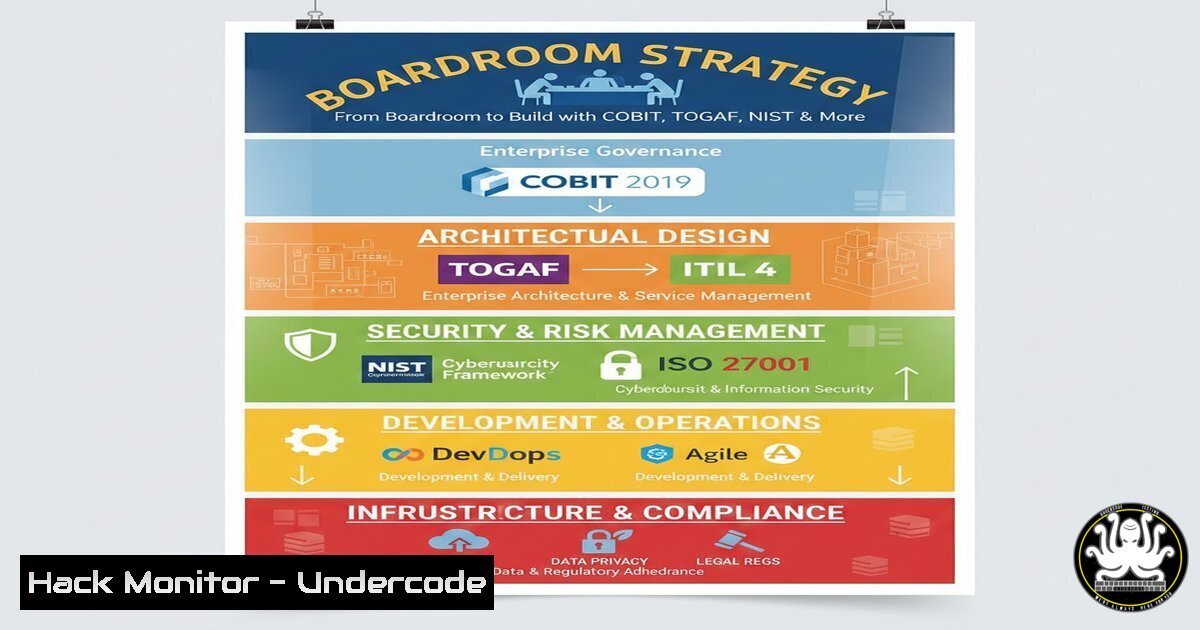
Introduction:
In the chaotic landscape of modern IT management, organizations often fail by treating frameworks like ITIL or COBIT as silver bullets. True governance is a multi-layered system, where each standard addresses a specific stratum of decision-making, from strategic board oversight to tactical operational execution. This article deconstructs the definitive layered model for IT governance, providing a blueprint to align enterprise principles with technical delivery while hardening your security posture.
Learning Objectives:
- Decode the hierarchical relationship between strategic governance frameworks (ISO/IEC 38500), management frameworks (COBIT), and operational standards (ITIL, NIST, TOGAF).
- Learn how to implement cross-framework controls for enhanced cybersecurity and architectural resilience.
- Apply practical commands and configurations to translate governance policies into technical enforcement at the build/run layer.
You Should Know:
- The Apex: Enterprise Governance & ISO/IEC 38500 Compliance
The journey begins at the board level. ISO/IEC 38500 provides the principles for governing the use of IT, focusing on responsibility, strategy, acquisition, performance, conformance, and human behavior. This is not about “how” but “why.” To translate these principles into actionable oversight, boards must demand specific reporting. A technical translation involves implementing centralized logging and compliance dashboards.
Step‑by‑step guide:
- Principle to Policy: For the “Conformance” principle, mandate a policy that all cloud infrastructure must be provisioned through approved, auditable IaC (Infrastructure as Code) templates.
- Technical Enforcement: Use a cloud governance tool like AWS Service Control Policies (SCPs) or Azure Policy to deny the creation of any resource not compliant with tagged IaC deployments.
- Verification Command: For an AWS environment, an auditor can use the AWS CLI to list non-compliant resources:
aws configservice list-discovered-resources --resource-type AWS::EC2::Instance --query 'resourceIdentifiers[?tags.Status!=<code>Approved</code>]'
This command checks for EC2 instances without an “Approved” tag, flagging potential policy violations.
-
The Strategic Bridge: EGIT & COBIT for Holistic Management
COBIT operates in the crucial Enterprise Governance of IT (EGIT) layer, bridging board principles with management practices. It provides process models and goals. For cybersecurity, align with COBIT’s DSS05 (Manage Security Services) objective. This involves implementing a centralized Identity and Access Management (IAM) system.
Step‑by‑step guide:
- Map Objective: Link COBIT DSS05 to the control “Ensure all privileged access is justified and time-bound.”
- Implement PAM: Deploy a Privileged Access Management (PAM) solution. For Linux servers, integrate with `sudo` via SSSD (System Security Services Daemon) to centralize authentication against an LDAP/Active Directory source.
- Configuration Snippet: Configure `/etc/sssd/sssd.conf` to enforce PAM rules:
[domain/example.com]
access_provider = ldap
ldap_access_order = expire
ldap_account_expire_policy = rhds
sudo_provider = ldap
This ensures sudo rights are managed centrally and can be revoked instantly.
3. Architectural Governance with TOGAF & ArchiMate
The architecture factory uses TOGAF’s ADM and ArchiMate’s modeling language to create coherent, secure blueprints. A key output is the “Application Security Architecture,” mandating patterns like API Gateways for all microservices.
Step‑by‑step guide:
- Define Standard: In the Architecture Repository, standardize that all external APIs must be routed through a gateway (e.g., Kong, Apache APISIX) for authentication, rate-limiting, and logging.
- Implement Pattern: Deploy the Kong API Gateway. A declarative configuration (
kong.yml) enforces the standard:services:</li> </ol> - name: internal-service url: http://internal-app:8080 routes: - paths: [/api/v1] strip_path: true plugins: - name: key-auth - name: rate-limiting config: minute: 100 policy: local
3. Security Hardening: This configuration ensures no service is directly exposed and all traffic is authenticated and throttled against DDoS.
- Service & Security Management: ITIL Meets ISO 27001/NIST
This convergent layer manages IT services (ITIL) and information security (ISO 27001/NIST CSF). A critical intersection is Incident Management (ITIL) and the NIST IR (Incident Response) framework. Automate the initial response to a security incident.
Step‑by‑step guide:
- Integrate Processes: Define that a “High” severity alert from an EDR tool automatically triggers an ITIL Incident record and a NIST IR “Containment” step.
- Automate Containment: Using a SIEM like Splunk or Elastic SIEM with automated playbooks. For a detected malicious process on a Windows host, trigger an orchestrated response.
- Example PowerShell Command (triggered remotely by orchestration tool):
Isolate host from network and collect process forensic data
Invoke-Command -ComputerName TARGET_HOST -ScriptBlock {
Stop-Process -Id $args[bash] -Force
Get-NetFirewallRule | Where-Object {$_.Enabled -eq 'True'} | Disable-NetFirewallRule
Get-NetTCPConnection | Select-Object LocalAddress, LocalPort, RemoteAddress, RemotePort, State | Export-Csv -Path C:\Forensics\net_conn.csv
} -ArgumentList $MaliciousPID
This script stops the process, disables the firewall (full isolation), and exports network connections for analysis.
-
The Execution Layer: Build, Delivery, and Secure Ops
This is where governance is physically enforced through CI/CD pipelines and infrastructure code. Integrate security scanning into every deployment. Use tools like Checkov for IaC security, Trivy for container scanning, and OWASP ZAP for dynamic testing.
Step‑by‑step guide:
- Shift-Left Security: In your Azure DevOps or GitHub Actions pipeline, embed security gates.
2. Pipeline YAML Snippet (GitHub Actions):
jobs:
security-scan:
runs-on: ubuntu-latest
steps:
- uses: actions/checkout@v3
- name: Scan Terraform for security issues
uses: bridgecrewio/checkov-action@v12
with:
directory: ./terraform/
soft_fail: false  Fail the build on critical issues
- name: Scan Docker image for vulnerabilities
uses: aquasecurity/trivy-action@master
with:
image-ref: 'myapp:latest'
format: 'sarif'
output: 'trivy-results.sarif'
severity: 'CRITICAL,HIGH'
3. Governance Outcome: This automated enforcement ensures no vulnerable infrastructure or container images are promoted to production, directly supporting ISO 27001 A.12.6.2 (Technical Vulnerability Management) and COBIT APO12.06.
What Undercode Say:
- Governance is a Composite System, Not a Single Tool. The profound power of this model is recognizing that COBIT, TOGAF, and NIST are not competitors but complementary components of an organizational cybernetic system. Attempting to use one in isolation creates critical blind spots.
- Technical Enforcement is the Ultimate Test of Governance. A governance principle is merely theoretical until it is encoded into a pipeline policy, a firewall rule, or an API gateway configuration. The real measure of maturity is the degree of automated, immutable enforcement from the top layer down.
The layered model provides the essential translation manual between the language of the boardroom and the language of the server room. It prevents strategic dilution and ensures that a high-level directive on risk appetite materially changes how code is committed and systems are patched. Without this stack, governance documents become shelfware, and technical teams operate in a strategic vacuum.
Prediction:
The future of effective IT governance lies in the automated convergence of these layers through AI/ML. We will see the emergence of Governance Platforms that ingest board-level policies (Layer 1), automatically map them to COBIT/ISO control sets (Layer 2), generate compliant architectural patterns and Terraform modules (Layer 3), configure service management tooling (Layer 4), and directly inject security scanning rules into CI/CD pipelines (Layer 5). AI will continuously monitor technical telemetry to predict governance drift and recommend real-time adjustments, creating a dynamic, self-healing governance loop that drastically reduces organizational risk and accelerates compliant innovation. The static, manual governance of today will become obsolete.
▶️ Related Video (78% Match):
🎯Let’s Practice For Free:
IT/Security Reporter URL:
Reported By: Yann Eric – Hackers Feeds
Extra Hub: Undercode MoN
Basic Verification: Pass ✅🔐JOIN OUR CYBER WORLD [ CVE News • HackMonitor • UndercodeNews ]
📢 Follow UndercodeTesting & Stay Tuned:
- Service & Security Management: ITIL Meets ISO 27001/NIST


