Listen to this Post
Introduction:
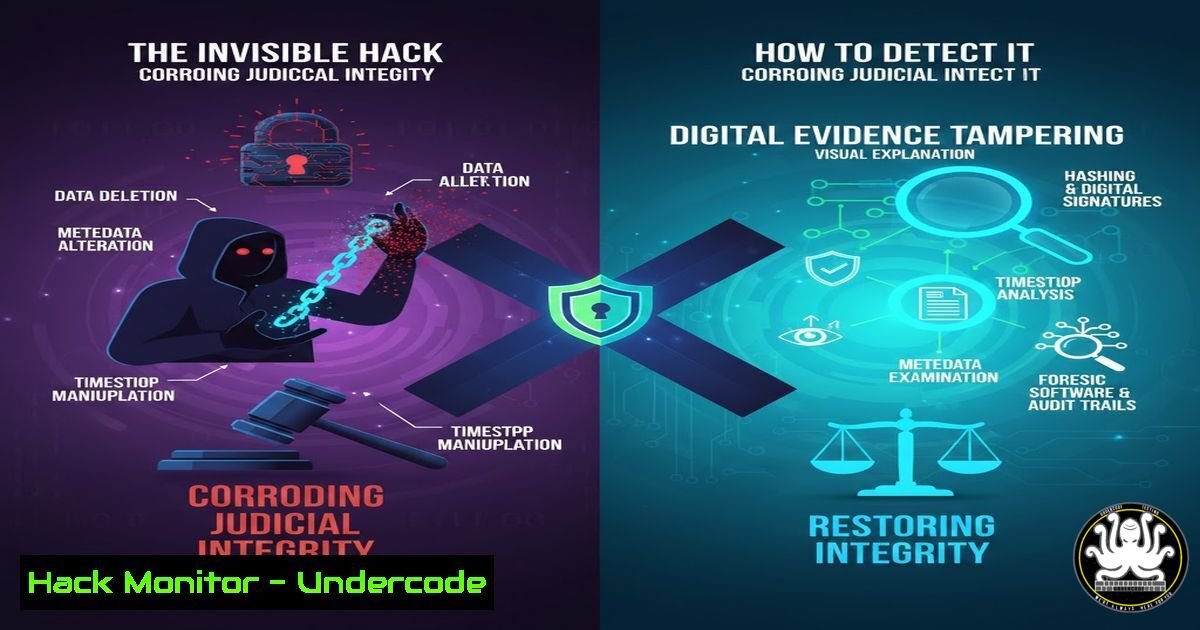
While Alison McDermott’s LinkedIn post details alleged procedural failures in the UK Employment Tribunal system, the underlying issue—potential tampering with official records—resonates deeply in cybersecurity. The assertion that material was omitted from an official transcript points to a critical threat vector: the integrity of digital evidence within legal and corporate systems. This article explores the technical parallels between judicial record-keeping flaws and deliberate digital evidence tampering, a tactic used by malicious actors to cover tracks, manipulate outcomes, and undermine trust in institutional systems.
Learning Objectives:
- Understand the technical methods and attack surfaces used for digital evidence tampering in systems like tribunals.
- Learn to apply basic forensic integrity checks on logs, documents, and system artifacts using command-line tools.
- Recognize how principles of Zero Trust and immutable logging can be architecturally applied to protect procedural integrity.
You Should Know:
- The Attack Surface: How Digital Legal Records Can Be Compromised
The post references the alleged withholding of an ET official record and omission of material from a transcript. Technically, this highlights a breach in the evidence chain of custody. Attack surfaces for such tampering include:
Application Vulnerabilities: Web portals for tribunal systems or document management systems with insecure direct object references (IDOR) or broken access controls could allow unauthorized viewing or alteration.
Insider Threat: Authorized personnel (admins, clerks) abusing privileges to delete, modify, or withhold records.
System Administration Backdoors: Unsecured administrative interfaces (e.g., unauthenticated database consoles, default credentials on logging servers) providing a path for alteration.
Lack of Integrity Verification: Systems that do not generate cryptographic hashes (like SHA-256) for documents upon creation, making undetected changes possible.
Step-by-step guide to basic file integrity monitoring:
A foundational practice is generating and checking hashes for critical files. On a Linux system housing logs or transcripts, you can create a baseline.
 Generate a SHA-256 hash of a critical file and store it securely.
sha256sum /var/log/tribunal/transcript_20241201.pdf > transcript_20241201.sha256
 Store this .sha256 file in a write-protected, off-system location.
 Periodically verify the file's integrity by re-calculating its hash and comparing.
sha256sum -c transcript_20241201.sha256
 If the file is unchanged, the output will be: "transcript_20241201.pdf: OK"
 A mismatch indicates corruption or tampering.
- Forensic Analysis: Hunting for Omissions and Anomalies in Logs
The comment “the ET/MoJ has omitted material” suggests a gap in expected data. In cybersecurity, attackers often clear or manipulate system logs to hide activity. Forensic analysis looks for these gaps and inconsistencies.
Log Sequence Analysis: System logs (Windows Event Logs, Linux syslog) have sequential IDs. Gaps in sequence numbers can indicate deletion.
Timeline Analysis: Creating a super-timeline of all system events (file access, user logins, process execution) can reveal suspicious activity around the time a document was supposedly altered.
Windows Event Log Analysis: Use PowerShell to query security logs for event IDs 4660 (object deletion) or 1102 (log cleared), which are critical for auditing.Query Windows Security Log for events indicating a log was cleared Get-WinEvent -FilterHashtable @{LogName='Security'; ID=1102} -MaxEvents 10 Query for file deletion events (requires detailed audit policy to be enabled) Get-WinEvent -FilterHashtable @{LogName='Security'; ID=4660} | Where-Object {$_.Properties[bash].Value -like "transcript"} -
Immutable Logging Architecture: The Technical Solution to “Withholding”
To prevent the “withholding” or alteration of records, systems must implement immutable logging. This ensures logs cannot be changed or deleted for a defined retention period.
Write-Once-Read-Many (WORM) Storage: Use cloud services (like AWS S3 Object Lock or Azure Blob Storage Immutable Storage) or on-prem appliances that enforce legal hold.
Security Information and Event Management (SIEM) Forwarding: Configure all endpoints and applications to forward logs in real-time to a centralized SIEM where access is tightly controlled and separate from the source system.
Blockchain-Based Verification: For ultra-high-integrity requirements, systems can write document hashes to a private blockchain (e.g., Hyperledger), creating a verifiable, tamper-proof audit trail. Any subsequent change to the document will not match the hash on the chain. -
Exploiting Weak Audit Trails: A Red Team Perspective
An adversary aiming to suppress evidence would target weak audit configurations. The post implies a system where omissions might go unnoticed.
Attack Path: An attacker with initial access might escalate privileges to a system administrator account, disable audit policies (auditpol /clearon Windows), alter files, and then re-enable auditing, leaving a minimal trace.
Mitigation Command (Windows): Enforce robust audit policies via Group Policy or script. The following command enables detailed auditing for a critical directory (example for a transcript storeD:\ET_Records).Enable object audit policy (requires Admin) auditpol /set /subcategory:"File System" /success:enable /failure:enable Then, in Windows Explorer GUI, navigate to the folder properties > Security > Advanced > Auditing tab, and add an entry to audit "Everyone" for "Success" and "Failure" on "Write" and "Delete" actions.
-
Building a “Zero Trust” Environment for Judicial and Corporate Integrity
The core issue is a breach of trust within a privileged system. The Zero Trust model—”never trust, always verify”—is directly applicable.
Principle of Least Privilege (PoLP): Ensure users, even judges or clerks, have only the access absolutely necessary for their role. Just-In-Time (JIT) access can be used for elevated actions.
Micro-Segmentation: Isolate the tribunal record database or document management system in its own network segment, controlling all traffic with strict firewall rules.
Continuous Verification: Implement tools that continuously validate the integrity of system files and configurations against a known good baseline, alerting on drift.
What Undercode Say:
The Integrity of a System is Defined by Its Weakest Log: A procedural or technical system that cannot cryptographically prove the integrity of its records is fundamentally compromised. The allegations in the post are a human-readable symptom of a potential digital integrity failure.
Opacity is the Enemy of Security: The inability for a claimant to independently verify the completeness of their own official transcript is a design flaw. Secure systems should allow for user-verifiable proofs of record integrity without compromising confidentiality.
The discussion transcends a single legal case. It highlights a universal systemic risk: when the processes designed to uncover truth lack transparent, verifiable security controls, they become vulnerable to manipulation. This erodes trust at an institutional level. The technical mitigations—cryptographic hashing, immutable storage, and robust auditing—are not just IT concerns but are foundational to modern, transparent justice and governance. The “landmark case” mentioned may be legal, but its precedent should be technological, mandating integrity-by-design in all official digital systems.
Prediction:
The convergence of legal advocacy and digital transparency movements will drive mandatory adoption of “Forensic-Readiness by Design” for public sector and critical corporate systems within the next 3-5 years. We will see the rise of independent, possibly open-source, verifiable audit trails for official proceedings. Furthermore, litigation will increasingly feature “Digital Forensics Experts” as expert witnesses to analyze system artifacts and logs, much like DNA experts in physical cases, creating a new specialization at the intersection of law and cybersecurity to objectively test claims of digital evidence tampering.
▶️ Related Video (80% Match):
🎯Let’s Practice For Free:
IT/Security Reporter URL:
Reported By: Alisonmcdermott2 The – Hackers Feeds
Extra Hub: Undercode MoN
Basic Verification: Pass ✅


