
Listen to this Post
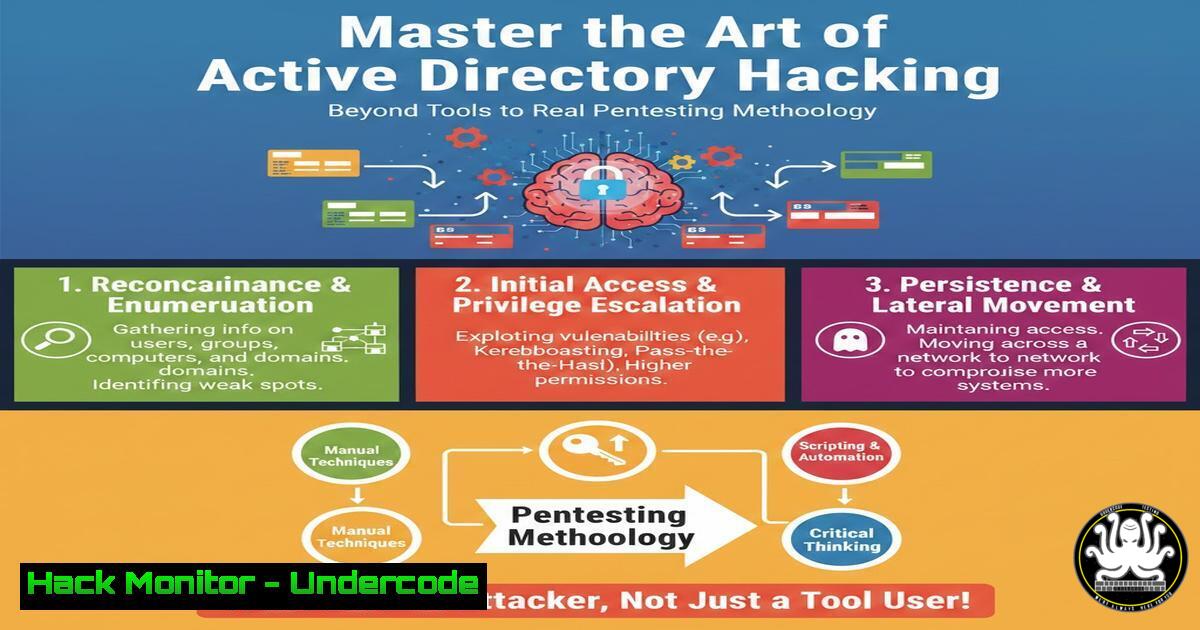
Introduction:
In the high-stakes world of cybersecurity, mastering Active Directory (AD) is non-negotiable, as it remains the backbone of enterprise identity and access management. However, most aspiring hackers get stuck in “tool fatigue”—mindlessly running scripts without understanding the underlying logic. This article breaks down the core pentester mindset for AD exploitation, moving beyond simply spraying payloads to adopting a structured, methodology-driven hunt for privilege escalation and domain dominance.
Learning Objectives:
- Understand the strategic mindset of a penetration tester versus a simple tool user.
- Learn a repeatable methodology for attacking Active Directory environments.
- Identify common misconfigurations and privilege escalation vectors in AD.
- Apply practical commands for reconnaissance, exploitation, and persistence.
You Should Know:
1. The Pentester Mindset: Hunting, Not Just Scanning
The fundamental shift in effective penetration testing is moving from a “scanner” mentality to a “hunter” mentality. In the context of Active Directory, this means you are not just looking for open ports; you are looking for trust relationships, misconfigured ACLs, and Kerberos quirks. The goal is to think like the domain administrator: where would they hide credentials? What scripts do they run? How are Group Policy Objects (GPOs) linked?
– Linux Command (Reconnaissance): Using `ldapsearch` to anonymously query the domain for juicy information without authentication.
ldapsearch -x -H ldap://<Domain_Controller_IP> -b "DC=<domain>,DC=<com>" "(objectClass=user)" sAMAccountName userPrincipalName
What this does: It anonymously binds to the LDAP server and dumps all usernames, giving you a target list for password spraying or ASREP-roasting.
2. The Methodology: The AD Kill Chain
A successful AD attack follows a logical chain: Initial Access -> Host Recon -> Privilege Escalation (Local) -> Domain Recon -> Privilege Escalation (Domain) -> Persistence. Without this structure, you are just guessing. After gaining a foothold on a workstation, your first step is never to run a domain exploit; it is to run BloodHound collectors to map the domain.
– Windows Command (Recon): Using native Windows tools to avoid alerting AV.
 Enumerate domain admins
net group "Domain Admins" /domain

Find all domain controllers
nltest /dclist:<domain_name>

Check current user's privileges
whoami /priv
whoami /groups
What this does: These built-in commands help you understand your current context within the domain without dropping any third-party binaries.
3. Exploiting Kerberos: The Art of Roasting
One of the most critical skills in AD exploitation is attacking the Kerberos protocol. The “ASREP Roast” attack targets users who do not require Kerberos pre-authentication. If you find such a user during your recon (using tools like `GetNPUsers.py` from Impacket), you can request their encrypted ticket data and crack it offline, effectively getting a password without ever sending a login attempt.
– Linux Command (Exploitation):
 Using Impacket from a Linux attack machine
impacket-GetNPUsers <domain_name>/ -usersfile usernames.txt -dc-ip <DC_IP> -format hashcat
What this does: It requests Authentication Server Replies (AS_REP) for the users listed in your file. If successful, it spits out a hash that Hashcat can crack.
4. Lateral Movement: Pass-the-Hash and Token Impersonation
Once you have a foothold, you rarely have a plaintext password. You have hashes. Understanding how to use those hashes to move laterally is key. Pass-the-Hash (PtH) allows you to authenticate to other machines using the NTLM hash of a user.
– Windows Command (Lateral Movement):
 Using wmic with a psexec style approach (requires admin rights on target)
wmic /node:"<Target_ComputerName>" /user:"<DOMAIN\Username>" process call create "cmd.exe /c whoami > C:\temp\output.txt"
Note: In a real scenario, if you have the hash but not the password, you would use tools like `mimikatz` to inject the hash into your current session (sekurlsa::pth) or use Impacket’s `psexec` on Linux.
– Linux Command (PtH):
impacket-psexec <domain>/<username>@<Target_IP> -hashes :<NTLM_Hash>
What this does: It authenticates to the target using only the NTLM hash and provides a semi-interactive shell.
5. Persistence: The Skeleton Key
After compromising the Domain Admin, the final step is persistence. A classic (though highly detectable) persistence method is the “Skeleton Key” attack using Mimikatz. This patches the domain controller’s LSASS process to allow a master password to work for any account.
– Windows Command (Persistence – Admin Required on DC):
 On a Domain Controller with SYSTEM privileges
mimikatz.exe "privilege::debug" "misc::skeleton" exit
What this does: Injects a skeleton key (default password: “mimikatz”) into the DC. Any user can now authenticate with their regular password OR the skeleton key. This ensures you retain access even if the target user changes their password.
6. Hardening: Viewing Misconfigurations from the Inside
To understand how to break AD, you must understand how to view its misconfigurations. Checking for unconstrained delegation, for example, is a massive red flag.
– PowerShell Command (Detection):
 Find computers with unconstrained delegation
Get-ADComputer -Filter {TrustedForDelegation -eq $true} -Properties TrustedForDelegation, userAccountControl
What this does: Lists all computers trusted for delegation, which can be exploited to compromise services like file servers or web servers hosting sensitive data.
What Undercode Say:
- Key Takeaway 1: The difference between a script kiddie and a professional pentester is the ability to adapt their methodology. Memorizing commands for ASREP Roast or Pass-the-Hash is useless if you don’t know why you are running them at that specific stage of the attack chain.
- Key Takeaway 2: Active Directory security is a layered game of “Trust.” Every link, every delegation, every GPO is a potential trust that can be abused. By mapping these trusts with tools like BloodHound, you visualize the attack paths that are invisible to standard vulnerability scanners.
The reality is that attackers are not just running exploits; they are exploiting the intended functionality of the domain (like Kerberos and LDAP). The key takeaway from the referenced video series is that you must train your brain to see the logic behind the domain architecture, turning the domain’s management features against itself.
Prediction:
As organizations migrate to the cloud and adopt hybrid identities (Azure AD Connect), the attack surface is shifting. We will see a rise in “Cloud-to-On-Prem” pivots. Attackers will compromise a simple Office 365 user, sync their password to the on-premise AD via misconfigured Azure AD Connect, and then pwn the entire corporate forest from the cloud. The methodology will evolve to include Graph API reconnaissance and targeting of synchronization accounts.
▶️ Related Video (82% Match):
🎯Let’s Practice For Free:
IT/Security Reporter URL:
Reported By: Belalfergani %D8%A8%D8%B3%D9%85 – Hackers Feeds
Extra Hub: Undercode MoN
Basic Verification: Pass ✅


