Listen to this Post
Introduction:
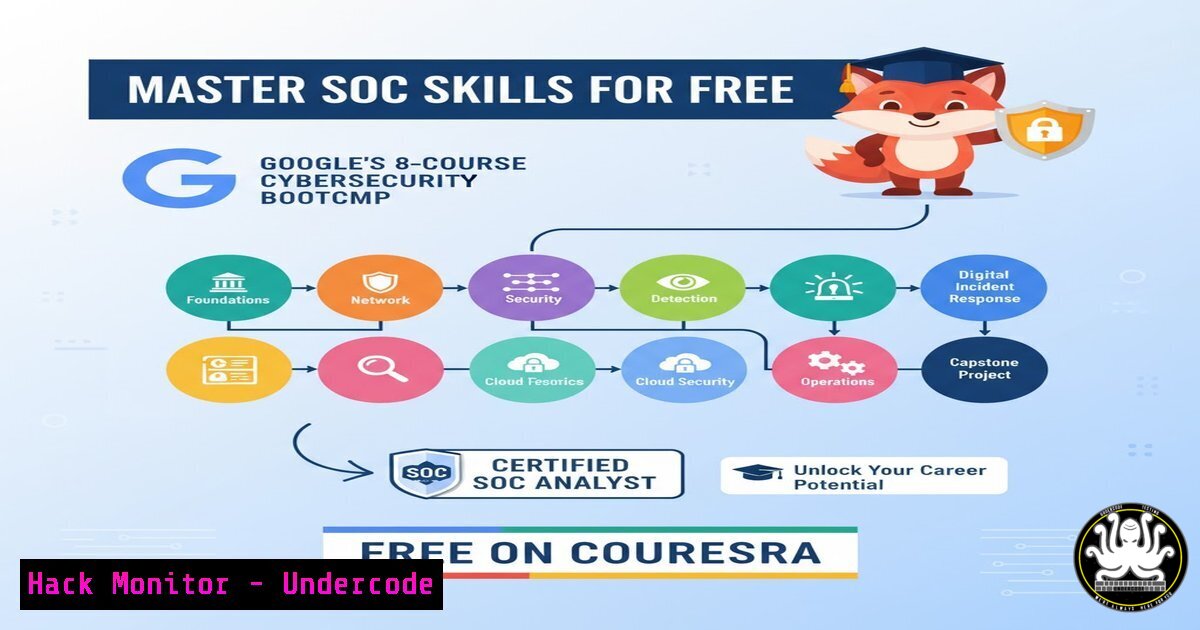
The demand for skilled Security Operations Center (SOC) analysts is skyrocketing, yet breaking into this critical cybersecurity field often requires hands-on experience that can be difficult to acquire. Google has directly addressed this challenge by launching eight free, comprehensive courses designed to equip aspiring and current cybersecurity professionals with the practical, real-world skills needed to detect, analyze, and respond to modern threats. This initiative provides a direct pathway to mastering the tools and methodologies used by SOC teams daily, from SIEM analysis to SOAR automation.
Learning Objectives:
- Understand the core functions and workflows of a modern Security Operations Center (SOC).
- Develop practical skills in creating and managing SIEM rules for threat detection.
- Learn to implement and utilize Security Orchestration, Automation, and Response (SOAR) platforms to streamline incident response.
You Should Know:
1. Foundational Security Operations
A SOC is the nerve center of an organization’s cybersecurity posture, responsible for continuous monitoring and incident response. Google’s “Security Operation Fundamentals” and “Deep Dive” courses lay the groundwork, teaching you how to triage alerts, investigate incidents, and understand the attacker lifecycle. This is not theoretical; the included labs simulate the pressure and procedures of a real SOC environment.
Step-by-step guide explaining what this does and how to use it:
Step 1: Enroll in the “Google Security Operation Fundamentals” course using the provided URL. This is your starting point.
Step 2: Familiarize yourself with core concepts like the Cyber Kill Chain and MITRE ATT&CK framework. These are the blueprints for understanding how attacks unfold.
Step 3: Practice log analysis. A fundamental SOC task is reviewing logs. On your own lab machine, you can practice with basic Linux commands to analyze authentication logs:
`sudo tail -f /var/log/auth.log` (on Ubuntu/Debian) or `sudo tail -f /var/log/secure` (on CentOS/RHEL). This command follows the system’s authentication log in real-time, showing login attempts.
`grep “Failed password” /var/log/auth.log` This filters the log to show only failed login attempts, a key indicator of brute-force attacks.
2. Mastering the SIEM for Proactive Threat Detection
A Security Information and Event Management (SIEM) system aggregates and analyzes log data from across an organization’s network. The “SIEM” and “SIEM Rules” courses teach you to harness this powerful tool. You’ll learn to write detection rules that identify suspicious activity, such as multiple failed logins from a single IP address or the execution of a known malware hash.
Step-by-step guide explaining what this does and how to use it:
Step 1: Access the “Google Security Operations – SIEM Rules” course.
Step 2: Understand the structure of a detection rule. A typical rule includes a trigger condition and a resulting action. For example, a rule might be triggered when more than five “Failed Login” events occur from one IP within 60 seconds.
Step 3: Apply the logic. While you may not have a commercial SIEM, you can practice the logic with command-line tools. To hunt for a specific process, you could use PowerShell on Windows:
`Get-Process | Where-Object {$_.ProcessName -like “suspicious_name”}` This command lists all running processes and filters for one with “suspicious_name” in its title.
3. Automating Response with SOAR
Security Orchestration, Automation, and Response (SOAR) platforms take SOC efficiency to the next level by automating repetitive tasks. The “SOAR Fundamentals,” “SOAR Analyst,” and “SOAR Developer” courses guide you through creating automated playbooks. For instance, a playbook can automatically quarantine a malicious file, block an attacking IP address at the firewall, and create a ticket in the ticketing system—all without human intervention.
Step-by-step guide explaining what this does and how to use it:
Step 1: Start with the “SOAR Fundamentals” course to grasp the core concepts of automation and orchestration.
Step 2: Diagram a simple incident response playbook. For example, on receiving a “Phishing Email Reported” alert, the playbook could: 1. Extract the sender’s IP and attachment hashes. 2. Query a threat intelligence API. 3. If malicious, delete the email from all user inboxes and block the sender.
Step 3: Practice automation logic. In a Windows environment, you could write a basic batch script to simulate an automated containment action:
`@echo off
echo Quarantining malicious file…
move “C:\Users\Public\suspicious_file.exe” “C:\Quarantine\”
echo File quarantined.`
This simple script “moves” a file to a quarantine directory, mimicking a SOAR action.
4. Implementing Modern Security Operations
The “Modern Security Operations” course synthesizes all the learned concepts into a cohesive strategy for a contemporary SOC. It covers cloud security integration, threat intelligence fusion, and metrics for measuring SOC performance. This high-level view is crucial for understanding how SIEM and SOAR tools fit into the broader organizational security strategy.
Step-by-step guide explaining what this does and how to use it:
Step 1: Take the “Modern Security Operations” course after completing the foundational and tool-specific courses.
Step 2: Map a threat to a mitigation. Using the MITRE ATT&CK framework, identify a technique like “Credential Dumping” (T1003). Then, document which SIEM rule would detect it and what SOAR playbook would trigger to contain it.
Step 3: Harden a system. As a proactive measure, you can harden a Linux server by disabling unused services, a key modern ops task. To check for listening ports, use: sudo netstat -tulpn. To disable a service, use: `sudo systemctl stop [bash]` and then sudo systemctl disable [bash].
5. Building a Practical Lab Environment
Theory alone is insufficient. The true value of these courses comes from applying the knowledge in a hands-on lab. While the courses include their own labs, building a personal home lab reinforces the skills and demonstrates initiative to potential employers.
Step-by-step guide explaining what this does and how to use it:
Step 1: Set up a virtualized environment using VirtualBox or VMware. Create two virtual machines: one acting as an “attacker” (Kali Linux) and one as a “victim” (Windows 10 or Ubuntu Server).
Step 2: Install and configure a free SIEM. Options include Security Onion, a dedicated Linux distribution that includes powerful tools like Elasticsearch, Logstash, and Kibana (the ELK stack).
Step 3: Forward logs. Configure your “victim” VM to send its Windows Event Logs or Linux syslogs to your SIEM VM. This is the foundational step of building your own mini-SOC.
Step 4: Generate and detect traffic. From your “attacker” VM, use a tool like `nmap` to perform a network scan against the “victim.” The command `nmap -sS [bash]` performs a TCP SYN scan. Your goal is to see this scan appear as an alert within your SIEM’s dashboard.
What Undercode Say:
- This initiative by Google is a significant market disruptor, democratizing access to high-quality SOC training and potentially setting a new standard for industry-led education.
- The focus on hands-on labs over pure theory directly tackles the experience gap that often prevents talented individuals from entering the cybersecurity workforce, making it one of the most practical upskilling resources available.
Analysis: Google’s foray into free, advanced security training is a strategic move that serves multiple purposes. It cultivates a larger talent pool familiar with security operations concepts, which in turn creates a more robust ecosystem for Google’s own security products. For professionals, this is an unparalleled opportunity. The curriculum’s depth, covering everything from foundational analysis to advanced SOAR development, provides a clear and credible career pathway. By completing these courses and supplementing them with personal lab work, a candidate can build a portfolio that demonstrates tangible competence, often making them more prepared for entry-level roles than candidates with only theoretical certifications.
Prediction:
The widespread availability of such high-quality, free training will accelerate the professionalization of SOC roles and raise the baseline expectation for entry-level analysts. Within two years, proficiency in SIEM and basic SOAR operations will become a standard prerequisite, not a differentiator. This will push the entire industry forward, forcing security vendors to improve product usability and integration while enabling smaller organizations to build more capable security teams. Consequently, we can expect a rise in the sophistication of automated attacks, as adversaries will also need to adapt to defenses that are faster, more intelligent, and increasingly automated.
🎯Let’s Practice For Free:
IT/Security Reporter URL:
Reported By: Mohammed Sasni – Hackers Feeds
Extra Hub: Undercode MoN
Basic Verification: Pass ✅


