Listen to this Post
Introduction:
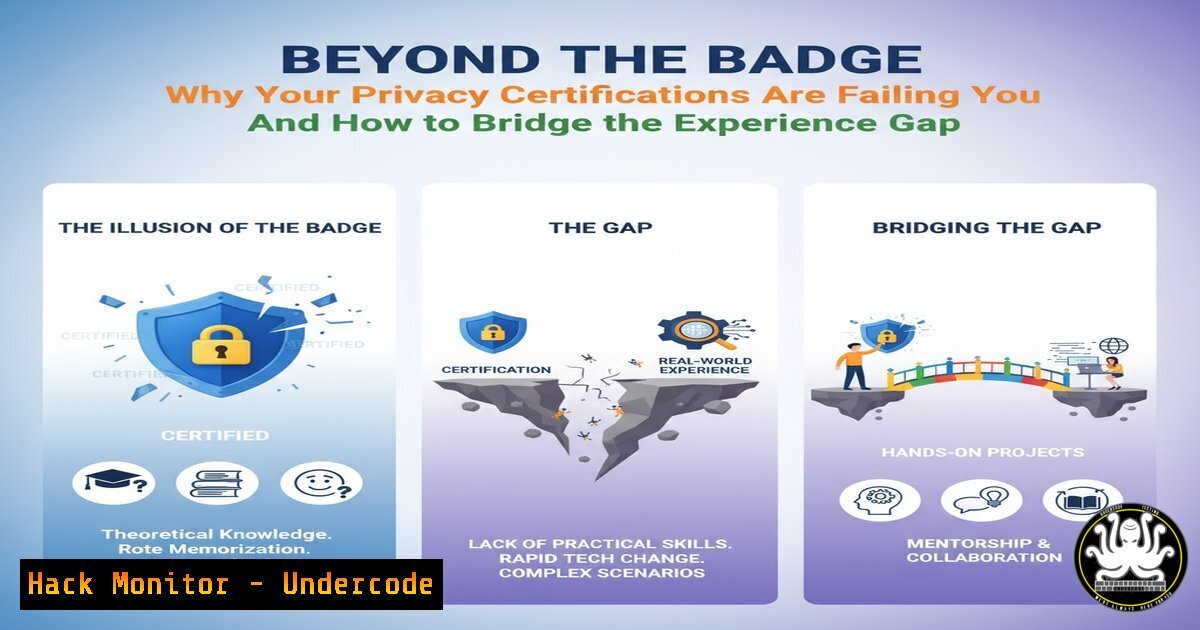
In the rapidly evolving fields of data privacy and cybersecurity, credentials like CIPPE, CIPT, and CIPM are often seen as the ultimate career accelerants. However, these certifications primarily provide theoretical knowledge, creating a critical chasm when professionals face real-world boardroom politics, technical pushback, and operational constraints. This article deconstructs the gap between academic knowledge and practical execution, providing a actionable roadmap to translate privacy theory into tangible business value and technical implementation.
Learning Objectives:
- Identify the critical soft skills and technical understandings missing from standard privacy certification curricula.
- Develop a framework for conducting a Privacy Impact Assessment (PIA) that withstands technical and legal scrutiny.
- Learn to operationalize privacy principles into enforceable technical controls and business processes.
You Should Know:
1. Navigating Stakeholder Politics and Pushback
The theoretical framework of a PIA means little without the political acumen to see it implemented. You may know the laws, but if you cannot persuade engineering, legal, and business teams, your recommendations will be ignored.
Step‑by‑step guide explaining what this does and how to use it.
Step 1: Pre-Meeting Intelligence Gathering: Before presenting your PIA, meet with key stakeholders individually. For the engineering lead, understand their deployment timeline and technical debt. For the legal counsel, identify their primary compliance concerns.
Step 2: Translate Jargon into Business Outcomes: Instead of saying “We need to implement data minimization,” say “By reducing the personal data we collect by 40%, we can lower our cloud storage costs and reduce the blast radius of a potential data breach, directly cutting our cyber insurance premiums.”
Step 3: Co-Create the Solution: In the meeting, frame recommendations as collaborative solutions. Use phrases like “Based on the engineering constraints we discussed, one approach could be…” This builds ownership and reduces defensive reactions.
2. Operationalizing Privacy Impact Assessments (PIAs)
A PIA is not a checkbox exercise. It’s a living document that must be technically grounded. This requires moving from abstract principles to specific system configurations.
Step‑by‑step guide explaining what this does and how to use it.
Step 1: Data Flow Mapping with Technical Precision: Create a detailed data flow diagram that includes all systems, APIs, and data stores. For each data element, document its classification and residency.
Example Command (to discover data flows): `tcpdump -i any -w dataflow.pcap host [bash]` – This captures network traffic for analysis (use only on authorized systems).
Step 2: Identify Technical Control Gaps: For each data storage point (e.g., an S3 bucket, a SQL database), verify encryption status.
Example Command (AWS CLI): `aws s3api get-bucket-encryption –bucket [bash]` – This checks if server-side encryption is enabled on an S3 bucket.
Example SQL (PostgreSQL): `\conninfo` and `SELECT FROM pg_settings WHERE name LIKE ‘%ssl%’;` – This checks the database connection and SSL settings.
Step 3: Implement and Verify Mitigations: If you find an unencrypted database, work with engineers to enable encryption and then verify it.
Example Command (to verify TLS on an endpoint): `openssl s_client -connect [bash]:[bash] -servername [bash]` – This tests the SSL/TLS certificate and connection details.
3. Building Credibility Through Technical Literacy
You don’t need to be a senior engineer, but you must speak their language. Understanding basic commands and system architectures prevents your recommendations from being dismissed as unrealistic.
Step‑by‑step guide explaining what this does and how to use it.
Step 1: Learn the Basics of Infrastructure: Familiarize yourself with core concepts: cloud IAM roles, containerization (Docker, Kubernetes), and API gateways.
Step 2: Use Command-Line Tools for Verification: Go beyond GUI-based tools. Use CLI to query systems and demonstrate findings concretely.
Example (Linux/Mac): Use `curl` to test API endpoints for security headers: `curl -I https://api.yourcompany.com/v1/users | grep -i “strict-transport-security\|content-security-policy”`
Step 3: Propose Actionable Technical Controls: Instead of “improve access controls,” specify “Let’s implement a mandatory step-up authentication (MFA) for this API endpoint using our identity provider’s policy framework.”
- From Statute to Story: The Art of Communication
Legal citations intimidate; stories persuade. Your ability to frame privacy risks in terms of brand reputation, customer trust, and financial loss is what wins executive support.
Step‑by‑step guide explaining what this does and how to use it.
Step 1: Collect Analogous Breach Stories: Maintain a dossier of real-world incidents. For example, have a summary of a GDPR fine levied against a company for a similar data processing misstep you’ve identified.
Step 2: Quantify the Impact: Use tools like the `OWASP Risk Rating Methodology` to assign a rough quantitative score (Low, Medium, High, Critical) to each privacy risk based on its likelihood and business impact.
Step 3: Craft the Narrative: Structure your risk presentation as: “Here is a problem we face [cite analogous story]. If this occurred, it could impact us in [bash] way, costing approximately [bash]. My recommendation of [bash] directly mitigates this with a minimal operational burden.”
5. Implementing Data Anonymization for Analytics
A common point of conflict is the use of personal data for analytics. Proposing a technical solution for anonymization demonstrates a practical understanding of the “data minimization” principle.
Step‑by‑step guide explaining what this does and how to use it.
Step 1: Identify Direct and Quasi-Identifiers: Work with the data science team to pinpoint PII (e.g., email) and quasi-identifiers (e.g., zip code, birth date).
Step 2: Apply Anonymization Techniques: Propose specific techniques.
Pseudonymization (Hashing): `echo -n “[email protected]” | sha256sum` – This creates a one-way hash, replacing the direct identifier with a token.
Generalization: Replace exact birth dates with age ranges.
k-Anonymity: Ensure that every combination of quasi-identifiers in the dataset applies to at least `k` individuals.
Step 3: Validate the Output: Before the dataset is used, re-identify a sample to ensure no individual can be singled out.
What Undercode Say:
- Certifications are your foundation, but experience is your fortress. They validate your knowledge, but only applied practice builds unshakable credibility.
- The most critical tool in a privacy pro’s arsenal is not a legal textbook, but the ability to translate abstract principles into technical and business realities.
The analysis reveals a systemic issue in professional education: an over-reliance on theoretical accreditation. The future of effective privacy and cybersecurity leadership lies in hybrid roles—practitioners who are as comfortable discussing API security headers with engineers as they are explaining risk scenarios to the board. Jamal Ahmed’s post underscores that the “cost” of a certification is not just its price, but the potential career stagnation if one fails to move beyond it. True expertise is demonstrated not by what you know, but by what you can successfully implement.
Prediction:
The demand for privacy professionals will increasingly bifurcate. Those who remain purely theoretical, relying solely on certifications, will find their influence and opportunities shrinking, relegated to advisory roles with limited impact. Conversely, practitioners who combine certifications with demonstrable, hands-on experience in technical implementation, cross-functional leadership, and risk quantification will become the new elite, commanding premium roles and becoming indispensable strategic partners in guiding organizations through the complex interplay of AI governance, data ethics, and cybersecurity.
🎯Let’s Practice For Free:
IT/Security Reporter URL:
Reported By: Kmjahmed Cippe – Hackers Feeds
Extra Hub: Undercode MoN
Basic Verification: Pass ✅


