Listen to this Post
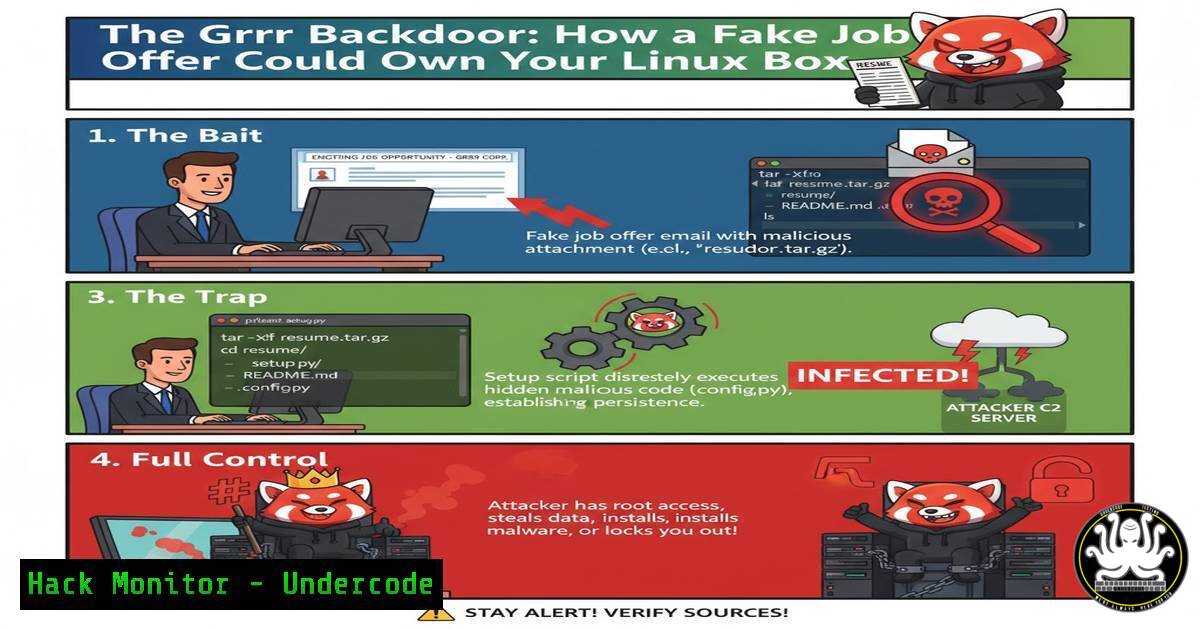
Introduction:
A sophisticated new Linux backdoor, dubbed “Grrr,” is being deployed through a cunning social engineering campaign targeting developers with fake job offers. This attack leverages a malicious npm module, node-ipc, to compromise systems, demonstrating a dangerous convergence of open-source supply chain threats and credential-harvesting tactics. Understanding its mechanics is critical for any professional operating in a Linux environment.
Learning Objectives:
- Decipher the attack chain of the Grrr backdoor, from social engineering to remote code execution.
- Learn the commands to detect and eradicate this specific malware from an infected Linux system.
- Implement proactive security measures to harden your development environment against similar supply chain attacks.
You Should Know:
- The Anatomy of the Attack: From Inbox to Infection
The attack begins not with a technical exploit, but with a persuasive social engineering email. The target, often a developer, receives a legitimate-looking job offer that includes a link to a coding challenge or a project brief. To complete this challenge, the victim is instructed to clone a specific Git repository and run the project, which appears to be a normal React.js application. Unbeknownst to them, the project’s `package.json` includes a dependency on the sabotaged `node-ipc` package. Upon installation or execution (via `npm install` or running the application), the malicious code within `node-ipc` is triggered, initiating the backdoor deployment.
2. The Malicious Payload: What “Grrr” Actually Does
Once activated, the Grrr backdoor performs a multi-stage deployment. Its primary objectives are persistence, reconnaissance, and providing remote access. The payload is known to perform the following actions:
Establish Persistence: It creates a scheduled task (cron job) or a systemd service to ensure it survives reboots.
System Profiling: It collects system information, including hostname, OS details, and user information.
Backdoor Connection: It opens a reverse shell or establishes a connection to a Command & Control (C2) server, granting the attacker full control over the compromised machine.
A key indicator is the creation of a specific, hidden file and process. The name often contains the string “Grrr,” which is how the malware got its name.
- Detection and Eradication: Hunting Grrr on Your System
Swift detection is key to limiting damage. Here is a step-by-step guide to hunt for and remove the Grrr backdoor on a Linux system.
Step 1: Check for Malicious Processes.
Use ps, top, and `htop` to look for suspicious process names. A common indicator is a process name containing “grrr” or a random string of characters.
ps aux | grep -i grrr
ps aux | grep -E '[a-z0-9]{10}'  Look for processes with random-looking names
Step 2: Scan for Suspicious Cron Jobs.
Attackers often use cron for persistence. Check the current user’s crontab and the system-wide cron directories.
crontab -l  List current user's cron jobs
ls -la /etc/cron /var/spool/cron/crontabs/  List system cron directories
Step 3: Identify and Remove Malicious Files.
The backdoor likely drops a binary in a temporary or hidden directory. Use `find` to search for recently modified or suspicious files.
find /tmp /var/tmp -name "grrr" -o -name ".sh" -mtime -1
find /home -type f -name "grrr" 2>/dev/null
If found, note the file path and terminate the associated process before deletion.
kill -9 <PID>  Replace <PID> with the malicious process ID
rm -f /path/to/malicious/file
Step 4: Audit npm Packages.
Check your project for the malicious `node-ipc` version and remove it.
npm list node-ipc  Check if the package is present
npm uninstall node-ipc  Remove the package
Review your `package-lock.json` for any other suspicious dependencies.
4. Proactive Defense: Hardening Your Linux Development Environment
Prevention is always superior to reaction. Harden your environment to make it resistant to such attacks.
Principle of Least Privilege: Never run development servers or package managers (npm, pip) as the root user. Use a standard user account to limit the damage of a compromised application.
Network Segmentation: Isolate your development machines from critical production networks using firewalls (ufw on Linux) or VLANs. This prevents lateral movement if a machine is compromised.
Security Auditing Tools: Integrate tools like `auditd` to monitor for suspicious file and process activity.
sudo apt install auditd
sudo auditctl -w /etc/cron.d/ -p wa -k cron_changes  Watch cron directory for changes
5. Supply Chain Security: Vetting Third-Party Dependencies
The `node-ipc` incident is a classic supply chain attack. You must vet your dependencies.
Use Trusted Sources: Prefer well-maintained, widely-used packages.
Automated Vulnerability Scanning: Integrate tools like npm audit, Snyk, or GitHub’s Dependabot into your CI/CD pipeline to automatically flag known vulnerable dependencies.
npm audit  Scans current project for vulnerabilities
npm audit fix  Attempts to automatically fix vulnerabilities
Software Bill of Materials (SBOM): Generate an SBOM for your projects to maintain a formal record of all components and dependencies, making it easier to respond when a component is compromised.
6. The Human Firewall: Defending Against Social Engineering
The initial attack vector was a fake job offer. Technical controls are futile if the user is tricked.
Verification: Always verify the authenticity of unsolicited job offers and the links they contain. Contact the company directly through their official website, not the contact information in the email.
Skepticism: Be inherently suspicious of any request to clone and run unknown code, especially as part of an uninitiated interaction.
Training: Organizations should conduct regular security awareness training that includes identifying sophisticated phishing and social engineering attempts.
What Undercode Say:
- The Grrr backdoor is a potent reminder that the attack surface now extends deep into the software supply chain, where a single malicious dependency can compromise an entire system.
- This campaign’s use of a credible lure like a job offer demonstrates a mature understanding of the target demographic, making traditional email filters less effective.
Analysis:
The Grrr campaign signifies an evolution in attacker methodology. By poisoning a legitimate, widely-used open-source component, attackers achieve scale and credibility simultaneously. The dual-use of the `node-ipc` package—both for legitimate purposes and as a malware carrier—blurs the lines of trust that the open-source ecosystem relies upon. This incident should serve as a critical case study for DevOps and SecOps teams, underscoring the non-negotiable need for robust software composition analysis (SCA), strict execution policies, and a security-aware culture. The fact that the payload establishes immediate persistence and a reverse shell indicates the attackers’ goal is long-term access and potential lateral movement within a corporate network, not just a one-time data theft.
Prediction:
The success of the Grrr backdoor campaign will inevitably spawn numerous copycats. We predict a significant rise in “typosquatting” and “dependency confusion” attacks targeting other popular package managers like PyPI (Python) and RubyGems. Furthermore, AI will be leveraged to generate more personalized and convincing fake job descriptions, making the social engineering component even harder to detect. In response, the industry will see a accelerated push towards code signing, reproducible builds, and the mandatory use of Software Bill of Materials (SBOMs) as a regulatory or contractual requirement, fundamentally changing how software is procured and trusted.
🎯Let’s Practice For Free:
IT/Security Reporter URL:
Reported By: Rbird Hoping – Hackers Feeds
Extra Hub: Undercode MoN
Basic Verification: Pass ✅


