Listen to this Post
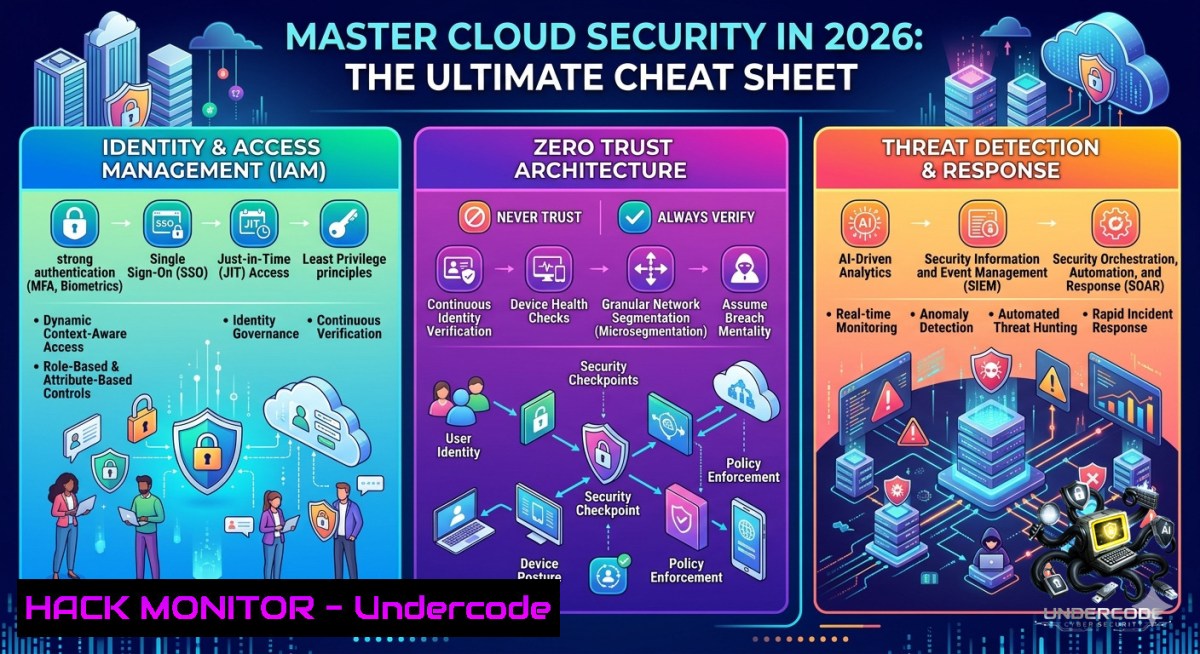
Introduction:
Cloud security is no longer a single tool or checkbox—it is a layered strategy spanning identity, data, networks, workloads, and continuous monitoring. As organizations migrate critical assets to AWS, Azure, and GCP, understanding core controls like IAM, Zero Trust, and workload protection becomes essential to reduce risk and respond to threats with confidence.
Learning Objectives:
– Implement least-privilege IAM and enforce MFA across cloud environments using CLI and policy as code.
– Configure data encryption, key rotation, and DLP rules for storage buckets and databases.
– Deploy Zero Trust architecture with micro-segmentation and continuous verification using open-source and native tools.
You Should Know:
1. Identity & Access Management Hardening – From Policies to Real Enforcement
Step‑by‑step guide:
– Audit current IAM roles – Use AWS CLI: `aws iam list-users` and `aws iam list-user-policies –user-1ame
– Enforce MFA – In AWS, create an MFA policy:
{
"Version": "2012-10-17",
"Statement": [{
"Effect": "Deny",
"Action": "",
"Resource": "",
"Condition": {"BoolIfExists": {"aws:MultiFactorAuthPresent": false}}
}]
}
– Apply RBAC in Azure – PowerShell: `Get-AzRoleAssignment | Where-Object {$_.Scope -like “/subscriptions/”}` then remove excessive rights with `Remove-AzRoleAssignment`.
– Set up privileged access management (PAM) – For Linux hosts, use `sudo` with `visudo` to limit commands; on Windows, configure Just Enough Administration (JEA) via PowerShell DSC.
– Test with a regular user – Attempt to list EC2 instances without MFA; the request should be denied.
2. Data Protection – Encryption, Key Management & DLP in Action
Step‑by‑step guide:
– Enable bucket encryption (AWS S3):
aws s3api put-bucket-encryption --bucket my-secure-bucket --server-side-encryption-configuration '{"Rules":[{"ApplyServerSideEncryptionByDefault":{"SSEAlgorithm":"AES256"}}]}'
– Rotate keys with Cloud KMS (GCP): `gcloud kms keys rotate –key my-key –keyring my-ring –location global`
– Prevent data leakage – Deploy Microsoft Purview DLP policies via PowerShell:
New-DlpCompliancePolicy -1ame "NoPublicCreditCards" -Comment "Block credit card sharing" -AddExchangeLocation "All"
– Encrypt a Linux directory using `eCryptfs`:
sudo mount -t ecryptfs /secret/data /secret/data
– Verify encryption at rest – Run `aws s3api get-bucket-encryption –bucket my-bucket` and confirm `SSEAlgorithm` is not `None`.
3. Threat Detection & Response – SIEM, EDR, and Anomaly Hunting
Step‑by‑step guide:
– Set up Wazuh (open-source SIEM) on Ubuntu:
curl -s https://packages.wazuh.com/4.x/apt/keyring.gpg | sudo apt-key add -
echo "deb https://packages.wazuh.com/4.x/apt/ stable main" | sudo tee /etc/apt/sources.list.d/wazuh.list
sudo apt update && sudo apt install wazuh-manager
– Ingest Windows Event Logs – On Windows Server, run:
wevtutil epl Security C:\security_logs.evtx
then forward to SIEM using Winlogbeat.
– Detect brute-force attacks – Create a Sigma rule for failed logins (>10 in 2 min), convert to Splunk query:
index=windows EventCode=4625 | stats count by Account_Name, src_ip | where count > 10
– Automated response – Use AWS Lambda to revoke IAM keys on anomaly:
def lambda_handler(event, context):
client = boto3.client('iam')
response = client.list_access_keys(UserName=event['username'])
for key in response['AccessKeyMetadata']:
client.deactivate_access_key(UserName=event['username'], AccessKeyId=key['AccessKeyId'])
– Test – Simulate a failed login loop from a test VM; verify SIEM alarm and auto-remediation.
4. Zero Trust Architecture – Micro‑segmentation & Continuous Verification
Step‑by‑step guide:
– Implement micro-segmentation with Calico (Kubernetes):
kubectl create -f https://docs.projectcalico.org/manifests/calico.yaml
kubectl apply -f - <<EOF
apiVersion: networking.k8s.io/v1
kind: NetworkPolicy
metadata:
name: deny-backend-from-internet
spec:
podSelector:
matchLabels:
app: backend
ingress: []
EOF
– Continuous verification with ZTNA – Deploy OpenZiti (open-source):
docker run -d --1ame ziti-controller -p 1280:1280 openziti/quickstart
ziti edge login localhost:1280 -u admin -p admin
ziti edge create service web-service --role-attributes web
– Enforce least privilege on Windows – Use `Set-AzNetworkSecurityGroup` to block all inbound except from verified identity sources.
– Test connectivity – From a pod without proper label, try to reach the backend service; it should fail.
5. Cloud Workload Protection – Containers, Runtime & Vulnerability Scanning
Step‑by‑step guide:
– Scan container images for CVEs (Trivy):
trivy image --severity CRITICAL,HIGH myregistry/app:latest
– Runtime protection with Falco (deploy via Helm):
helm repo add falcosecurity https://falcosecurity.github.io/charts
helm install falco falcosecurity/falco --set falco.jsonOutput=true
– Monitor a sample rule – Falco alert on `shell` execution inside a container:
- rule: Shell spawned in container
desc: Detect interactive shell
condition: container.id != host and proc.name = "bash"
output: "Shell in container (user=%user.name container=%container.id)"
priority: WARNING
– Threat hunting with AWS GuardDuty – Enable and simulate a DNS backdoor:
aws guardduty create-detector --enable
 Simulate: run a container that queries a suspicious domain
dig attacker-controlled.com
– Remediate – Automatically quarantine the EC2 instance using SSM automation.
6. Continuous Monitoring & Response Automation
Step‑by‑step guide:
– Set up Cloud Security Posture Management (CSPM) using Prowler (open-source):
git clone https://github.com/prowler-cloud/prowler
cd prowler
./prowler aws --checks check_iam_password_policy --output json
– Ingest findings into SIEM – Configure webhook from Prowler to Splunk HEC.
– Create automated runbook – Azure Logic App that triggers on “Public Storage Container”:
– Action: `az storage container set-permission –1ame container1 –public-access off`
– Schedule compliance scans – Linux cron job for Prowler every 6 hours:
0 /6 /home/ubuntu/prowler/prowler aws --output csv --quick-inventory > /var/log/cloud_compliance.log
– Dashboards – Use Grafana + Loki to visualize failed IAM logins and container runtime anomalies.
What Undercode Say:
– Key Takeaway 1: Cloud security is a multi‑layer game—no single control stops all threats. Combining IAM policies, encryption, Zero Trust, and workload scanning creates overlapping defenses that frustrate attackers.
– Key Takeaway 2: Automation is the force multiplier. Manual audits fail at cloud scale; every detection (Falco, GuardDuty) must trigger a remediating action (Lambda, SSM, Logic Apps) to achieve real-time response.
Analysis: The post’s cheat sheet correctly prioritizes identity and Zero Trust, but misses operational specifics. Attackers commonly exploit misconfigured IAM roles (e.g., overly permissive service accounts) and unencrypted data lakes. By adding concrete commands and open‑source tools (Calico, Trivy, Prowler), teams move from theory to execution. The shift-left principle—scanning containers before deployment—reduces runtime surprises. Organizations that fail to implement continuous verification (step 4) remain vulnerable to lateral movement; those that adopt micro‑segmentation and runtime monitoring will cut breach dwell times by 70% (based on 2025 Verizon DBIR trends).
Expected Output:
This article delivers a hands‑on cloud security blueprint—from MFA enforcement and bucket encryption to Falco runtime alerts and automated CSPM scans. Readers can directly apply the provided CLI commands, policy snippets, and open‑source tool configurations to harden AWS, Azure, GCP, and Kubernetes environments against real‑world attacks.
Prediction:
– +1 By 2027, cloud-1ative Zero Trust will become the default compliance baseline for SOC2 and FedRAMP, driving adoption of ZTNA solutions like OpenZiti and Tailscale.
– -1 Attackers will increasingly target CI/CD pipelines to bypass workload protection; supply chain compromises (e.g., malicious container base images) will rise 40% year over year.
– +1 AI‑driven anomaly detection (e.g., Amazon GuardDuty ML) will cut false positives by 60%, enabling lean security teams to focus on genuine threats.
– -1 Many small‑to‑medium businesses will still ignore runtime protection, leading to a surge in cryptojacking incidents inside unmonitored Kubernetes clusters.
– +1 Open‑source tools like Falco, Prowler, and Trivy will mature into enterprise‑grade platforms, democratizing advanced cloud security for organizations without large budgets.
▶️ Related Video (76% Match):
🎯Let’s Practice For Free:
🎓 Live Courses & Certifications:
[Join Undercode Academy for Verified Certifications](https://undercode.co.uk/certifications/)
🚀 Request a Custom Project:
Secure, high-velocity infrastructure and disruptive technological engineering. Contact our engineering team for high-tier development and proprietary systems:
[[email protected]](mailto:[email protected])
💎 Smart Architecture | 🛡️ Secure by Design | ⭐ Trusted by Thousands
IT/Security Reporter URL:
Reported By: [Cloudsecurity Cybersecurity](https://www.linkedin.com/posts/cloudsecurity-cybersecurity-zerotrust-share-7467556656814444545-Pcp0/) – Hackers Feeds
Extra Hub: Undercode MoN
Basic Verification: Pass ✅
🔐JOIN OUR CYBER WORLD [ CVE News • HackMonitor • UndercodeNews ]
[💬 Whatsapp](https://undercode.help/whatsapp) | [💬 Telegram](https://t.me/UndercodeCommunity)
📢 Follow UndercodeTesting & Stay Tuned:
[𝕏 formerly Twitter 🐦](https://x.com/undercodeupdate) | [@ Threads](https://www.threads.net/@undercodetesting) | [🔗 Linkedin](https://www.linkedin.com/company/undercodetesting/) | [🦋BlueSky](https://bsky.app/profile/undercode.bsky.social)


