Listen to this Post
Introduction
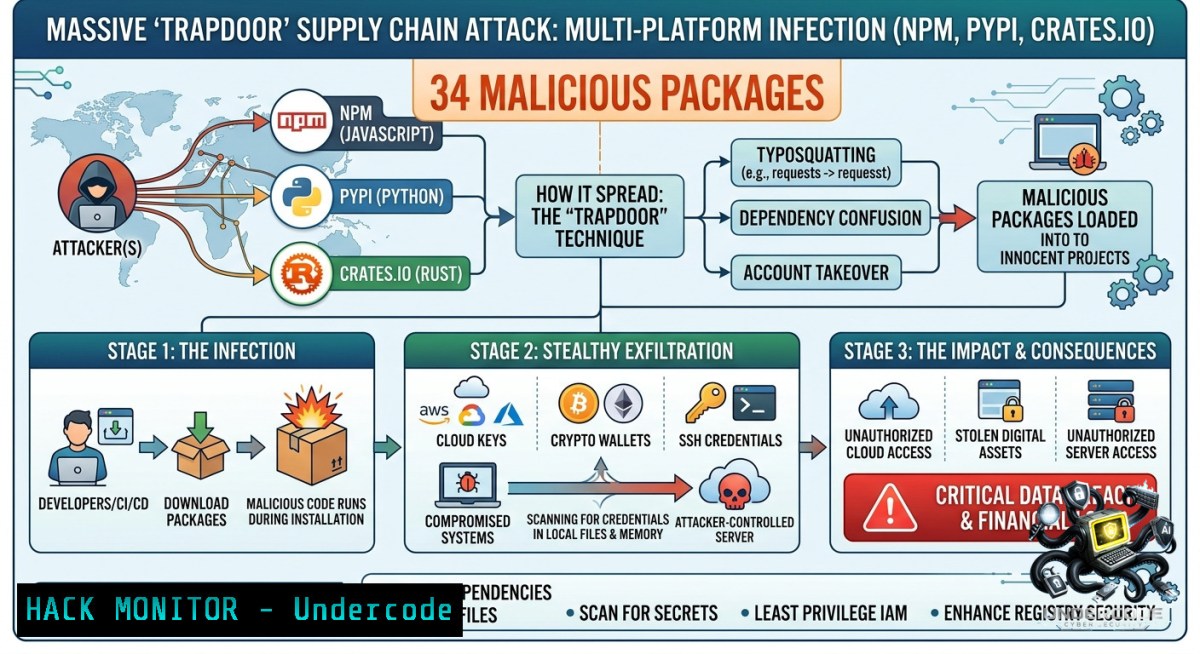
A sophisticated and ongoing software supply chain attack, codenamed “TrapDoor,” has been discovered across the npm, PyPI, and Crates.io ecosystems. The campaign leverages over 34 malicious packages across more than 384 versions to target developers, particularly those in cryptocurrency, DeFi, Solana, and AI sectors, aiming to steal sensitive data including SSH keys, cloud credentials, crypto wallets, and browser data.
Learning Objectives
– Identify the Execution Vectors: Understand how TrapDoor exploits postinstall hooks, auto-import behaviors, and build scripts to execute malicious code during routine development workflows.
– Implement Mitigation Strategies: Learn practical commands and configurations to detect and block the attack’s indicators of compromise (IOCs) across Linux and Windows environments.
– Apply Hardening Techniques: Master the steps to secure developer endpoints, package registries, and CI/CD pipelines against cross-ecosystem supply chain poisoning.
You Should Know
1. How TrapDoor Injects Malware Across npm, PyPI, and Crates.io
TrapDoor’s threat actors tailored their approach to each package manager’s unique mechanics, ensuring automatic code execution during normal installation or import processes.
Step-by-Step Technical Breakdown:
– npm (JavaScript/Node.js): Malicious packages use a `postinstall` script. When a developer runs `npm install`, the script silently deploys a shared payload named `trap-core.js` (approx. 1,149 lines of code). This payload scans for credentials, tests them against AWS and GitHub APIs, establishes persistence via systemd services and cron jobs, and even performs lateral movement using stolen SSH keys. It also poisons AI development files like `.cursorrules` and `CLAUDE.md` to manipulate coding assistants.
– PyPI (Python): Packages execute malicious code upon being imported (e.g., `import malicious_package`). The code downloads a remote JavaScript payload from a GitHub Pages domain (`ddjidd564.github[.]io`) and executes it using `node -e`. This external hosting allows attackers to update the payload dynamically without republishing the Python package.
– Crates.io (Rust): Malicious crates utilize a `build.rs` script, which runs automatically during compilation (`cargo build`). The script scans for blockchain wallet files (e.g., for Sui, Solana, and Aptos), encrypts the stolen data using a hardcoded XOR key, and exfiltrates it to public GitHub Gists.
2. Detecting Infection and Blocking IOCs
This section provides verified commands to detect signs of the TrapDoor malware and block its known command-and-control (C2) infrastructure.
Step-by-Step Guide for Detection and Blocking:
1. Search for the Core Payload (Linux/macOS):
 Recursively search for trap-core.js
sudo find / -1ame "trap-core.js" 2>/dev/null
 Search for known malicious directory patterns
grep -r "ddjidd564" ~/.npm/ ~/.cache/pip/ ~/.cargo/ 2>/dev/null
2. Audit Installed Packages (All Platforms):
 npm: List all globally installed packages and look for malicious names
npm list -g --depth=0
 PyPI: List all installed packages and versions
pip list
 Cargo: List installed crates
cargo install --list
3. Check for Persistence Mechanisms (Linux):
 Review cron jobs for suspicious entries
crontab -l
sudo crontab -l
 Check systemd services for unknown units
systemctl list-units --type=service | grep -v "systemd\|dbus\|user"
 Examine bashrc/zshrc for malicious hooks
grep -i "node\|curl\|wget" ~/.bashrc ~/.zshrc
4. Check for Persistence Mechanisms (Windows – PowerShell as Admin):
 Check scheduled tasks
Get-ScheduledTask | Where-Object {$_.TaskPath -1otlike "Microsoft"}
 Check registry for run keys
Get-ItemProperty HKLM:\Software\Microsoft\Windows\CurrentVersion\Run
Get-ItemProperty HKCU:\Software\Microsoft\Windows\CurrentVersion\Run
5. Block IOCs (Network/Endpoint): Add the following known malicious domains and URLs to your firewall, proxy, or `hosts` file:
– `ddjidd564.github[.]io`
– `https[:]//ddjidd564[.]github[.]io/defi-security-best-practices/config.json`
– `webhook[.]site` and its endpoints (e.g., `https[:]//webhook[.]site/2ada14c8-00f6-43ce-9ad6-f5dc15952246`)
3. Hardening Developer Environments Against Supply Chain Attacks
To prevent future compromise, implement a defense-in-depth strategy across your development lifecycle.
Step-by-Step Hardening Guide:
1. Enforce Package Verification:
– Use `npm ci` instead of `npm install` in CI/CD pipelines. It strictly adheres to the lockfile and fails if it doesn’t match.
– For Python, use `pip-tools` or `poetry` to generate a lockfile and verify hashes before installation.
– For Rust, consider using `cargo-audit` to check for known vulnerabilities in dependencies.
2. Sandbox Package Installation: Run package installations in isolated environments.
– Use Docker containers:
docker run --rm -v $PWD:/app -w /app node:latest npm install
– Use Python virtual environments (`venv`) and avoid `pip install –user` on shared systems.
3. Network-Level Controls:
– Implement an egress firewall on developer workstations to block unexpected outbound connections (e.g., deny `github.io` and `webhook.site` except for explicitly allowed endpoints).
– Use a transparent proxy or a Secure Web Gateway (SWG) to inspect all traffic, including that to encrypted APIs.
4. Secrets Management & Rotation:
– Never store plaintext secrets (AWS keys, GitHub tokens, SSH private keys) in environment variables or local config files on developer endpoints.
– Use a dedicated secrets manager (e.g., HashiCorp Vault, AWS Secrets Manager, or a passphrase-protected password manager).
– Implement short-lived credentials. For cloud providers, enforce automatic key rotation every 90 days or less.
5. Monitor and Alert on Suspicious Process Behavior:
– Use EDR (Endpoint Detection and Response) or a simple monitoring script to alert on unexpected `node` processes reading SSH keys or wallet files.
– Example Linux Audit Rule (`/etc/audit/rules.d/`):
-w /home/ -p r -k developer_ssh_watch
-w ~/.ssh/ -p r -k ssh_key_access
What Undercode Say:
– Key Takeaway 1: The “TrapDoor” campaign highlights a dangerous escalation in supply chain attacks: threat actors are now weaponizing the very tools and scripts developers rely on for automation (like `build.rs` and `postinstall`) to gain automatic, stealthy access to high-value development environments. This is not a simple phishing attack; it’s a systemic compromise of the software supply chain’s foundational trust model.
– Key Takeaway 2: The use of dynamic, externally-hosted payloads and sophisticated encryption (Fernet, ECDH, XOR) demonstrates a move toward professional-grade attack infrastructure. By exfiltrating data through trusted platforms like GitHub Pages and Gists, the attackers bypass many traditional network monitoring tools, making detection reliant on behavioral analysis and strict egress filtering rather than simple signature-based scanning.
Prediction:
– -1 The “TrapDoor” campaign will likely inspire a new wave of cross-ecosystem supply chain attacks. We can expect to see these techniques weaponized against other package managers (e.g., Go modules, RubyGems) and extended to target AI/ML model repositories (e.g., Hugging Face) and internal corporate artifact registries.
– -1 The long-term impact will be a significant erosion of trust in open-source ecosystems. Organizations will increasingly mandate private mirrors and air-gapped build environments, slowing down development velocity and increasing operational costs. This may lead to a “trust but verify” model becoming a mandatory compliance standard for all software development, especially in fintech and critical infrastructure.
▶️ Related Video (64% Match):
🎯Let’s Practice For Free:
🎓 Live Courses & Certifications:
[Join Undercode Academy for Verified Certifications](https://undercode.co.uk/certifications/)
🚀 Request a Custom Project:
Secure, high-velocity infrastructure and disruptive technological engineering. Contact our engineering team for high-tier development and proprietary systems:
[[email protected]](mailto:[email protected])
💎 Smart Architecture | 🛡️ Secure by Design | ⭐ Trusted by Thousands
IT/Security Reporter URL:
Reported By: [Varshu25 Malicious](https://www.linkedin.com/posts/varshu25_malicious-packages-target-cloud-keys-wallets-share-7467511710510399488-Qjs5/) – Hackers Feeds
Extra Hub: Undercode MoN
Basic Verification: Pass ✅
🔐JOIN OUR CYBER WORLD [ CVE News • HackMonitor • UndercodeNews ]
[💬 Whatsapp](https://undercode.help/whatsapp) | [💬 Telegram](https://t.me/UndercodeCommunity)
📢 Follow UndercodeTesting & Stay Tuned:
[𝕏 formerly Twitter 🐦](https://x.com/undercodeupdate) | [@ Threads](https://www.threads.net/@undercodetesting) | [🔗 Linkedin](https://www.linkedin.com/company/undercodetesting/) | [🦋BlueSky](https://bsky.app/profile/undercode.bsky.social)


