Listen to this Post
Introduction:
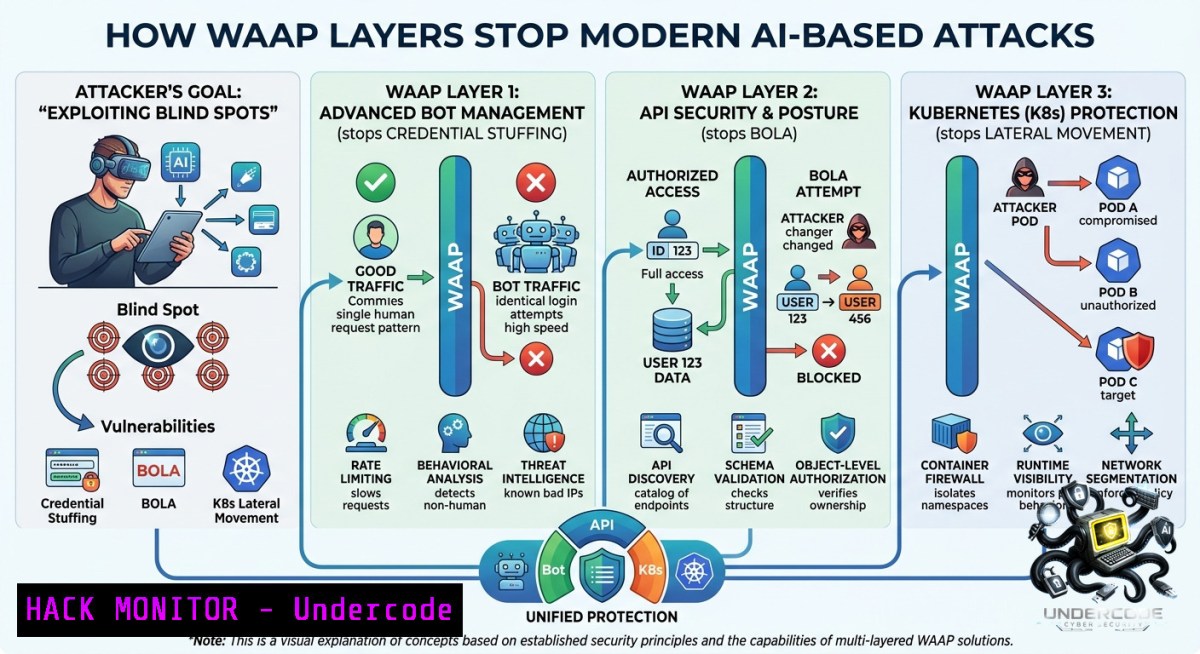
Traditional web application firewalls (WAFs) and API gateways are failing to detect slow, low‑and‑slow credential stuffing, broken object‑level authorization (BOLA) exfiltration, and east‑west lateral movement inside Kubernetes clusters. As attackers weaponize AI to mimic legitimate traffic, organizations remain blind to compromises that unfold over days or weeks. Modern WAAP (Web Application and API Protection) combines discovery, posture management, and runtime protection into a unified, continuously adaptive defense.
Learning Objectives:
– Detect and mitigate slow credential stuffing campaigns using rate‑limiting anomaly detection and behavioral fingerprinting.
– Identify BOLA vulnerabilities in APIs through automated fuzzing and enforce object‑level authorization controls.
– Implement east‑west microsegmentation and eBPF‑based runtime visibility to block lateral movement within Kubernetes clusters.
You Should Know:
1. Slow Credential Stuffing – How Attackers Evade Rate Limits and How to Stop Them
Attackers now distribute login attempts across thousands of IPs (residential proxies) with random delays between 10–60 seconds. Traditional rate limits (e.g., 5 requests/minute per IP) fail because each IP stays under the threshold. AI tools like `OpenBullet 2` or custom Python scripts use rotating user‑agent pools and adaptive sleep intervals.
Step‑by‑step guide to detect and block slow credential stuffing:
– Linux – Analyze Nginx logs for distributed patterns:
 Extract failed logins per minute across all client IPs (cluster ‑wide view)
sudo awk '{print $1, substr($4,14,5)}' /var/log/nginx/access.log | grep "401" | sort | uniq -c | awk '$1 > 2 {print}' | head -20
This reveals many different IPs each causing 1–2 failures per minute – a classic slow‑stuffing fingerprint.
– Windows – Using PowerShell and IIS logs:
Get-Content C:\inetpub\logs\LogFiles\W3SVC1\u_ex.log | Where-Object {$_ -match "401"} | ForEach-Object {($_-split' ')[bash] + " " + ($_-split' ')[bash]} | Group-Object | Where-Object {$_.Count -le 3} | Format-Table -AutoSize
– Mitigation with WAAP runtime:
Implement session‑based velocity (e.g., 5 failed attempts per session ID, regardless of IP) and device fingerprinting (TLS fingerprint, canvas hash). Configure ModSecurity with dynamic blocking:
SecRule REQUEST_URI "@streq /login" "phase:1,id:1001,block,msg:'Slow stuffing detected',setvar:session.failcount=+1,expirevar:session.failcount=60,action:drop"
2. Silent Data Exfiltration via BOLA (Broken Object‑Level Authorization)
BOLA (OWASP API 1) allows an attacker to change an object identifier in an API request and access another user’s data. Attackers silently enumerate `GET /api/v1/invoice/{invoice_id}` with sequential IDs, exfiltrating thousands of records over hours. Traditional WAFs see only valid HTTP 200 responses.
Step‑by‑step guide to discover and fix BOLA:
– Automated BOLA fuzzing using `Autorize` (Burp Suite extension) or `BOLA‑Runner`:
 Clone BOLA tool and run against a target API endpoint
git clone https://github.com/cr0hn/bolareturn.git
cd bolareturn
python3 bolareturn.py -u "https://api.target.com/v2/user/1/profile" -c "session_cookie.txt" -i 1 100
– Implement object‑level authorization check in code (Node.js example):
// Wrong – only checks authentication, not ownership
app.get('/api/invoice/:id', auth, (req, res) => {
db.query(`SELECT  FROM invoices WHERE id=${req.params.id}`); // BOLA vulnerable
});
// Correct – enforce user context
app.get('/api/invoice/:id', auth, (req, res) => {
const userId = req.session.userId;
db.query(`SELECT  FROM invoices WHERE id=${req.params.id} AND user_id=${userId}`);
});
– WAAP posture layer – Continuous API discovery and schema validation:
Enforce that every API response includes a `X‑Content‑Type‑Options: nosniff` and validate JWT claims against object IDs. Use OWASP ZAP in passive scan mode:
zap-cli quick-scan --self-contained --spider -r -s all https://api.target.com/v2/
3. East‑West Lateral Movement in Kubernetes – Detecting pod‑to‑pod API abuse
Once an attacker compromises a frontend pod, they scan internal Kubernetes APIs and service meshes. Traditional network firewalls don’t inspect pod‑to‑pod traffic. Attackers use `kubectl exec` or cURL to internal services (e.g., metadata APIs, Redis, internal dashboards), bypassing ingress WAFs entirely.
Step‑by‑step guide to enforce east‑west microsegmentation and runtime detection:
– Enable Kubernetes network policies to deny all intra‑namespace traffic by default:
apiVersion: networking.k8s.io/v1
kind: NetworkPolicy
metadata:
name: default-deny-all
spec:
podSelector: {}
policyTypes:
- Ingress
- Egress
– Use eBPF‑based runtime visibility (Cilium or Tetragon):
 Deploy Tetragon to log all execve syscalls inside pods
kubectl apply -f https://raw.githubusercontent.com/cilium/tetragon/main/examples/quickstart/daemonset.yaml
 Watch for suspicious kubectl exec or curl to internal IPs
kubectl logs -1 kube-system -l app=tetragon -f | jq 'select(.process_exec.filename | contains("kubectl") or contains("curl"))'
– WAAP runtime layer – Sidecar proxy injection (e.g., Istio + OPA):
Enforce that any pod‑to‑pod API call must present a valid JWT signed by the ingress gateway. Reject requests from pods without expected `pod‑identity` header.
4. AI‑Powered Web Attacks – How Adversarial ML Bypasses Signature Detection
Attackers now use generative AI to craft polymorphic payloads that mutate after every request. For example, SQLi payloads are rephrased by GPT‑4 to avoid signature patterns like `’ OR 1=1 –`. Traditional regex‑based WAFs fail.
Step‑by‑step to test and mitigate AI‑evasion:
– Generate adversarial payloads with `Garak` (LLM vulnerability scanner):
pip install garak
garak --model_type openai --model_name gpt-3.5-turbo --probes encoding --payloads "sql_injection"
– Deploy a behavioral anomaly detection model (e.g., using `scikit‑learn` on request logs):
from sklearn.ensemble import IsolationForest
import numpy as np
 Features: request length, character entropy, parameter count, time between requests
X_train = np.load('normal_requests.npy')
model = IsolationForest(contamination=0.01).fit(X_train)
prediction = model.predict([[512, 3.2, 8, 1.2]])  -1 = anomalous
– WAAP discovery layer – ML‑powered API schema auto‑learning:
The WAAP learns baseline JSON structures and flags any deviation (e.g., extra parameters, unexpected data types) as suspicious.
5. Cloud Hardening Against API Reconnaissance – Blocking Attackers Before They Exploit
Attackers use tools like `ffuf`, `dirsearch`, and `Arjun` to discover hidden API endpoints. They combine wordlists from leaked GitHub repos and AI‑generated parameter names.
Step‑by‑step to harden cloud APIs:
– Deploy a deception token (honeytoken) in your API responses:
Add a fake endpoint `/api/admin/debug?token=HONEY_XYZ` that only attackers would find. When accessed, auto‑block the source IP in your WAF.
– Linux – Use `fail2ban` to dynamically block API scanners:
 /etc/fail2ban/filter.d/api-scan.conf
[bash]
failregex = ^<HOST> . "GET /api/v(1|2)/. HTTP/." 404.$
 Ban IPs that generate 3+ 404s within 60 seconds
sudo fail2ban-client set api-scan banip 192.168.1.100
– Windows – PowerShell script to monitor IIS 404 spikes and add firewall rule:
$events = Get-WinEvent -LogName 'Microsoft-IIS-Logging/Logs' | Where-Object {$_.Message -match '404'} | Group-Object -Property @{Expression={$_.TimeCreated.Hour}} -1oElement
if ($events.Count -gt 100) { New-1etFirewallRule -DisplayName "BlockAPIHarvester" -Direction Inbound -RemoteAddress (Get-1etTCPConnection -State Listen | Select -ExpandProperty RemoteAddress) -Action Block }
6. Runtime Protection with WAAP – Deploying a Real‑Time Blocking Policy
Combine all three layers: Discovery (finds all APIs), Posture (enforces auth schemas), Runtime (inspects every request). Example using ModSecurity with CRS (Core Rule Set) and dynamic rate‑limiting.
Step‑by‑step on an Nginx + ModSecurity WAAP:
– Install and enable ModSecurity OWASP CRS:
sudo apt install libmodsecurity3 nginx-modsecurity
sudo git clone https://github.com/coreruleset/coreruleset /etc/nginx/modsec/coreruleset
sudo cp /etc/nginx/modsec/coreruleset/crs-setup.conf.example /etc/nginx/modsec/coreruleset/crs-setup.conf
– Configure anomaly scoring to block AI‑evasion:
 In /etc/nginx/modsec/main.conf
SecAction "id:900000,phase:1,setvar:tx.blocking_paranoia_level=3,setvar:tx.detection_paranoia_level=3"
Include /etc/nginx/modsec/coreruleset/crs-setup.conf
Include /etc/nginx/modsec/coreruleset/rules/.conf
– Add dynamic BOLA detection for APIs:
-- Inline Lua script to compare user_id from JWT with object_id in URL
if ngx.var.request_uri:match("/api/user/(%d+)/profile") then
local path_user_id = ngx.var.request_uri:match("/api/user/(%d+)/profile")
local jwt_user_id = ngx.ctx.jwt_claim.sub
if path_user_id ~= jwt_user_id then
ngx.exit(403)
end
end
What Undercode Say:
– Key Takeaway 1: Traditional rate‑limiting and signature‑based WAFs are completely blind to slow credential stuffing and AI‑generated polymorphic payloads. You must shift to behavioral analytics and session‑based velocity controls.
– Key Takeaway 2: BOLA and east‑west lateral movement require a three‑layer WAAP approach – Discovery (find every API), Posture (enforce object‑level auth), Runtime (inspect pod‑to‑pod traffic with eBPF). No single tool fixes these; integration is mandatory.
Analysis (around 10 lines):
The scenarios described are not theoretical – they represent real breaches from 2023–2025 (e.g., Microsoft’s BOLA‑driven email exfiltration, Uber’s Kubernetes lateral movement). Attackers now treat APIs as the new network perimeter, and they’ve automated low‑and‑slow techniques to bypass any static threshold. The most dangerous gap is runtime visibility inside clusters: most security teams still don’t log egress from pods. WAAP solutions that unify discovery, posture, and runtime are finally closing this gap, but they require a shift left – embedding authorization logic into the API code itself, not just adding a perimeter appliance. The free webinar referenced provides live demos of these three layers, which is essential because abstract concepts fail without seeing how a single exploited pod can lead to database compromise within minutes.
Prediction:
– +1 WAAP will merge with CNAPP (Cloud Native Application Protection Platforms) by 2026, giving security teams a single pane of glass from code commit to runtime pod communication.
– -1 Attackers will weaponize LLMs to automatically rewrite BOLA payloads for each target API, increasing successful bypass rates by over 60% in the next 12 months.
– +1 eBPF‑based runtime sensors will become default in all managed Kubernetes services (EKS, AKS, GKE) by 2027, dramatically reducing lateral movement detection time from days to seconds.
– -1 Most organizations will continue to underinvest in API discovery, leaving 20–30% of their attack surface completely unmonitored – a primary entry vector for 2025’s largest breaches.
▶️ Related Video (66% Match):
🎯Let’s Practice For Free:
🎓 Live Courses & Certifications:
[Join Undercode Academy for Verified Certifications](https://undercode.co.uk/certifications/)
🚀 Request a Custom Project:
Secure, high-velocity infrastructure and disruptive technological engineering. Contact our engineering team for high-tier development and proprietary systems:
[[email protected]](mailto:[email protected])
💎 Smart Architecture | 🛡️ Secure by Design | ⭐ Trusted by Thousands
IT/Security Reporter URL:
Reported By: [Cybersecuritynews Webinar](https://www.linkedin.com/posts/cybersecuritynews-webinar-share-7467520569811431424-4RRV/) – Hackers Feeds
Extra Hub: Undercode MoN
Basic Verification: Pass ✅
🔐JOIN OUR CYBER WORLD [ CVE News • HackMonitor • UndercodeNews ]
[💬 Whatsapp](https://undercode.help/whatsapp) | [💬 Telegram](https://t.me/UndercodeCommunity)
📢 Follow UndercodeTesting & Stay Tuned:
[𝕏 formerly Twitter 🐦](https://x.com/undercodeupdate) | [@ Threads](https://www.threads.net/@undercodetesting) | [🔗 Linkedin](https://www.linkedin.com/company/undercodetesting/) | [🦋BlueSky](https://bsky.app/profile/undercode.bsky.social)


