
Listen to this Post
Introduction:
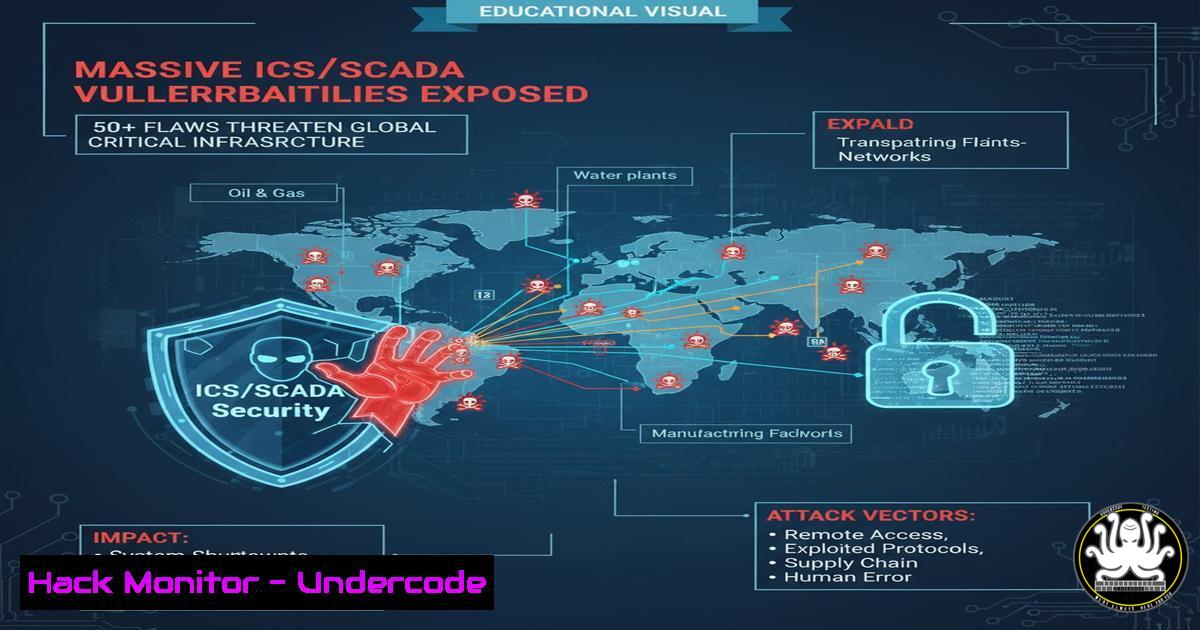
A sweeping security disclosure has revealed over 50 vulnerabilities affecting industrial control systems (ICS) and supervisory control and data acquisition (SCADA) environments, with several rated as critical. These flaws, impacting major vendors and open-source operational technology (OT) platforms, could allow remote attackers to disrupt power grids, water treatment facilities, and manufacturing lines. This post dissects the technical nature of these exploits, provides mitigation commands, and analyzes the broader implications for global critical infrastructure security.
Learning Objectives:
- Understand the architecture and common attack vectors within ICS/SCADA networks.
- Learn to identify, patch, and mitigate specific vulnerabilities using Linux/Windows commands and security tools.
- Implement network segmentation and hardening techniques to protect OT environments from remote compromise.
You Should Know:
- Initial Reconnaissance and Discovery of Vulnerable SCADA Interfaces
Attackers often begin by scanning for exposed Human-Machine Interfaces (HMIs) and engineering workstations. Shodan and Censys are frequently used for internet-wide scans, but internally, tools like Nmap are employed.
Step‑by‑step guide: Using Nmap for ICS Discovery
To identify potentially vulnerable Modbus or DNP3 devices on a network, security teams can use the following commands to audit their own infrastructure:
 Scan for common SCADA ports (Modbus TCP - 502, IEC 60870-5-104 - 2404, DNP3 - 20000)
sudo nmap -sS -p 502,2404,20000 -O -sV <target_IP_range>

Use NSE scripts to enumerate Modbus slave IDs
sudo nmap --script modbus-discover -p 502 <target_IP_range>
What this does: The first command performs a SYN scan on specific OT ports to identify live devices and their operating systems. The second uses Nmap’s scripting engine to query Modbus devices for their slave IDs, revealing the layout of the control system. Identifying these exposed interfaces is the first step in verifying if they are patched against the newly disclosed vulnerabilities.
2. Exploiting Hard-Coded Credentials and Weak Authentication
Many of the disclosed flaws involve hard-coded or default credentials in embedded web servers and HMI software. Attackers can use these to gain administrative access.
Step‑by‑step guide: Testing for Default Credentials with Hydra
Security professionals can test for weak credentials using password-cracking tools in a controlled environment.
 Using Hydra to brute-force a basic auth SCADA web interface
hydra -l admin -P /usr/share/wordlists/rockyou.txt <target_IP> http-get /path/to/hmi
What this does: This attempts to log in to an HTTP-GET protected page using the username “admin” and a list of common passwords. In a real-world attack, success here would grant the adversary control over the HMI, allowing them to alter set points or disable alarms. Mitigation involves enforcing multi-factor authentication and removing default credentials immediately upon deployment.
3. Command Injection in Legacy OT Middleware
The report highlights command injection flaws in legacy data gateways that translate between IT and OT protocols. These often run on stripped-down Linux distributions.
Step‑by‑step guide: Simulating a Command Injection Payload
If a vulnerable web parameter is found (e.g., a ping tool), the following payload might be tested:
POST /diagnostic HTTP/1.1
Host: vulnerable-gateway.local
...
parameter=127.0.0.1; whoami
What this does: If the application does not sanitize input, the semicolon allows the attacker to chain the `whoami` command after the intended ping. To verify impact on a Linux-based controller, a defender can check for unauthorized processes:
 On the compromised Linux host, check for suspicious processes
ps aux | grep nc  Look for netcat reverse shells
netstat -antp | grep ESTABLISHED  Check for unusual outbound connections
Mitigation requires strict input validation and disabling shell execution functions within the application code.
4. Memory Corruption Exploits in Protocol Parsers
Several critical vulnerabilities exist in how SCADA servers parse industrial protocols like OPC UA and PROFINET. These can lead to Remote Code Execution (RCE).
Step‑by‑step guide: Applying Windows Patches and Hardening
Many engineering workstations run Windows and are the primary target for these exploits.
 PowerShell script to check installed KBs against known vulnerable versions
Get-HotFix | Where-Object { $<em>.HotFixID -match "KB4507459" -or $</em>.HotFixID -match "KB4512534" }  Example KBs

Enable Enhanced Mitigation Experience Toolkit (EMET) or Attack Surface Reduction (ASR) rules
 ASR rule to block Office applications from creating child processes (common exploit vector)
Add-MpPreference -AttackSurfaceReductionRules_Ids "D4F940AB-401B-4EFC-AADC-AD5F3C50688A" -AttackSurfaceReductionRules_Actions Enabled
What this does: The first command verifies if a specific security update is installed. The second enables an ASR rule that prevents Microsoft Office (often used to view SCADA reports) from spawning malicious processes, a common payload delivery method for memory corruption exploits.
5. Man-in-the-Middle (MitM) Attacks on Unencrypted Fieldbus Communications
Many industrial protocols, such as Modbus and EtherNet/IP, lack encryption. Attackers who have gained a foothold in the OT network can intercept or modify traffic.
Step‑by‑step guide: Network Segmentation with VLANs and ACLs
The primary defense is network segregation.
 On a Cisco IOS switch, create a dedicated OT VLAN and apply an ACL
configure terminal
vlan 20
name OT_Network
exit
interface GigabitEthernet0/1
switchport mode access
switchport access vlan 20
exit
!
 Apply ACL to block OT devices from initiating connections to the IT network
access-list 101 deny ip any 192.168.1.0 0.0.0.255 (Example IT subnet)
access-list 101 permit ip any any
interface vlan 20
ip access-group 101 in
What this does: This places all field devices in a separate VLAN and applies an access control list to prevent them from talking to the corporate network, containing a potential breach and preventing protocol manipulation from crossing zones.
6. Firmware Backdoors and Insecure Update Mechanisms
Some disclosed vulnerabilities involve unsigned firmware updates, allowing attackers to implant persistent backdoors.
Step‑by‑step guide: Verifying Firmware Integrity on Linux-based PLCs
For controllers running embedded Linux (like some CODESYS platforms), defenders can verify file integrity.
 Calculate cryptographic hashes of critical binaries to detect tampering
sha256sum /bin/busybox /usr/bin/plc_executable > /config/golden_hashes.txt

Periodically run a verification script
sha256sum -c /config/golden_hashes.txt --quiet || echo "ALERT: Binary mismatch detected" | mail -s "Integrity Alert" admin@localhost
What this does: This creates a baseline of critical system files. Any deviation from these hashes during a routine scan indicates potential firmware modification, a key indicator of compromise following an exploit attempt.
What Undercode Say:
- The Air Gap is a Myth: These disclosures reinforce that most critical infrastructure is more connected than operators admit. The focus must shift from assuming isolation to actively monitoring for threats inside the OT network.
- Asset Management is Non-Negotiable: You cannot protect what you cannot see. The Nmap and network scanning techniques outlined are not just for attackers; they are essential baseline practices for defenders to discover rogue or forgotten devices running outdated, vulnerable firmware.
- Patch Management in OT is an Operational Challenge: Unlike IT, you cannot simply reboot a power grid controller to apply a patch. This necessitates virtual patching through IDS/IPS (like Snort rules for SCADA protocols) and enhanced network segmentation to buy time until scheduled maintenance windows.
Prediction:
We will see a sharp increase in targeted ransomware attacks shifting from corporate IT networks directly to ICS environments. As these vulnerabilities become commoditized, financially motivated groups will combine RCE exploits in protocol parsers with data encryption, moving beyond operational disruption to extortion models that threaten physical safety. This will force governments to mandate stricter “safe harbor” liability for vendors producing insecure OT components.
▶️ Related Video (88% Match):
🎯Let’s Practice For Free:
IT/Security Reporter URL:
Reported By: Juanjomarle Ayer – Hackers Feeds
Extra Hub: Undercode MoN
Basic Verification: Pass ✅


