Listen to this Post
Introduction
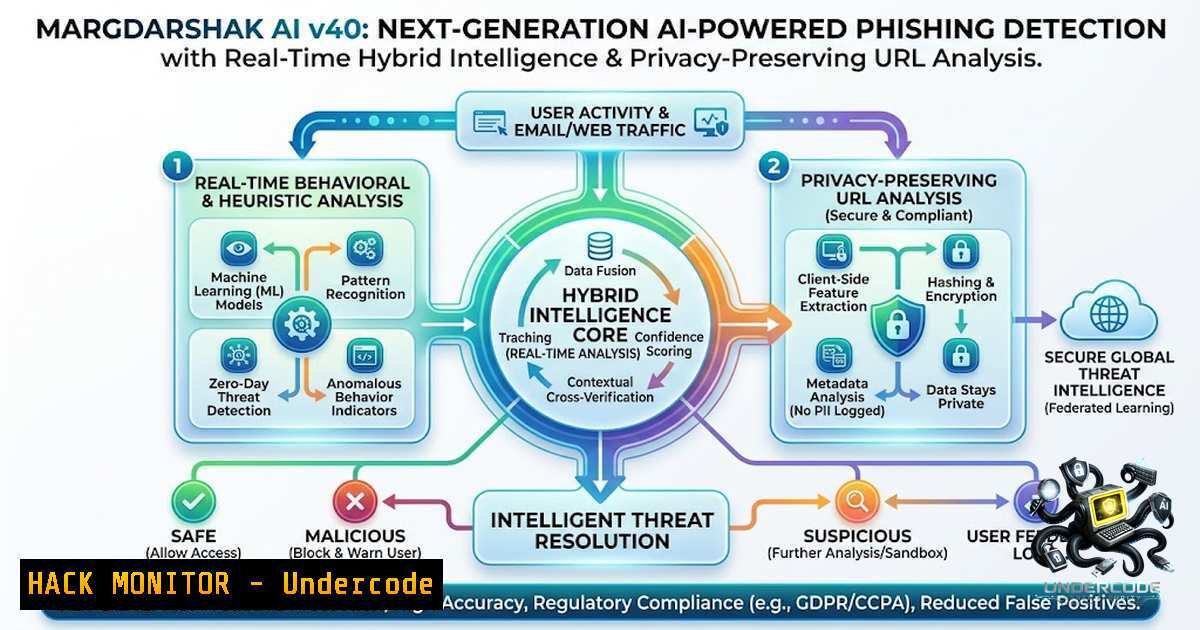
Phishing remains the most pervasive initial-access vector in cybersecurity, with over 80% of reported security incidents originating from a phishing email or malicious link that directs victims to credential-harvesting pages. Traditional detection methods—static blacklists and heuristic rule engines—fail catastrophically against modern threats, as phishing domains are typically registered, weaponized, and abandoned within 48 hours, rendering blocklists obsolete almost immediately. MargDarshak AI v4.0—AI Phishing Guard, unveiled by Indian Cyber Security Solutions (CyberSecOps Pvt. Ltd.) on 10 August 2026, addresses this gap through a hybrid AI analysis engine that combines real-time URL semantics comprehension, structural representation, visual deception detection, and threat intelligence feed integration—all while maintaining a privacy-first architecture that never exposes user browsing data.
Learning Objectives
- Understand how AI-powered real-time URL safety analysis detects phishing, credential-harvesting attempts, and suspicious websites through multi-layered threat scoring
- Master the architecture of hybrid AI phishing detection systems combining machine learning classifiers, natural language processing, and threat intelligence feeds
- Learn practical implementation of phishing URL analysis using open-source CLI tools, Python scripts, and threat intelligence APIs for security operations and incident response
You Should Know
1. How AI-Powered Real-Time URL Safety Analysis Works
Modern AI-driven phishing detection operates through a multi-stage pipeline that processes each URL in three critical steps: semantics comprehension, structural representation, and visual deception detection. State-of-the-art frameworks like APS-1et+ employ a compact transformer for phishing language pattern recognition, a Graph Attention Network (GAT) for token connections and structural hints, and a Visual Similarity Index (VSI) to detect deceptive behaviors such as punycode manipulation, homograph attacks, and zero-width character injection. This integrated approach achieves 98.91% accuracy with an ROC-AUC of 0.996, significantly outperforming traditional lexical and heuristic models.
The detection engine extracts URL and HTML-based features, derives composite features to enhance accuracy while minimizing dependence on third-party data, and feeds these vectors into machine learning classifiers. CatBoost has demonstrated the highest detection accuracy at 99.48% in optimized feature engineering frameworks, while ensemble models combining Random Forest and SVM achieve superior performance on URL-level features. For online deployment, these models are typically implemented as browser extensions communicating with backend APIs—APS-1et+ classifies URLs in under 400 milliseconds through a Chrome extension paired with a FastAPI server.
Practical Implementation: URL Analysis with Open-Source Tools
Security analysts can perform real-time URL phishing analysis using CLI-based tools:
Using dnstwist for Domain Permutation Detection (Kali Linux):
 Install dnstwist
sudo apt install dnstwist

Generate lookalike domains for a given domain
dnstwist example.com

Check for registered lookalike domains only
dnstwist -r example.com

Output in JSON format for integration
dnstwist -f json example.com > lookalike_domains.json
dnstwist generates similarly looking domain names and performs DNS queries (A, AAAA, NS, MX) to detect typosquatting, homograph phishing attacks, and brand impersonation.
Using Phishing Link Analyser (Python-based CLI):
 Clone and install
git clone https://github.com/aaronsawit/phising-analyser.git
cd phising-analyser
pip install requests
chmod +x phishing_checker.py

Analyze a URL
python phishing_checker.py https://login-micros0ft.com

Check exit codes for automation (0=clean, 1=suspicious, 2=malicious)
python phishing_checker.py suspicious-site.com
if [ $? -eq 2 ]; then echo "Blocking malicious site!"; fi
This tool queries live threat feeds (OpenPhish, URLhaus), detects brand impersonation, identifies character substitution attacks (e.g., micros0ft.com), and provides color-coded output with machine-readable exit codes.
2. Hybrid AI Analysis with Threat Intelligence Integration
MargDarshak AI v4.0’s hybrid approach combines multiple detection modalities: rule-based heuristics, machine learning classification, and Explainable AI (XAI) for real-time defense. This architecture, similar to frameworks like SafeSurf-AI, integrates Unicode homoglyph and Internationalized Domain Name (IDN) checking for visually deceptive domain detection, NLP-based tone analysis, and phishing-awareness simulation components that send controlled mock attacks to test user alertness.
The threat intelligence layer ingests domains from curated feeds—including community-driven sources such as phish.co.za and other OSINT providers—updated every 24 hours, with each domain undergoing DNS verification to confirm active resolution. Domains that stop resolving are automatically pruned, ensuring the database reflects the current threat landscape rather than an ever-growing graveyard of expired campaigns.
Python Implementation: Phishing Detection API Client
 Install the phishing detection API client
pip install phishingdetectionapi

Single domain check
from phishingdetectionapi import PhishingDetectionClient

client = PhishingDetectionClient("your_api_key_here")
result = client.check("suspicious-login.example.com")

print(result["is_phishing"])  True
print(result["category"])  "phishing/malware"
print(result["confidence"])  0.97
print(result["dns_active"])  True

Policy gate implementation
if result["is_phishing"]:
block_request("suspicious-login.example.com")

Bulk check up to 1,000 domains
domains = ["suspicious-bank.example.com", "legitimate-site.com", "phish-attempt.example.net"]
report = client.bulk_check(domains)
for entry in report["results"]:
if entry["is_phishing"]:
print(f"BLOCKED: {entry['domain']} — {entry['category']}")
This production-ready Python client maintains a database of 390,000+ DNS-verified active phishing domains.
Threat Intelligence Feed API Integration (PowerDMARC)
 Retrieve spoofing IP data via REST API
curl -X GET "https://api.powerdmarc.com/api/v1/ipinfo/spoofing-ips" \
-H "Authorization: Bearer YOUR_API_TOKEN" \
-H "Content-Type: application/json"
Security teams can integrate this feed with SIEM or SOAR platforms to automatically block or isolate malicious IPs in real-time, reducing response time from hours to seconds.
3. Privacy-First Protection Architecture
Privacy preservation is a cornerstone of modern AI phishing detection. MargDarshak AI v4.0 employs zero-knowledge architecture where user data is never exposed—inference runs on-device or in a privacy-preserving manner, analyzing up to 80 visual and behavioral signals per page in real time without transmitting raw browsing data to servers.
Advanced implementations leverage federated learning with Byzantine-resilient aggregation, homomorphic encryption, Trusted Execution Environments (TEEs), and verifiable federated learning using zero-knowledge proofs. This approach ensures that:
– User browsing history never leaves the device
– Model training occurs without accessing individual user data
– Inference results are verifiable without revealing sensitive inputs
– Zero-knowledge proofs guarantee model integrity against poisoning attacks
On-Device Detection Concept
 Conceptual on-device phishing detection (privacy-preserving)
import hashlib

def analyze_url_privacy_preserving(url):
 Generate cryptographic hash of URL (never store raw URL)
url_hash = hashlib.sha256(url.encode()).hexdigest()

Run local detection model (on-device inference)
 Features extracted locally: domain age, SSL validity, URL structure
risk_score = local_model.predict(extract_features(url))

Zero-knowledge verification of result
zk_proof = generate_zk_proof(risk_score, url_hash)

Return risk score without exposing URL to server
return {"risk_score": risk_score, "zk_proof": zk_proof}
4. Real-Time Phishing Detection and Risk Scoring
Real-time phishing detection requires sub-second latency to protect users without disrupting browsing experiences. Modern frameworks achieve this through:
– Semantic analysis: Compact transformers identify phishing language patterns in URLs
– Structural analysis: Graph Attention Networks analyze token connections and structural hints
– Visual deception detection: Visual Similarity Index detects punycode, homographs, and zero-width character injection
– Risk scoring: Multi-factor scoring combining domain reputation, content similarity, and URL structure
The risk scoring engine typically assigns categorical verdicts: Malicious (found in known blocklists), Suspicious (brand impersonation, suspicious patterns detected), Clean (no indicators detected), or Unknown (unable to determine).
Windows PowerShell URL Reputation Check
 Check URL reputation using Microsoft Defender SmartScreen demonstration
 SmartScreen identifies phishing and malware websites based on URL reputation
Invoke-WebRequest -Uri "https://suspicious-site.com" -UseBasicParsing

Using VirusTotal API (Windows)
$apiKey = "YOUR_VIRUSTOTAL_API_KEY"
$url = "https://www.virustotal.com/api/v3/urls"
$scanUrl = "https://suspicious-login-example.com"
$body = @{ url = $scanUrl } | ConvertTo-Json
$headers = @{ "x-apikey" = $apiKey }
Invoke-RestMethod -Uri $url -Method Post -Headers $headers -Body $body
Microsoft Defender SmartScreen provides URL reputation-based identification of phishing and malware websites.
- Cloud Hardening and API Security for Phishing Defense
Organizations deploying AI phishing detection systems must implement robust cloud security and API protection measures:
API Security Best Practices:
- Use bearer tokens with short expiration for all threat intelligence API calls
- Implement rate limiting to prevent abuse of detection endpoints
- Validate and sanitize all URL inputs before processing
- Use HTTPS with TLS 1.3 for all API communications
- Implement proper authentication for SIEM/SOAR integrations
Linux Security Hardening Commands:
 Monitor suspicious outbound connections
sudo netstat -tunap | grep ESTABLISHED

Check for unauthorized DNS queries
sudo tcpdump -i eth0 port 53 -1

Review system logs for phishing-related indicators
sudo journalctl -u nginx | grep -E "login|verify|secure|account"

Update threat intelligence blocklists automatically
curl -s https://urlhaus.abuse.ch/downloads/text_online/ | sudo tee /etc/hosts.blocklist
Cloud SIEM Integration (Elastic Security):
 Ingest Google Threat Intelligence for continuous detection
 Known-malicious IPs, domains, URLs, and file hashes matched against telemetry
curl -X POST "https://your-elastic-instance:9200/_security/api_key" \
-H "Content-Type: application/json" \
-d '{"name":"threat-intel-ingest"}'
6. Vulnerability Exploitation and Mitigation in Phishing Campaigns
Phishing attacks exploit both human trust and technical weaknesses. Common exploitation techniques include:
Technical Exploits:
- Punycode manipulation: Using Internationalized Domain Names with visually similar characters (e.g., `аррӏе.com` instead of
apple.com) - Zero-width character injection: Inserting invisible characters to evade detection
- Homograph attacks: Using Unicode characters that visually resemble ASCII characters
- Typosquatting: Registering domains with common typographical errors
- URL shorteners: Obfuscating malicious destinations behind trusted shortening services
Mitigation Strategies:
- Deploy browser extensions with real-time URL inspection
- Implement IDN homoglyph checking and Unicode normalization
- Use SHAP-based interpretability to understand which features trigger phishing classification
- Train employees with simulated phishing campaigns
- Enable DNSSEC and implement DMARC, SPF, DKIM policies
Explainable AI for Phishing Detection
 SHAP-based explainability for phishing detection
import shap
import pandas as pd
from sklearn.ensemble import RandomForestClassifier

Train model on URL features
model = RandomForestClassifier()
model.fit(X_train, y_train)

Explain predictions
explainer = shap.TreeExplainer(model)
shap_values = explainer.shap_values(X_test)

Visualize feature importance
shap.summary_plot(shap_values, X_test, feature_names=feature_names)
SHAP (SHapley Additive exPlanations) improves precision and interpretability by highlighting the most important features for phishing detection, with Random Forest models achieving 97% accuracy in explainable detection frameworks.
What Undercode Say
- AI phishing detection is no longer optional — With over 963,994 phishing attacks recorded in Q1 2024 alone and 80% of organizations experiencing phishing attacks annually, AI-powered real-time detection has transitioned from a competitive advantage to an operational necessity.
-
Hybrid architectures outperform single-model approaches — Combining rule-based heuristics, machine learning classifiers, transformer-based NLP, and threat intelligence feeds achieves detection accuracy exceeding 99% while maintaining explainability through SHAP and LIME integration.
-
Privacy-preserving design builds trust — Zero-knowledge architectures and on-device inference ensure user data never leaves the client, addressing growing regulatory concerns and user privacy expectations while maintaining detection efficacy.
-
The 48-hour window is critical — Phishing domains are typically weaponized and abandoned within 48 hours, making static blocklists ineffective. Real-time threat intelligence feeds with continuous DNS verification are essential for maintaining an accurate threat database.
-
Explainability bridges the trust gap — Security analysts and end-users alike need to understand why a URL was flagged as malicious. XAI techniques like SHAP provide transparency, enabling faster incident response and building user confidence in AI-driven security tools.
Prediction
+1 AI-powered phishing detection will become a standard feature in all major browsers and email clients by 2028, with on-device inference models replacing cloud-dependent solutions to address privacy concerns and latency requirements.
+1 The integration of quantum-enhanced hybrid AI frameworks—combining classical neural networks with parameterized quantum circuits—will push detection accuracy beyond 99.5% while reducing trainable parameters and achieving faster convergence than conventional deep learning approaches.
-1 Generative AI will simultaneously empower attackers to create increasingly sophisticated phishing content, including perfectly cloned brand pages and personalized social engineering campaigns that bypass traditional detection methods.
+1 Federated learning and zero-knowledge proofs will enable collaborative threat intelligence sharing across organizations without exposing sensitive data, creating a global, privacy-preserving phishing defense network.
-1 The proliferation of AI-generated phishing content will outpace the development of detection models unless organizations invest continuously in adversarial training and real-time threat intelligence feeds.
+1 Regulatory frameworks will mandate AI-powered phishing detection for financial institutions and critical infrastructure operators, driving widespread adoption of solutions like MargDarshak AI v4.0 across enterprise and government sectors.
▶️ Related Video (78% Match):
🎯Let’s Practice For Free:
🎓 Live Courses & Certifications:
Join Undercode Academy for Verified Certifications
🚀 Request a Custom Project:
Secure, high-velocity infrastructure and disruptive technological engineering. Contact our engineering team for high-tier development and proprietary systems:
[email protected]
💎 Smart Architecture | 🛡️ Secure by Design | ⭐ Trusted by Thousands
IT/Security Reporter URL:
Reported By: Margdarshakai Cybersecurity – Hackers Feeds
Extra Hub: Undercode MoN
Basic Verification: Pass ✅


