Listen to this Post
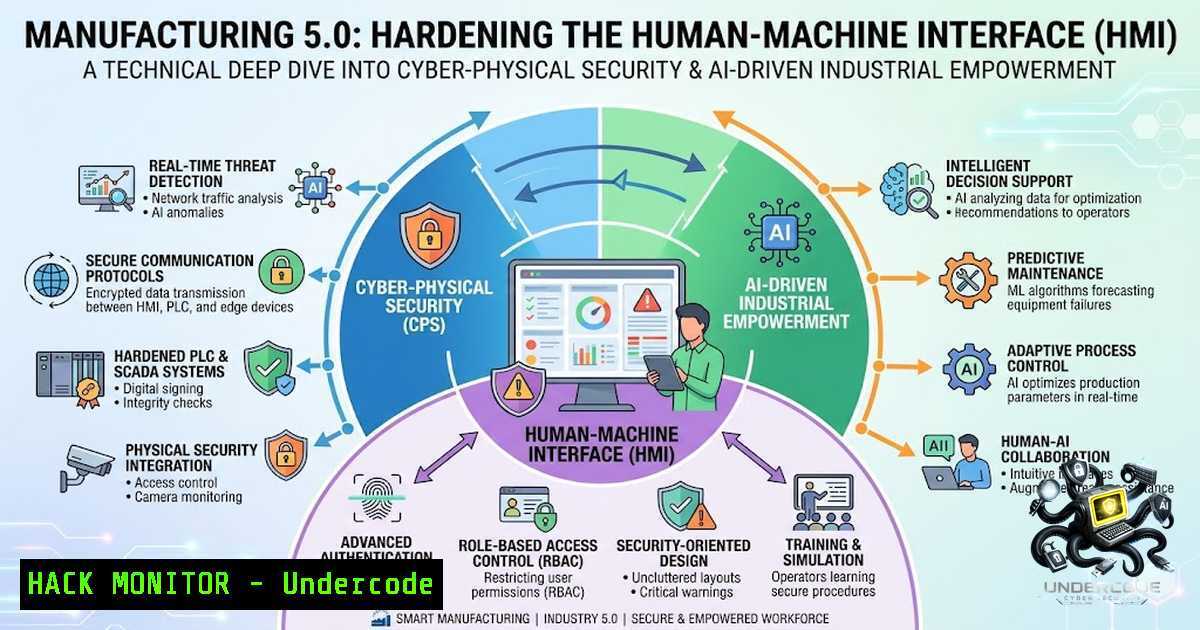
Introduction:
Manufacturing 5.0 represents a paradigm shift from purely automated, data-driven processes to a human-centric ecosystem where cyber-physical systems, artificial intelligence, and human ingenuity converge. While the vision emphasizes empowering people with technology, this convergence introduces a complex attack surface where compromised AI models, insecure APIs, and vulnerable Industrial Internet of Things (IIoT) devices can cascade into operational downtime, safety hazards, and intellectual property theft. This article provides a technical roadmap for security professionals, IT administrators, and automation engineers to secure the Manufacturing 5.0 stack—covering everything from API hardening and container security to AI model validation and OT network segmentation—ensuring that the human element is empowered, not exploited.
Learning Objectives:
- Objective 1: Understand the core components of a Manufacturing 5.0 architecture, including the integration of cyber-physical systems, edge AI, and cloud-based analytics, and identify the primary security threats to each layer.
- Objective 2: Implement practical hardening techniques for industrial APIs, containerized AI workloads, and OT/IT network boundaries using Linux, Windows, and specialized security tools.
- Objective 3: Develop a proactive incident response strategy for AI-driven manufacturing environments, including model integrity verification, anomaly detection, and secure firmware update procedures.
You Should Know:
- Securing the Cyber-Physical Bridge: API and Edge Gateway Hardening
The backbone of Manufacturing 5.0 is the seamless flow of data between operational technology (OT) sensors, edge gateways, and cloud-based AI analytics. This flow is typically mediated by RESTful APIs, MQTT brokers, and OPC UA servers. A single misconfigured API endpoint can expose real-time production data or, worse, allow an attacker to inject malicious control commands. The OWASP API Security Top 10—particularly broken object-level authorization (BOLA) and excessive data exposure—is directly applicable here.
Step‑by‑step guide to securing industrial APIs:
- Inventory and Document: Use `nmap` to scan your OT network for exposed services. For example, `nmap -sV -p 443,8443,1883,8883,4840 192.168.1.0/24` identifies APIs and MQTT brokers. Document every endpoint, its purpose, and data flow.
- Implement API Gateway with Rate Limiting and Authentication: Deploy an API gateway (e.g., Kong, Tyk, or Azure API Management) in front of all industrial microservices. Enforce OAuth 2.0 or client certificate (mTLS) authentication. On Linux, configure `nginx` as a reverse proxy with rate limiting:
location /api/ { auth_request /auth; limit_req zone=one burst=5 nodelay; proxy_pass http://backend_services; } - Validate and Sanitize Input: All payloads—especially those containing JSON or XML—must be validated against a strict schema. Use a library like `ajv` (Node.js) or `cerberus` (Python) to enforce data types and ranges, preventing injection attacks that could alter production parameters.
- Enable Comprehensive Logging and Monitoring: Forward API logs to a SIEM (e.g., Wazuh or Splunk). On Windows, use `Event Viewer` to monitor security logs, and on Linux, configure `rsyslog` to send `nginx` access logs to a central server. Set up alerts for 4xx/5xx error spikes, which may indicate brute-force or fuzzing attempts.
- Regularly Rotate Secrets and Certificates: Use HashiCorp Vault or Azure Key Vault to manage API keys and certificates. Automate rotation with a cron job on Linux or a Scheduled Task on Windows to renew certificates before expiry.
-
AI Model Integrity and Secure Deployment in Industrial Contexts
AI models in Manufacturing 5.0 are used for predictive maintenance, quality inspection, and process optimization. These models are often deployed as containerized microservices (Docker/Kubernetes) at the edge or in the cloud. An attacker could poison the training data, manipulate model weights, or exploit the model’s input space (adversarial attacks) to cause false predictions—leading to catastrophic production failures.
Step‑by‑step guide to securing AI pipelines:
- Secure the Training Pipeline: Implement data provenance and validation. Use cryptographic hashing (SHA-256) to verify the integrity of training datasets. On Linux, generate a hash with
sha256sum dataset.csv. Store this hash in an immutable ledger (e.g., a blockchain or a secure database). Before each training run, verify the hash:if [ "$(sha256sum dataset.csv | awk '{print $1}')" != "$EXPECTED_HASH" ]; then echo "Data integrity check failed!" && exit 1 fi - Containerize with Minimal Privileges: Build Docker images using a minimal base (e.g.,
python:3.9-slim). Avoid running containers asroot; create a dedicated user inside the Dockerfile:RUN useradd -m -u 1000 modeluser USER modeluser
- Implement Model Signing and Verification: Use TUF (The Update Framework) or a similar mechanism to sign model artifacts. Before loading a model into production, verify its signature. In Python, use `cryptography` to check the signature:
from cryptography.hazmat.primitives import hashes, serialization
from cryptography.hazmat.primitives.asymmetric import ed25519
Load public key and verify signature
- Deploy with Kubernetes Security Contexts: Use `PodSecurityPolicy` (or the newer `Kyverno` policies) to restrict container capabilities. In your deployment YAML, set:
securityContext:
runAsNonRoot: true
readOnlyRootFilesystem: true
allowPrivilegeEscalation: false
- Monitor Model Drift and Anomalies: Implement a monitoring layer that tracks model confidence scores and input feature distributions. Use tools like `Prometheus` and `Grafana` to visualize drift. Set alerts for when the model’s confidence drops below a threshold, which could indicate an adversarial attack or data corruption.
-
Network Segmentation and Zero Trust for OT/IT Convergence
The convergence of IT and OT networks is a hallmark of Manufacturing 5.0. However, traditional perimeter-based security fails in this environment. A Zero Trust Architecture (ZTA) is essential, treating every device, user, and service as untrusted until verified. This requires micro-segmentation, strict firewall rules, and continuous authentication.
Step‑by‑step guide for implementing Zero Trust in a converged network:
- Map Data Flows: Create a detailed data flow diagram of all OT-to-IT communications. Identify which PLCs, HMIs, and sensors communicate with which IT services (e.g., databases, cloud APIs).
- Implement Micro‑segmentation with VLANs and ACLs: On managed switches, create separate VLANs for different OT zones (e.g., `VLAN 100` for safety-critical PLCs, `VLAN 200` for non-critical sensors). Use Access Control Lists (ACLs) to restrict traffic between VLANs to only necessary protocols and ports. For example, on a Cisco switch:
access-list 100 permit tcp 192.168.100.0 0.0.0.255 192.168.200.0 0.0.0.255 eq 443
access-list 100 deny ip any any
- Deploy a Next‑Generation Firewall (NGFW) with Application Awareness: Use a firewall like pfSense or a commercial NGFW to inspect traffic at the application layer. Create rules that allow only specific industrial protocols (e.g., Modbus/TCP on port 502, OPC UA on 4840) and block all other traffic.
- Enable 802.1X Port Authentication: Use RADIUS-based authentication to ensure only authorized devices can connect to the network. Configure switches to authenticate devices based on their MAC addresses or digital certificates before granting network access.
- Continuous Monitoring and Anomaly Detection: Deploy a Security Information and Event Management (SIEM) solution with OT-specific threat intelligence. Use `Zeek` (formerly Bro) as a network sensor to parse and log OT protocol metadata. For example, to monitor Modbus traffic:
zeek -r capture.pcap modbus
Analyze the logs for unusual function codes or register reads/writes that could indicate reconnaissance or command injection.
4. Secure Remote Access and Vendor Integration
Manufacturing 5.0 often involves collaboration with external partners, suppliers, and remote experts. Providing secure remote access for maintenance, troubleshooting, or data sharing is critical. VPNs alone are insufficient; a Zero Trust Network Access (ZTNA) approach is recommended.
Step‑by‑step guide for securing remote access:
- Deploy a ZTNA Solution: Use a ZTNA gateway (e.g., Cloudflare Access, Zscaler, or an open-source alternative like
Pomerium) that authenticates users based on identity and context before granting access to specific applications. This eliminates the need for a full network-level VPN. - Implement Just‑In‑Time (JIT) Access: Grant access only for a limited time window. On Windows, use `Active Directory` with time-based group membership. On Linux, use `sudo` with timestamp limitations or integrate with a PAM module that enforces JIT.
- Audit and Log All Remote Sessions: Use session recording tools like `Teleport` or `Apache Guacamole` to record all remote terminal or RDP sessions. Store these logs in a tamper-proof location for forensic analysis.
- Enforce Multi‑Factor Authentication (MFA): All remote access, including to HMIs and engineering workstations, must require MFA. Integrate with Azure AD or Okta to provide a seamless MFA experience.
- Regularly Review and Revoke Access: Conduct quarterly reviews of all vendor and remote user accounts. Automate the revocation process using PowerShell on Windows:
Get-ADUser -Filter {Enabled -eq $true -and (LastLogonDate -lt (Get-Date).AddDays(-90))} | Disable-ADAccountOr on Linux, use `userdel` and `usermod` to disable inactive accounts.
-
Incident Response and Recovery in a Cyber-Physical System
When a security incident occurs in a Manufacturing 5.0 environment, the impact can be physical—damaged equipment, unsafe conditions, or production stoppages. An incident response plan must be tailored for OT, with a focus on safety and rapid recovery.
Step‑by‑step guide for OT‑centric incident response:
- Develop a Playbook with Safety Overrides: Create a playbook that prioritizes human safety and equipment protection over data confidentiality. Define clear steps for isolating affected systems without triggering emergency shutdowns that could cause physical harm.
- Establish a Forensics Capability for OT: Use tools like `GRR` or `Velociraptor` for endpoint forensics, but ensure they are compatible with Windows Embedded and Linux-based PLCs. For network forensics, capture full packet captures (PCAPs) using `tcpdump` on a span port:
tcpdump -i eth0 -s 0 -w incident_$(date +%Y%m%d_%H%M%S).pcap
- Create Clean Backups and Golden Images: Maintain offline, verified backups of all PLC firmware, HMI configurations, and engineering workstation images. On Windows, use `DISM` to capture a system image:
dism /Capture-Image /ImageFile:E:\Backup.wim /CaptureDir:C:\ /Name:"HMI_Backup"
On Linux, use `dd` or `clonezilla` for disk imaging. Store these images in a secure, physically separate location.
- Practice Tabletop Exercises: Run regular tabletop exercises that simulate a ransomware attack on the OT network. Involve both IT and OT staff to ensure seamless communication. Practice the “air gap” procedure: physically disconnecting the infected network segment.
- Post‑Incident Analysis and Patching: After an incident, conduct a root cause analysis. Identify the vulnerability that was exploited and apply patches. On Windows, use `WSUS` to manage and deploy patches. On Linux, use `apt` or `yum` with a staged rollout process for OT devices.
What Undercode Say:
- Key Takeaway 1: Manufacturing 5.0 is not just about automation; it is about creating a symbiotic relationship between humans and intelligent machines. However, this symbiosis demands a security architecture that treats every component—from the smallest sensor to the most advanced AI model—as a potential attack vector.
- Key Takeaway 2: The technical safeguards detailed above—API hardening, container security, Zero Trust networking, secure remote access, and OT-specific incident response—are not optional add-ons. They are foundational to ensuring that the “empowerment” of people through technology does not become a vulnerability. The future of manufacturing depends on our ability to build resilient, secure, and human-centric systems from the ground up.
Prediction:
- +1 The integration of AI-driven predictive maintenance and automated quality control will reduce unplanned downtime by up to 40% over the next five years, as manufacturers who successfully secure their cyber-physical systems will be able to trust and scale these technologies.
- +1 The demand for cybersecurity professionals with deep OT and AI knowledge will skyrocket, creating a new specialty: “Industrial AI Security Engineer.” This role will be as critical as the production manager in ensuring operational continuity.
- -1 Failure to adequately secure the human-machine interface and AI pipelines will lead to a high-profile industrial sabotage or safety incident within the next 18 months, prompting regulatory bodies to impose mandatory security standards for all Industry 5.0 deployments.
- -1 The complexity of securing diverse, multi-vendor OT environments will continue to be a major barrier to adoption for small and medium-sized manufacturers, potentially creating a two-tier industrial landscape where only large enterprises can safely embrace Manufacturing 5.0.
▶️ Related Video (72% Match):
🎯Let’s Practice For Free:
🎓 Live Courses & Certifications:
Join Undercode Academy for Verified Certifications
🚀 Request a Custom Project:
Secure, high-velocity infrastructure and disruptive technological engineering. Contact our engineering team for high-tier development and proprietary systems:
[email protected]
💎 Smart Architecture | 🛡️ Secure by Design | ⭐ Trusted by Thousands
IT/Security Reporter URL:
Reported By: Omkar Sutar – Hackers Feeds
Extra Hub: Undercode MoN
Basic Verification: Pass ✅


