Listen to this Post
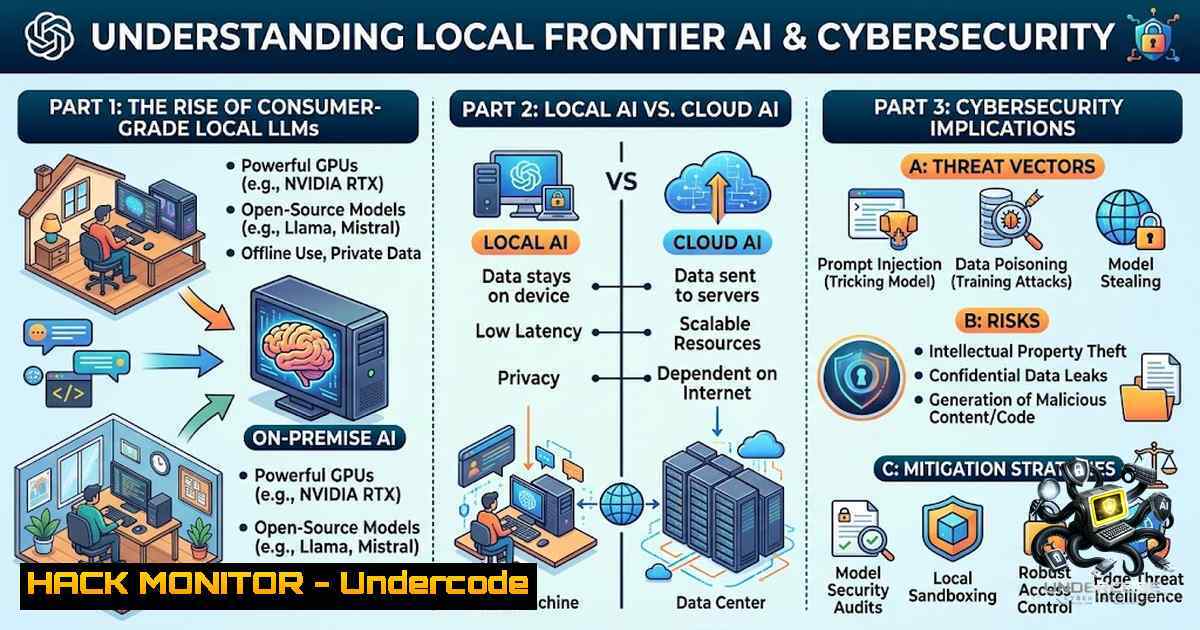
Introduction:
The artificial intelligence landscape has undergone a seismic shift. Just one year ago, running frontier-class large language models—those rivaling GPT-5.6—on consumer hardware or even high-end laptops was widely dismissed as impractical. Today, thanks to breakthroughs in open-weight models like DeepSeek V4 Flash, Kimi K3, and GLM-5.2, combined with specialized inference engines such as Salvatore Sanfilippo’s DwarfStar, this is no longer science fiction. For roughly €9,000 (the price of a high-spec MacBook Pro), developers and security professionals can now run models with hundreds of billions of parameters entirely offline, without cloud dependencies, API costs, or data leaving their local machine. While this democratization of AI unlocks immense creative and analytical potential, it also introduces a profound cybersecurity dilemma: the same locally hosted frontier models capable of generating high-quality films or private applications can also be weaponized for offensive security operations, vulnerability exploitation, and hacking—free from the content moderation guardrails imposed by commercial providers like OpenAI or Anthropic.
Learning Objectives:
- Understand the technical breakthroughs enabling local frontier AI inference, including asymmetric quantization and specialized inference engines like DwarfStar.
- Learn how to deploy and run models such as DeepSeek V4 Flash, Kimi K3, and GLM-5.2 on consumer-grade Apple Silicon hardware.
- Identify the cybersecurity implications of locally hosted frontier models, including their potential use in offensive security, penetration testing, and autonomous exploitation.
- Explore mitigation strategies and hardening techniques to secure local AI infrastructure against misuse and external threats.
You Should Know:
- DwarfStar 4: The Inference Engine Revolutionizing Local AI
At the heart of this local AI revolution is DwarfStar 4 (ds4) , a compact native inference engine created by Salvatore Sanfilippo (antirez)—the legendary developer behind Redis. Unlike general-purpose runtimes like Ollama or llama.cpp that aim to support a wide range of models, DwarfStar takes the opposite approach: it is obsessively optimized for a single model family, DeepSeek V4 Flash (284B total parameters, 13B active in MoE architecture). This narrow focus eliminates abstraction layers, resulting in a smaller, faster, and more predictable system.
Key features of DwarfStar 4 include:
- Asymmetric 2-bit/8-bit quantization: MoE expert layers are compressed to 2-bit while other layers remain at 8-bit, preserving model accuracy while dramatically reducing memory footprint—from hundreds of gigabytes down to approximately 81GB.
- Metal, CUDA, and ROCm backends: Runs on Apple Silicon (primary target), NVIDIA GPUs, and AMD GPUs.
- Disk-backed KV caching: Uses fast SSDs as an extension of memory, enabling context windows up to 1 million tokens.
- OpenAI/Anthropic-compatible APIs: Allows seamless integration with existing tooling like Claude Code.
- Built-in coding agent: Includes tool calling, prompt rendering, and a native agent framework.
According to Sanfilippo, DwarfStar 4 leverages GPT 5.5 for assistance, but the core brainstorming, testing, and debugging remained human-driven. The project has already garnered over 9,000 stars on GitHub, reflecting significant community interest.
Step‑by‑step guide: Deploying DwarfStar 4 on a MacBook Pro
To run DeepSeek V4 Flash locally via DwarfStar 4, follow these steps (tested on MacBook Pro M4 Max with 128GB RAM):
- Verify hardware requirements: Minimum 96GB unified memory (128GB recommended for optimal performance). Ensure you have sufficient SSD space for the model weights (~81GB for the 2-bit quantized version).
-
Install Xcode Command Line Tools (if not already present):
xcode-select --install
3. Clone the DwarfStar 4 repository:
git clone https://github.com/antirez/ds4.git
cd ds4
- Download the DeepSeek V4 Flash GGUF weights (quantized version compatible with DwarfStar):
Example using Hugging Face CLI
huggingface-cli download sokann/DeepSeek-V4-Flash-GGUF --local-dir ./models
Alternatively, DwarfStar only runs with the specific GGUF files provided in its ecosystem.
5. Build and run the inference engine:
make
./ds4 --model ./models/DeepSeek-V4-Flash-Q2_K.gguf --prompt "Your prompt here"
Performance benchmarks on M4 Max 128GB show approximately 120 tokens/second during prefilling and 15 tokens/second during generation, even with long contexts.
- (Optional) Integrate with Claude Code for a local development environment:
Configure Claude Code to use the local DwarfStar endpoint
export ANTHROPIC_API_URL=http://localhost:8080
claude
-
The New Frontier Models: DeepSeek, Kimi K3, and GLM-5.2
The models themselves are equally remarkable. Three open-weight models now sit close to the closed frontier:
| Model | Total Parameters | Active Parameters | License | Key Benchmark |
|-||-|||
| Kimi K3 (Moonshot) | 2.8T | ~104B | Apache 2.0 | Frontend Code Arena Elo 1,679 |
| DeepSeek V4-Pro | 1.6T | 49B | MIT | SWE-bench Verified 80.6% |
| DeepSeek V4-Flash | 284B | 13B | MIT | LiveCodeBench 91.6 |
| GLM-5.2 (Z.ai) | 753B | ~40B | MIT | Terminal-Bench 2.1 leader |
All three offer roughly 1-million-token context windows and permissive licenses. The full-weight versions require data-center-class hardware, but quantized versions—enabled by engines like DwarfStar—can run on high-end consumer systems. For instance, DeepSeek V4 Flash at 284B parameters compresses to approximately 81GB with 2-bit asymmetric quantization, fitting comfortably within a 128GB MacBook Pro.
Alternative deployment via Ollama (once support merges):
brew install ollama
ollama run hf.co/sokann/DeepSeek-V4-Flash-GGUF
Running Kimi K3 on CPU-only systems: An experimental C implementation runs Kimi K3 (2.8T parameters) on CPU with just 8GB RAM, albeit at extremely slow speeds (~one token per 30 seconds).
3. The Cybersecurity Double-Edged Sword
The ability to run frontier AI locally is not merely a convenience—it is a transformative cybersecurity development with profound implications.
Offensive Capabilities: Local LLMs can now perform autonomous penetration testing sub-tasks such as Linux privilege escalation. Recent research demonstrates that with targeted enhancements (chain-of-thought prompting, retrieval-augmented generation, and reflective analysis), small local models (Llama3.1 8B, Qwen2.5 7B) can be elevated from an 8–16% success rate on standardized privilege-escalation tasks to 67%, matching guided GPT-4o. Larger open-weight reference models reach 83%. Studies have also shown that models such as Qwen-14B and Qwen-32B can successfully execute multiple real-world exploits in fully autonomous, local-agent frameworks.
The Guardrail Problem: Commercial providers like OpenAI and Anthropic impose content moderation and safety filters on their API-accessible models. Locally hosted models have no such restrictions. As Gianpaolo Papa’s post highlights, this means security exploits and hacking attempts can be generated directly from a home PC without the guardrails imposed on platforms like Anthropic’s Claude. Researchers have already demonstrated AI-driven computer worms that use locally hosted open-weight models to reason through networks and generate attack logic at runtime.
Exposed Endpoints as Attack Vectors: The security risks extend beyond deliberate misuse. Between March and May 2026, honeypot sensors detected three separate campaigns where attackers hijacked exposed Ollama and LiteLLM endpoints—misconfigured self-hosted AI infrastructure—as the backend for offensive tooling. Attackers don’t need special authentication; they simply need to know where the exposed endpoint is located. This represents a new class of threat: LLMjacking evolved from stolen compute resale to fully autonomous offensive pipelines capable of scanning, exploiting, and weaponizing AI inference.
Step‑by‑step guide: Hardening local AI deployments against external threats
- Bind inference servers to localhost only (never expose to the public internet):
When starting Ollama or DwarfStar, use localhost binding
ollama serve --host 127.0.0.1 --port 11434
For DwarfStar, configure the HTTP server to bind to localhost
2. Implement firewall rules to restrict access:
 Linux (iptables)
iptables -A INPUT -p tcp --dport 11434 -s 127.0.0.1 -j ACCEPT
iptables -A INPUT -p tcp --dport 11434 -j DROP
 macOS (pfctl)
echo "block in proto tcp from any to any port 11434" | sudo pfctl -f -
- Enable authentication for any exposed API endpoints. Use API keys or mutual TLS:
Example: Ollama with authentication proxy
Use a reverse proxy (nginx) with basic auth
-
Monitor egress traffic from AI servers. Unexpected outbound connections may indicate compromise.
5. Regularly audit exposed services:
 Scan for open ports
nmap -sS -p- localhost
 Check for listening services
netstat -tulpn | grep LISTEN
4. Privacy and Data Sovereignty Advantages
Despite the security concerns, local inference offers significant privacy benefits. Cloud-based LLMs require transmitting all interaction data—command histories, system outputs, sensitive configurations—to external providers. In penetration testing scenarios, this data typically contains vulnerabilities, exploits, and sensitive customer information. Locally hosted open-weight models eliminate these data sovereignty and supply-chain risks entirely. Sensitive data never leaves the local system.
Organizations handling regulated data (GDPR, HIPAA, financial services) can now leverage frontier AI capabilities without compliance violations or data leakage concerns. This is particularly valuable for security teams conducting red-team exercises or vulnerability assessments on sensitive infrastructure.
5. Performance Tuning and Optimization
Achieving usable performance on consumer hardware requires careful optimization:
Memory Management:
- For DeepSeek V4 Flash (284B), the 2-bit quantized version requires ~81GB.
- A 64GB Mac can run the model with SSD streaming, though slower.
- For 4-bit quantized models in the 25B–32B range, 32GB unified memory is the minimum viable configuration.
CPU-Only Inference: Projects like `cpubrrr` demonstrate frontier-class MoE inference on Apple M4 Max CPU only, achieving ~90 tokens/second—approximately 1.17× faster than llama.cpp under identical conditions.
Multi-Mac Clustering: For models exceeding 120B parameters, multiple Macs can be clustered over Thunderbolt 5 for sovereign team deployments.
Monitoring performance:
 On macOS, monitor memory pressure
memory_pressure
 Check GPU utilization (if using Metal)
sudo powermetrics --samplers gpu_power
6. The Emerging Ecosystem: Routing and Orchestration
The local AI ecosystem is rapidly maturing. Tools like Baseten Switch—a local Mac app written in Go—route requests from harnesses like Claude Code or Codex to models including Kimi K3 and GLM-5.2 with a simple toggle. This enables mixed-model orchestration: one frontier model for planning and review, with specialized subagents for execution.
Installation and usage:
brew trust basetenlabs/baseten
brew install basetenlabs/baseten/baseten-switch
baseten-switch setup
baseten-switch up --install
baseten-switch claude on  Enable for Claude Code
baseten-switch codex on  Enable for Codex
This flexibility allows security teams to test different models for specific tasks—Kimi K3 for orchestration, GLM-5.2 Fast for subagent execution—without reconfiguring endpoints or restarting sessions.
What Undercode Say:
- The democratization of frontier AI is irreversible. The combination of open-weight models, asymmetric quantization, and specialized inference engines has permanently lowered the barrier to entry. Within 12–18 months, we can expect even more capable models to run on increasingly affordable hardware.
-
Security teams must adapt or be left behind. The same capabilities that enable local AI video generation and private applications also enable autonomous, guardrail-free offensive security operations. Organizations must assume that adversaries have access to these tools and adjust their defense strategies accordingly—implementing zero-trust architectures, hardening AI infrastructure, and investing in AI-powered defensive measures.
-
The privacy-compute tradeoff is shifting. For years, organizations accepted cloud-based AI for its compute power, sacrificing data privacy. Local frontier AI now offers a compelling alternative, enabling sensitive workloads to remain on-premise without compromising capability. This will drive significant adoption in regulated industries.
-
Exposed endpoints are the new soft underbelly. As more organizations deploy self-hosted AI, misconfigurations will proliferate. The documented attacks on Ollama and LiteLLM endpoints are just the beginning. Security practitioners must treat AI inference infrastructure with the same rigor as database or authentication services.
-
The guardrail question remains unresolved. Commercial providers impose content filters; local models do not. This creates a regulatory and ethical vacuum that will likely attract legislative attention. Organizations deploying local frontier models must establish internal governance frameworks for acceptable use.
Prediction:
-
+1 Local frontier AI will accelerate innovation in privacy-preserving applications, enabling healthcare, finance, and government sectors to leverage cutting-edge AI without data sovereignty compromises. This will create new markets for on-premise AI solutions.
-
+1 The open-source ecosystem around local inference (DwarfStar, llama.cpp, MLX, cpubrrr) will continue to mature, driving performance improvements that make frontier models accessible on increasingly modest hardware. Expect 1B+ parameter models on smartphones within 3 years.
-
-1 The absence of guardrails on locally hosted models will lead to a surge in AI-assisted cyberattacks, including automated vulnerability discovery, exploit generation, and autonomous penetration testing. Small and medium enterprises with limited security resources will be disproportionately affected.
-
-1 Misconfigured self-hosted AI endpoints will become a primary vector for LLMjacking, with attackers weaponizing stolen inference compute for offensive operations. This will necessitate new security frameworks and insurance requirements for AI deployments.
-
-1 Regulatory backlash is inevitable. The ability to run unrestricted frontier models locally will prompt governments to introduce legislation around AI capability ownership, similar to encryption export controls. This could fragment the global AI ecosystem and create compliance burdens for open-source projects.
-
+1 The security community will respond with AI-1ative defensive tools, leveraging the same local capabilities to build autonomous threat detection, incident response, and vulnerability remediation systems. The offensive-defensive AI arms race will accelerate, ultimately benefiting defenders with better tools and faster response times.
-
-1 The cost barrier (€9,000+ for capable hardware) will create a digital divide between organizations that can afford local frontier AI and those that cannot. This could exacerbate existing cybersecurity inequities, with well-resourced attackers gaining asymmetric advantages.
▶️ Related Video (82% Match):
https://www.youtube.com/watch?v=2O-v4dFFEIM
🎯Let’s Practice For Free:
🎓 Live Courses & Certifications:
Join Undercode Academy for Verified Certifications
🚀 Request a Custom Project:
Secure, high-velocity infrastructure and disruptive technological engineering. Contact our engineering team for high-tier development and proprietary systems:
[email protected]
💎 Smart Architecture | 🛡️ Secure by Design | ⭐ Trusted by Thousands
IT/Security Reporter URL:
Reported By: https://lnkd.in/p/eNXPDx8w – Hackers Feeds
Extra Hub: Undercode MoN
Basic Verification: Pass ✅


