Listen to this Post
Introduction:
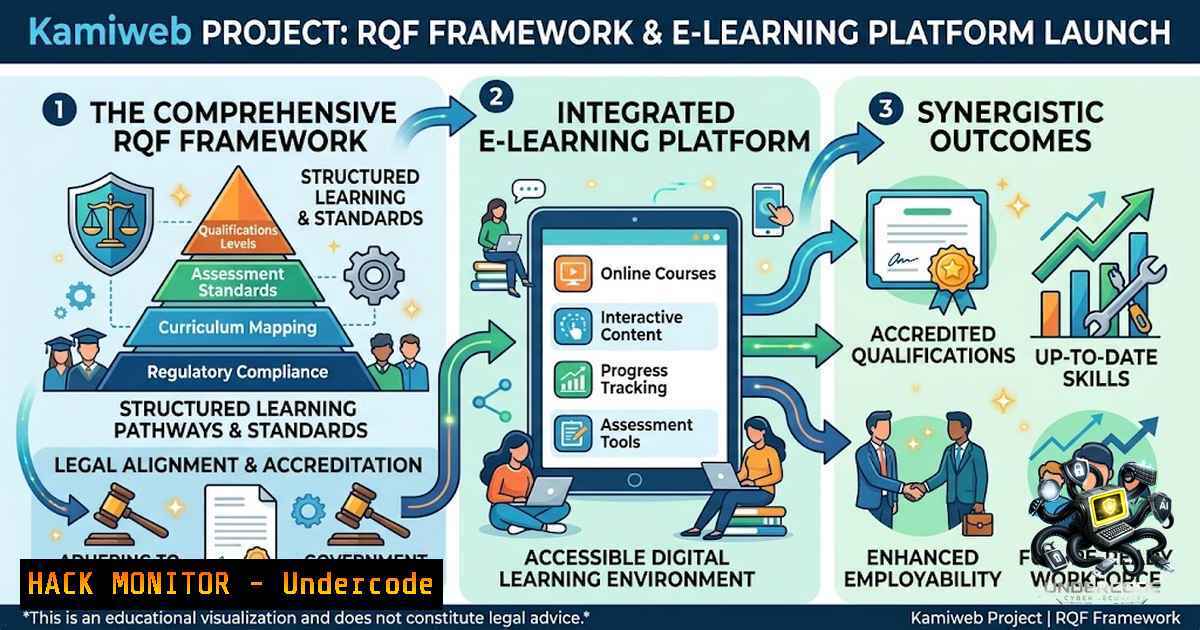
The Kamiweb Project has announced the launch of its Regulated Qualifications Framework (RQF) and e-learning platform, marking a significant expansion in accessible, structured technical education. With over 50 specialized certificates ranging from Level 3 Core Computing to Level 4 certifications in advanced cybersecurity, cloud engineering, and artificial intelligence, the initiative aims to bridge the gap between foundational IT skills and specialized, industry-demand expertise. This comprehensive curriculum is designed for aspiring professionals seeking to validate their skills in a rapidly evolving digital landscape, integrating practical assessment and quality assurance processes to ensure competency-based learning outcomes.
Learning Objectives:
- Master the core principles of computing and develop proficiency in front-end, back-end, and mobile application development across multiple platforms including iOS, Android, Windows, and MacOS.
- Acquire specialized skills in cybersecurity operations, including Blue Team/SOC, Purple Team/Offensive Security, threat intelligence, vulnerability management, and penetration testing.
- Gain expertise in modern IT operations, including cloud security engineering, DevSecOps, zero-trust architecture, and data science with a focus on Python, R, SQL, and machine learning.
You Should Know:
- Cybersecurity Engineering and Operations: Core Defensive and Offensive Strategies
The curriculum’s cybersecurity track is extensive, covering everything from foundational security engineering to advanced threat hunting. Candidates will learn to implement, manage, and optimize security operations centers (SOCs), including the configuration of SIEM tools, endpoint detection and response (EDR) systems, and security automation via SOAR platforms. For instance, to simulate a basic log analysis task commonly found in a SOC environment, one might use Linux command-line tools. Analyzing system authentication logs on a Linux server is a fundamental skill:
 View failed SSH login attempts
sudo grep "Failed password" /var/log/auth.log | tail -20

Monitor real-time authentication logs
sudo tail -f /var/log/auth.log | grep "authentication failure"

On Windows (PowerShell), query security logs for event ID 4625 (failed logon)
Get-WinEvent -LogName Security | Where-Object { $_.Id -eq 4625 } | Select-Object TimeCreated, Message -First 10
To further operationalize security, understanding network geofencing and implementing access control lists (ACLs) is crucial. A simple example involves using `iptables` on Linux to restrict SSH access to specific IP ranges:
 Allow SSH only from a specific subnet (e.g., 192.168.1.0/24)
sudo iptables -A INPUT -p tcp --dport 22 -s 192.168.1.0/24 -j ACCEPT
sudo iptables -A INPUT -p tcp --dport 22 -j DROP
This step-by-step command sequence demonstrates how to block all SSH traffic except from a trusted network, a basic yet effective geofencing technique.
- Security Testing and Analysis: From Vulnerability Assessment to Exploitation
The program offers dedicated certificates in Web Application Security Testing, Mobile Application Security, and Penetration Testing and Ethical Hacking. Students will learn to use industry-standard tools and methodologies. For web application testing, understanding and using tools like `curl` and `sqlmap` is essential. For example, to test for SQL injection vulnerabilities, one might start with parameter fuzzing using `sqlmap` against a target URL:
 Using sqlmap to test a vulnerable parameter
sqlmap -u "http://example.com/page?id=1" --batch --level 2
For Windows-based environments, tools for Active Directory security assessments are critical. Using PowerShell to enumerate domain users is a common reconnaissance task:
 Enumerate all domain users
Get-ADUser -Filter  -Properties SamAccountName, Enabled | Export-Csv -Path domain_users.csv -1oTypeInformation
This proactive enumeration highlights the importance of identity and access management (IAM)—a key certificate in the program—by demonstrating how an attacker might gather user information to plan further attacks.
3. Cloud and DevSecOps: Securing the Modern Infrastructure
With certificates in Cloud Security Engineering and DevSecOps, the curriculum emphasizes integrating security into the CI/CD pipeline. Students will learn to configure cloud environments (AWS, Azure, GCP) securely and implement infrastructure as code (IaC) scanning. A practical scenario involves using `checkov` or `tfsec` to scan Terraform scripts for misconfigurations. Here’s a command to scan a Terraform directory for security violations:
 Install checkov and scan a Terraform directory
pip install checkov
checkov -d /path/to/terraform/
Furthermore, configuring a basic security group in AWS via CLI illustrates cloud hardening:
 Create a security group that allows only HTTP and HTTPS from anywhere and SSH from a specific IP
aws ec2 create-security-group --group-1ame WebAppSG --description "Web Application Security Group"
aws ec2 authorize-security-group-ingress --group-1ame WebAppSG --protocol tcp --port 80 --cidr 0.0.0.0/0
aws ec2 authorize-security-group-ingress --group-1ame WebAppSG --protocol tcp --port 443 --cidr 0.0.0.0/0
aws ec2 authorize-security-group-ingress --group-1ame WebAppSG --protocol tcp --port 22 --cidr YOUR_IP_ADDRESS/32
This foundational skill is critical for securing cloud-hosted applications.
- Data Science, AI, and MLOps: Harnessing Data for Intelligence
The platform also delves into data science and AI, covering Python, R, SQL, machine learning, and MLOps. For a data science track, a typical task involves data preparation and quality management. Using Python with Pandas to clean a dataset is a fundamental exercise:
import pandas as pd
 Load dataset
df = pd.read_csv('sales_data.csv')
 Drop rows with missing values
df.dropna(inplace=True)
 Remove duplicates
df.drop_duplicates(inplace=True)
 Standardize column names
df.columns = df.columns.str.strip().str.lower().str.replace(' ', '_')
print(df.head())
For machine learning, setting up a Jupyter notebook environment with essential libraries (scikit-learn, TensorFlow) is standard. A simple example of training a predictive model using scikit-learn:
from sklearn.ensemble import RandomForestClassifier
from sklearn.model_selection import train_test_split
from sklearn.metrics import accuracy_score

Sample training
X_train, X_test, y_train, y_test = train_test_split(X, y, test_size=0.2)
model = RandomForestClassifier()
model.fit(X_train, y_train)
predictions = model.predict(X_test)
print(f"Accuracy: {accuracy_score(y_test, predictions)}")
These practical exercises are essential for any certificate in the data science domain.
5. Governance, Risk, Compliance (GRC) and Third-Party Security
Beyond technical skills, the program includes certificates in Cybersecurity Governance, Risk, and Compliance (GRC) and Third-Party Security. Understanding frameworks like NIST and ISO 27001 is crucial. A common task in GRC is performing a simple risk assessment using a quantitative model. For instance, calculating the Single Loss Expectancy (SLE) and Annualized Loss Expectancy (ALE) helps prioritize security investments.
Step-by-step guide for basic risk assessment calculation:
- Identify Asset Value (AV): Assign a monetary value to the asset, e.g., $50,000.
- Determine Exposure Factor (EF): Estimate the percentage of loss if a risk materializes, e.g., 20% for a data breach.
- Calculate SLE: `SLE = AV EF` = $50,000 0.20 = $10,000.
- Estimate Annualized Rate of Occurrence (ARO): Determine how often the risk might occur in a year, e.g., 0.5 (once every two years).
- Calculate ALE: `ALE = SLE ARO` = $10,000 0.5 = $5,000 per year.
This quantitative approach allows organizations to decide if implementing a security control costing $2,000 per year is justified, thereby providing a practical understanding of risk management.
6. Incident Response and Digital Forensics
The Level 4 Certificate in Incident Response and Digital Forensics focuses on investigating and responding to security breaches. A foundational command in Linux forensics is using `dd` or `dcfldd` to create a forensic image of a storage device:
 Create a bit-for-bit copy of a drive to an image file
sudo dcfldd if=/dev/sdb of=/path/to/evidence.dd hash=sha256 hashlog=evidence.hash
On Windows, `FTK Imager` is a popular tool for acquiring memory and disk images. Understanding how to analyze these images using tools like `Volatility` for memory forensics is a critical skill. For example, listing active processes from a memory dump using Volatility:
 Identify the profile first
volatility -f memory.dump imageinfo
 List processes
volatility -f memory.dump --profile=Win10x64_18362 pslist
These hands-on activities solidify the concepts of digital forensics and incident handling.
What Undercode Say:
- Comprehensive Skill Development: The Kamiweb Project’s RQF framework is a pivotal move towards democratizing access to high-quality technical education. By offering a structured progression from core computing to specialized fields like purple teaming and MLOps, it addresses the current skills gap in the cybersecurity and IT industries, providing a clear career pathway.
- Practical and Industry-Aligned Curriculum: The integration of practical assessment and quality assurance processes suggests a strong focus on applied learning. Certificates covering SOC operations, penetration testing, and cloud security directly align with industry needs, ensuring that graduates are job-ready and capable of handling real-world challenges. The inclusion of emerging fields like responsible AI and security automation indicates a forward-thinking approach that prepares students for the future of technology.
Prediction:
+1 The launch of such a diverse and structured e-learning platform will likely accelerate the professionalization of the cybersecurity workforce by standardizing competencies and providing accessible, affordable certification.
+1 The emphasis on cloud security and DevSecOps will help organizations mitigate the risks associated with rapid cloud adoption, potentially reducing the frequency and impact of cloud-related data breaches.
-1 However, the rapid evolution of cybersecurity threats means that the curriculum must be continuously updated to remain relevant, posing a significant challenge for the platform’s longevity and its students’ career relevance.
+1 The inclusion of data science and AI tracks will produce a new generation of professionals capable of leveraging AI for security analytics, improving threat detection and response times.
-1 The sheer volume and breadth of certificates might lead to a “jack of all trades, master of none” scenario if not approached with careful specialization, potentially diluting the perceived value of individual certifications in the job market.
▶️ Related Video (90% Match):
🎯Let’s Practice For Free:
🎓 Live Courses & Certifications:
Join Undercode Academy for Verified Certifications
🚀 Request a Custom Project:
Secure, high-velocity infrastructure and disruptive technological engineering. Contact our engineering team for high-tier development and proprietary systems:
[email protected]
💎 Smart Architecture | 🛡️ Secure by Design | ⭐ Trusted by Thousands
IT/Security Reporter URL:
Reported By: https://lnkd.in/p/eQQ3eXjk – Hackers Feeds
Extra Hub: Undercode MoN
Basic Verification: Pass ✅


