Listen to this Post
Introduction:
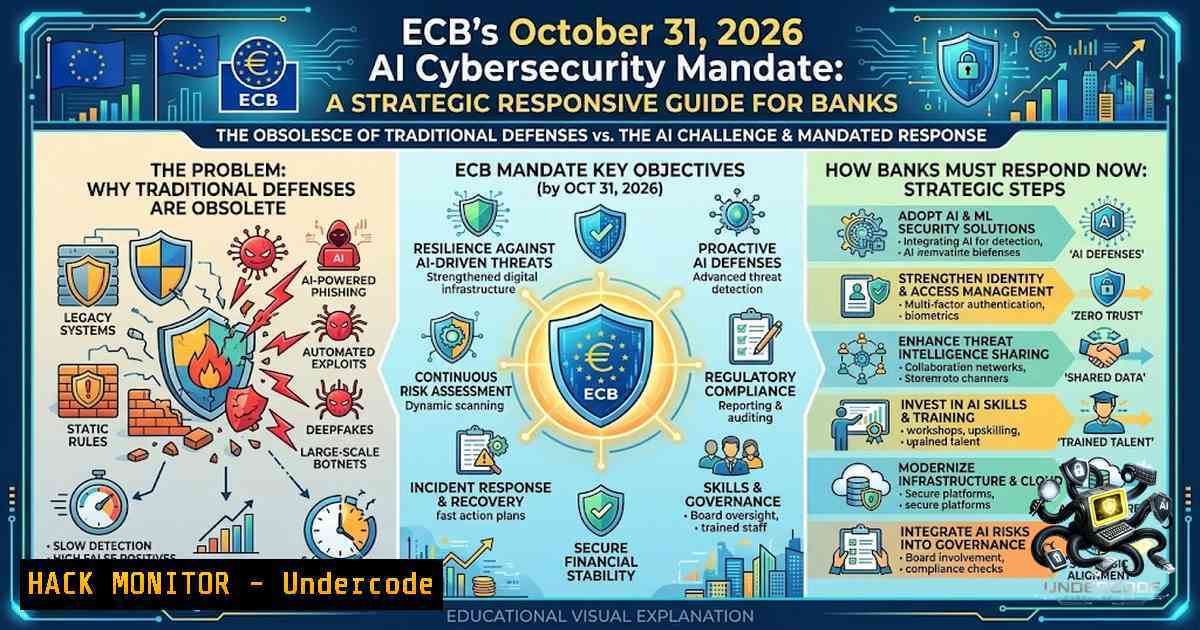
The European Central Bank has fundamentally altered the cybersecurity compliance landscape for financial institutions. On July 7, 2026, ECB Supervisory Board Chair Claudia Buch issued a direct letter to CEOs of all significant institutions, declaring that artificial intelligence has permanently transformed the cyber threat environment. With the European Systemic Risk Board upgrading its cybersecurity risk rating to “severe,” banks have until October 31, 2026, to submit a board-endorsed action plan addressing AI-driven cyber risks—a deadline that is rapidly approaching. This is not merely a regulatory checkbox; it is a recognition that frontier AI models can now discover and exploit software vulnerabilities at speeds that render traditional patch cycles obsolete.
Learning Objectives:
- Master the ECB’s specific requirements for AI cyber risk action plans, including the six short-term priority areas and DORA integration
- Implement practical vulnerability management, zero-trust architecture, and AI-enabled defensive capabilities using verified Linux/Windows commands
- Develop a comprehensive board-ready cyber strategy that addresses immediate priorities while building long-term operational resilience
You Should Know:
1. Accelerating Vulnerability and Patch Management at Scale
The ECB’s letter explicitly states that AI models can now generate functioning exploits at unprecedented speed, compressing the timeline between vulnerability discovery and exploitation. Banks must prepare for “more frequent and higher-volume patching” as vendors and internal teams struggle to keep pace. The traditional remediation cycle is becoming obsolete.
What this means in practice: Your organization must move from periodic patching to continuous, automated vulnerability remediation. The ECB expects banks to map the most exposed ICT assets—internet-facing systems, remote access points, cloud environments, third-party software, and open-source components—then prioritize vulnerabilities based on criticality and exploitability.
Linux Commands for Automated Vulnerability Scanning:
 Install and run OpenSCAP for comprehensive vulnerability scanning
sudo apt-get install openscap-scanner  Debian/Ubuntu
sudo yum install openscap-scanner  RHEL/CentOS

Perform a system scan against CIS benchmarks
sudo oscap xccdf eval --profile xccdf_org.ssgproject.content_profile_cis \
--results scan_results.xml \
/usr/share/xml/scap/ssg/content/ssg-ubuntu2004-ds.xml

Scan for known CVEs using Lynis
sudo lynis audit system --quick

Check for outdated packages with critical CVEs
sudo apt list --upgradable | grep -i security  Debian/Ubuntu
sudo yum check-update --security  RHEL/CentOS
Windows PowerShell Commands for Patch Management:
 Get list of missing security updates
Get-WindowsUpdate -Category "Security" -1otInstalled

Install all critical security updates
Install-WindowsUpdate -Category "Security" -AcceptAll -AutoReboot

Check patch status for specific KB
Get-HotFix | Where-Object {$_.HotFixID -eq "KB5034441"}

Export vulnerability report
Get-WindowsUpdate -1otInstalled | Export-Csv -Path "C:\Security\missing_updates.csv"
Step-by-Step Guide:
- Asset Inventory: Create a comprehensive inventory of all ICT assets using `nmap` for network discovery and cloud provider APIs for dynamic environments
- Continuous Scanning: Deploy automated scanning tools (OpenSCAP, Qualys, Tenable) with daily scheduled scans
- Risk Prioritization: Implement a CVSS-based scoring system that factors in exploitability (AI models can weaponize within hours)
- Automated Remediation: Use Ansible or PowerShell DSC to deploy patches across fleets without manual intervention
- Emergency Procedures: Establish “break-glass” procedures for critical zero-day patches that bypass normal change management cycles
2. Zero-Trust Architecture and Identity-Centric Security
The ECB explicitly advocates for zero-trust principles, recognizing that perimeter defenses will be breached—particularly as frontier AI accelerates vulnerability discovery, including zero-day exploitation. Once you accept that the perimeter will fall, identity becomes the control plane that matters. The letter names least-privilege access, multi-factor authentication, accurate asset inventories, and comprehensive logging as central baseline controls.
What this means in practice: Identity governance across human and non-human identities (service accounts, APIs, machine identities) is now a supervisory expectation, not an internal preference. Banks must implement continuous verification of users, devices, applications, APIs, and service accounts.
Linux Commands for Identity and Access Hardening:
 Audit user accounts and privileges
sudo awk -F: '{print $1 ":" $3}' /etc/passwd | sort -t: -k2 -1

Find accounts with empty passwords
sudo awk -F: '($2 == "") {print $1}' /etc/shadow

Check sudo privileges
sudo grep -r "NOPASSWD" /etc/sudoers /etc/sudoers.d/

Implement account lockout policies
sudo pam_tally2 --user=username --reset  Reset failed attempts

Audit SSH key-based authentication
sudo find /home -1ame "authorized_keys" -exec ls -la {} \;
Windows Commands for Identity Security:
 List all local users and their last logon
Get-LocalUser | Select-Object Name, Enabled, PasswordLastSet, LastLogon

Check for inactive accounts (90+ days)
Search-ADAccount -AccountInactive -TimeSpan 90.00:00:00 |
Select-Object Name, LastLogonDate

Enforce MFA and conditional access policies (Azure AD)
Get-AzureADPolicy | Where-Object {$_.DisplayName -like "MFA"}

Audit service account permissions
Get-Service | Where-Object {$_.StartName -1e "LocalSystem"} |
Select-Object Name, StartName
Step-by-Step Guide:
- Continuous Verification: Deploy identity-aware proxies (IAP) that validate every access request in real-time
- Least Privilege Implementation: Review and revoke excessive permissions using tools like AWS IAM Access Analyzer or Azure AD Privileged Identity Management
- Service Account Governance: Create a centralized registry of all non-human identities with automated rotation of credentials
- Comprehensive Logging: Enable detailed logging for all authentication attempts, API calls, and privileged actions
- Zero-Trust Network Access: Implement micro-segmentation to limit lateral movement, assuming breach as inevitable
3. AI-Enabled Defensive Capabilities and Threat Detection
The ECB requires banks to strengthen monitoring, detection, and AI-enabled defensive capabilities. This means deploying AI-driven threat protection that can detect AI-powered attacks in under a second and identify zero-day vulnerabilities in real time. The fundamental challenge is asymmetry: attackers are already leveraging automated, AI-based attacks while defenders are still operating with limited resources.
What this means in practice: Banks must deploy AI-powered security tools that can match the speed of AI-driven attacks. Traditional signature-based detection is no longer sufficient. You need behavioral analysis, anomaly detection, and machine learning models that can identify novel attack patterns.
Linux Commands for Enhanced Monitoring and Detection:
 Monitor for suspicious network connections in real-time
sudo ss -tunap | grep ESTABLISHED | awk '{print $5}' | sort | uniq -c | sort -1r

Detect unusual processes using auditd
sudo auditctl -a always,exit -F arch=b64 -S execve -k process_execution
sudo ausearch -k process_execution --start recent

Monitor for privilege escalation attempts
sudo grep "sudo.FAILED" /var/log/auth.log

Set up real-time log monitoring with journalctl
sudo journalctl -f -p err -u sshd -u apache2

Detect crypto-mining or botnet activity
sudo lsof -i -P -1 | grep ESTABLISHED | awk '{print $1, $9}' | sort | uniq

AI-powered log analysis with GoAccess (web traffic analysis)
goaccess /var/log/nginx/access.log -o /var/www/html/report.html --log-format=COMBINED
Windows Commands for Threat Detection:
 Monitor for suspicious PowerShell activity
Get-WinEvent -FilterHashtable @{LogName='Microsoft-Windows-PowerShell/Operational';
ID=4104} | Where-Object {$_.Message -match "DownloadString|Invoke-Expression|IEX"}

Detect lateral movement attempts
Get-WinEvent -FilterHashtable @{LogName='Security'; ID=4624} |
Where-Object {$_.Properties[bash].Value -match "Network"}

Monitor for anomalous process creation
Get-WinEvent -FilterHashtable @{LogName='Security'; ID=4688} |
Select-Object TimeCreated, @{n='Process';e={$_.Properties[bash].Value}}

Enable advanced audit logging
auditpol /set /subcategory:"Process Creation" /success:enable /failure:enable
Step-by-Step Guide:
- Deploy AI-Powered IPS: Enable AI/machine learning IPS definitions alongside traditional signature detection
- Implement SIEM with ML Capabilities: Use AI-driven SIEM tools that can correlate events and identify subtle attack patterns
- Shadow AI Discovery: Actively discover and control unsanctioned AI applications within your environment
- Behavioral Baselines: Establish normal behavior patterns for users, devices, and applications to detect anomalies
- Automated Response: Configure automated playbooks that can isolate compromised systems without human intervention
-
Third-Party ICT Risk Management and Supply Chain Assurance
The ECB emphasizes that threat vectors originate not only externally but from internal sources and third-party relationships. Banks must maintain adequate supply chain assurance, including understanding third-party providers’ readiness for accelerated vulnerability disclosure. Contracts and service levels with ICT providers must enable rapid reporting of vulnerabilities and provision of patches within appropriate timeframes.
What this means in practice: Your security posture is only as strong as your weakest third-party vendor. The ECB expects banks to map connections with providers, assess their AI readiness, and ensure contractual obligations support accelerated patching cycles.
Linux Commands for Third-Party Risk Assessment:
 Scan for open ports and exposed services (external footprint)
nmap -sS -p- -T4 --min-rate 1000 target_domain.com

Check for SSL/TLS vulnerabilities in third-party endpoints
sslscan --1o-failed thirdparty-api.com:443

Verify third-party certificate validity
openssl s_client -connect thirdparty-api.com:443 -servername thirdparty-api.com < /dev/null |
openssl x509 -1oout -dates

Check for exposed S3 buckets or cloud storage
aws s3 ls s3://thirdparty-bucket --1o-sign-request  Test for public access

Audit third-party software dependencies
npm audit --json > npm_audit_report.json  Node.js
pip-audit --requirement requirements.txt  Python
Step-by-Step Guide:
- Third-Party Inventory: Create a comprehensive register of all ICT service providers, including sub-processors
- Contract Review: Ensure SLAs require immediate vulnerability disclosure and patch availability
- Continuous Monitoring: Implement automated scanning of third-party endpoints and APIs
- Incident Response Integration: Ensure third-party incidents are included in your crisis management plans
- DORA Alignment: Map third-party risk management to DORA Chapter V requirements
5. DORA Integration and Governance Framework
The ECB explicitly states that DORA obligations remain fully relevant. The expected action plan must build on the existing digital operational resilience framework: governance, asset mapping, vulnerability management, detection, response, recovery, resilience testing, and oversight of ICT service providers. Banks must demonstrate how they are concretely adapting their DORA framework to these AI-specific supervisory expectations.
What this means in practice: Your AI action plan cannot be a standalone document—it must integrate with and enhance your existing DORA compliance framework. The ECB’s AI mandate is an overlay on DORA, not a replacement.
DORA Compliance Commands and Checks:
 ICT asset inventory verification (Linux)
sudo dmidecode -t system  Hardware inventory
sudo lshw -short  Complete hardware listing
dpkg -l | wc -l  Count installed packages (software inventory)

Network segmentation verification
sudo iptables -L -1 -v  Check firewall rules
sudo nft list ruleset  nftables ruleset verification

Backup and recovery testing
sudo rsync -av --dry-run /critical/data /backup/location  Test backup
sudo du -sh /backup/location  Verify backup size

Log retention verification (DORA requires retention)
sudo find /var/log -1ame ".log" -mtime +365 -ls  Check logs older than 365 days
DORA Compliance Checklist:
1. Governance: Board-level responsibility for ICT risk management
2. Asset Inventory: Maintain comprehensive ICT asset inventories
3. Vulnerability Management: Implement continuous vulnerability management processes
- Security Testing: Conduct regular digital operational resilience testing
5. Third-Party Risk: Oversee ICT third-party risk
- Incident Reporting: Implement DORA’s streamlined incident reporting framework
6. Quantum Risk Preparation
The ECB letter does not stop at AI. It indicates that progress toward operational quantum computing could also transform the cyber landscape and weaken traditional encryption methods. The transition to post-quantum cryptography will take several years, but the ECB estimates that preparation must begin now.
What this means in practice: Banks must begin planning for post-quantum cryptography alongside their AI defenses. This includes cryptographic inventory, assessment of vulnerable systems, and migration planning.
Commands for Cryptographic Assessment:
 Check for weak cryptographic algorithms in use
openssl ciphers -v 'ALL:eNULL' | grep -E "RC4|MD5|DES"

Audit TLS configurations
testssl.sh --standard example.com

Check SSH key strength
ssh-keygen -l -f ~/.ssh/id_rsa.pub  Check key length

Verify certificate algorithms
openssl x509 -in certificate.crt -text -1oout | grep "Public Key Algorithm"
What Undercode Say:
- AI is not just another threat vector—it fundamentally changes the economics of cyber attacks. Frontier AI models can now accomplish in hours what previously required human experts days or weeks. The speed and scale of AI-enabled attacks make traditional, manual security processes obsolete.
-
The ECB’s mandate is a watershed moment for cybersecurity governance. By placing responsibility squarely on bank management bodies and explicitly connecting AI risk to DORA compliance, the ECB has elevated cybersecurity from an IT concern to a board-level strategic imperative.
-
The integration of AI defenses with existing frameworks creates both challenges and opportunities. Banks that treat the ECB mandate as a compliance exercise will struggle. Those that use it as an opportunity to build truly resilient, AI-powered security architectures will gain competitive advantage.
-
Zero-trust and identity security are no longer optional. The ECB’s explicit endorsement of zero-trust principles and identity-centric security validates what security professionals have been advocating for years. The funding conversation for identity security programs has fundamentally changed.
-
The regulatory landscape is evolving rapidly beyond Europe. The ECB’s proactive stance on AI cyber risks is likely to influence regulators globally. Banks that achieve early compliance will be better positioned for future regulatory requirements in other jurisdictions.
Prediction:
-
+1 The ECB’s October 2026 deadline will drive significant investment in AI-powered security solutions across the European banking sector, creating a multi-billion-euro market for cybersecurity vendors specializing in AI defense, zero-trust architecture, and automated vulnerability management.
-
+1 Banks that successfully integrate AI defenses with DORA compliance will emerge with stronger operational resilience, reduced breach risk, and enhanced customer trust, potentially gaining market share from less prepared competitors.
-
-1 Financial institutions that fail to meet the October 31 deadline or submit inadequate action plans may face increased supervisory scrutiny, potential enforcement actions, and reputational damage that could impact customer confidence and investor relations.
-
-1 The accelerated adoption of AI security tools may introduce new risks, including AI model vulnerabilities, algorithmic bias in threat detection, and over-reliance on automated systems that could create single points of failure.
-
+1 The ECB’s leadership on AI cyber risk will likely catalyze similar regulatory actions in other jurisdictions, including the United States, the United Kingdom, and Asia, creating a global regulatory framework for AI security in financial services.
▶️ Related Video (72% Match):
https://www.youtube.com/watch?v=5VsZUKISTnw
🎯Let’s Practice For Free:
🎓 Live Courses & Certifications:
Join Undercode Academy for Verified Certifications
🚀 Request a Custom Project:
Secure, high-velocity infrastructure and disruptive technological engineering. Contact our engineering team for high-tier development and proprietary systems:
[email protected]
💎 Smart Architecture | 🛡️ Secure by Design | ⭐ Trusted by Thousands
IT/Security Reporter URL:
Reported By: Raulbarraganlopez Ai – Hackers Feeds
Extra Hub: Undercode MoN
Basic Verification: Pass ✅


